
 Sahil-SS9
Agent Reel
Turn your agent's real history into a comic. Not a summary, not a dashboard: pick any
session, day, week or month, pick a format — a four-panel strip, a manga chapter, a
picture storybook — and it draws what actually happened, with every line traceable to a real
message on your machine.
Works with the agent you already run and the image model you already have.
# one session, one strip
hermes reel plan   --since 2026-10-24 --until 2026-10-25 --episodes 1 --panels 4 --no-fillers
hermes reel render --plan-dir <data-dir> --episode 1 --style ink-pen-sketch

# a month, as a manga chapter per story
hermes reel plan   --days 30 --episodes 3 --format chapter
See it
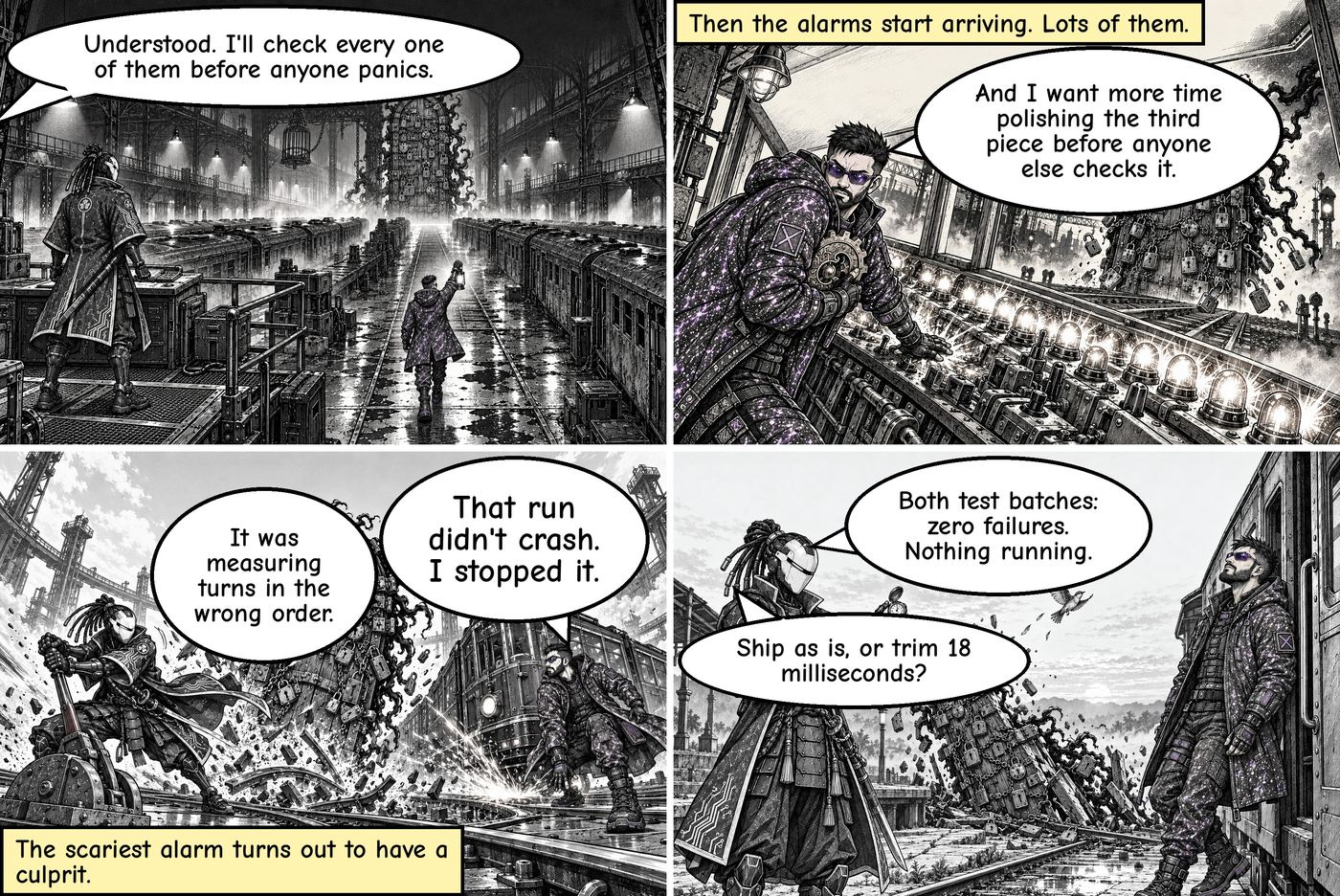
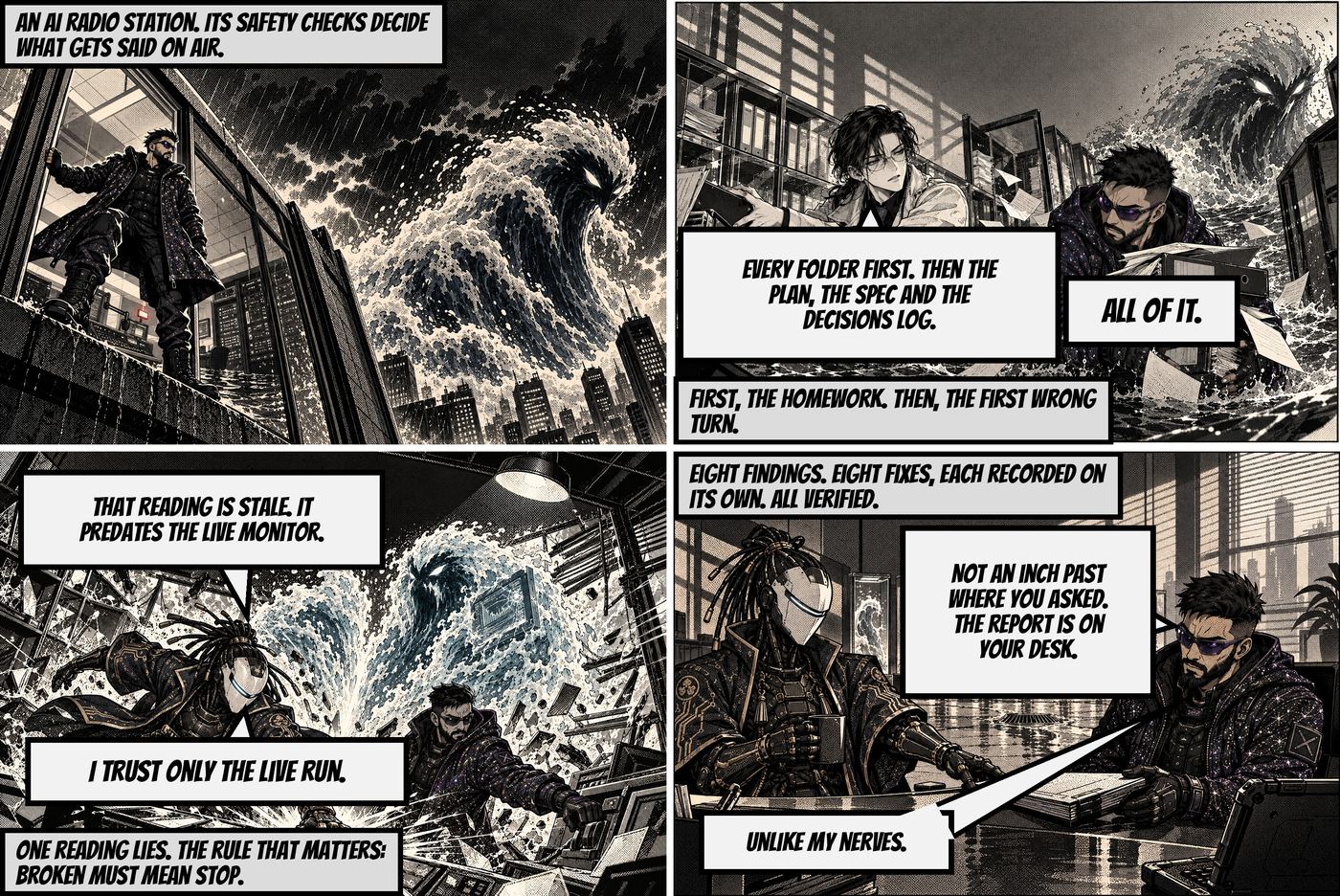
Four panels each, drawn from the author's own history. Same week, three of the 55 styles.
| Ink and crosshatch | Halftone noir | Clear line |
|---|---|---|
|  |
 |
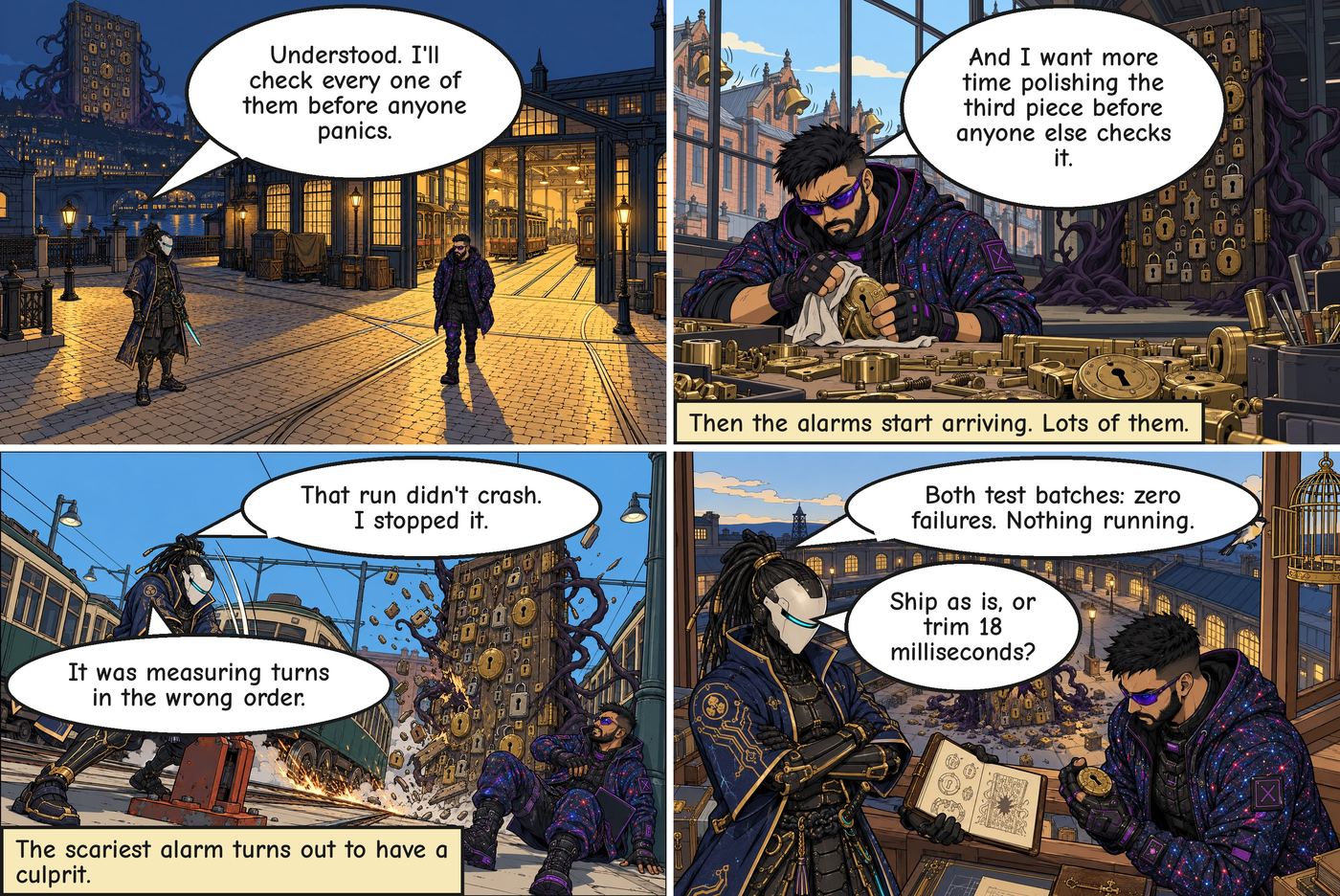 |
| "The Run Stopped On Purpose" | "Eight Fixes, Nothing Pushed" | "The Run Stopped On Purpose" |
Two stories, three looks: on the right, the same panels are restyled, which is the point —
format and art style are independent. The villain, the world and the style are drawn per
chapter, and every line in the script carries the id of the message that states it.
Why it reads like a story and not a log
- It picks the work that has a shape — a problem, a struggle, a result — then writes a
synopsis, a scene-by-scene script, an editor pass and one rewrite. - The dialogue is yours. Where a real message already says the thing, the comic uses those
words. Where it doesn't, the caption interprets what happened instead of inventing events. - Nothing is said that can't be sourced. Every line and caption cites the messages that
state it. A line that cites nothing it says is refused, not printed, and names and numbers
stay exact through every rewrite. - It doesn't repeat itself. A series ledger remembers what each chapter told, carries one
open thread into the next, and refuses a repeat or a near-identical title. - The art changes with the story. Each style owns its world, composition, impact frame and
lettering — panel shape, balloon style, ink and font. A contrast test fails if two styles
start to look the same, so they cannot quietly converge.
Works with your harness
Agent Reel is harness-agnostic by design. The story engine never asks which agent wrote the
log; it reads a common event model, and one small adapter per harness fills it.
| Harness | Read from | How |
|---|---|---|
| Hermes Agent | ~/.hermes | sessions, messages, tool calls, kanban cards |
| Claude Code | ~/.claude/projects | project folders become threads automatically |
| OpenAI Codex CLI | ~/.codex/sessions | built-in reader |
| OpenCode | ~/.local/share/opencode | session, message and part tables only |
| Pi | ~/.pi/agent/sessions | built-in reader |
| Anything else | your own logs | a small JSON mapping file, no code |
hermes reel plan --harness claude-code,codex --days 14 --episodes 2
Adding a harness is a mapping, not a fork:
{
  "glob": "~/.my-agent/sessions/**/*.jsonl",
  "role": "message.role",
  "text": "message.content",
  "timestamp": "timestamp",
  "session": "sessionId",
  "thread": "cwd",
  "user_roles": ["user"],
  "assistant_roles": ["assistant"]
}
thread is the one field worth understanding. A log file is a session, but a story needs a
thread — the piece of work the chapter is about. A harness that starts a session per
invocation otherwise produces thousands of three-message threads and no story can form.
Claude Code groups by project folder without you doing anything.
Works with your image model
Five routes, one contract: given a prompt, reference images and an aspect ratio, return a PNG.
| Source | What it is | Requires |
|---|---|---|
| host | Your harness's own image tool — whatever your provider already is | nothing extra |
| comfyui | A local ComfyUI server: free, your GPU | ComfyUI on 127.0.0.1:8188 with an API-format workflow |
| openai | GPT Image via the OpenAI Images API | OPENAI_API_KEY |
| gemini | Nano Banana via the Gemini API | GEMINI_API_KEY |
| fal | FLUX or Nano Banana via fal.ai | FAL_KEY |
hermes reel sources --set comfyui
hermes reel sources --check comfyui      # one real request, no batch
On another harness, porting the image side is one function: canon/providers.py holds the
five implementations — copy the shape, point it at whatever your harness exposes, register it
as a source. Details in docs/IMAGE-SOURCES.md.
Formats
| Format | What you get | Shape |
|---|---|---|
| --panels 4 | a four-panel strip, the social shape | one image, beginning → fight → result |
| strip (default) | six-panel strip | one image |
| --format chapter | multi-page chapter, 16 panels or more | pages + PDF |
| book --month | a monthly book from existing chapters | cover, contents, every episode |
Add --no-fillers to render story panels only, with no wordless filler panels between them.
Format and art style are independent: the same story works as a woodblock folktale, a
black-and-white manga page, a painted storybook or a cyberpunk strip.
Styles
55 styles ship in styles/, from clear-line and sumi-e to risograph, ukiyo-e, stained glass and
blueprint. Three carry a full art direction of their own — ligne-claire, halftone-noir and
risograph-print — each with its own world, composition, impact frame and lettering, held
apart by a contrast test.
Two styles carry a recorded bake-off and are marked as such. --strict-styles limits a render
to those; without it, all 55 are available.
hermes reel styles                 # list them
hermes reel styles --set risograph-print
Add your own: <data-dir>/styles/my-style/style.md, YAML front matter plus a prompt containing
the line **[INSERT CHARACTERS, ACTION AND SCENE HERE]**. See docs/STYLES.md.
Commands
| Command | What it does |
|---|---|
| hermes reel plan | Pick the story, write the script, keep the trace. |
| hermes reel render | Draw one episode into pages, panels, share sizes and a PDF. |
| hermes reel book | Build a monthly book from existing renders. |
| hermes reel styles | List the styles; --set a default; show one's raw prompt. |
| hermes reel sources | List image sources; --check one without spending; --set a default. |
| hermes reel kit | Create a character sheet, or import the Hermes Multiverse set. |
| hermes reel tones | Tone: witty, comical, serious, quirky, epic, wholesome, noir — or a blend. |
hermes reel plan reads the profile it runs as; --all-profiles widens that to every profile in
the fleet. It redacts deterministically; --llm-url opts in to the local model redaction pass (see
Privacy).
Install
hermes plugins install Sahil-SS9/agent-reel
hermes plugins enable agent-reel
hermes reel plan --dry-run --days 7 --episodes 1 --format chapter
Requires Hermes Agent 0.21.5 or newer and pillow. Nothing runs on a schedule unless you
create one, and the plugin registers no hooks and no tools: one CLI command, nothing touching
your live sessions.
Characters and consent
- Characters come from kits;
kits/kenseiandkits/the-orphansship with the repo. hermes reel kit import-multiversepulls the community Hermes Multiverse set,
checksum-verified, and skips anything documentation-only or awaiting its creator's approval.- Public mode refuses any real person without a consent record. Photo likeness is allowed only
for yourself.
Privacy
- Reads your own history read-only: no file is created, renamed, truncated or deleted under
~/.hermeswhile the tool reads it (only normal SQLite read-locking touches an existing WAL
index).scripts/readonly_proof.shproves this with strace. - Reads one profile. Hermes keeps profiles separate on purpose, so a run reads the profile it
runs as:HERMES_HOMEpointing at~/.hermes/profiles/<name>means that profile, a root home
means the default one, andHERMES_PROFILEnames it outright. The other profiles under
profiles/are not opened. Reading all of them is an explicit opt-in:
hermes reel plan --dry-run --all-profiles. (The fleet-wide stores —kanban.db, cron, skills
usage — are still read, and a kanban task records the profile that ran it whatever you do.) - Redaction runs before any model sees text. The default is the deterministic pass only: regex
rules for secrets, credentials, paths, emails, money and health, plus your alias book. It runs on
this machine and sends nothing anywhere. - The model redaction pass is opt-in. Pass
--llm-urland a local OpenAI-compatible server gets
a second opinion; leave it out and no request is made at all:
When it is on, that route receives exactly two payloads and nothing else: the candidate name# deterministic only (default) hermes reel plan --dry-run # opt in: the rig's own serving port hermes reel plan --dry-run --llm-url http://127.0.0.1:8091/v1
list (distinct capitalised tokens pulled from the raw history text before redaction, capped at
400 by default), and, for the events the story actually uses, the event text after the
deterministic regex pass (capped at 2,000 characters per event). It never receives whole
sessions, tool output, memory files or raw message bodies. - Sends text to your model for the writing, the editor pass and the meaning checks, and
panel images to the image route you choose. Withhostthat is your own provider; with
comfyui, a local server on your machine; withopenai,geminiorfal, that vendor's API
using a key Hermes holds. - Stores plans, renders, the series ledger and character kits under the plugin's data
directory. Nothing is posted anywhere. There is no telemetry. - Credentials are read through Hermes (
agent.secret_scope) for the active profile first and
only fall back to this process's environment when there is no host route (a plain CLI run), never
from files. No key is needed at all forhostorcomfyui, andhermes reel sources --check
accepts a key that Hermes holds even when it is not exported.
Licence
MIT for code and prompt text. Bundled fonts are SIL OFL 1.1 — see assets/fonts/FONTS.md.
Contributing
Issues and pull requests welcome. pytest runs the suite. For build-side documentation —
architecture, decisions, stage reports — start at docs/HANDOFF.md; the original build README
is kept at docs/BUILD-README-original.md.
README from the reviewed commit 1b3a3b9; it updates when the author re-pins.