 KyaniteLabs
Epoch for Hermes (native plugin)
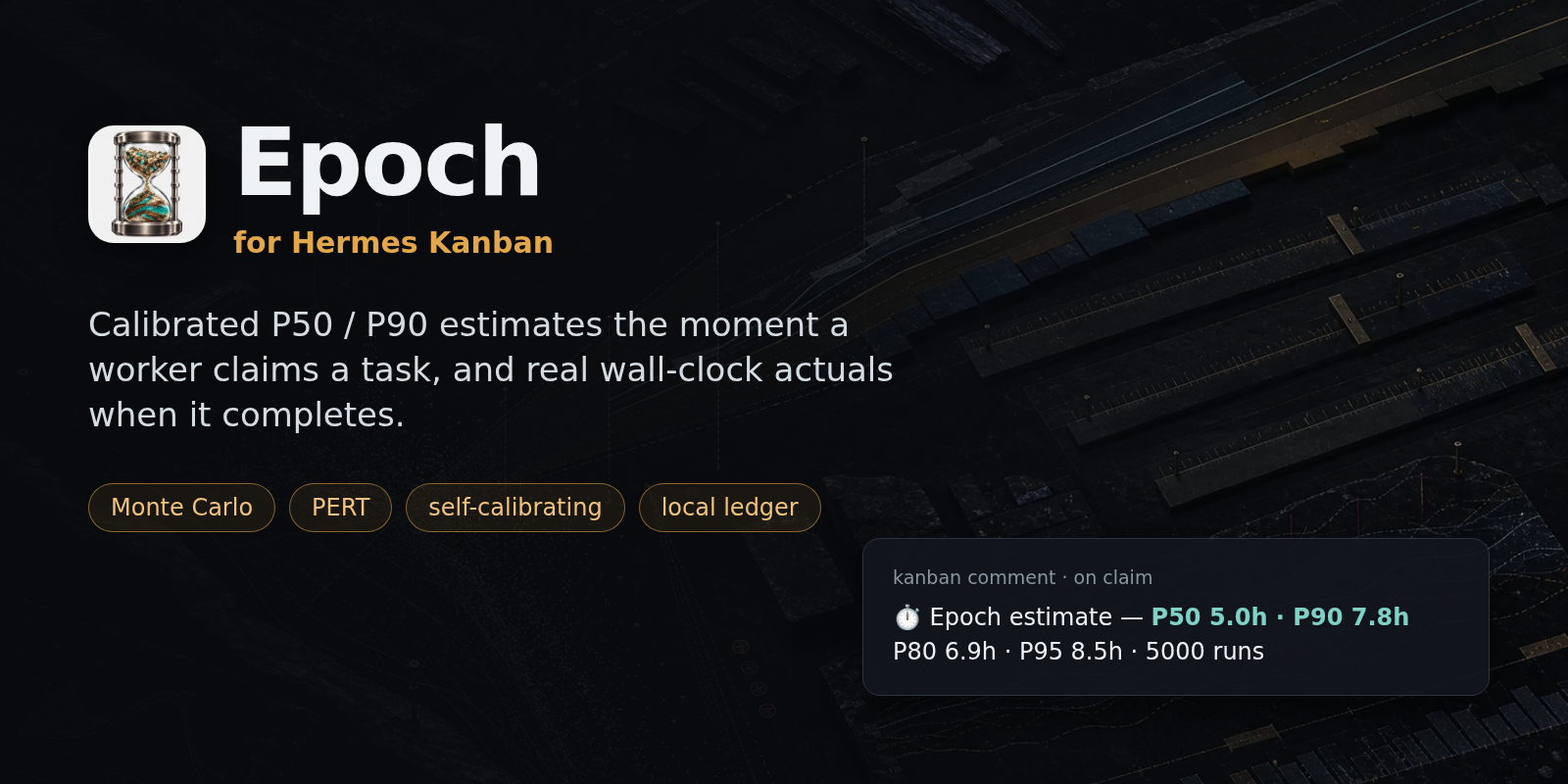
Calibrated P50/P90 estimates on your Hermes Kanban board.
Disclosure. This plugin shells out to
npx -y @kyanitelabs/epoch@0.7.0(downloads Epoch
from npm on first run; needs Node >= 22 andnpxonPATH). The child process gets a
scrubbed environment: only allow-listedPATH/HOME/locale/temp, Node/npm (cache,
registry, CA certs) and proxy variables. Your parent environment, API keys and Hermes secrets
are never passed through. The ledger and run bindings live under
<HERMES_HOME>/plugin-data/epoch/(the root Hermes home, shared by every profile) unless you set
epoch_data_dir. Epoch telemetry is forced off for every plugin run (EPOCH_TELEMETRY=0,
which overridesepoch telemetry enable). Apart from the npm download there is no network
access, and no API key. The task title (first 80 chars) and itsepoch:hint go only to the
local CLI. Hook work runs on a short-lived background thread.
| Surface | What it does |
|---|---|
| kanban_task_claimed hook | Estimates the task and posts a comment. An epoch: 2/4/10h line (optimistic/most-likely/pessimistic; d = 8h days) in the title or body gives a Monte Carlo P50/P90 (plus P80/P95); otherwise a reference-class point estimate. A malformed or out-of-order hint is named in the comment and ignored, never silently dropped. Runs in the background, never delays worker spawn. |
| kanban_task_completed hook | Records that run's wall-clock hours (run.ended_at - run.started_at) against the run's own Epoch feedbackRef with calibration_provenance: auto_wallclock, so Epoch's wall-clock sanity gate (0.05–12h, <10× the estimate) applies. Rejected actuals are explained on the card. |
| /epoch <subcommand> [flags] | Epoch CLI subcommands, e.g. /epoch pert-estimate --optimistic 2 --most-likely 4 --pessimistic 10. serve, self-improve and telemetry/data mutations are refused (only telemetry status and data where run). Ledger writes (record-actual, batch-record-actuals, auto-actuals, mine-git, calibrate-estimates) are refused on gateway platforms (Telegram, Discord, …) unless allow_write_slash_on_gateway: true. |
| epoch_estimate tool | Agent-callable estimate. Explicit optimistic/most_likely/pessimistic hours (all three, 0 < o <= m <= p) override any text hint; invalid values are rejected. |
Install
hermes plugins install KyaniteLabs/Epoch/plugins/epoch-hermes   # or symlink into ~/.hermes/plugins/epoch
hermes plugins enable epoch
Enable it in every profile that runs a Kanban dispatcher or worker. Requires Hermes >= 0.21.6,
Node >= 22 and npx on PATH. No API key or secret. The first claim may take a few seconds while
npx downloads Epoch; an npm min-release-age policy can block the pinned version until it ages
(the job stays in the outbox and retries). Settings (all optional) under plugins.entries.epoch.settings in
config.yaml:
| Setting | Default | |
|---|---|---|
| epoch_command | npx -y @kyanitelabs/epoch@0.7.0 | Set to epoch if installed globally. |
| epoch_data_dir | unset → <HERMES_HOME>/plugin-data/epoch | Epoch ledger + run bindings (passed as EPOCH_DATA_DIR). The default resolves to the root Hermes home even under profiles/<name>, so dispatcher and worker share it. Set ~/.epoch to reuse a standalone Epoch ledger. An EPOCH_DATA_DIR env var is honored when this is unset. |
| comment_on_claim | true | Post the estimate comment. |
| record_actuals | true | Record wall-clock actuals on completion. |
| iterations | 5000 | Monte Carlo iterations. |
| timeout_seconds | 60 | Per Epoch CLI call. |
| shutdown_wait_seconds | 20 | How long an exiting process waits for in-flight Epoch work. |
| allow_write_slash_on_gateway | false | Allow /epoch ledger-writing commands from gateway platforms. |
What it looks like
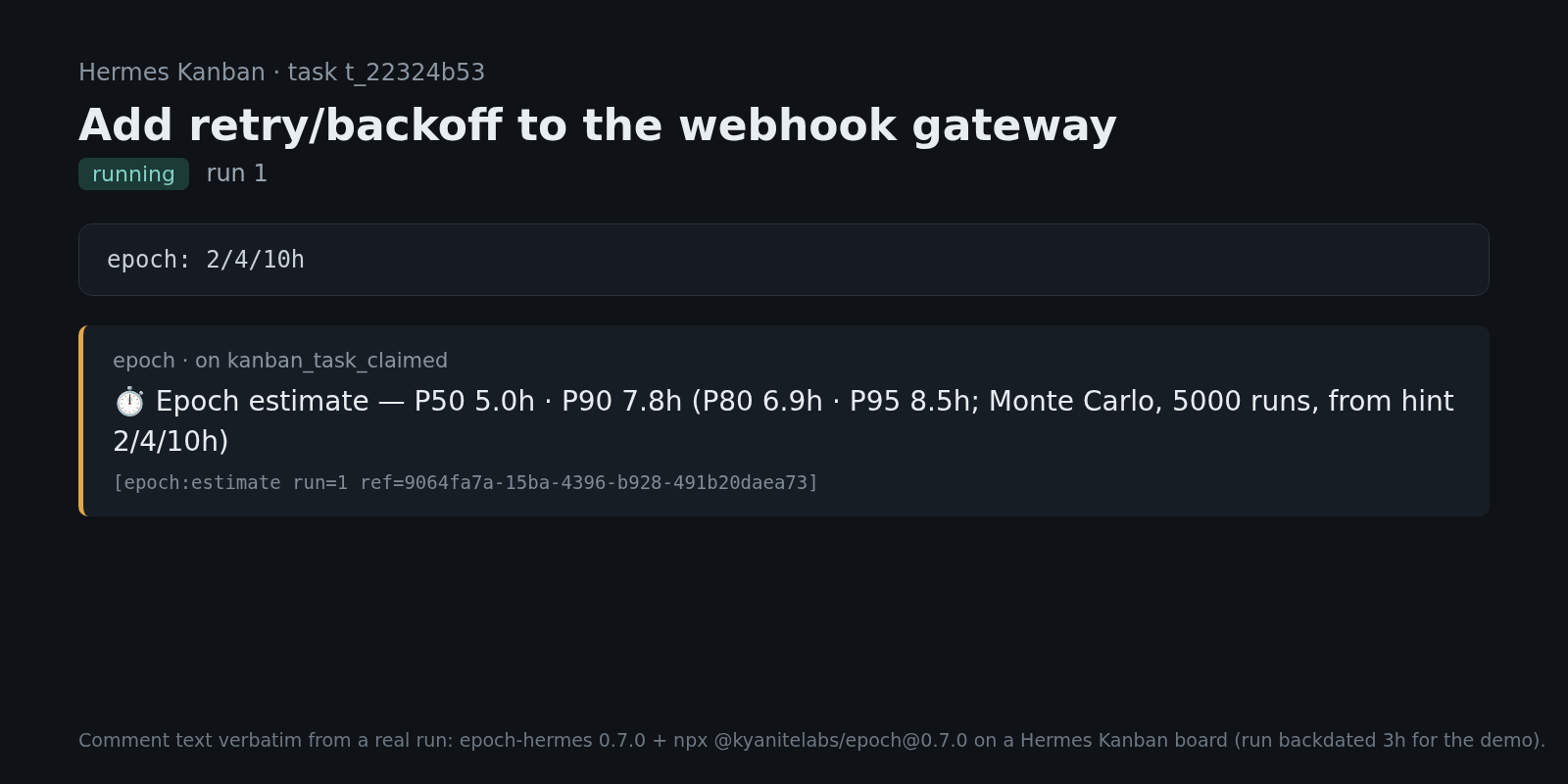
On claim, a calibrated estimate lands on the card:
On completion, that run's wall-clock actual is recorded back to the ledger:
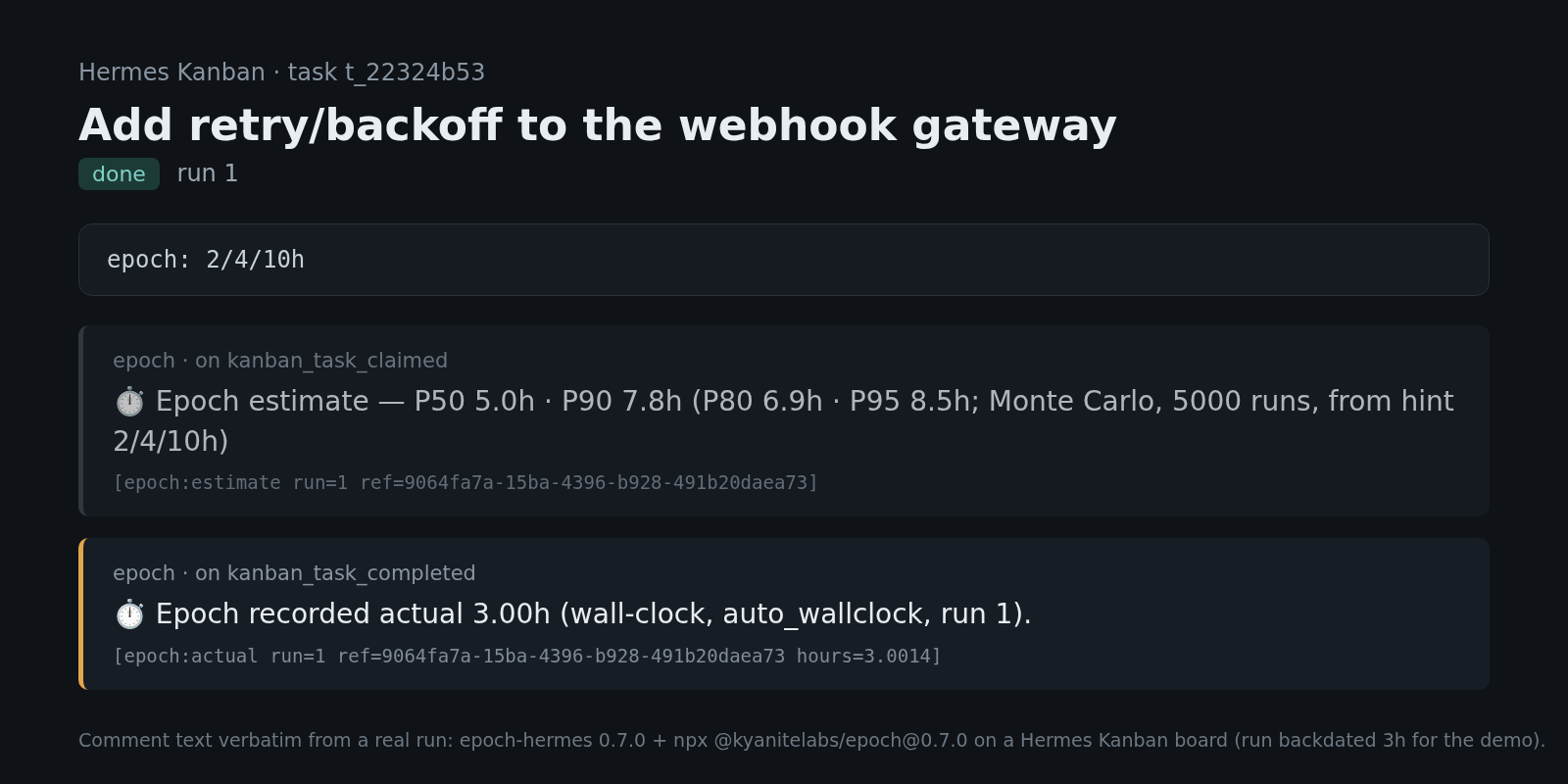
These are renders of verbatim comment text from a real run (epoch-hermes 0.7.0 plus
npx @kyanitelabs/epoch@0.7.0 on a Hermes Kanban board).
How it works
- Shared bindings, comments for display. The dispatcher (claim) and the assignee's worker
(complete) usually run in different profiles, and plugin state is per profile. The authoritative
run → feedbackRefbinding is written next to the ledger (default
<HERMES_HOME>/plugin-data/epoch/, which every profile resolves to). Kanban comments still show
[epoch:estimate run=<run_id> ref=<feedbackRef>]for humans, but forged or quoted markers are
never trusted for recording. A late result from a reclaimed run is dropped, because the plugin
re-checks that the claim still owns the task before it posts. Comment delivery is tracked
separately from the ledgerrecordedflag and is claimed under the same bindings flock, so
concurrent success/duplicate recorders and concurrent claim racers cannot double-post the audit
comment. A crash after the board accepts the comment but before the local delivery flag flips
can still retry (at-least-once for that crash window only); calibration data is never duplicated. - Either event order. If a task finishes before its estimate is ready (a short task, or a
slow firstnpx), the claim side records the actual after it stores the binding. Epoch accepts
one actual per estimate, and the bindings store marks the run recorded, so each run is recorded
once. - Process lifecycle. Each job goes into a profile-local outbox before it starts. Outbox
updates take a cross-process lock so concurrent Hermes processes cannot lose an enqueue or
double-claim a lease. When the process exits, the plugin waits up toshutdown_wait_seconds
for in-flight work. Anything left over (for example, a one-shot CLI that exits or is killed)
replays the next time the plugin loads in that profile, up to 5 attempts within 7 days. - Public Hermes surface only. Board reads and writes go through
ctx.dispatch_tool
(kanban_show,kanban_comment). Background threads run undercontextvars.copy_context(),
so the event's profile settings and state follow the job.
Tests
python -m pytest plugins/epoch-hermes/tests               # unit + fake-Epoch regression tests
HERMES_AGENT_SRC=/path/to/hermes-agent python -m pytest plugins/epoch-hermes/tests   # + real Hermes, separate processes
Privacy
Estimates and actuals live in Epoch's local ledger under <HERMES_HOME>/plugin-data/epoch/.
Plugin-driven Epoch runs always have telemetry off (EPOCH_TELEMETRY=0). Standalone Epoch
telemetry is opt-in (epoch telemetry enable) and the plugin never turns it on. Task text goes
only to the local Epoch CLI, which runs with a scrubbed environment.
The MCP server and skills for Claude/Cursor are in ../epoch.
README from the reviewed commit 36de521; it updates when the author re-pins.
