Hermes Project Stewardship
Durable project ownership for Hermes agent fleets.
Hermes can complete tasks. Stewardship makes a team of Hermes profiles responsible for a project over time: it verifies reality before acting, turns gaps into evidence-backed initiatives, executes through existing Kanban, enforces explicit autonomy policy, and measures whether the project actually improved. CLI, RPC, dashboard and Desktop share one backend; authenticated approval remains on RPC/dashboard and permission-bound gateway adapters.
Status: v0.3.0 local release. O1 complete work management and O2 initiative-to-observation delivery are implemented. The release is not installed or activated. Run
hermes verify --jsonfor current test and readiness evidence.
The ownership loop
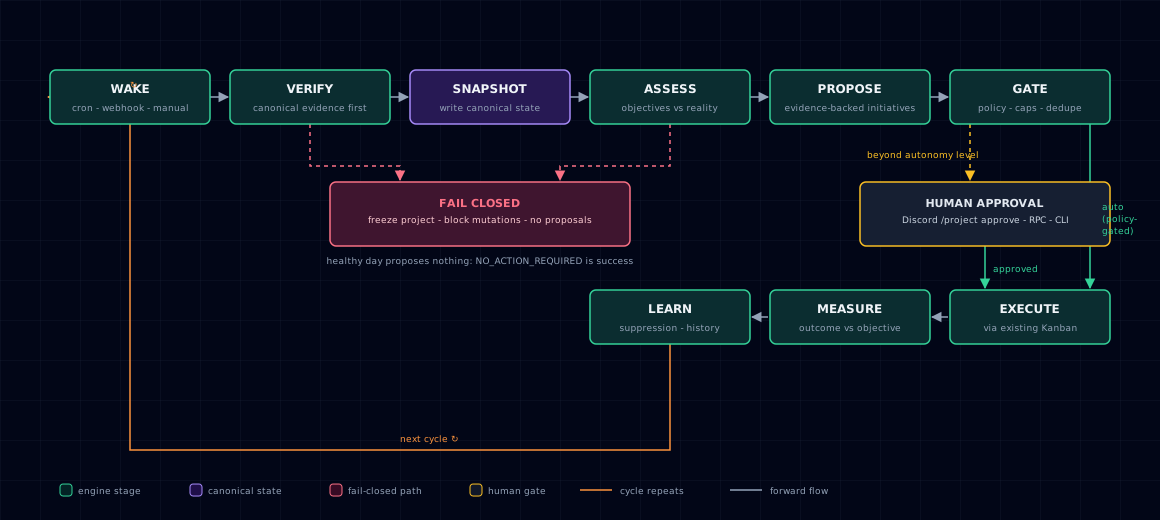
Every stewardship cycle walks the same ring:
WAKE → VERIFY → SNAPSHOT → ASSESS → PROPOSE → GATE → EXECUTE → MEASURE → LEARN ↺
- Verify first. A cycle may not claim project status or authorise mutating work without canonical evidence (git state, tests/CI, declared files). Memory and session history are supporting evidence only.
- Fail closed. Unknown or contradictory project state blocks mutations.
- Autonomy is restriction-only. Project policy may narrow what Hermes may do; it never escalates tool permissions or credentials.
- No busywork.
NO_ACTION_REQUIREDis a first-class cycle outcome.
System workflow
The full cycle as it runs in the engine — including where human approval and the fail-closed freeze sit:
Architecture
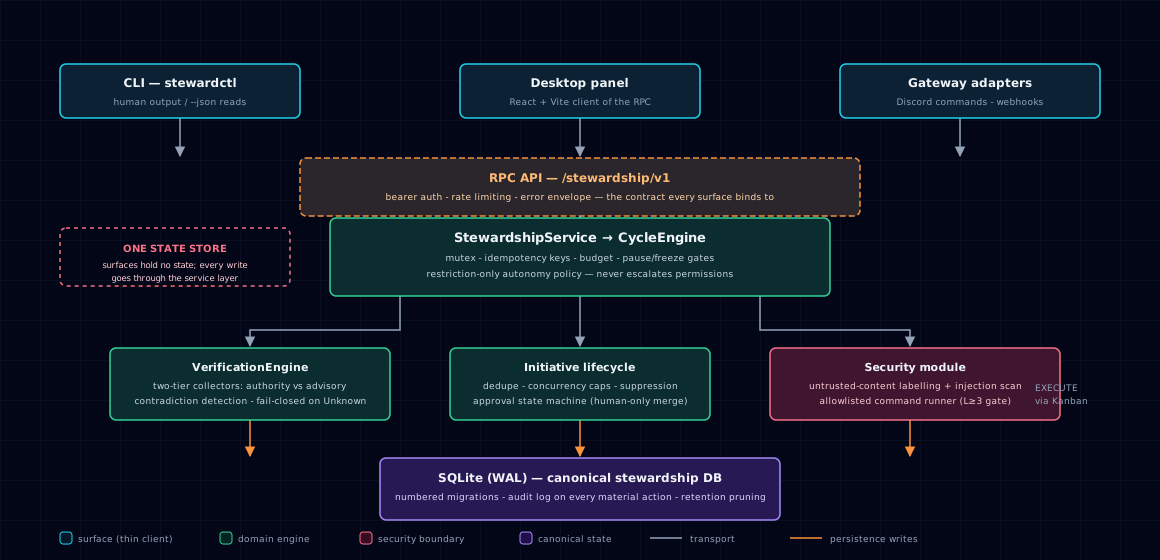
Canonical Hermes Projects/Kanban owns projects, tasks, epics, hierarchy, dependencies and execution state. Dockyard owns stewardship policy, evidence, rankings, views, workflows, approvals and audit metadata in its SQLite WAL store. Production work writes cross the versioned host adapter; there is no legacy task dual-write path.
Surfaces
| Surface | Entry point | Notes |
|---|---|---|
| CLI | stewardctl |
human output by default, --json on reads |
| RPC API | /stewardship/v1 |
FastAPI optional extra; bearer auth + rate limiting |
| Gateway commands | Discord et al. | permission binding + idempotent approvals |
| Desktop plugin | host React wrapper + vanilla TypeScript | thin client of the same RPC |
Autonomy levels
| Level | Name | Allowed by default |
|---|---|---|
| 0 | Assistant | Inspect and answer only |
| 1 | Investigator | Observe, research, non-mutating diagnostics |
| 2 | Planner | + create initiatives/plans (no source changes) |
| 3 | Builder | + branches, code, tests, PRs (gated: see security model) |
| 4 | Maintainer | + low-risk merges when policy gates pass |
| 5 | Steward | Broad lifecycle within release/budget policy |
Level ≥ 3 additionally requires the runtime capability allowlist gate
(docs/threat-model.md §6). Levels 4–5 ship disabled pending the merge-gate
implementation (docs/prd-v0.2.md §Deferred).
Install
Requires Python 3.10+. No third-party runtime dependencies for the core engine.
git clone https://github.com/Sahil-SS9/hermes-project-stewardship.git
cd hermes-project-stewardship
uv sync --locked --extra dev --extra plugin
hermes verify --json         # bootstrap, full suite and readiness smoke
stewardctl --help            # standalone CLI
export STEWARD_RPC_TOKEN="$(python3 -c 'import secrets; print(secrets.token_urlsafe(32))')"
uvicorn hermes_project_stewardship.api.server:app --host 127.0.0.1 --port 9310
Vanilla Hermes plugin install
Install the repository as a Hermes directory plugin so its Python tools, bundled skill, dashboard and Desktop assets stay together:
hermes plugins install Sahil-SS9/hermes-project-stewardship --enable
The plugin uses only shipped vanilla APIs: register_tool, register_command,
register_cli_command, register_skill, dashboard manifest.json/router,
and the Desktop plugin SDK. Canonical Projects/Kanban integration falls back
to the bundled vanilla adapter when hermes_cli.project_kanban_host is absent.
Operational export and isolated restore
stewardctl --db ./stewardship.db export --output ./dockyard-export
stewardctl restore --archive ./dockyard-export --target ./restored.db
Exports use SQLite's online backup API and include a versioned manifest, SHA-256 digest, byte size, schema version and integrity result. Restore refuses existing targets, traversal, symlinks, checksum mismatches and invalid schemas.
60-second example
from pathlib import Path
from hermes_project_stewardship.persistence.store import Store
from hermes_project_stewardship.cycles.engine import CycleEngine

store = Store(Path("./stewardship.db"))
svc = store.services()

svc.enable(project_id="my-repo", mission="Keep CI >99% and deps fresh",
           lead_profile="lead", member_profiles=["coder", "qa"])
svc.add_objective("my-repo", name="ci-health", evaluator_type="command",
                  target=">=0.99", command=["pytest", "-q"], severity="high")

engine = CycleEngine(svc)
result = engine.run_cycle("my-repo")
print(result["health"]["state"])          # e.g. "healthy"
print([i["title"] for i in result["initiatives"]])
Then:
stewardctl health my-repo
stewardctl initiative list my-repo
stewardctl initiative approve INIT-0001
See examples/example-project for a full walkthrough, and demo/ for a scripted 5-act terminal demo plus an interactive HTML dashboard of the same story.
Documentation
- PRD v0.2 — product requirements this implementation satisfies
- Architecture
- Threat model
- Gateway command contract
- Roadmap to upstream Hermes core
- API contract
- Canonical roadmap
- v0.2.0rc2 release packet
- v0.2.0rc1 historical release packet
Security
Read SECURITY.md and docs/threat-model.md before enabling autonomy above level 2 on any repository that accepts content from untrusted people (issues, PRs, READMEs). Retrieved repository content is untrusted input; it is never treated as authority over project policy.
Licence
Apache-2.0. See LICENSE.