
 RegeneratusLabs
Lazy Plugin
A page in Hermes Desktop where you describe a plugin and watch it get built — then proves it runs
before you install anything.
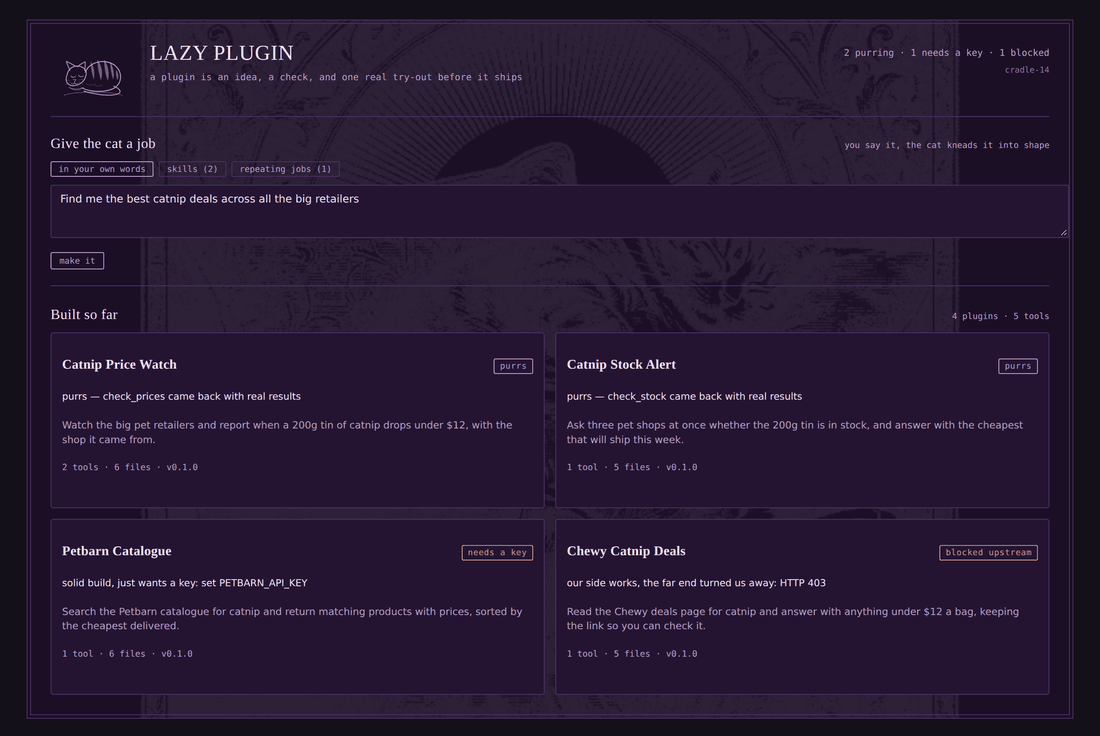
What it is
A Hermes plugin that builds Hermes plugins — on the desktop page, from a chat turn, or as
lazyplugin_create inside any conversation. What makes it different from a scaffolder is what
happens after the files are written: the new plugin is loaded, its tools are called for real, and
the result is graded. A plugin that validates but cannot run shows up as broken, on screen, before
you install it.
Where a build starts
| Start from | Why it works |
|---|---|
| a sentence | you know the job; it becomes tools |
| a skill the agent wrote | the procedure is already written — turn it into something that runs without the model |
| a job that runs on a schedule | recurring work with a history — make it a tool call instead of a turn |
The loop
page ──▶ a real chat turn, in the chat pane (you watch it happen)
          └─▶ spec in words: name, 1–5 tools, what each reads/fetches, what it returns
              └─▶ lazyplugin_create ─▶ fixed templates write the code
                  └─▶ hermes plugins validate ─▶ the exact ✗ line if it fails
                      └─▶ every tool dispatched once ─▶ works · needs a key · blocked upstream · half-built · broken
                          └─▶ the page shows the receipt, then you decide about installing
The model writes the spec. Templates write the code. Model-authored Python is how you get
plausible garbage that dies on import; model-authored intent rendered through fixed templates
always registers, declares exactly the capabilities it provides, and cannot carry injected code.
Handler bodies are limited to four shapes:
command— runs the spec's argv as a list, never a shell stringhttp— GET/POST the spec's URL, with a declaredurlparameter winning over itfile— read/write the spec's path, or a declaredpathargumentstub— raisesNotImplementedErrorcarrying the described behaviour
A spec that cannot work is refused before any file is written: name shape, description length,
unique snake_case tool names, and a real target — an http tool needs an absolute URL, a command tool
needs argv, a file tool needs a path or a declared path parameter.
The part a skill cannot do
A skill can describe a plugin. It cannot execute one inside the host and hand back a verdict.
Every build ends with a dispatch: the new tool is called through the real registry, exactly as the
model would call it, and graded.
| Verdict | Means |
|---|---|
| purrs | the tool was called and returned real results |
| needs a key | sound package, wants an environment variable you have not set |
| blocked upstream | our side works; the far end answered 403/404 |
| half-built | the handler was never written — the spec fell to a stub |
| broken | it would not load, or the handler raised |
The receipt is a straight line — plan · files · check · try-out — and every row is either a tick
or the exact failing line. No green badge without the line underneath it.
Never installs by itself
Generated plugins land in $HERMES_HOME/lazy-plugin/created/<name>/ as files you can read. Nothing is
linked into ~/.hermes/plugins until you ask:
hermes plugins validate $HERMES_HOME/lazy-plugin/created/<name>
ln -s $HERMES_HOME/lazy-plugin/created/<name> ~/.hermes/plugins/<name>
hermes plugins enable <name>
Install re-runs the validator first and refuses to clobber an existing plugin. A generated plugin
that fails its try-out is refused too — a scaffold you can install is a trap.
Publishing
There is no upload endpoint and no self-serve registry: the catalog is a human-merged gate. A PR
adds plugin-catalog/<name>.yaml to NousResearch/hermes-agent pinning a full 40-character commit
SHA of a public repo.
Publish does the mechanical half with your own gh login — validate, commit, create the public
repo, pin the SHA, write the entry from the real manifest, then offer the catalog PR. A maintainer
still decides; nothing here merges anything.
Using it from chat
lazyplugin_create is an ordinary tool, so it runs inside a turn and the host resolves whatever model
and credential that profile has — API key, OAuth proxy, cloud or local. The plugin holds no key, names
no provider, and makes no model call of its own: the agent that runs the build is yours, on your
profile. Install it anywhere and the agent already knows how to build plugins.
Tools
| Tool | Does |
|---|---|
| lazyplugin_create | build from idea, or from source_kind + source_name |
| lazyplugin_sources | list the agent's own skills and scheduled jobs |
| lazyplugin_built | list what has been generated, with paths |
Tests
python3 -m venv .venv && .venv/bin/pip install pytest fastapi httpx
.venv/bin/python -m pytest tests -q          # 107 passed
hermes plugins validate .                    # every catalog gate
Limits, honestly
- The four handler shapes cover most small tools. Anything needing real state, retries or pagination
wants a hand-written plugin, and the spec validator will refuse shapes it cannot render safely. - The try-out uses sample arguments (
date→ today,domain→ example.com). A tool that needs a
specific id will come back broken even if the code is fine — the receipt says why. - A build never calls the code it just generated: templates are rendered, the contract is checked,
and the try-out waits for your click on the page. When a tool declares a key, the try-out will
only carry it to a publichttpshost the handler names, and never to one of Hermes' own
credentials — that case is gradedrefusedwith the variable and the host quoted. - A
filetool reads and writes inside the plugin's own data dir (~/.hermes/plugin-data/<name>/).
It cannot be pointed at~/.hermes/.envor anywhere else on the host, by a spec or by a call. - Builds are agent turns, so they cost tokens and they take as long as your model thinks.
MIT.
README from the reviewed commit 0adb8ff; it updates when the author re-pins.
