 P0GL0L
hermes plugins install lineage
hermes plugins enable lineage
Sixty seconds
Ask Hermes for something that touches the world:
Read
revenue.csv, fetch https://hermes-agent.nousresearch.com/docs/, then writeq3-note.mdwith three bullets that cite the CSV figures and that URL.
Then ask where it came from:
$ hermes lineage show q3-note.md
q3-note.md  (d41d886bb02e…, 395 bytes)
  written by write_file at 2026-11-05T03:04:08Z
  by main (grok-4.7)
  model call grok-4.7
  asked: “Read revenue.csv, fetch https://hermes-agent.nousresearch.com/docs/ with web_extract, then write q3-note.md…”
  from 2 source(s):
    ◉ evidenced file  revenue.csv   path appears in artifact
    ◉ evidenced url   https://hermes-agent.nousresearch.com/docs   url appears in artifact
  ● observed  ◉ evidenced  ○ inferred
Write the receipt next to the file, and check it with no database and no Hermes at all:
$ hermes lineage receipt q3-note.md --write
wrote q3-note.md.receipt.json

$ hermes lineage check q3-note.md.receipt.json
{ "ok": true, "artifact_sha256_matches": true, "receipt_sha256_matches": true, "signature": "valid", "sources": 2 }
Change the CSV under it, and the note goes stale:
$ echo 'Q4,21' >> revenue.csv && hermes lineage verify q3-note.md
q3-note.md: unchanged  → verdict: stale
  changed     evidenced  revenue.csv
  unchecked   evidenced  https://hermes-agent.nousresearch.com/docs
That transcript is from a real run on Hermes Agent 0.22.7, not a mock-up. In chat, the same things are /lineage, /lineage q3-note.md, /lineage receipt …, /lineage verify ….
The graph
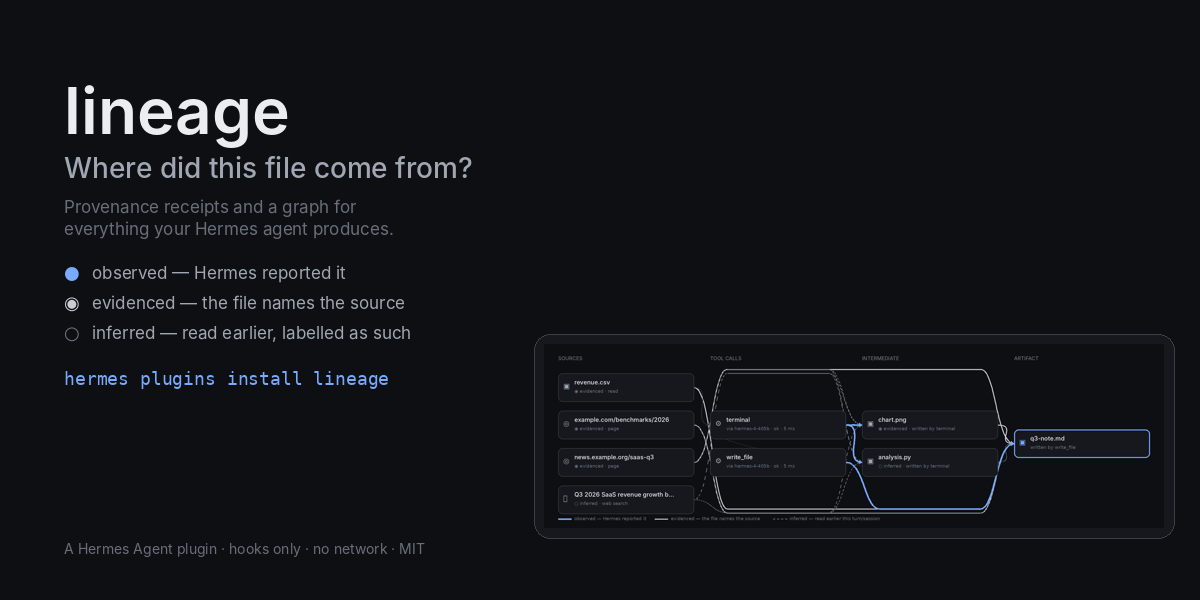
Open Lineage in the Hermes Desktop sidebar (or click the N artifacts chip in the status bar). Sources on the left, the tool calls that read and wrote them in the middle — each annotated with the model call that issued it — intermediate files next, and the artifact you asked about on the right. Click anything:
- a URL shows the content hash at fetch time and which tool read it
- a tool call shows its redacted, bounded arguments and what it wrote
- the artifact shows its hash and versions, with Verify, Verify + refetch URLs, Write receipt, Copy Mermaid and Reveal one click away
The page refreshes while the agent works.
Three kinds of link, never blended
The honest part. Most provenance tooling draws one arrow and calls it "derived from". lineage keeps three, labels each, and writes the label into the receipt so a reader can discount the weak ones.
| | basis | what it means | drawn as |
|---|---|---|---|
| ● | observed | Hermes reported it: write_file wrote this path; this tool call came out of that model request; this child agent was spawned by that turn. | thick accent line |
| ◉ | evidenced | The artifact's own bytes name the source — a URL that was fetched this session, or the path of a file that was read. | solid line |
| ○ | inferred | The source was read earlier in the same turn (confidence 0.6) or in a recent turn of the session (0.35). A dashed edge says read earlier, not used. | dashed line |
The receipt
<file>.receipt.json sits beside the file, on request or automatically with sidecar: true. Trimmed from the run above:
{
  "schema": "lineage.receipt.v1",
  "artifact": { "name": "q3-note.md", "sha256": "d41d886b…", "size": 395, "versions": [ … ], "cited_in_final_reply": true },
  "produced_by": { "tool": "write_file", "tool_call_id": "call-99df…-4", "at": "2026-11-05T03:04:08Z", "duration_ms": 23 },
  "agent": { "chain": [ { "role": "main", "model": "grok-4.7", "platform": "cli" } ] },
  "turn": { "user_prompt_preview": "Read revenue.csv, fetch https://…", "user_prompt_sha256": "5b7e2ce6…" },
  "models": [ { "model": "grok-4.7", "usage": { "input_tokens": 27241, "output_tokens": 472, "reasoning_tokens": 290 } } ],
  "sources": [
    { "kind": "file", "locator": "/…/revenue.csv", "sha256": "75e92e4b…", "basis": "evidenced", "confidence": 0.9,
      "reason": "path appears in artifact", "read_by": { "tool": "read_file", "at": "2026-11-05T03:04:00Z" } },
    { "kind": "url",  "locator": "https://hermes-agent.nousresearch.com/docs", "basis": "evidenced", "confidence": 0.9,
      "reason": "url appears in artifact", "read_by": { "tool": "terminal" } }
  ],
  "transformations": [ { "tool": "web_extract", "status": "error" }, { "tool": "read_file" }, { "tool": "terminal" }, { "tool": "write_file", "wrote_this": true } ],
  "integrity": { "receipt_sha256": "…", "signature": { "alg": "HMAC-SHA256", "key_id": "…" } }
}
Notice web_extract … "status": "error" followed by terminal: the fetch tool failed, the model fetched the page from the shell instead, and lineage still caught the URL as a source — from the command text. The receipt records what happened, not what was supposed to happen.
The signature is from a per-install random key. It lets this install recognise receipts it issued; it is not a third-party attestation, and the receipt says so.
Verify, and staleness
hermes lineage verify q3-note.md               # the file and its file sources against recorded hashes
hermes lineage verify q3-note.md --refetch     # also re-fetch URL sources — the only network lineage ever does; public hosts only
| verdict | meaning |
|---|---|
| fresh | nothing moved |
| stale | a source changed since the artifact was made |
| modified | the artifact itself changed |
| missing | the artifact is gone |
The Desktop list marks every artifact with its last verdict. URL change detection is honest about its limits: the hash recorded at fetch time is of the extracted text, which a raw re-fetch cannot reproduce, so the first --refetch sets a baseline fingerprint and later runs report unchanged since / changed since that date.
Everything you can ask
| in chat | on the command line | what you get |
|---|---|---|
| /lineage | hermes lineage list | artifacts made in this session, with source counts and verdicts |
| /lineage <file> | hermes lineage show <file> | the plain-text account above; --json for the full receipt |
| /lineage receipt <file> | hermes lineage receipt <file> --write | <file>.receipt.json beside the file |
| /lineage verify <file> | hermes lineage verify <file> [--refetch] | fresh / stale / modified / missing |
| | hermes lineage check <file>.receipt.json | verify a receipt with no database |
| /lineage mermaid <file> | hermes lineage graph <file> [--format mermaid\|dot\|json] | the graph, ready for a diagram tool |
| /lineage stats | hermes lineage stats · sessions · prune --days 90 --yes | what the store holds; housekeeping |
What it will not do
Said plainly, because the receipts are only worth something if their limits are.
- lineage sees what Hermes's hooks report. A file written by a background process that outlives the tool call, or by anything outside Hermes, is not attributed.
- Inferred means inferred. The
basisandconfidencefields exist so you can ignore the dashed lines. - Working trees over
snapshot_max_files(6000) or slower than half a second to walk are not scanned after terminal calls;write_file/patchattribution still works there. A file another process modifies during a terminal call's window can be attributed to that call. - URL hashes are of Hermes's extracted text; raw re-fetches establish their own baseline.
- The signature proves which install issued a receipt, nothing more.
- Under
plugins.isolation: host, the Desktop backend and/lineagestill work buthermes lineage …is not wired (Hermes does not route CLI subcommands into the host).
Configuration
Defaults are sensible; nothing is required. ~/.hermes/config.yaml:
plugins:
  enabled: [lineage]
  entries:
    lineage:
      settings:
        sidecar: false             # write <file>.receipt.json beside every artifact when its turn ends
        store_previews: true       # short redacted previews of prompts, args and results (false = ids and hashes only)
        track_aux_calls: true      # record compression / title / vision model calls as nodes in the turn
        snapshot_max_files: 6000   # largest working tree scanned after a terminal / execute_code call
        max_artifacts_per_call: 50 # most files attributed to one tool call
        session_window_turns: 3    # earlier turns that count as inferred sources (0 disables)
How it works, briefly
Ten observer hooks → a SQLite graph at <HERMES_HOME>/plugin-data/lineage/lineage.db → receipts and the page. write_file and patch (including V4A multi-file patches) are observed directly; terminal and execute_code get one bounded walk of the working tree after the call, attributing every file whose mtime falls inside the call's window; read_file, web_search, web_extract, skill_view, and paths or URLs named in commands and arguments become sources; when an artifact lands, its text is scanned for the session's sources (evidenced), then the turn's reads (inferred 0.6) and the last three turns' (0.35). api_request_id on each tool call links it to the model request that issued it; subagent_start/stop carry the agent chain.
Everything stored is bounded and redacted before it reaches disk — vendor key prefixes, token=, Bearer …, PEM blocks, FOO_KEY=… in shell text, user:pass@ and credential-shaped query values in URLs. A blocked or failed tool call records nothing.
lineage registers no pre_tool_call. Hermes treats that hook as fail-closed — a slow callback blocks the agent's tool call — and an observer must never be able to do that. Every callback also swallows its own errors: a provenance recorder that can interrupt the agent is worse than no recorder.
The full account — every node kind, edge rule, bound and redaction — is in docs/how-it-works.md.
Disclosure
Hooks only (post_tool_call, pre_llm_call, post_llm_call, post_api_request, api_request_error, post_auxiliary_call, subagent_start, subagent_stop, on_session_start, on_session_end); no tools, no middleware, no LLM calls, no credentials. Runs no commands. Reads files the agent wrote (to hash them, up to 32 MB, and scan their text for sources, up to 512 KB) and stats the working tree once after terminal/execute_code calls (bounded by file count and time). Receipts and verify apply only to files the agent produced, never to files it only read. Writes only under <HERMES_HOME>/plugin-data/lineage/ (SQLite store, install.key) and, on request or with sidecar: true, <file>.receipt.json beside artifacts. Stores redacted, bounded previews of prompts, tool arguments and results (store_previews: false turns previews off). Network only when you run verify --refetch or press Verify + refetch URLs, and then only GET to the recorded source URLs on public hosts (loopback, private and link-local addresses are refused, through Hermes's own is_safe_url when available). No telemetry.
Validated
hermes plugins validate on Hermes Agent v0.22.7 (macOS): every check passes — manifest, requires_hermes, config schema, loadable, capability probe, declared tools/hooks/middleware, built-in collisions, security scan safe, no core override, desktop surface inside the SDK. The transcript in Sixty seconds is from a live task on that install. Before that, an independent review against the Hermes source found eight defects (including the pre_tool_call risk and secret-bearing URL ids); all are fixed and covered by tests.
Development
python -m pytest -q tests                 # 17 tests: tracker, receipts, redaction, CLI, slash command, API, review regressions
cd tests-js && npm install && npm test    # Desktop half under jsdom, against fixtures generated by the Python core
hermes plugins validate .                 # the catalog admission checks
Develop the Desktop half live: ln -s $(pwd) ~/.hermes/plugins/lineage, enable it, and every save of desktop/plugin.js hot-reloads. The graph picture above is rendered from the same test fixture by docs/render.py.
License
MIT — Charles Bonetti / ASV Labs. Built for the Hermes Agent Plugin Hackathon, November 2026.
README from the reviewed commit 61de709; it updates when the author re-pins.