 chenfeijiang95-ui
The problem it kills
Hermes stamps Conversation started: ... once, when the session is created — and
never refreshes it. Keep one conversation going for a day or a week and the model is
quietly stuck at session-start time: it calls yesterday "today", misses that it's 3 a.m.,
and can't tell a five-minute reply from a two-day gap.
live-time re-injects the real, current, timezone-aware time on every LLM call, so
that whole class of confusion disappears. Tracking issue:
#10421.
Before → after, in an ordinary cross-day session:
You        Let's keep going with option B.
Assistant  Sure — drafting the migration plan now.

          ······ you close the laptop; the session stays alive ······

You        OK, continue.

Assistant (without live-time)  Above, you said "today we'll finish" — so …
                               ← still convinced it's the same afternoon

Assistant (with live-time)     It's been about two days; picking up from option B,
                               here's the next step — and it's 11:40 p.m. your time,
                               so I'll keep this short.
Install
From the official catalog (recommended):
hermes plugins install live-time --enable
hermes gateway restart        # the plugin loads on gateway start
Straight from this repo:
hermes plugins install chenfeijiang95-ui/hermes-live-time --enable
hermes gateway restart
Manual (development): drop the repository contents into
<HERMES_HOME>/plugins/live-time/ and restart. No build step — it's plain Python.
Verify in 5 seconds: ask the agent "what time is it right now?" — it should answer
accurately without calling any tool. Or look for the injected marker in the request:
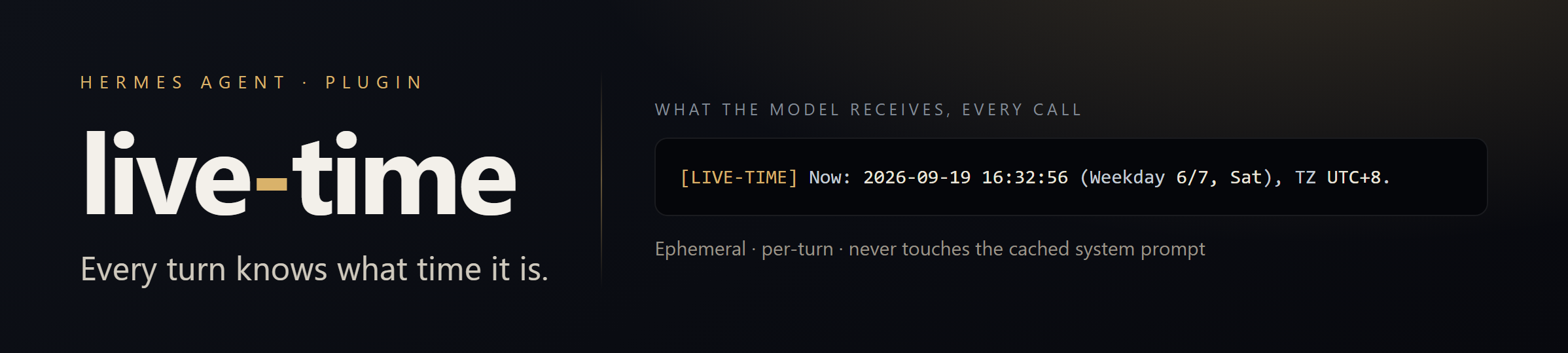
[LIVE-TIME] Now: 2026-09-19 16:32:56 (Weekday 6/7, Sat), TZ UTC+8.
What the model actually sees
One small, self-describing block, appended on the user-message side of every request:
[LIVE-TIME] Now: 2026-09-19 16:32:56 (Weekday 6/7, Sat), TZ UTC+8.
Injected by live-time plugin at THIS LLM call's moment. Use THIS as the
authoritative current time for any today/now/elapsed/date judgment. Ignore
the 'Conversation started' timestamp in the system prompt for anything
except session-creation facts.
The wording is deliberate: the block claims authority over "now", and explicitly tells
the model to treat the session-start stamp as history rather than as the present.
Design guarantees
| Guarantee | Why it matters |
|---|---|
| Ephemeral | Appended to the request only — never written into the cached system prompt, so prompt caching is unaffected. |
| Read-only | Touches no transcript, no memory store, no network. Nothing is persisted. |
| Zero dependencies | Standard library only. The runtime's YAML shim (hermes_yaml, ruamel-based) is used when importable, PyYAML otherwise — both optional. |
| One guarded internal import | hermes_time._resolve_timezone_name, wrapped in try/except ImportError, so a standalone copy still works. |
| Fails open | Unreadable config, unknown timezone, missing zoneinfo data → falls back to system-local time instead of raising. |
| Single hook | pre_llm_call and nothing else — one line in register(). |
| Cheap | A few string operations per turn. No I/O in the hot path. |
Timezone resolution
Resolved fresh on each call, in this order:
hermes_time._resolve_timezone_name()— Hermes' own resolver, and the only source that
knows the routed profile (see the multiplex caveat below). Guarded by
try/except, so a standalone copy falls through to step 2.HERMES_TIMEZONEenvironment variable- top-level
timezonekey in<HERMES_HOME | ~/.hermes>/config.yaml
(parsed withhermes_yaml.safe_loadinside a Hermes runtime, PyYAML elsewhere) - local system timezone (rendered as an offset, e.g.
TZ UTC+8)
Weekday labels are English abbreviations (Mon … Sun) on purpose: the injected block
stays identical no matter what locale the rest of the conversation is in.
Multiplex caveat. A host gateway serving several profiles does not export
HERMES_HOMEper routed profile: inside the gateway process it still points at the
host's home (~/.hermes) while the session runsprofiles/<name>. Reading the config
file directly therefore resolves the default profile'stimezone— usually unset —
and the plugin silently falls back to system-local time.HERMES_TIMEZONEcannot cover
this either, since one env value can only describe one profile. Step 1 exists for this:
hermes_timeresolves the profile that is actually answering.
Troubleshooting
| Symptom | Likely cause |
|---|---|
| Agent still quotes a stale date | Plugin isn't loaded — run hermes plugins list (look for live-time, status enabled), then hermes gateway restart. |
| Time is right but the timezone is off | HERMES_TIMEZONE unset and config.yaml has no timezone key → it's using system-local. Set either one. |
| Timezone ignored for a specific profile | See the multiplex caveat above: the config file is the host's, not the routed profile's. Step 1 (hermes_time) is what fixes this. |
| Timezone ignored everywhere (TZ UTC+8 while config.yaml sets one) | The runtime has no importable hermes_time and no YAML module (hermes_yaml/PyYAML), so only system-local time is available. |
| Nothing in the request at all | Another plugin or an older Hermes build. Check hermes plugins doctor . in the plugin directory. |
Tests
pytest tests/test_live_time.py -v
Requires pytest in your environment.
Covers the injected-block shape, the timezone resolution order, and the invalid-timezone
fallback path.
Links
- Upstream feature request: hermes-agent#10421
- Catalog entry:
plugin-catalog/live-time.yaml - Submitted via #114567
- In-tree plugin PR (open): #85158
License
MIT — see LICENSE.
README from the reviewed commit f5e4edc; it updates when the author re-pins.