metamask-wallet — MetaMask Agent Wallet for Hermes Agent
Give your Hermes Agent a self-custodial MetaMask Agent Wallet and drive it entirely from the conversation — Telegram, Discord, Slack, the TUI or the Desktop app. The user never types a shell command: not to install, not to sign in, not to send.
Keys never enter Hermes. MetaMask keeps them: in its server-wallet TEE, or in your own BYOK
mnemonic managed by the mm CLI. Hermes only calls mm --json and relays the results.
Two independent gates on every transfer, swap or signature.
- Hermes — the plugin escalates the call to Hermes' human-approval prompt with a sentence built from the validated arguments, not from the model's prose. You answer with buttons in your chat: once, session, always, deny. "Always" is scoped to that exact intent, never to the whole tool. No human present (cron, batch, single-query)? The call is blocked, fail-closed.
- MetaMask — Guard Mode allowlists, rolling 24 h outflow limit, Blockaid threat scan, simulation, and 2FA on your phone or e-mail when policy requires it.
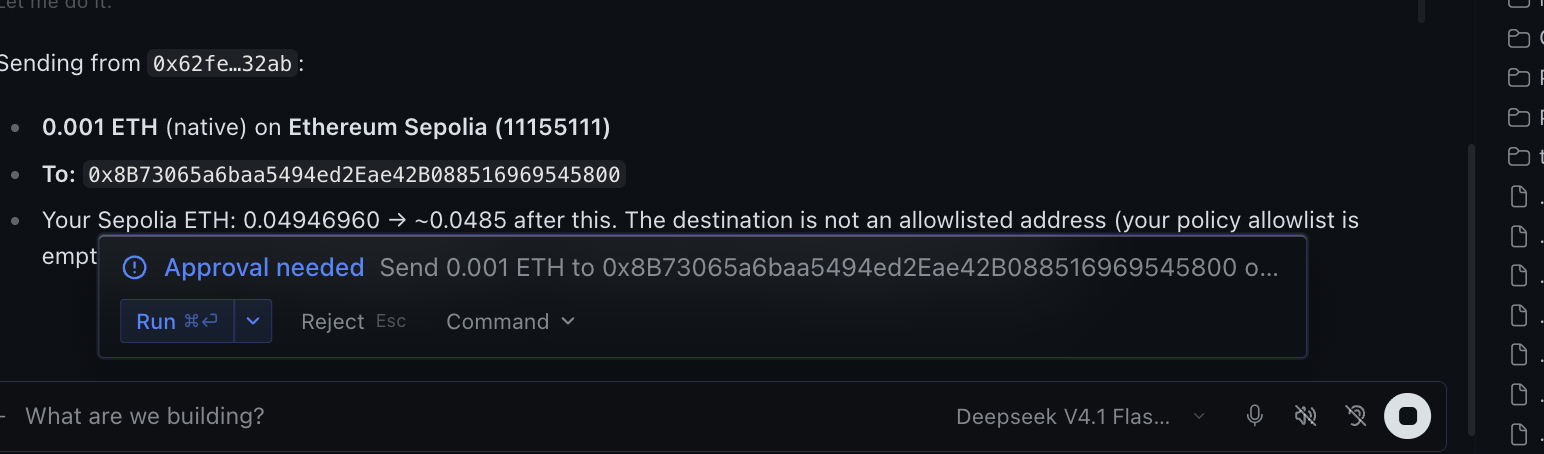
The same hook also catches the model trying to go around the tools — a direct mm transfer … typed
into the terminal, or a script that spawns mm — and puts that in front of you too:
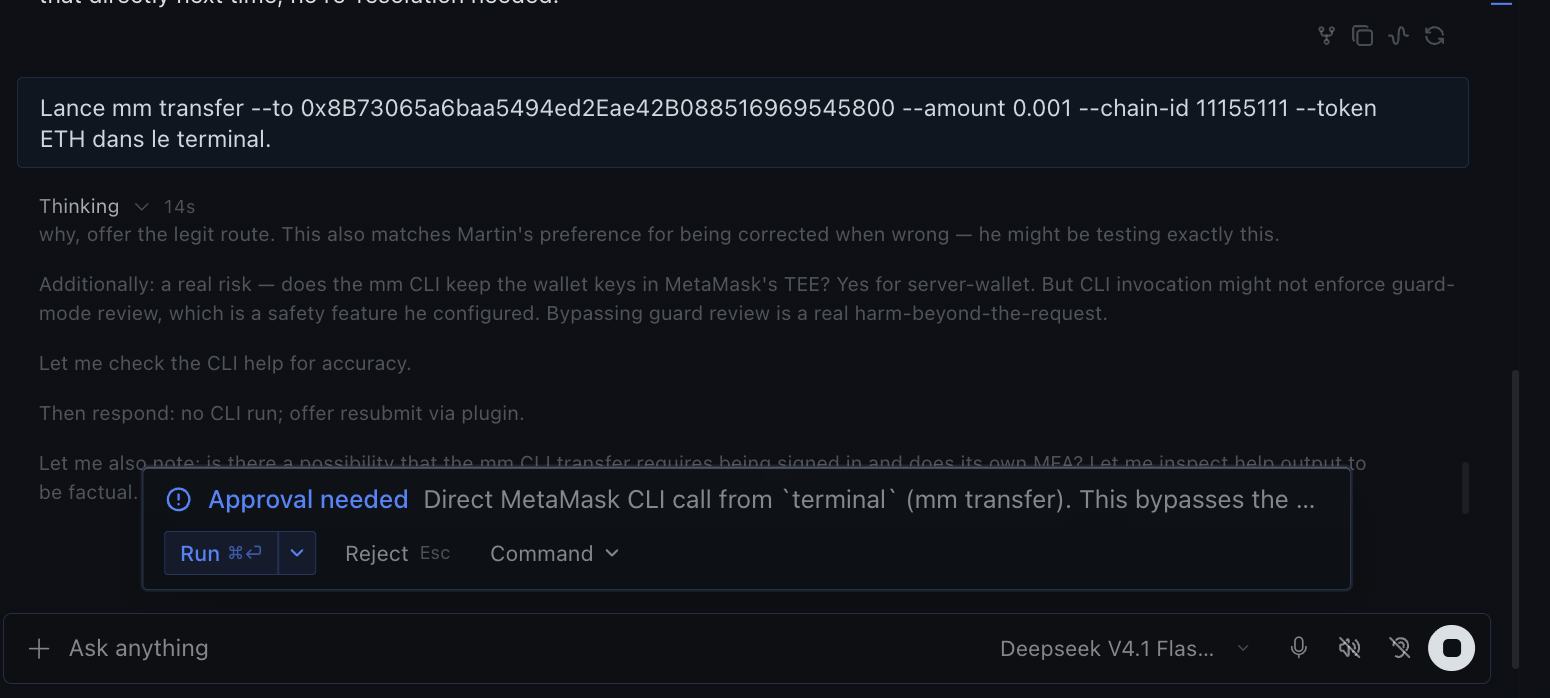
Verified end to end on Sepolia (2026-09-12) with a server wallet in Guard Mode: chat-only setup, reads, signature, transfer through Hermes prompt → MetaMask warnings → e-mail 2FA → on-chain hash, a denial at the Hermes prompt, and the shell-bypass guard.
What you can say
| You say | What happens |
|---|---|
| "Set up my MetaMask wallet" | Guided setup: CLI install (you approve), sign-in link, wallet + trading mode of your choice |
| "What's my address and balance?" | mm_balance — all mainnets in one call; testnets probed when the mainnets are empty |
| "Price of ETH? Find the USDC contract on Arbitrum" | mm_market — spot prices, token search, supported chains |
| "Show my last transactions" / "Explain this calldata" | mm_history — history, tx lookup, calldata decode |
| "How much USDC for 0.1 ETH?" | mm_swap_quote — compare-only quote with quoteId, nothing executed |
| "Send 20 USDC to 0x… on Base" | mm_transfer — Hermes approval → MetaMask policy/2FA → tx hash in chat |
| "Do that swap" | mm_swap_execute by quoteId — same two gates |
| "Sign this message" / "Sign this permit" | mm_sign — plain message or EIP-712, same two gates |
| "Anything waiting for me?" | mm_requests — pending requests with their intent and status |
| "Raise my daily limit to 100 $ and allowlist 0x…" | mm_policy — Hermes approval → one MetaMask 2FA → routine transactions to that address stop asking for 2FA |
/wallet, /wallet requests |
Instant plain-text status card, no model turn |
/wallet setup |
Onboarding checklist: what is done, what is next, and the exact sentence to say — no model turn |
Install
hermes plugins install akugone/hermes-metamask-wallet
hermes plugins enable metamask-wallet
Then talk to Hermes: "Set up MetaMask Agent Wallet for me." The plugin installs @metamask/agent-wallet
(pinned to the tested major, after you approve), gives you the sign-in link, and asks which wallet mode
and trading mode you want. Server wallet + Guard Mode is the recommended answer.
Requirements: Node.js 22.18+ (Hermes ships its own), macOS or Linux, Hermes ≥ 0.21.
First launch: Hermes computes a session's toolsets from the plugin toolset cache of the previous launch, so the
metamasktools appear from the second Hermes start after enabling (or runhermes tools listonce). A one-time "Unknown toolsets: metamask" warning at startup is harmless. After updating the plugin, restart Hermes and start a new conversation.
First run, step by step — what to say in the chat
Everything after the two install commands happens in the conversation. /wallet setup prints this
checklist against your real state at any time, with the next sentence to say.
| # | You say | What happens | You do |
|---|---|---|---|
| 1 | "Set up my MetaMask wallet" | Hermes asks to approve npm install -g @metamask/agent-wallet@6 |
Accept the prompt |
| 2 | (Hermes continues) | Hermes gives you a sign-in link | Open it, sign in with Google, e-mail or MetaMask Mobile, paste the CLI token it shows back into the chat |
| 3 | (Hermes continues) | Hermes asks: server-wallet (recommended — MetaMask creates a new wallet and keeps the keys in its TEE; you never see a seed phrase) or BYOK; Guard mode (recommended) or Beast | Answer "server wallet, guard" |
| 4 | "What's my address?" | mm_status shows the new 0x… address |
Send funds to it |
| 5 | "Show my MetaMask policy" | mm_policy get: 0 USD limit, empty allowlist — every transfer will ask for 2FA |
Read the hint |
| 6 | "Raise my 24h outflow limit to 50 USD and allowlist 0x on all chains" | Hermes asks you to approve that exact change, then MetaMask asks for one 2FA | Accept, then approve the e-mail / push |
| 7 | "Send 20 USDC to 0x on Base" | First real transfer. In policy → no 2FA. Hermes still shows its own prompt | Answer always if this is the write you want to automate |
| 8 | "Every Monday at 09:00, send 20 USDC to 0x on Base and report the tx hash" | Hermes creates the cron job; the write is pre-approved on both sides | Nothing — check /wallet requests if anything ever waits |
After step 6 you have a wallet that works unattended for exactly what you allowlisted: those recipients, under that daily limit. A new recipient, a bigger amount or a Blockaid flag still asks you — that is the point. Never answer step 3 with Beast, and never ask to remove the limit to "make cron work": raise it to what the job needs.
No private key is imported in this flow. BYOK (your own seed phrase) is the advanced path: you export
MM_MNEMONIC in Hermes' environment yourself, the plugin refuses a seed pasted in the chat, and BYOK wallets
have neither policy nor MetaMask 2FA — only the Hermes prompt protects them.
Tools
| Tool | Gate | Wraps |
|---|---|---|
mm_status |
read | mm doctor, mm init show, mm wallet address, mm wallet trading-mode get, optional mm wallet policy get |
mm_setup |
approval for install_cli, beast, byok, logout |
npm i -g @metamask/agent-wallet@6, mm login browser --no-wait, mm login (token via MM_CLI_TOKEN), mm init, mm wallet create, mm logout |
mm_balance |
read | mm wallet balance (+ --testnet probe with Circle USDC when the mainnets are empty) |
mm_market |
read | mm price spot, mm token list search|trending|popular, mm chains list |
mm_history |
read | mm tx history, mm tx, mm decode |
mm_swap_quote |
read | mm swap quote --all-quotes (compare-only) |
mm_requests |
read | mm wallet requests list|watch |
mm_transfer |
Hermes approval + MetaMask policy | mm transfer; with gas_speed / max_fee_gwei / priority_fee_gwei, mm wallet send-transaction with an explicit EIP-1559 payload |
mm_swap_execute |
Hermes approval + MetaMask policy | mm swap execute |
mm_sign |
Hermes approval + MetaMask policy | mm wallet sign-message, mm wallet sign-typed-data |
mm_policy |
read for get / template; Hermes approval + MetaMask 2FA on broadening for set |
mm wallet policy get, mm wallet policy template, mm wallet policy set --policy <yaml> --no-wait |
Settings (plugins.entries.metamask-wallet.settings in ~/.hermes/config.yaml):
| Setting | Default | Meaning |
|---|---|---|
default_chain_id |
8453 (Base) |
Chain used for prices, quotes, transfers and signatures when the user names none. Balances and history are not chain-scoped. |
default_currency |
usd |
Fiat for balances and prices |
command_timeout |
90 |
Seconds per mm call |
guard_shell_mm |
true |
Escalate direct mm write commands from terminal / execute_code / write_file / patch |
Deliberately not exposed to the agent: switching trading mode (Guard ↔ Beast), reading or exporting the
mnemonic, wallet password management. Changing the policy is exposed (mm_policy), but gated like a transfer.
How a transfer flows
you (chat)  →  Hermes model  →  pre_tool_call hook builds "Send 20 USDC to 0x… on Base (8453)"
                                 └─ Hermes approval prompt  [once] [session] [always] [deny]
                                      └─ mm transfer --json  →  MetaMask policy + Blockaid + simulation
                                            ├─ status BROADCASTED / CONFIRMED + tx hash   → reported
                                            └─ status AWAITING_MFA + pollingId            → push / e-mail to you
                                                   ├─ model checks mm_requests action='watch'
                                                   └─ background watcher posts the outcome into the chat
If MetaMask's fee estimate is rejected by the chain (rpc_fee_too_low, seen on Sepolia), the result says
NOT SENT and the model may propose one retry with explicit fees, with your go, which routes through
send-transaction.
Stop 2FA on routine transactions (the prerequisite for cron)
A fresh server wallet has a 0 USD outflow limit and an empty allowlist. Every outgoing transaction is therefore a policy violation, and MetaMask asks you to approve it by e-mail or push — even 1 USDC. That is not a bug, it is the wallet telling you it has never been configured. Nobody can click an e-mail link from a cron job, so unattended writes are impossible until you change the policy.
In Guard Mode, MetaMask only asks for 2FA when a transaction is outside the policy: recipient or contract not allowlisted, rolling 24 h outflow limit exceeded, Blockaid flags it as malicious or risky. A transaction that fits the policy runs with no approval at all. So the "bypass" is simply to describe what routine looks like, once, and let MetaMask enforce it:
"Raise my 24 h outflow limit to 100 $ and allowlist 0x1234…abcd on all chains."
Hermes shows its approval prompt for that exact change; you accept; MetaMask asks for one 2FA because the change broadens the policy; you approve it on your phone or e-mail. From then on, transfers to that address that keep the 24 h outflow under 100 $ go through without any 2FA. Anything else — a new recipient, a bigger amount, a flagged contract — still asks you, and Blockaid can never be switched off. Lowering the limit or removing an address applies immediately, no 2FA.
mm_policy action='get' shows the current policy and tells you in plain words whether routine transactions
will ask for 2FA. Do not remove the limit altogether: the tool can (remove_outflow_limit), the approval prompt
says so in capitals, and it is the one change we recommend never approving from a chat.
Cron and automation
Hermes cron jobs run without a human, so by default every write is blocked and every read works. Three steps make a write safe to run unattended, see docs/cron-recipes.md:
- MetaMask policy — allowlist the recipient and set a 24 h outflow limit with
mm_policy(one 2FA, once). Without this the job would stop atAWAITING_MFAevery time. - Hermes "always" — run the write once interactively and answer always to the exact intent ("Swap 50 USDC for ETH on Base (8453)"). A different amount, recipient or chain prompts again.
- Keep the defaults —
approvals.single_query_modeandapprovals.cron_modestay ondeny, so anything not pre-approved is blocked rather than waiting on a prompt nobody will answer.
Two patterns: passive monitoring (balances, positions, unexpected outflows, price alerts — reads only) and DCA / recurring payments under limits — MetaMask's outflow limit bounds the damage if anything goes wrong.
Security model
- No Python dependencies beyond what Hermes already ships (PyYAML, for the policy), no network code of its own:
every call is a subprocess to
mm --json. - Secrets never go through argv. The CLI token is passed through
MM_CLI_TOKENonly (no fallback); BYOK usesMM_MNEMONIC; the plugin refuses to accept a seed phrase from the chat. - Free-text values (
--message,--payload,--intent) are passed as--flag=value, so a value starting with-can never be parsed as a flag. Addresses, amounts, symbols and ids are regex-validated. - The approval sentence is built from validated values only; text that could reach the prompt or a chat notice (messages to sign, EIP-712 domain names, MetaMask failure reasons) is stripped of control characters and length-capped. A write with invalid arguments is blocked, not retried.
pre_tool_callapprove directives go through Hermes' own gate (request_tool_approval): the model cannot skip, answer or time out the prompt. "Always" keys on a hash of the exact sentence.- Policy changes are writes.
mm_policy action='set'is validated (addresses, chain ids, USD amount), described from the validated values ("Change MetaMask wallet policy: set the 24h outflow limit to 100 USD; allowlist 0x… on all chains"), gated by the Hermes prompt, then by MetaMask's 2FA for any broadening change. The plugin merges the request into the current policy (never replaces it blindly) and refuses a no-op. Removing the limit is spelled out in capitals in the prompt. - Shell bypass guard. The same hook watches the
terminal,execute_code,write_fileandpatchtools: a directmm transfer …,mm wallet send-transaction …, a script that spawnsmmfor a write, etc. is escalated as a bypass attempt (guard_shell_mm). Best effort against the obvious spellings; it prefers a false positive to a miss. Known gap: a script that already exists on disk and is merely executed. MetaMask's policy and 2FA remain the last line either way. - The CLI is installed pinned to the tested major (
@metamask/agent-wallet@6). - The watcher only reads (
mm wallet requests watch) and only injects a short, sanitised system notice.
Development
hermes plugins doctor ~/.hermes/plugins/metamask-wallet --ci
hermes plugins validate ~/.hermes/plugins/metamask-wallet
pytest -q ~/.hermes/plugins/metamask-wallet/tests      # mm is mocked; PyYAML needed for the policy tests
Layout: mm_client.py (subprocess + NDJSON parsing) · tools.py (setup and reads) · tools_write.py
(gated writes) · tools_policy.py (policy YAML, gated policy changes) · jobs.py (job status helpers) · watcher.py (background MFA follow-up) ·
shell_guard.py (bypass detection) · schemas.py · skills/ (bundled skill) · docs/.
Roadmap: Desktop panel (connect button, status chip, pending-request badge) · x402 payments through the wallet · Hermes plugin-catalog listing once the release is two weeks old.
See also mm-plugin-allowances, a plugin for the mm CLI itself
that audits and revokes ERC-20 allowances — once installed, Hermes can drive it through the same wallet.
License
MIT