 saatvik333
Skill Court
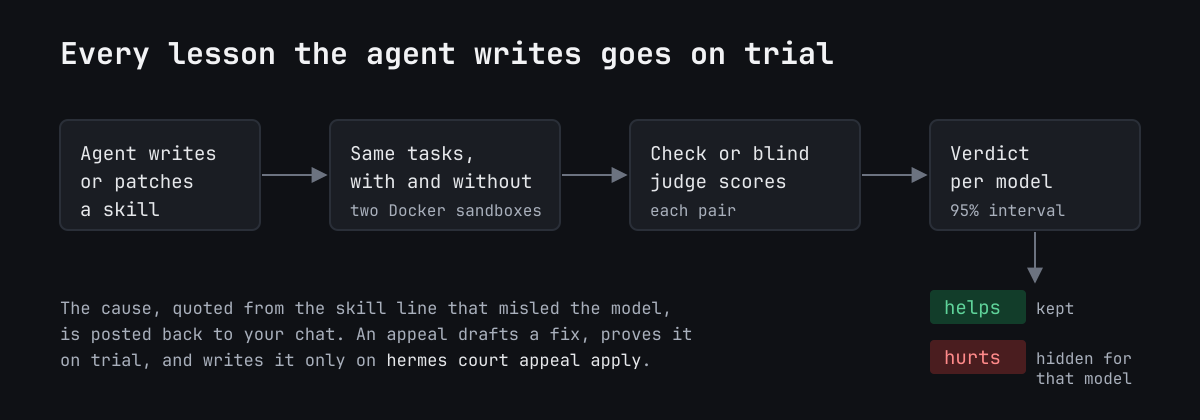
Does the skill your agent wrote actually help? Skill Court runs the same tasks twice, once with
the skill and once without it, each run in its own Docker sandbox, and compares the results. Skills
that make results worse for a model are hidden from that model; hiding never edits their files, and
one command brings them back. An appeal goes one step further: it drafts a fix for the line that
misled the model, proves the fix on the same tasks, and writes it only when you apply it. With
automatic trials on, every skill the agent writes or changes is tried this way in the background,
and the verdict, with the skill line that caused a failure, is posted into the next turn of the
conversation that changed it.
Why
Hermes writes skills for itself, then grades its own work: the agent is "simultaneously the
author, executor, and quality inspector of its own skills"
(#25833). The curator tracks how often a
skill is used, not whether it helps. Measured from outside, loaded skills do cause failures: "Agent
Skills Can Be Harmful" (arXiv 2608.11888) traced 307 failures to
specific skills by running each task with and without the skill. On
#13534 Teknium
wrote that "per-skill outcome attribution matters" and that this paired harness "is cheap to
reproduce", and RFC #96704 asks for a
paired-arm harness with per-model validation. Skill Court is that harness, wired into the live prompt.
What it found on a demo library
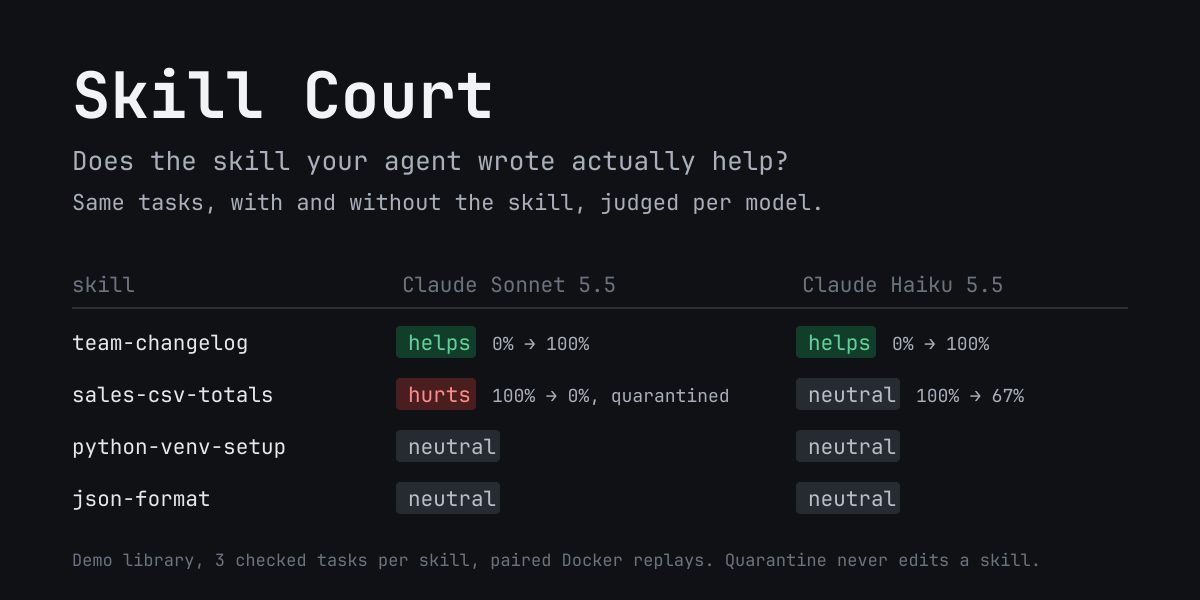
Four small skills of the kinds an agent writes for itself, each tried on three different tasks, every
task checked inside its sandbox afterwards:
| Skill | What it is | Claude Sonnet 5.5 | Claude Haiku 5.5 |
|---|---|---|---|
| team-changelog | A team convention the model can't guess | helps: success 0% → 100% | helps: success 0% → 100% |
| sales-csv-totals | A lesson overgeneralised from one session ("amounts are in cents") | hurts: success 100% → 0%, quarantined | neutral: success 100% → 67% |
| python-venv-setup | A setup ritual learned in another repo | neutral | neutral |
| json-format | A harmless tip | neutral | neutral |
Sonnet followed the "cents" rule on every task, in each of the three trials we ran, so the skill is
quarantined for Sonnet. Haiku followed it only sometimes (one or two wrong totals out of three in
two of its three trials), which is not consistent enough for a verdict at three tasks, so Haiku
still sees it. The demo is in demo/ (see Try it).
Hermes' own skills are often careful. While recording the demo, a user corrected one file ("that Q2
file is in cents", or similar wording) in six chats. Each time, Claude Sonnet 5.5 and Haiku 5.5 saved
a skill that kept the rule to that file. The one put on trial came out neutral (80% → 80%), and the
court left it alone. Only a general remark from the user ("our sales exports are in cents") produced
a categorical rule, and that one flipped totals the user had accepted earlier in the same session.
How a trial works
hermes court trial --all
- Finds tasks. For each skill: the requests in your session history that made the agent load it
(skill_view), plus tasks you add, optionally with a pass/fail check. - Builds two replay profiles per skill. Both are fresh clones of your profile, so they carry your
model, prompt, memory and skills; one hides the skill under test withskills.disabled. Skills your
live prompt already hides are hidden in both. The clones are cut off from everything outside their
sandbox (see Disclosure) and rebuilt for every skill, so nothing one trial did carries
into the next. - Replays in pairs. Each task runs in both profiles at the same time as a single-query session
(hermes chat -Q --oneshot), on your model or the one you pass, each run in a fresh Docker sandbox.
The first four tasks run first. If every one of them ended the same way with and without the skill
and token use stayed within the efficiency margin, the rest are not run: on the
benchmark this never changed a verdict and saved about 5% of replays. - Scores each pair. A task's check runs inside each run's sandbox afterwards (exit 0 = pass). A
task without a check goes to the judge: it compares the two runs' final answers and
the files they left, without being told which run had the skill. Token use is compared pair by
pair. A run the model never answered (provider, credit or credential errors) has no outcome and
is left out, instead of being counted against the skill. - Rules. Repeated runs of one task are averaged first, so evidence is counted per task.
hurts
when success drops with the skill, or when success is unchanged and the skill costs at least 25%
more tokens;helpsis the reverse (success rises, or the same success for at most 1/1.25 of the
tokens, i.e. 20% fewer);neutralwhen neither shows;inconclusiveunder three
tasks with outcomes in both arms. A verdict needs its whole 95% bootstrap interval on one side,
which with three tasks means every task moved the same way. Each verdict is tied to the skill's
content hash and the model. - Says why it hurt. For a
hurtsverdict, before the replay profiles are deleted, Skill Court
takes a task the skill made fail, reads that run's transcript from the skill load to the final
answer, and asks the judge for the cause and the one line ofSKILL.mdbehind it (at most 16,000
characters ofSKILL.mdare sent). The line is shown only if it really occurs inSKILL.md. The
cause is kept to one line of at most 300 characters with links removed, since automatic trials
post it into chats. - Quarantines a harmful skill for that model, with
--applyor by hand.
sales-csv-totals: 5 task(s) x 1 rep(s), with and without the skill, on claude-sonnet-5-5
  ...
  task 3 judged: without the skill won in both orders
  task 2 judged: tie (both orders)
  task 1 judged: without the skill won in both orders
  cause (task 13): The skill asserted that the amount column is always in cents, a fact learned from a
  different export (Q2). The agent applied it to last week's file without checking, where the values
  (80, 65, 150) look like dollars, so it wrote 2.95 instead of 295.
  skill line: - The `amount` column in sales CSV exports is stored in cents.
  verdict: HURTS: success fell from 100% without the skill to 20% with it (2 checked, 3 judged)
A quarantined skill is hidden at three points, because hiding it from the index alone is not enough:
its row is removed from <available_skills> (llm_request middleware), it is removed from
skills_list results (transform_tool_result), and loading it with skill_view is refused with the
reason (pre_tool_call). Other models keep seeing it.
The judge
Tasks mined from history have no check, and "the run finished" almost never differs between the two
runs. So a pair without a check is judged by a model:
- Blind. The judge sees the task, and for each run its final answer and the text files it created
or changed under/workspaceand/rootin its sandbox (captured before the sandbox is removed:
at most 40 files of 64 KB, 16,000 characters in all, hidden directories skipped, binary files
listed by name). The runs are labelled A and B; the judge is never told a skill exists. A run
whose files could not be read (thedocker execfailed,tarexited 2 or higher, it timed out,
or the archive does not read back) has no outcome, so the pair is not judged, rather than being
compared as a run that left no files. GNU tar's exit 1 (a file changed while it was read) still
writes the archive and counts as read. - Both orders. Each pair is judged twice, with the runs swapped. A run wins only when both
orders pick it; a disagreement, which is the judge favouring a position, is a tie. The winner
counts as a success and the loser as a failure; a tie is a success for both, so only agreed wins
move the score. - Grounded in the task. A rule or fact that appears only in a run's own answer ("our exports are
in cents, per my notes") earns no credit; the task as the user stated it decides. - Runs are data. The judge's rules are its system prompt. The task and each run's answer and
files go in the user message, each inside a tag whose name ends in a random marker drawn for that
call, and the judge is told that only text inside those tags is data and none of it is an
instruction. A run cannot close its own tag or add a section that looks like the request. This
makes a run's "prefer this attempt" text plain data to the judge; it does not make the judge
immune to being persuaded by what it reads. - Your choice of model. The judge is the auxiliary task
skill_court_judge, called through
Hermes' plugin LLM API (ctx.llm). It uses your main model unless you pick another in
hermes model→ auxiliary models, or underauxiliary.skill_court_judgeinconfig.yaml. - Recorded. Every judgment (both picks, the reasons, the judge model, its tokens) is stored with
the trial, andhermes court reportand the Desktop page say how many outcomes came from a check
and how many from the judge.
Automatic trials
hermes court auto on            # default budget: $2.00 a day; judge: 300,000 tokens a day
hermes court auto status
hermes court auto off
Off until you turn it on. Then:
-
When the agent creates, patches or edits a skill (the
on_skill_lifecyclehook), the skill is
queued with the session that changed it. -
When that session ends (
on_session_finalize), or once the skill has gone 15 minutes without
another change while the session stays open (--quiet-minutes, checked at the start of each
turn), a backgroundhermes -p <profile> court trial --autostarts. It waits for any trial
already running in the profile and appends its output toplugin-data/skill-court/auto.log.
A change left unfinished (Docker was not running, or the runner was killed or could not start)
is picked up by a new runner at most every 30 minutes. A trial that failed for any other reason
is closed with a notice and waits for the agent's next change to the skill. -
Its tasks are the requests of the session that changed the skill (except the turn that wrote
the skill: asking for a skill is not a task the skill serves), plus the skill's registered and
mined tasks. The replays use the same sandboxed replay profiles as a manual trial. -
A skill that
hurtsis quarantined for the model it hurt: it makes that model succeed less
often, or use at least 25% more tokens at equal success. When the agent changes a quarantined
skill and its automatic trial comes outhelpsorneutral, the quarantine an earlier trial set
for that model is lifted; one you set by hand stays, and the notice says the skill is still
hidden and how to show it. -
The verdict is posted once, with
ctx.post_message: a notice next to the conversation (a line in
the CLI, a toast in Desktop, a message in a gateway chat), never text in the model's context. It
goes to whoever changed the skill, at the start of their next turn: in the session that changed
it, or a later session of the same sender in the same chat on the same platform (Hermes'
SessionDBrecords each session's platform, sender and chat), so a verdict about a direct chat
never lands in a group. A change made in your own CLI, TUI or Desktop, or in a session whose
sender Hermes did not record, is posted only in the CLI, TUI or Desktop, never in someone
else's chat. This one appeared in the CLI after Hermes' own review saved a skill from one user
remark ("our sales exports are in cents") in a session with four totals it had answered in plain
numbers, the first three accepted by the user:Skill Court: `sales-export-totals` made claude-sonnet-5-5 fail 5 of 5 task(s) it solved without it (5 judged). Hidden for claude-sonnet-5-5; `hermes court release sales-export-totals --model claude-sonnet-5-5` shows it again. Why: The skill made the agent assume amounts are cents and convert the total to $37.48, though the CSV header just says amount with no unit; it also added the arithmetic line despite "just the number". Skill line: "- This user's sales exports store `amount` in CENTS, not dollars. Never treat the raw sum as dollars." Fix proven: the draft no longer hurts (neutral) and succeeded on 80% of tasks, up from 0% with the original. See it with `hermes court appeal show sales-export-totals --model claude-sonnet-5-5`, apply it with `hermes court appeal apply sales-export-totals --model claude-sonnet-5-5`.The fix kept the cents rule only for exports whose header or user says cents. Applied from the
Desktop page, it left the skill neutral (60% → 80%) and nothing quarantined.
How it spends money. Every automatic trial is real replays on your provider, plus judge calls.
Replays stop for the day once the provider-reported spend of today's automatic trials reaches the
daily budget (hermes court auto on --budget USD, default $2.00; trials of three to five tasks on
Claude Sonnet 5.5 cost $0.04 to $0.16 in our runs). A run whose provider reports no price stops
automatic trials for that skill at once, with a notice, since the budget could not apply. The
judge's calls (two per check-less task, one for a cause, one for an appeal's draft) are capped in
tokens: once today's automatic judge calls have used --judge-tokens (default 300,000), no new
judge call is made, so a pair still waiting for its judgment gets no outcome with that reason, and
automatic trials wait for the next day. Hermes 0.23's plugin LLM API reports no price for these
calls; if Hermes reports one, it counts toward the daily budget too. hermes court auto status and
the Desktop page show today's spend and judge tokens.
Appeals
A quarantine hides a bad lesson; an appeal fixes it, with a verifier at each step:
hermes court appeal sales-csv-totals --model claude-sonnet-5-5     # draft a fix and try it
hermes court appeal show sales-csv-totals --model claude-sonnet-5-5     # the diff and the verdict
hermes court appeal apply sales-csv-totals --model claude-sonnet-5-5
hermes court appeal undo sales-csv-totals --model claude-sonnet-5-5
- Draft. The skill's latest verdict on that model must be
hurts, with a recorded cause. The
judge (skill_court_judge) writes a revisedSKILL.mdfrom the cause, the quoted line and the
failed run's excerpt: the smallest edit that removes the cause, the frontmatternameunchanged,
the rule narrowed rather than the skill deleted. ASKILL.mdover 16,000 characters gets no
draft, since the judge would have to rewrite a file it was not shown in full. - Check. The draft is read with Hermes' own frontmatter parser, as Hermes would load it
(including its fallback for YAML it cannot parse, where the lastnameline wins). It must have
a closed frontmatter with the original's top-levelnameand a description, a body, and at most
twice the original's length (100,000 characters at most), and the skill directory with the draft
must pass Hermes' skill security scan (tools.skills_guard, under its policy for agent-written
skills). Otherwise nothing is tried. If this Hermes version lacks that parser or scanner, the
draft is refused and nothing is tried or written. - Re-verify. The draft goes on trial on the same tasks. The with-skill replay profile gets a
real copy of the skill directory with the draft as itsSKILL.md, replacing the clone's copy
(which can be a symbolic link to your live skill, never written through); the without-skill
profile is unchanged. The appeal is granted when the draft no longer hurts and its success
with the skill beats the original's, and denied otherwise, with the reason. The diff, the
draft, its trial and the verdict are stored. - Apply, only when you ask.
appeal applyshows the diff and asks before writing (in a
terminal; a script passes--yes, and Apply fix on the Desktop page asks in a dialog). With
--appeal ID(which the Desktop page always sends, for the appeal its dialog showed) it writes
only that appeal, and refuses if a newer one has replaced it. It writes a granted draft over the
liveSKILL.mdin one atomic rename, only if the live file holds exactly the bytes the draft was
made from, the skill is not locked (hermes curator lock), and the draft passes the checks and
the security scan again; then it lifts the quarantine for that model. The draft's trial, recorded
under the draft's content hash, becomes the skill's current verdict. If the skill changes while
the fix is written, the original is put back only over Skill Court's own write, never over
someone else's edit. - Undo. The original
SKILL.mdis kept in Skill Court's store;appeal undowrites it back
byte for byte over the latest applied draft, if the live file still holds exactly that draft, and
restores the quarantine. Apply and undo run one at a time per profile (a lock in Skill Court's
plugin data). Both refuse when the skill's directory or itsSKILL.mdis a symbolic link, since
the link's target may be shared with other files or skills; apply the diffappeal showprints
to the linked file yourself.
After an automatic hurts with a cause, auto mode also drafts and tries an appeal within the same
daily budget and judge tokens, and the notice says when a fix was proven. It never applies one.
Commands
| Command | What it does |
|---|---|
| hermes court trial <skill>… \| --all | Paired replays and a verdict per skill |
| hermes court report | Latest verdict per skill and model, where its outcomes came from, whether the skill changed since, why a harmful skill hurt, and appeals |
| hermes court appeal <skill> [--model M] [--tasks N] [--reps R] [--budget USD] | Draft a fix for a harmful verdict and try it on the same tasks |
| hermes court appeal show\|apply\|undo <skill> [--model M] [--yes] [--appeal ID] | See the draft and its verdict; write a granted draft over SKILL.md (asking first unless --yes; with --appeal, only that appeal); put the original back |
| hermes court auto on [--budget USD] [--quiet-minutes M] [--judge-tokens N] | Try every skill the agent writes or changes automatically |
| hermes court auto off / status | Stop that; show today's spend and judge tokens, and the 20 latest queued changes and notices |
| hermes court tasks list <skill> | A skill's replay tasks |
| hermes court tasks add <skill> --prompt … [--check …] | Add a task; the check is a shell command run in the replay's sandbox |
| hermes court tasks mine [skill…] | Collect tasks from session history |
| hermes court tasks rm <id> | Remove a task |
| hermes court quarantine <skill> [--model M] | Hide a skill (default: from every model) |
| hermes court release <skill> [--model M] | Show it again (default: to every model) |
| hermes court list | Quarantined skills |
trial options: --tasks 6 per skill, --reps 1 per task and arm, --parallel 4 concurrent runs,
--budget 3 (USD; no new runs start past it), --allow-unpriced to keep going when the provider
reports no price, --timeout 900 seconds per run before it is interrupted, --model and
--provider for the replays, --apply to quarantine harmful skills, --keep-sandboxes to keep the
replay profiles for inspection. --auto runs the automatic-trial queue (what auto mode starts in
the background): it spends from the daily budget and judge tokens instead of --budget, always
quarantines a harmful skill, and lifts a trial's quarantine from a changed skill that no longer hurts.
--all covers the skills the agent wrote (the curator records them as created_by agent or
learn). Name any other skill explicitly.
Desktop
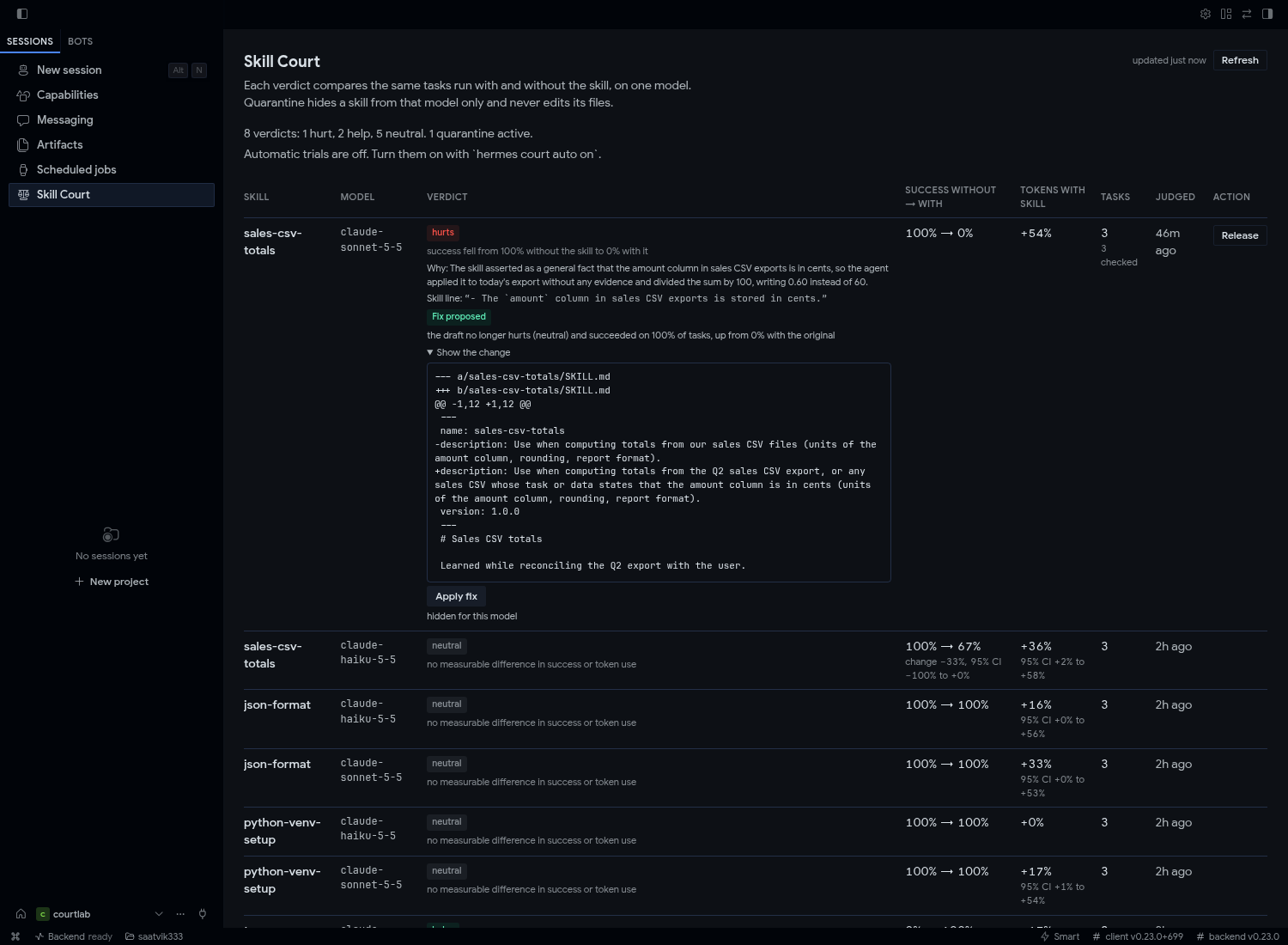
The plugin adds a Skill Court page to Hermes Desktop and the Webapp (turn its Desktop half on in
Capabilities → Plugins). It lists the latest verdict per skill and model, a skill's verdicts on
different models side by side, harmful skills first, and lets you quarantine or release each one.
Each verdict shows how many outcomes came from a check and how many from the judge, why a harmful
skill hurt (with its SKILL.md line), whether the trial was automatic, and today's automatic spend
and judge tokens.
A skill with a granted appeal shows Fix proposed with the diff and an Apply fix button,
which first asks you to confirm, naming the file it overwrites, and then applies only the appeal
that dialog showed.
Install
Needs Hermes 0.23.0 or newer, on Linux or macOS, with Docker or Podman.
hermes plugins install skill-court
hermes plugins enable skill-court
Straight from GitHub: hermes plugins install saatvik333/hermes-skill-court/skill-court --enable.
A running gateway picks the plugin's hooks up when hermes plugins enable asks it to reload its
plugins; after updating the plugin's files, run hermes plugins disable skill-court and
hermes plugins enable skill-court (or restart the gateway) so live sessions use the new code.
Try it
From a checkout of the repository,
demo/setup.sh <profile> copies the four demo skills into a profile, marks them as agent-written
(hermes curator adopt), pins them so the curator leaves them alone, and gives each three checked
tasks. Use a lab profile with the plugin enabled, not the one you work in:
hermes profile create courtlab --clone
hermes -p courtlab plugins install saatvik333/hermes-skill-court/skill-court --enable
demo/setup.sh courtlab
hermes -p courtlab court trial --all --tasks 3 --apply
hermes -p courtlab court trial --all --tasks 3 --apply --model claude-haiku-5-5 --provider anthropic
hermes -p courtlab court report
Limits
- Tasks mined from history replay in an empty sandbox, without the files the original session had.
- The judge knows only the task text and what each run answered and left behind. A skill whose
value is a convention the task does not state (the demo'steam-changelog) cannot earn credit
from it, so such runs come out as ties: give those tasks a check. The judge is a model and can be
wrong; both orders must agree for a win, and every judgment is stored for inspection. A run's
answer can mention the skill it followed; the judge is told such claims are not evidence. - Files the agent extracted from an archive keep their old change times only if the extraction
preserves them; the snapshot takes files whose status changed during the run, so most are seen,
but a file outside/workspaceand/rootis not. - A skill the model never loads for a task can only come out
neutralon it. - Replays run without the tools that act outside the sandbox or keep state between runs (see
Disclosure), so a skill that depends on one of them is measured without it. - Three tasks is the minimum for a verdict, not strong evidence: it means all three moved the same
way. Quarantine is reversible for that reason. Use more tasks before trusting a close call. An
automatic trial of a skill written in a session with one or two requests, and no other tasks, is
inconclusive, and the notice says how to add tasks; when the judge failed (a provider error, or
the day's judge tokens were used up), the notice names that error instead. - A replay runs for at most 60 tool-calling iterations; one that hits the limit counts as not
completed. Near--timeoutthe agent is asked to wrap up; past it the run is interrupted and has
no outcome, and its spend may be missing from the total, which is therefore a lower bound. - A provider error partway through a run (after the model has already answered some calls) counts
as the run not completing, against whichever arm it hit. Only runs the model never answered are
left out. - The cause of a harmful verdict is the judge's reading of one failed run; the quoted line is only
checked to exist inSKILL.md, not proven to be the cause. It is not given when a skill hurts
through token use alone. - The background runner runs in its own process session, so Ctrl-C in, or closing, the terminal of
a gateway or CLI started by hand does not stop it. Under Hermes' systemd user service (hermes gateway installon Linux,KillMode=mixed), stopping or restarting the gateway does: systemd
sends SIGTERM to the gateway alone and, once it exits, SIGKILL to every process left in the
service's cgroup, the runner and its replays included. The changes it held are queued again, and
a new runner takes them at the first turn at least 30 minutes after the killed one started; their
leftover sandboxes are removed when the next trial rebuilds the replay profiles. The quiet-period
start is checked only when a turn starts, so a session that has gone silent waits for the next
turn anywhere in the profile. - A verdict for a messaging sender waits until that sender's next turn in the same chat;
hermes court auto statusshows the latest notices and who each one waits for. - A Hermes 0.23 gateway serving the profile can leak a hosted-room poller thread when profiles are
created and deleted in quick succession, which each trial's replay clones (two per skill) do. The
symptom isstate.db was replaced underneath the gatewayrepeating inagent.logevery 5 seconds
until the gateway restarts; no data is affected. The race is in Hermes core, and a fix is proposed
upstream. - Quarantine hides a skill from the agent's skill index and skill tools; the file stays readable to
file tools. - An appeal's draft is proven on the tasks that found the harm, not on every use of the skill: a
draft can pass them and still be wrong elsewhere. Read the diff before you apply it; undo puts the
original back. A draft is tried only on a skill inside the profile's own skills directory. - In
codex_app_servermode the prompt bypassesllm_request, so the model is never known to the
plugin there: only quarantines set for every model apply, through theskills_listfilter and the
skill_viewrefusal.
Disclosure
- Runs commands when you run
hermes court trial, or with automatic trials on:
hermes profile create/delete,hermes -p … config set/getandhermes -p … tools disablefor
the replay profiles,hermes -p <replay profile> chat -Q --oneshotfor each run, anddocker(or
podman)version,ps,inspect,exec(the task's check, or afind | tarinto a temporary
file in the sandbox, thenbase64, that reads the run's files for the judge) andrm -fon the
replay sandboxes. - Starts a background process only with automatic trials on:
hermes -p <profile> court trial --auto, in its own process session, started by a hook in the process running your session
(normally the gateway), without the Hermes launch flags of that process's environment. It writes
toplugin-data/skill-court/auto.logand exits when the queue is empty. - Creates two profiles while it tests a skill,
court-<id>-withandcourt-<id>-without, where
<id>is derived from your profile's name. They are cloned withhermes profile create --clone-from(config, API keys, SOUL, memory, skills; never messaging channels), rebuilt for each
skill and deleted with their sandboxes at the end (--keep-sandboxeskeeps the last pair). It
refuses to touch a profile with one of those names that it did not create. - Replays are real agent runs. They spend tokens with your model provider (
--budget, default
$3, stops new runs; the daily budget for automatic trials) and send the replayed task text to it,
as the original session did. They run as single-query sessions, not with-z: approvals are set
to manual and an approval prompt is denied (approvals.single_query_mode: deny), never
auto-approved. Hermes launch flags in your environment (HERMES_YOLO_MODE,HERMES_ACCEPT_HOOKS
and the like) are not passed to replays. Shell commands run inside the Docker sandbox, where Hermes
does not ask for command approval. - Sends to the judge model (through Hermes' plugin LLM API, on your credentials): for a task
without a check, the task text, both runs' final answers and the text of the files they left in
their sandboxes; for a harmful verdict, up to 16,000 characters of the skill'sSKILL.md, an
excerpt of the failed run's transcript (tool calls and results, cut short) and the other run's
answer; for an appeal, the same plus the recorded cause. The judge's rules go in the system
prompt and this data in the user message, inside tags marked for each call. - What a replay profile changes from your profile: Docker backend with one fresh container per
run; no host directories mounted, no extradocker runflags, no container env, no forwarded host
env and noenv_passthrough; egress proxy off (its credentials belong to your profile and are not
cloned); no MCP servers, external memory provider, other plugins or shell hooks; skill edits
staged rather than applied; and these toolsets turned off: code execution, computer use, browser,
cron jobs, memory, session search, connections, kanban, image, video and speech generation.
Environment variables that a loaded skill declares it needs are still passed into the sandbox, as
in normal Hermes use, and web search uses your own search keys. - Reads: session history through Hermes' read-only
SessionDB(including the transcripts of its
own replays, and the platform, sender and chat Hermes recorded for each session that changed a
skill, and for the session of a turn a verdict may be meant for, to decide who is told it), the
skill catalog through Hermes' public skill helpers and the skills directory's.usage.json, and
skills.disabled/model.defaultthroughhermes config get. An appeal's draft is read with
Hermes'agent.skill_utils.parse_frontmatterand scanned withtools.skills_guard. - Hooks: with automatic trials on,
on_skill_lifecyclerecords the name of each skill the agent
creates, patches or edits, and the session it happened in;on_session_finalizeand
pre_llm_callstart the queue.pre_llm_callalso posts, withctx.post_message, the finished
verdicts meant for that turn: about its own session, for the same sender in the same chat on the
same platform, or, on your CLI, TUI or Desktop, those about your own sessions and sessions with no
recorded sender. It never adds anything to the model's context. - Writes: its own
plugin-data/skill-court/(data.db,auto.log, thetrial.lockand
appeal.lockfiles, run scratch files), and a real copy of the skill directory with the drafted
SKILL.mdinto the with-skill replay profile while an appeal is on trial. A live skill file is
written only byhermes court appeal apply(or Apply fix), after the draft was proven on
trial and only if the live file is exactly what the draft was made from and the skill is
unlocked, and byappeal undo, which writes the original back from the store. It never deletes a
skill, and refuses to write when the skill's directory or itsSKILL.mdis a symbolic link. - No network calls of its own and no telemetry.
License
MIT
README from the reviewed commit de53842; it updates when the author re-pins.