 stffinfcti
Understudy
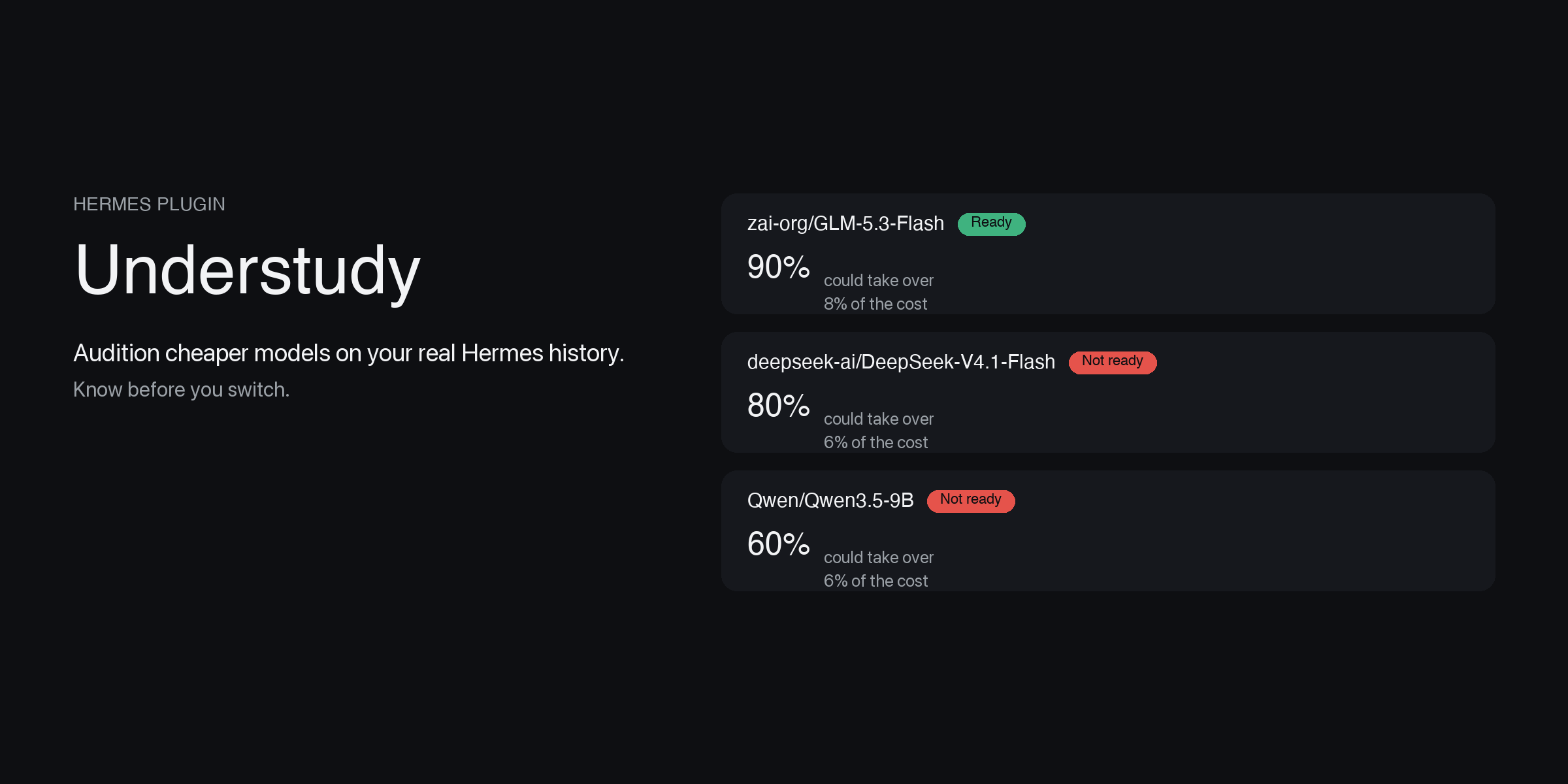
Audition cheaper models on your real Hermes history before you switch.
Understudy replays a sample of your agent's actual past decisions — assistant
replies and tool calls stored in the Hermes session database — on one or more
candidate models, has a judge model compare each candidate step to what your
agent actually did, and reports how often each candidate could have taken
over, its critical misses, and what the switch would cost you per month.
In a real run on a fresh Hermes profile (20 decisions, ~7 minutes, $0.86):
GLM-5.3-Flash matched the current model on 90% of decisions at 8% of the
cost — Ready, while DeepSeek-V4.1-Flash (80%) and Qwen3.5-9B (60%) both
came back Not ready. The current model matched itself 8/8 on the
re-asked baseline subset.
How it works
- Corpus — reads the local session DB read-only: real decisions from your
recent conversations (subagent sessions and the current session excluded,
sources you configured skipped). - Stratified sample — a deterministic, category-floored sample spread
across sessions and decision kinds. - Blind replay — each candidate sees the transcript exactly as your agent
saw it (truncated, secrets redacted, persona excerpt included) and must
return the single next step as JSON: a reply or tool calls. - Judge — the current model (or your
judge_model) compares production
vs candidate on substance, blind to which is which; exact matches skip the
judge entirely. - Baseline noise floor — your own model re-answers a subset, so a 90%
takeover rate means "as good as the model was with itself", not perfection. - Wilson CI + verdict — scored takeover with a 95% interval, critical and
minor miss rates, per-category breakdown, and a Ready / Partial /
Not ready / Not enough data verdict. - Pricing — projected monthly cost from the last 30 days of real token
usage (scaled by the actual span covered), priced fromsettings.prices,
local endpoints (free), or Hermes's models.dev cache — never guessed.
What you get
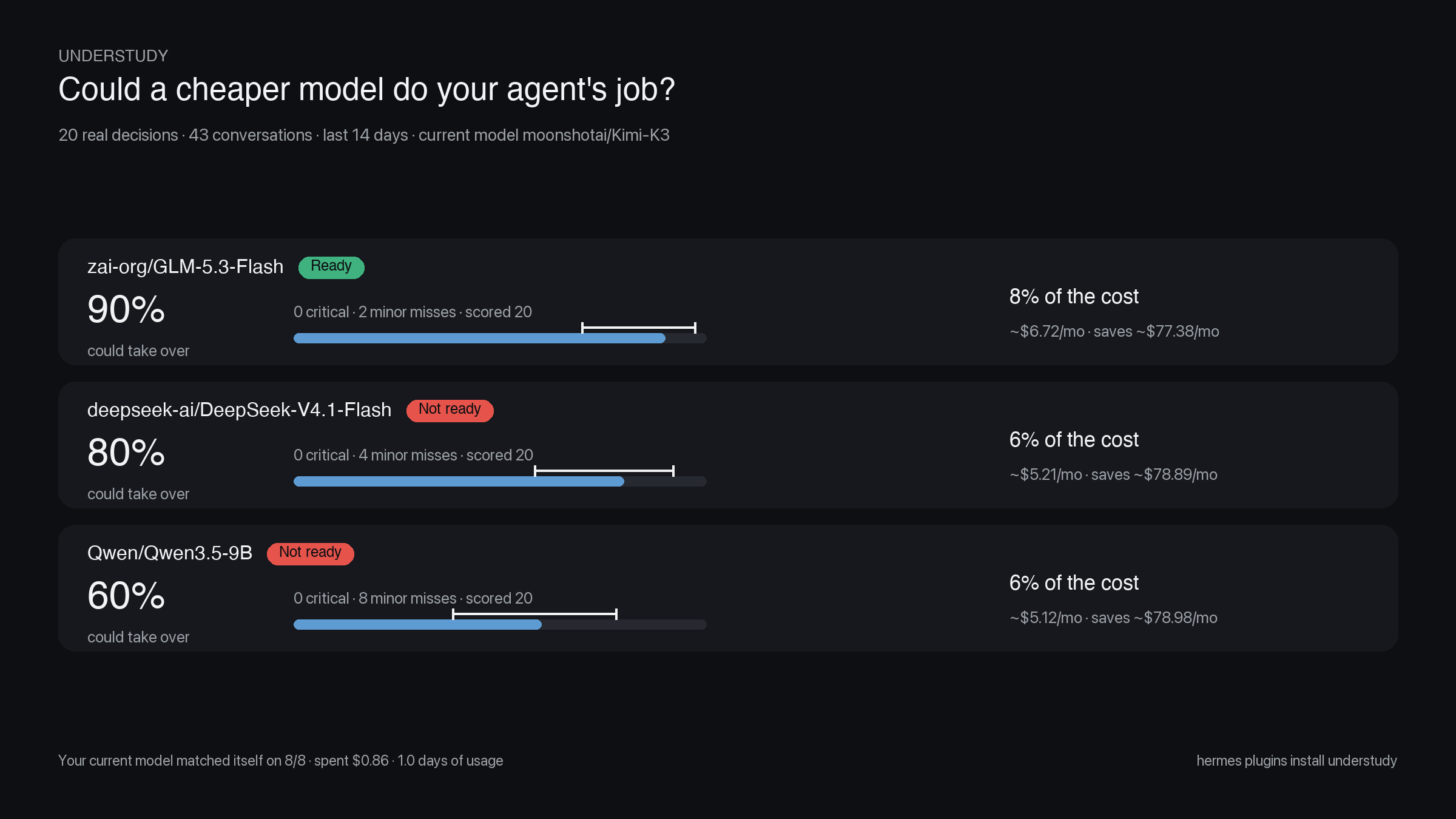
A chat scorecard like the one above, a self-contained HTML report with a
decision browser (excerpt, your agent's step vs the candidate's, the judge's
reasoning, cost and latency), and a Desktop page for browsing runs.
Install
hermes plugins install understudy                                    # from the catalog
hermes plugins install https://github.com/stffinfcti/understudy      # from git
On enable, Hermes asks consent for the two capabilities the plugin needs:
llm.model_override (run candidates) and llm.provider_override
(provider:model candidates). The Desktop page is opt-in — enable it under
Capabilities → Plugins.
Using it
- Desktop — sidebar "Understudy": runs list, scorecards, decision browser,
new-audition dialog. - Chat — ask your agent to audition a model; it calls
understudy_audition
(dry-run first, then the run) and posts the scorecard. - Slash —
/understudy openrouter:vendor/model --sample 20 --days 30;
/understudy last,/understudy runs. - CLI —
hermes understudy audition <models…>,estimate,list,
show [RUN_ID].
Permissions
Model/provider overrides are fail-closed. Grant llm.model_override (and
llm.provider_override for provider:model candidates) on the consent screen,
or set plugins.entries.understudy.llm.allow_model_override: true in
config.yaml. Judge calls use your current model unless judge_model is set.
Settings (plugins.entries.understudy.settings)
| key | default | meaning |
|---|---|---|
| sample | 20 | past decisions replayed per candidate |
| days | 14 | history window |
| budget_usd | 1.5 | hard spend cap per audition |
| concurrency | 6 | parallel model calls |
| baseline_sample | 8 | decisions your model re-answers |
| judge_model | "" | provider:model for the judge |
| include_persona | true | send a system-prompt excerpt |
| exclude_sources | [] | session sources to skip |
| prices | {} | "provider:model"/"model" → {input, output, cache_read?} USD per 1M tokens |
Privacy and disclosure
- Reads your local session history read-only.
- Sends redacted excerpts of past conversations to the candidate models you
pick and to the judge model, throughctx.llmon your existing Hermes
credentials, capped bybudget_usd. A candidate on a different provider than
your usual one receives those excerpts too: only audition providers you trust
with your chat history. - Reads Hermes's local
models_dev_cache.jsonfor list prices. - Writes run records and reports under
plugin-data/understudy/(newest 20
kept). - Requests
llm.model_override+llm.provider_overridecapabilities at
install consent; runs a background worker thread only during an audition.
No telemetry, no other network calls.
Limitations
A single-step replay is a proxy for a full agent run: it measures whether the
candidate takes a sound next step, not whether it finishes the whole task.
The judge is itself a model and adds noise; small samples give wide CIs —
treat "Not enough data" seriously and widen sample/days.
README from the reviewed commit e0920f9; it updates when the author re-pins.