 thehangingforest
Bonsai Garden — local Hermes Desktop page
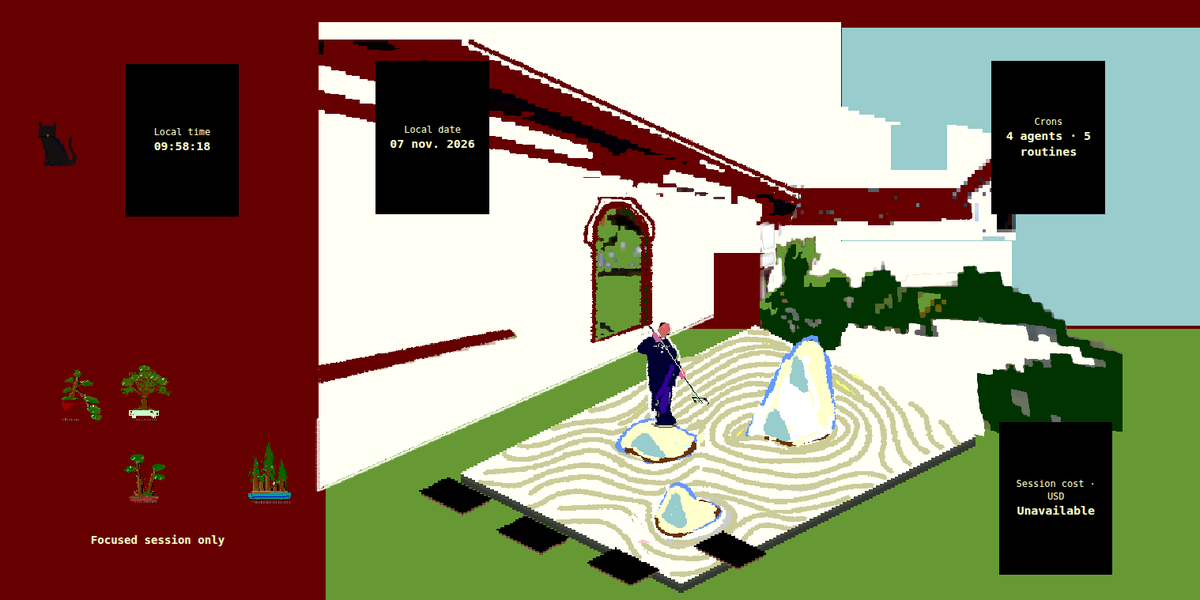
Work by thehangingforest for the Hermes plugin hackathon. Artwork: the artist's approved GIMP
composition of BONSAI GARDEN 3; the twelve tree sprites are unchanged from v1, asserted at the
pixel. The tests install nothing.
Files
src/plugin.mjs— single-file ESM SDK page. Plugin idbonsai-garden, route/bonsai-garden,
sidebar Garden, palette Open Bonsai Garden.assets/scene.json— 1340×650 manifest: embedded PNG data URIs, twelve tree ids, monk, cat, four
stands, the four HUD anchors (time, date, crons, cost) plus the painted season strip, XCF
provenance.assets/care-tips.json— twelve English care lines, keyed01..12(one per month, 40–60 chars).
assets/avatars.json— nine inline pixel portraits, one per profile. Both ship with the art.scripts/prepare_art3.py— packs the exported XCF, deriving every number from its layers and
asserting it against the geometry measured inside the XCF; tree sprites are asserted
pixel-for-pixel against the frozen v1 assets. The export hides and moves the drawn shelf, so the
pack re-anchors that layer to its v1/v2 position and asserts every opaque plank pixel against the
frozen v2 room.scripts/build_plugin.py— replaces the art placeholder insrc/plugin.mjswith the JSON object
(art + tips + avatars) and writesdesktop/plugin.js.hermes plugins validate .must pass (Validation passed.). Imports are limited to
@hermes/plugin-sdk,reactandreact/jsx-runtime: no Python backend, no extra npm
dependencies, no core patches.
Deploy (a separate, explicit step)
Copy desktop/plugin.js and plugin.yaml into ~/.hermes/desktop-plugins/bonsai-garden/, compare
the sha256sum of both copies, then let the running Desktop hot-reload (fallback: palette action
Reload desktop plugins). Building alone changes nothing on screen — the background lives base64
inside scene.json and plugin.js.
What is real
Subscriptions go through SDK useValue on host.state.busy, focusedSessionProfile,
focusedSessionId and focusedUsage; the gateway socket is not work; clock and date use Date.now()
and the local timezone. Cost uses only a finite nonnegative focusedUsage.cost_usd: absent, null or
invalid means Unavailable, never a fabricated zero, and a reported zero shows as zero. Tokens
without dollars (local models, older gateways) give an approximate line at one documented blended
rate, APPROX_USD_PER_MTOKEN = 0.15, marked with a tilde (~$0.3000); a reported cost always wins.
Routines are read on demand from each profile's own gateway cron store (host.profileRoutes() plus
host.requestProfile(route, 'cron.manage', …)), the same scoped contract the desktop bot plugins
use. Only recurring agent work qualifies: script-only watchers, one-shots and finished jobs never
appear; suspended routines stay visible as suspended, with their real schedule and next run. Failed
routes and mismatched scoped replies count as incomplete, never charged to a profile; without
profile routing the garden claims nothing and keeps Crons unavailable.
One bonsai per agent, from those routes plus the focused agent itself when the route list does not
carry it yet. A stable hash with linear probing gives each agent a distinct sheet sprite — no shared
sprite, no filler tree. Homes are the measured grid: four columns by three planks (dividers at x = 58,
120, 189, 259, 324; plank lines at y = 367, 456, 545), twelve compartments for nine agents; the
cascade bunjingi sits on the fourth stand (x = 752, y = 575). Only the focused busy agent's tree
moves, to stands[0], and returns to its exact home. The monk is never frozen: it drifts ±30 px
around its home on a triangle wave from accumulated monotonic time, 2 px/s at rest and 8 px/s while
busy, so the pace never depends on the tick rate. The cat spawns at random, can be dragged, and
carries no action.
Task text is the actual session.info.title (read-only), requested only when focused-session
ownership matches the active connection/profile and fenced by the gateway activation epoch;
cross-owner tiles, missing titles and offline gateways fall back clearly. No transcript is requested,
and metadata refreshes on focus or busy transitions through the host's React Query integration, not a
fake timer. Older SDKs without focused atoms get a primary-session fallback, with usage and title
unavailable where unsupported; native rendering of those paths is left to the parent to verify.
Gestures
- Every drawn bonsai has a click-to-open hit area (
data-tree-hit) over its canopy: a click
resolves the agent to a profile route like the roster row and opens the conversation. - A black name cartouche under each pot (
data-tree-name, avatar included,pointer-events: none)
signs the agent:agentLabelprefers the label the route ships, otherwise capitalises the profile,
so a raw slug never reaches the visitor. - Conversation on each row (
data-gesture="open"): the name resolves to a route matching
profileortargetProfile, the most recent stored session resumes in place when one exists,
otherwise a new chat draft opens on that route. - Stop (
data-gesture="interrupt") appears only while that agent is busy, calls
session.interruptwith the runtime session id fromsession.active_list, and disappears after a
successful stop; refusals are reported asnot-busy,not-interrupted,no-route,unsupported
orfailed, never as a silent success.
Rendering, tools and season
Art positions are manifest coordinates used as percentages inside a responsive,
aspect-ratio-preserving stage capped at 1340 px, with image-rendering: pixelated. No readout breaks
mid-word: the widest unbreakable token (Unavailable) is asserted to fit the drawn frame's usable
width.
The four readouts are movable objects, not painted labels: black plaques with agave-white type,
placed from their measured hud anchor, clamped inside the drawn frame (placeTool), and keeping
that anchor's width and height so the black covers the painted rectangle instead of shrinking onto
its own text — only the position moves. Stacking order is fixed (time < date < crons <
cost); the dragged plaque comes forward only under the finger, moves nothing else, and falls back
into rank on release. Cream HUD text comes from the artwork palette; shell text and background use
real Desktop theme variables.
Season and month come from the local clock, in English and without locale guessing:
seasonOf/seasonLine return Autumn · November (winter December–February, spring March–May,
summer June–August, autumn September–November). One care line per month is read from the shipped
assets/care-tips.json (careTip(art, now)) and appended to the footer strip; a blank or missing
line adds nothing. Only the page's own elements are rendered — no body observers, no global DOM
injection — and scoped timers dispose on unmount.
Tests
node --test tests/plugin.test.mjs
A test-only transform injects fixture art or the real assets/scene.json and maps only the SDK
boundary to a small stub, so the real source exports and the existing Hermes React/ReactDOM/React
Query are exercised without installing anything. Node module hooks need a modern Node release
(registerHooks; verified on v26.8.1). JSDOM checks render structure, not browser pixels.
Twenty-five tests: registration and navigation; the one-bonsai-per-agent roster (distinct sprites,
focused profile always placed, homes inside the frame and non-overlapping); tree identity and exact
home return; busy/idle; null or invalid usage; clock and date formatting; the monk's walk; the cat's
spawn and clamped drag; both row gestures and their refusal codes; verified, read-only, stale-fenced
titles; the old-SDK fallback; live scoped routine collection and its rendering; the movable plaques
and their mounted drag; the English season line; the approximate cost line; the agent signature; the
monthly tip from the shipped art; reactive host updates with timer cleanup. The last test re-derives
desktop/plugin.js from src/plugin.mjs and the three art files (code textually, so a stale build
fails the suite; art structurally).
Interaction notes: docs/GESTES.md. Build and deploy recipes, red/green evidence and measured art
numbers: /home/papa/Bureau/SESSIONS/.
Attribution, sources and boundaries
Garden art and design: thehangingforest. Upstream attribution retained: office-3d, Copyright (c)
2026 office-3d contributors, MIT License — this page is a separate SDK implementation, not a claim of
authorship of office-3d. Both notices live in LICENSE; keep them in any derived package. The
background is packed by scripts/prepare_art31.py from the artist's BONSAI GARDEN 31.xcf (sha256
bad9db9f…, edits recorded in the scene provenance: the four painted black pavers removed, the tool
frames now opaque DOM plaques); the earlier v3 XCF (8c854dbd…) remains the source of the tree and
stand geometry, asserted pixel-for-pixel. The source XCFs stay outside this package.
Routines read only each profile's own scoped cron store, on demand, through the public SDK: no
CLI-global state, no all-profile monitoring backend, no season or weather service, no inferred
dollars, no activity demo timers. Installed plugins and Hermes core stay untouched.
README from the reviewed commit e02e93e; it updates when the author re-pins.