GitHub profile
Plugins by e-is
2 plugins by e-is in the catalog, most-starred first.
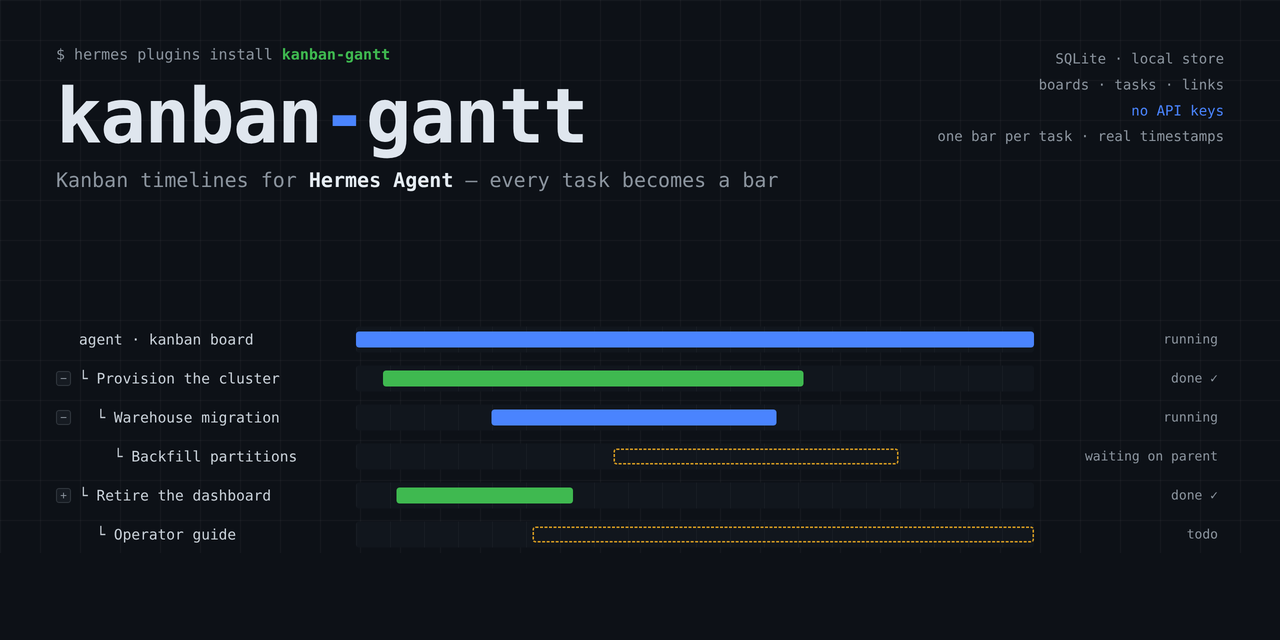
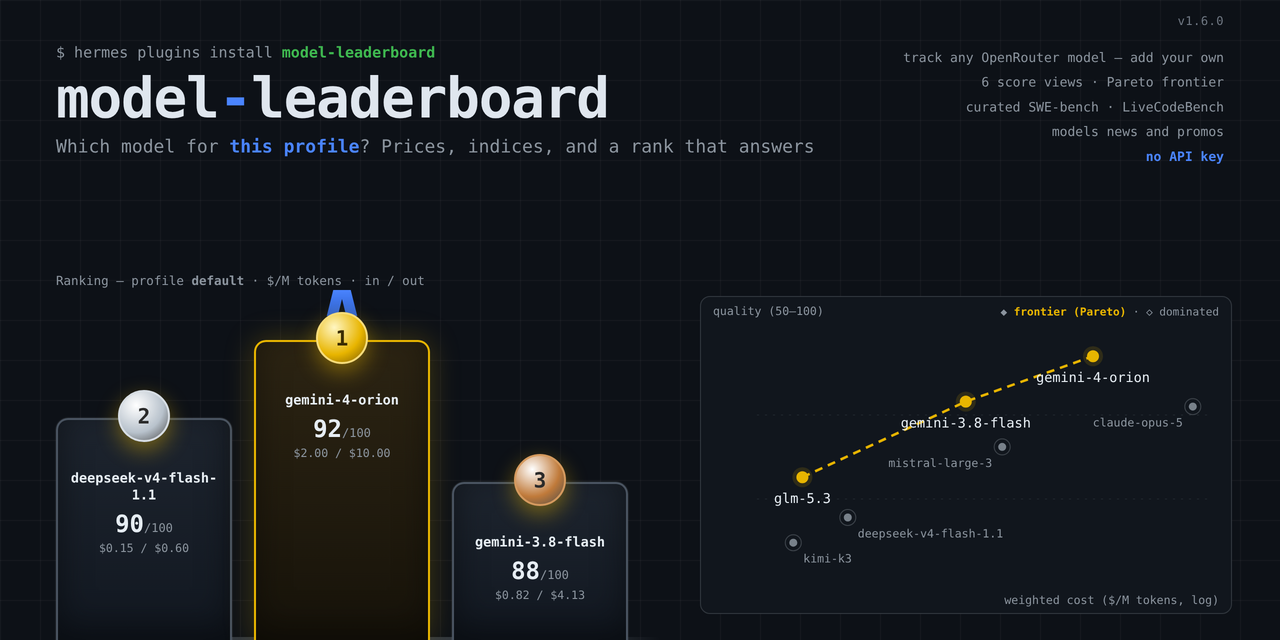
e-iskanban-ganttOne board, four views, and each answers a different question: List says what the work is, Timeline says when it happened, Graph says what hangs off what, and the Whiteboard lays the same cards out as a spatial plan you can arrange, frame and link by hand. The Graph view draws a card per task and an arrow per dependency, laid out top-down by longest path (or left to right, by status, or as a compact grid), with a transitive reduction that counts the arrows it implies instead of hiding them, links you draw, move and delete where they are drawn, and a click that lights the whole upstream and downstream lineage of a task. The Timeline renders any board as real work timestamps (created/started/review/done), with a collapsible tree column (boxed fold controls, tree connectors, per-board fold state, multi-parent links kept visible), live-activity arcs, filters, bulk actions, and a period selector from 6 hours to 7 days. The List view trades the bars for a dense table — task, assignee, status, last activity. Quick scopes (Running, Blocked, Open, All) narrow the board in all three views alike, and a lineage switch widens any of them to what leads to the selection and what follows it. Tasks are created from the page (project, workspace, skills, model override, goal mode), re-parented by drag & drop or from the drawer, and moved between boards with their children; any task with files carries a paperclip, its files listed on demand — the board payload carries only a count — and previewed by type (markdown, plain text, image, PDF, HTML in a sandboxed frame) or downloaded. Zero API keys, zero model tokens; live updates follow the plugin's /events websocket, which a gateway turns off with KANBAN_GANTT_WS=0 (the page then polls every 60 s and shows a Refresh button). Since 1.10 the header keeps its reading controls on one row — scope chips, a segmented period selector that zooms the Timeline and filters the other views, and the search — while the camera is a single floating bar (−, zoom, +, Fit) shared by the Timeline, the Graph and the Whiteboard, with the Fit state lit in the accent colour and the Graph's footer counting the cards in scope. Disclosure — Desktop page plus dashboard routes that read and write the local kanban boards (create boards, optionally defaulting to a project's repo folder; create tasks with workspace path, skills, model override and goal mode; change a task's model, provider and reasoning-effort override; reclaim a running task, which releases its worker claim and resets its failure count; re-parent; move a task, with its children, to another board — the copy is verified there before the source rows and their links are deleted; edit status, assignee and description; bulk archive and delete; read task attachment files from the board's own attachments folder for preview and download; read a task's worker log from the kanban worker-log folder); live updates over a dashboard-authenticated /events websocket, off with KANBAN_GANTT_WS=0; no third-party network.CommunityDesktop app12e-ismodel-leaderboardModel leaderboard for Hermes Desktop: a full /model-leaderboard page that ranks any OpenRouter model for a chosen Hermes profile — context window, prices, Artificial Analysis indices and curated SWE-bench Verified / LiveCodeBench — with per-profile criteria, six score views (cards, table, score bars, histograms, heatmap, quality-vs-cost Pareto frontier), an OpenRouter news feed (new models, price changes, promos) and a documented REST surface under /api/plugins/model-leaderboard/. Disclosure — outbound HTTPS to OpenRouter's public model API (catalogue and pricing) on a 60 s poll and a forced refresh every 10 minutes while the page is visible, and to Hugging Face's public model API (safetensors metadata, for parameter counts) on demand and cached; reads the installed Hermes profiles' own config.yaml files once, to seed the tracked list from the models those profiles declare; an index the catalogue does not publish for a variant is borrowed from its exact alias or from a published member of the same model family and shown as inherited (⤵), with no network call for that; keeps its state in <hermes home>/plugin-data/model-leaderboard/ (seeded from the JSON shipped with the plugin), which LLM_DASH_DATA / LLM_DASH_CACHE_TTL can move or tune; the optional "Auto-fill criteria" action runs on the host LLM facade (ctx.llm.complete_structured), so it spends the user's configured model tokens; prices the models at the context size each profile declares (the profile's Hermes compaction settings, or a fixed 32k-1M volume) using OpenRouter's published context-price tiers; the news feed's promotions are curated examples, labelled as such, not live OpenRouter offers; ships one read-only skill (model-leaderboard:refresh-benchmarks) whose only write is a POST to its own /benchmarks route; ships an optional harvester (scripts/harvest_aa.py) that the plugin never runs (a user or a cron does) to fill the intelligence index from Artificial Analysis, either through their free data API with the user's own ARTIFICIAL_ANALYSIS_API_KEY or, without a key, by reading their public leaderboard page once, writing the result only into the plugin's own benchmarks.json; the plugin itself makes no Artificial Analysis request, writes nothing outside its data directory, and only checks through Hermes whether the optional ARTIFICIAL_ANALYSIS_API_KEY is set, never storing, echoing or logging it.Communitymodels9