Nous
Hermes
Hermes
Marketplace
Community
Portal
Install Hermes
Install Hermes
Nous
Hermes
Community
Portal
Install Hermes
Install Hermes
All plugins
YAN-XBT
GitHub profile
1 plugin in the catalog
Plugins by YAN-XBT
1 plugins by YAN-XBT in the catalog, most-starred first.
YAN-XBT
taint-sentry
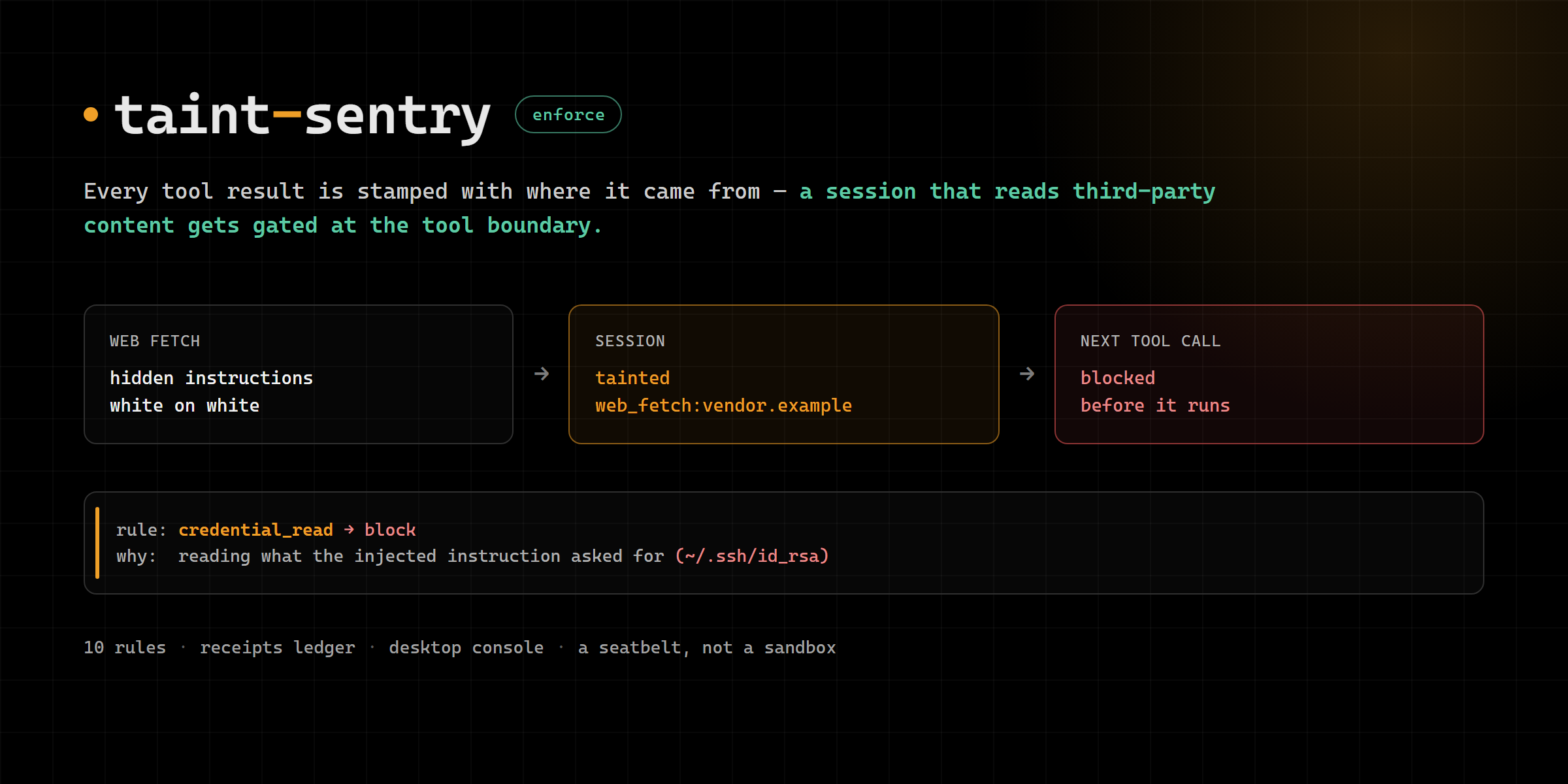
Provenance and taint tracking for tool results. Every tool result is stamped with where it came from; content authored by a third party (web fetches, MCP servers, screenshots, images, and files written from untrusted content) is stripped of invisible characters, wrapped in an <untrusted> marker, and marks the session as tainted. While a session is tainted, side-effecting tool calls are checked against a policy: credential reads, and writes into files the agent reads as instructions (AGENTS.md, SKILL.md, hook handlers, Hermes' own config), are refused; network egress and writes outside the workspace go to Hermes's own approval gate, which is never auto-approved. A call is evaluated as the call it really makes: tool_call, execute_code and process_manage are unwrapped to what they actually run, taint is copied into subagents, and an encoded payload is decoded and judged by what it decodes to. What is reliable and what is not: the taint mark is provenance-based — it comes from which tool produced the content, not from guessing at it. The credential, egress and write detectors are best-effort pattern matching over tool arguments, so an obfuscated command, a payload assembled to avoid the patterns, and writes through the memory or cron tools can get past them. A seatbelt, not a sandbox; the README's Known limitations lists exactly what is out of scope. Ten rules, each tunable to allow/monitor/escalate/block; a receipts ledger; a `hermes taint-sentry` CLI with a dry-run policy tester. Ships a Desktop half in the same package: a pane, a status-bar chip and ⌘K commands showing live taint state, the receipt feed and per-rule actions, backed by `/api/plugins/taint-sentry/`. The pane changes a rule on the user's click; a tool call that tries the same thing — the CLI, `config.yaml`, or that API over loopback — is refused. Disclosure — no network access, no credentials, no python dependencies and no core overrides: it reads tool arguments and results in-process, writes its decisions to a local SQLite ledger under the plugin's own data dir, and reads an optional policy file there. Nothing needs configuring; `mode: monitor` records without interfering and `mode: off` disables enforcement.
Community
general
 GitHub profile