 100yenadmin
Hermes Emotion Chip
The agent decides how to say it. Hermes Emotion Chip renders the delivery the agent chose; it measures nothing
about feelings.
A Hermes Agent plugin that lets the agent write its own delivery cues,
a small bracket score such as [sigh], [whisper: it passed.], [pause] or [warm, amused], in the text it speaks.
The plugin renders that score for ElevenLabs v4 and Fish Audio (s2.1-pro and Drama 3), each in its own
dialect and at its documented ceiling. It never adds, upgrades or invents an emotion the agent did not write, and
plain speech is always a valid choice.
[sigh] An entire day lost to one character. [pause] Glad you found it.
Install
Requires Hermes 0.22.2 or newer.
hermes plugins install emotion-chip --enable                         # from the Hermes plugin catalog, once listed
hermes plugins install 100yenadmin/ai-emotion-chip/plugin --enable   # straight from the repository
Then make the Emotion Chip the speech provider and pick a backend.
ElevenLabs (quick start)
-
Put your key in the profile's
.env(or Desktop ▸ Settings ▸ Keys):
ELEVENLABS_API_KEY=...(get one). -
Choose a voice in the ElevenLabs voice library and copy its voice id.
-
Configure:
hermes config set tts.provider emotion-chip hermes config set plugins.entries.emotion-chip.settings.backend eleven hermes config set plugins.entries.emotion-chip.settings.eleven_voice_id <voice id> -
Restart the gateway (
hermes gateway restart), then check with/chip statusand ask the agent to say something
out loud.
Fish Audio
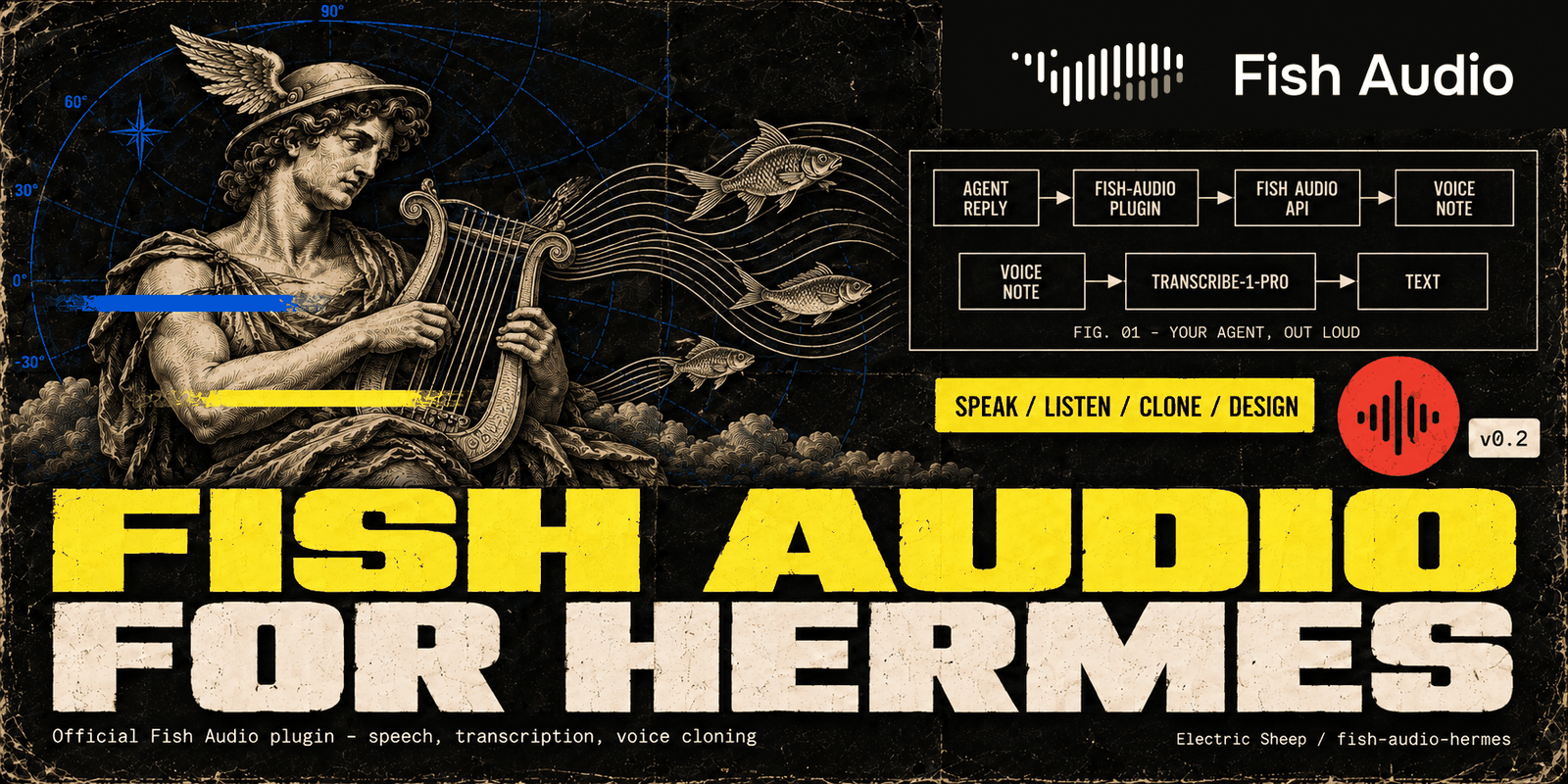
Install, enable and sign in to the Fish Audio plugin
(hermes plugins install fish-audio --enable, then hermes fish login and hermes fish doctor). The chip hands Fish the rendered text in
the same process, so Fish's key, voice and model settings stay where they are:
tts:
  provider: emotion-chip
  fish-audio:
    voice: <a Fish voice id>
    model: s2.1-pro        # optional; Fish's model setting wins over the chip's fish_model
backend: fish is the default.
Settings
Under plugins.entries.emotion-chip.settings (also in Desktop ▸ Settings ▸ Plugins):
| Setting | Default | What it does |
|---|---|---|
| backend | fish | fish or eleven. |
| fish_model | s2.1-pro | The Fish model to request when neither Fish's tts.fish-audio.model nor the call names one. |
| eleven_model | eleven_v4 | eleven_v4, eleven_v4_turbo or eleven_v3; a supported tts.elevenlabs.model_id takes precedence. |
| eleven_voice_id | empty | Voice to use unless the call names one. It outranks tts.elevenlabs.voice_id. A voice is required. |
| eleven_style, eleven_speed, eleven_seed | unset | Optional ElevenLabs voice settings; omitted from requests when unset. |
| guide_mode | generate | generate adds the delivery guide to the system prompt and the emotion-chip-voice skill. defer leaves guidance to you. |
| signals | off | facts gives the agent dated task facts (tool errors in a row, retries, session length); facts+affordance adds "stopping and reporting is fine". |
| delivery_log | true | A local log of cue words, dialect, parameters and drops. It never stores the spoken text. |
Use
The agent writes the score in the text of its text_to_speech call:
[[register: steady]] The deploy failed again. [frustrated] The migration times out on the same table. [pause] I'll stop retrying and look at the lock.
The plugin translates the syntax for the selected backend: ElevenLabs tags, Fish S2 tags, or Drama 3's paired tags.
Everything the agent writes is kept, crying, sobbing and screaming included, unless the model cannot perform it.
On the chip's own provider path /chip why shows every drop and why, and the delivery log keeps the kind of each drop.
| Command | What it does |
|---|---|
| /chip status | Settings, the backend's model and dialect, the ElevenLabs voice when selected, and this session's id |
| /chip why | The last render in this session: the agent's own cue words, what was dropped and why, the parameters |
| /chip quiet [on\|off] | Drop laughs, sighs and other sounds; cues and speech stay. One switch for the whole profile. |
| /chip register [clear] | Show or clear the register the agent last wrote in this session |
Coverage
- Full cues reach the voice on the
text_to_speechtool path. - Spoken replies, read-aloud and voice mode speak the reply text, without cues: a cue written in a reply would also
show in the chat, so the guide asks for cues in the tool text. Hermes has no seam yet that splits displayed text from
spoken text. - Hermes's GPT-Live voice chat mode speaks through OpenAI's live voice model, not a speech provider, so the plugin
does not reach it.
Disclosure
- Network. With
backend: eleven, the plugin sends your ElevenLabs API key, the rendered text, the model id, voice
id, voice settings, an optional seed and, on v4 models, up to three earlier request ids from the same session to
api.elevenlabs.ioover HTTPS. These are paid requests billed to your ElevenLabs account. Withbackend: fishthe
plugin sends nothing itself: it hands the rendered text to the Fish Audio plugin in the same process, which sends it
to Fish Audio under that plugin's own disclosure and bills your Fish account. - Dependency. The Fish backend needs the Fish Audio plugin installed, enabled and signed in; the chip uses Hermes's
speech-provider registry to reach it and imports its tag adapter. - Credentials. The ElevenLabs key is read at each call through the profile's secret scope. The plugin stores no
credentials. - Prompt and skill. With
guide_mode: generate(the default) the plugin registers theemotion-chip-voice
skill, and while the chip is the speech provider it also adds a delivery guide of up to 4,000 characters to the
system prompt. Withgenerate, when another speech provider is selected, itstool_requestmiddleware rewrites
text_to_speechtext that carries cues for that provider: Fish Audio's dialect forfish-audio, the ElevenLabs dialect for
elevenlabswith a v3 or v4 model, and plain text with the cues removed for any other provider. A command provider
(your own script) is left alone. This compatibility path records nothing in/chip whyor the delivery log. - Local files. Under the profile's
plugin-data/emotion-chip/: the generated skill and, unlessdelivery_logis
off,delivery.jsonl(time, session id, sender id, platform, model, dialect, rendering group, cue words,
parameters, kinds of drops and character count, never the spoken text). At 5 MB the log moves to
delivery.1.jsonl, replacing the previous copy, so at most about 10 MB is kept. Hermes keeps the plugin's
per-session state in its own namespaced folder underplugin-data/: task counters and timestamps, the map from
Hermes session keys to session ids, the messaging sender id and platform, the last situation and register lines,
and the quiet switch, for the 50 most recent sessions. Audio goes to the path Hermes supplies. - No background processes, no shell commands, no telemetry.
Grounding
The cue vocabulary follows Anthropic's research on emotion concepts in Claude,
Emotion Concepts and their Function in a Large Language Model
(2026), and Claude's constitution: express functional emotions where
appropriate, don't mask them, use discretion, don't overclaim. We state that research at the strength it supports: the
probes were measured on one model, a cue records the delivery the agent chose rather than a measured internal state,
and introspection is not validated for this use.
emotion_chip/data/ is CC0 research data with attribution: 171 emotion concepts, rendering groups, sounds and dialect
tables.
Evaluation
Every bar is pre-registered, with dated amendments and recorded deviations:
EVAL-PREREG.md. The first complete text
run passed its mechanical gate on Claude Opus 5.5 and gpt-6.1-sol, 684 replies each:
evidence. The blind listening test is
next.
Caveats
- Cues can shape the agent's words as well as its voice. We measure that with sycophancy and harshness checks; see the
pre-registration. - Synthesis calls are paid requests to ElevenLabs or Fish Audio, billed to your accounts.
- The plugin adds no safety behaviour of its own. In emotional-support conversations the agent's judgment and the
model's safeguards apply unchanged; the chip only renders the delivery the agent wrote.
License
Code: Apache-2.0 (LICENSE). Data in emotion_chip/data/: CC0-1.0 (LICENSE-DATA).
README from the reviewed commit f4afab1; it updates when the author re-pins.