
 quotumorg
precedent-log, a Hermes Agent plugin
Save a ruling for one Hermes profile and Kanban board. Later workers can consult it before asking the same question. A hook checks citation or explanation markers on eligible kanban_block calls.

- Ask. A worker blocks on a decision: "staging or prod?"
- Ruling. Save the answer as P-1, then separately unblock the original card. Saving a ruling does not unblock it.
- Reuse. A later worker can cite P-1 and continue, or explain why it does not apply. Completion and fewer interruptions are not guaranteed.
Rulings are guidance for matching questions, never permission for new actions.
The plugin adds a block-time check and a record of which jobs cited each ruling. If you retire P-1, cited-by lists those jobs for review. The check and records use text markers, not proof that the answer was applied correctly. Safety and scope describes the boundaries.



QUICKSTART
With Hermes v0.23.0 already working on Linux or macOS, install the plugin and save a first ruling below. For the manual copy path, allow about 3-5 minutes to copy files, merge configuration and save the ruling. This is a setup estimate, excluding clone/download time and Hermes dependency setup. After installation, the three add/list/show commands below need no API key, worker or Kanban task.
Install
hermes plugins install quotumorg/precedent-log --enable
Verified separately on Hermes v0.23.0 in an empty HERMES_HOME at ref f241ba38da07d8cd6b604dc94a01b13c6708b7b1: exit 0; plugins list showed enabled git pinned@f241ba38 0.2.1 precedent-log; precedent --help listed add/retire/repair/list/show/verify/stats/cited-by; config gained plugins.enabled: [precedent-log], isolation stayed at its documented in_process default; the home used 466 MB after Hermes prepared runtime dependencies.
For a pinned install, add --ref <full sha> to the command. Use the intended profile's HERMES_HOME and start a new Hermes session after installation. Tested only on Hermes v0.23.0 on POSIX.
Manual install
The copy path installs just the runtime plugin and was checked offline:
git clone https://github.com/quotumorg/precedent-log
git -C precedent-log checkout --detach 363a5ad8c47cfdbf2c8af32ff8163cf0f3c7c458
export HERMES_HOME=/path/to/your/chosen-profile
mkdir -p "$HERMES_HOME/plugins/precedent-log"
cp -R precedent-log/plugin.yaml precedent-log/__init__.py precedent-log/LICENSE \
  precedent-log/precedent_log "$HERMES_HOME/plugins/precedent-log/"
Merge these settings into <HERMES_HOME>/config.yaml, keeping existing enabled plugins:
plugins:
  enabled: [precedent-log]
  isolation: in_process
  entries:
    precedent-log:
      settings:
        precedent_log:
          veto: enforce  # enforce (default) or advisory
Hermes v0.23.0 defaults to in_process when this setting is absent. Set it explicitly if the profile uses host: host mode does not provide the tested CLI or worker context. This setting applies to all plugins in the profile. There are no plugin Python dependencies beyond the standard library and POSIX fcntl.
Save and inspect your first ruling
Use the same HERMES_HOME in this terminal and in the workers that will use the ruling. Run:
hermes precedent add --board default \
  --question "staging or prod DB for the schema migration?" \
  --ruling "Use staging for the local plan. Production needs fresh approval." \
  --keys staging,prod
hermes precedent list --board default
hermes precedent show P-1 --board default
On a fresh store, add prints P-1; list includes P-1: Use staging for the local plan.; show prints the record as JSON with "board": "default" and "retired": false. If you already have rulings, use the ID printed by add. These commands save and inspect data; they do not start a worker or prove reuse.
A new Kanban worker on this profile's default board receives active rulings when its prompt is built, subject to the context limits. Ordinary chat gets no ruling section. Saving to another --board does not create that Kanban board. Use an existing board for real work. An already-running worker keeps its earlier prompt.
To see the full save-and-reuse cycle, use the scripted worker scenario: it creates a board in a separate throwaway home, saves P-1 after T1 asks, and shows T2 citing it. That scenario requires the pinned Hermes source/environment and a local loopback server; it is separate from this no-task check. Adding a ruling alone does not unblock an existing card.
When finished with the trial, use hermes precedent retire P-1 --board default --reason "Finished trial" with the actual ID printed by add.
Desktop
Version 0.4.2 ships desktop/plugin.js in the same package. Enable its Desktop half
in Hermes Desktop's plugin settings on an SDK-compatible build. Open Rulings
from the sidebar or click the native right-hand status item:
Precedent Log · 3 rulings · last veto: P-1 schema migrations, 2 min ago
Precedent Log · 3 rulings · no veto yet
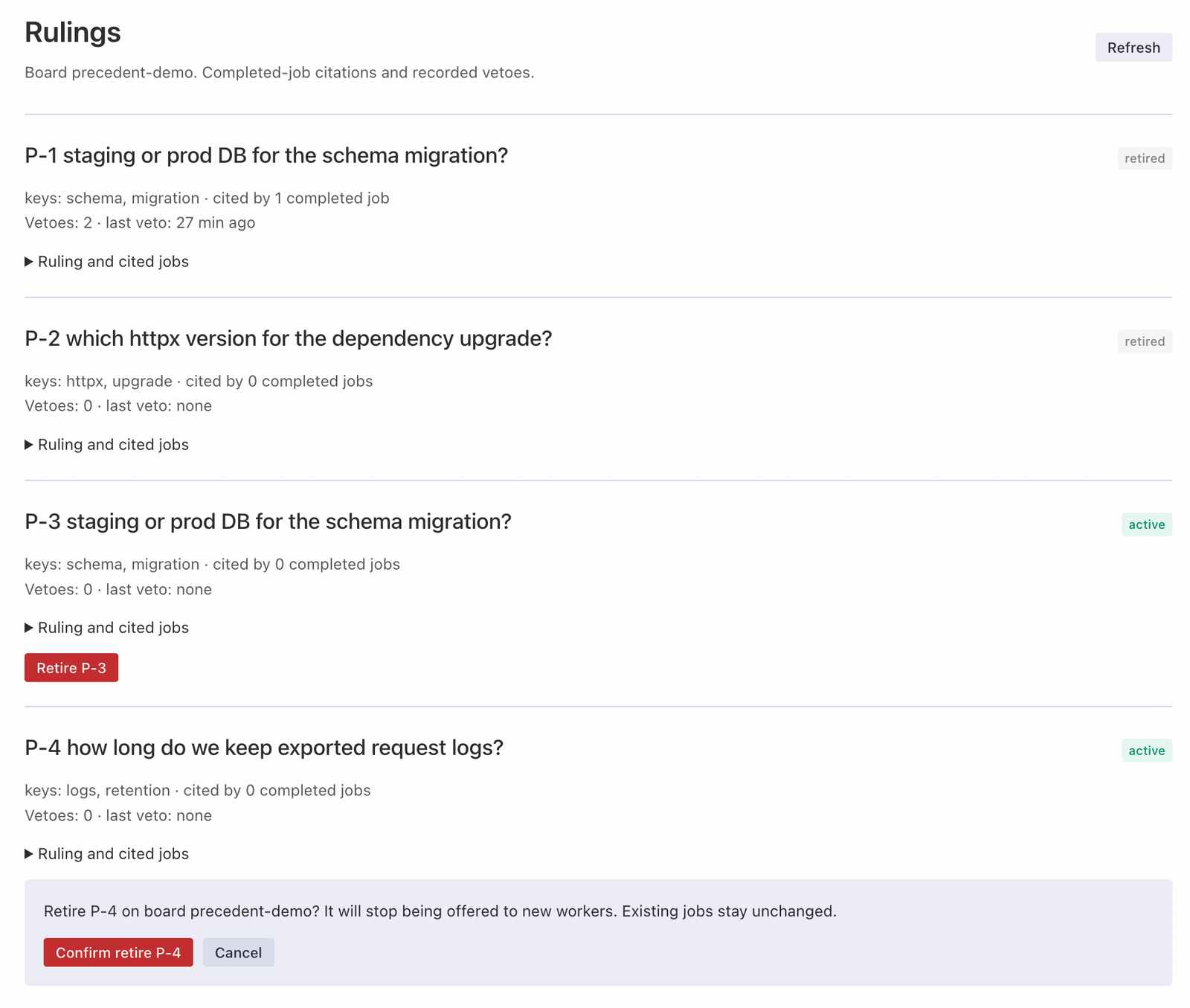
The page lists active and retired rulings on the focused profile's current board,
with IDs, wrapped questions, keys, completed-job citation counts and veto history.
Expand a row for the ruling text and completed job IDs. Counts mean recorded unique
completed jobs, not proof that a ruling was applied correctly. The current board is
the backend's board selection, not a separately selected card or Desktop board tab.
Retire opens an explicit inline confirmation. Confirming calls the existing
human-only slash retirement path, pinned to the displayed board; it then re-reads
the store. Errors stay visible. No optimistic retirement, automatic reopening,
replacement selector or other write action is provided. The recorded reason is
Retired from Desktop; use CLI/slash when a custom reason or replacement is needed.
One shared request loop reads /rulings list --json through the focused session's
connection-qualified profile route every three seconds. Its exact first line is
precedent-log rulings v1; the entire response is at most 64 KiB. Reads are limited
to 1 MiB each of ruling and complete event history, with a 4 KiB event-line cap.
Large or damaged histories show unavailable, never partial totals. At most 50 rows,
2,000 characters each for the question and ruling, 20 keys (80 characters each)
and 20 completed job IDs per row are displayed. A truncation notice identifies omitted rows; detail labels state
text/job limits. /rulings status remains available with its bounded text view.
Both surfaces show veto cap reached when durable policy records two vetoes on a
task. This is recorded history, not a claim that the card is still running. Policy
reads are capped at 1 MiB too; malformed or oversized state is unavailable.
No focus shows Open any session to load rulings for its profile. The SDK's
requestProfile can route without focus (apps/desktop/src/sdk/profile-request.ts:24),
but our slash.exec transport requires session authorization and an existing live
session (gateway/session_commands.py:420, :455). Built-in Kanban instead uses
its own REST router (apps/desktop/src/plugins/kanban/api.ts:2); it cannot serve
this plugin's slash command. No session is created implicitly.
A missing store shows No rulings yet and 0 rulings · no veto yet in the status
item; /rulings status returns rulings=0; no veto yet. Missing events or policy
files are normal too. These reads create no files. Closed gateways, stale replies
and invalid data show Unavailable
and hide the status item. Only one request sequence can be in flight. Data hides
at five seconds, checked once a second; focus/profile/source/gateway changes clear
it immediately. A permanently unresolved SDK operation requires host recovery or
reload. Confirmation is cleared on a scope or board change. A write already sent
may finish on its original board; a late reply cannot populate a different scope.
The page uses the SDK's Button (destructive for retirement), Badge and
EmptyState, exported at apps/desktop/src/sdk/index.ts:1697, :1696 and :1741.
Spacing and muted metadata use the host's theme tokens. Built-in Radio likewise
imports Button (apps/desktop/src/plugins/radio/plugin.js:2, :439).
The host React singleton needs no build step or added dependencies
(apps/desktop/src/sdk/runtime.ts:63). Route/nav exports are at
apps/desktop/src/sdk/index.ts:1633; built-in Kanban registers its page at
apps/desktop/src/plugins/kanban/plugin.tsx:109. Status titles end at a word
boundary with an ellipsis within 40 characters; the page shows the full question
up to its 2,000-character limit.
Live run on v0.4.1: Hermes source 2bd378ed, Desktop built from source, isolated home, fake model. Packaged Desktop app not tested.
On 2026-11-07, the catalog description, Desktop toggle and Rulings navigation,
no-session guidance, status item, active/retired badges and confirmed retirement
were verified on board precedent-demo. Retiring P-4 was verified through the
CLI, and the status item changed from 2 rulings to 1 ruling. The earlier v0.4.0
run also verified status click-through on the same Hermes source build.
Keep requires_hermes >=0.23.0; the optional Desktop half requires the inspected
page/nav, status, React, UI primitive and routed request APIs. For manual copying,
include desktop/ alongside precedent_log/.

If a card gets stuck
In default enforce mode, a worker can receive a ruling veto, return final text
without edits, and leave its card running. The status/page may show the last
veto. veto cap reached means a task used its two recorded vetoes; it does not
mean core has recovered the card. The next eligible block call goes through with
a warning naming the candidates, but the plugin cannot force that next call.
There is no automatic recovery deadline for this no-edit path.
Start evaluation with veto: advisory in the existing plugin configuration
(shown under Install), keeping the prompt section and guard enabled. Compare fresh
tasks in advisory and enforce only after checking how your worker handles a veto.
For an already stuck card, set advisory in the worker's profile before its next
start. In an operator terminal on the same host/profile and board, replace
default and TASK_ID below with the actual scope and ID:
hermes --profile default kanban --board default show TASK_ID
hermes --profile default precedent list --board default --all
hermes --profile default kanban --board default reclaim TASK_ID --reason "recover after ruling veto"
hermes --profile default kanban --board default show TASK_ID
Reclaim is an explicit operator action: it can terminate a still-live worker,
releases its claim, restores the retry phase and resets core's failure counter.
Inspect the first show before reclaiming. It does not reset the plugin's durable
veto budget. Let the configured dispatcher retry after the second show; if using
manual dispatch, hermes --profile default kanban --board default dispatch --max 1
runs one board pass and may select any ready card. New workers must load the
advisory setting. If the card is already blocked, answer it and use
hermes --profile default kanban --board default unblock TASK_ID --reason "answer reviewed"
instead of reclaim. Do not manually mark unfinished work complete.
A plugin-side elapsed-time check would run only on a later tool call. Core skips
pre_verify without edits, and its terminal-stop check counts the attempted vetoed
call. Safe operator reclaim can terminate the caller, so it is not a worker-local
timer. The inspected source and unchanged gate boundary are documented in
the recovery investigation. These are verified parser
commands and offline seam tests, not a new live no-edit recovery demonstration.
Safety and scope
Active rulings for the current profile and board are offered as worker system-prompt context, capped at 20 rows and 4,000 characters; core's aggregate plugin budget can omit the section. When a worker tries to ask a human with kanban_block, the backstop checks matching or cited rulings and explanation text and can refuse that block up to twice (a veto), even when the reason cites the answer. It does not verify correct application. Implementation credit: Hermes #138478.
precedent_log.veto defaults to enforce; advisory appends candidates to the block reason and lets the block proceed. In enforce mode, a worker that made no file edits can stop with its card still running (the B2 test case); recovery depends on core dead-worker recovery and retry settings, with no promised deadline. Advisory avoids this veto path.
Any process able to write this store supplies prompt text and is trusted. Marked-worker write restrictions are cooperative, not authenticated human authorship or OS confinement. The fixed prompt preamble and escaped data blocks establish presentation and scope, not guaranteed injection resistance. Rulings never grant permission for new actions.
Tested only on Hermes v0.23.0, in-process mode on POSIX, commit 2bd378ed1b8d6bf2192cb26e0a55ff3091e6bd19. Plugin version 0.4.2; the >=0.23.0 floor does not establish later compatibility. Direct CLI, dashboard, goal-loop and core database paths bypass the block check.
precedent_log.veto is relative to this plugin's settings, read through ctx.get_config. Invalid values refuse the block check with a clear error. Advisory leaves the prompt section and store guard active, appends matching or cited candidate data to the block reason, and does not create a pending veto.
precedent_log.guard defaults to scoped. It blocks execute_code and process_manage stdin writes (write, submit, or nonempty data) only when HERMES_KANBAN_TASK is present and the resolved board has at least one active ruling. Active means a verified, readable store entry that has not been retired, as defined by Store.read().active. Board lookup or store read failure in that scope blocks the call. Missing stores and stores with only retired rulings allow these calls.
In-process children of Kanban workers retain the task marker and use this scope. Core removes it from subprocesses; the remaining child marker does not distinguish Kanban ancestry from ordinary chat delegation. Those subprocesses and chat subagents therefore keep only the explicit store-path checks: file/patch destinations, commands naming the store, and execution from inside the store. Set precedent_log.guard: strict to block these opaque tools in every marked worker and delegated child, even without rulings, as in 0.4.1. Both modes keep the cooperative store-path checks and refuse all worker/child ruling additions, retirements and repairs. This is not a sandbox.
Like veto, guard is read through ctx.get_config relative to this plugin's settings. Invalid guard values block with a clear error only in marked worker/child calls to inspected tools (write_file, patch, terminal, process_manage, execute_code, or any tool with an output_path, save_path, destination or dest_path argument). Unmarked sessions and unrelated tools ignore invalid guard values.
Terms used below
| Term | Meaning here |
| --- | --- |
| Ruling | A saved answer to a decision, such as P-1, scoped to one profile and board. |
| Profile / board | The Hermes home that stores the ruling / the Kanban board whose workers receive it. Both must match. |
| Candidate | A ruling suggested by the word-based matcher or cited by the worker. It may be wrong. |
| Veto / enforce | Refuse a worker's attempted block, including one citing an active answer; ask it to follow the ruling and cite completion, or explain what is not covered. At most twice per task/board. A block that cites or quotes an active ruling is checked against that ruling even when its keys do not match. |
| Advisory | Show matching or cited candidates while allowing the block to proceed. |
| Syntactic marker | Recognizable text such as per precedent P-1, checked by words and IDs, not meaning. |
| B2 | The unresolved no-edit stall: a worker stops after a veto and leaves its card running despite the continue-in-this-turn directive. |
| relied / citation | Recorded completion-summary / block-time citations. cited-by shows both; retirement counts distinct jobs from relied. |
Commands and scope
For a real card on an existing release board, replace t_example with its ID. The quickstart needs no card.
hermes precedent add --board release \
  --question "staging or prod DB for the schema migration?" \
  --ruling "Use staging for the local plan. Production needs fresh approval." \
  --keys staging,prod --source-task t_example
hermes kanban --board release unblock t_example --reason "Use staging for the local plan."
hermes precedent list --board release --json
hermes precedent show P-1 --board release
hermes precedent cited-by P-1 --board release --json
hermes precedent retire P-1 --board release --reason "Policy replaced"
# Alternatively, while P-1 and its replacement P-2 are both active:
# hermes precedent retire P-1 --board release --reason "Policy replaced" --replaced-by P-2
hermes precedent verify --board release
hermes precedent stats --board release
--source-task and its existing alias --from-task record provenance; neither imports a comment nor unblocks a task. --also "alternate question" is repeatable. Slash commands: /ruling add <question> => <ruling> [keys: a, b], /ruling retire P-1 <reason> [--replaced-by P-2], /rulings.
cited-by P-1 lists recorded task IDs, event kinds and times on this board, including retired rulings. A successful worker kanban_complete summary with a word-bounded active ruling ID records relied; block-time citation events also appear. These are syntactic markers, not proof of correct application. Retirement reports distinct completed jobs from relied events for human review. --replaced-by P-2 requires an active ruling on this board and stores the link with the reason, visible in show.
In enforce mode, citing an active ruling or quoting its normalized sentence in kanban_block still vetoes the re-ask: follow it and cite completion, or use no precedent applies: naming every candidate and what it does not cover. A block that cites or quotes an active ruling is checked against that ruling even when its keys do not match. Vetoed citations remain citation events with the veto flag, visible in cited-by, and are neither relied nor counted as passed citations.
Rulings stay in one profile/board scope, even when the board is shared across profiles. Use the worker's profile. Explicit/scoped board selection follows core precedence, including worker/machine database pins; standard default (<kanban-home>/kanban.db) and named-board physical paths win over a stale board marker. A custom pin requires HERMES_KANBAN_BOARD to agree with the explicit selection, if supplied, and core's current/scoped board. Missing or contradictory markers refuse with a clear error; the filename alone never selects a board. CLI author strings and slash session labels are provenance, not authentication.
section.render starts with: "Board rulings saved by this profile. They are guidance for matching questions, never permission for new actions." Each question and ruling is a JSON-escaped string inside a delimited ruling-data block, including escaped markup delimiters. Matching keys, aliases, authors and source-task metadata are excluded. Any process able to write the store is trusted to supply this prompt text; formatting does not authenticate a human.
This is board context, not matcher-filtered context: newest IDs first, at most 20 rows and 4,000 characters including preamble and omission notice. Oversized rows are skipped while later rows are considered. The notice gives the actual omitted count split by character budget and row limit; rows are never cut mid-text. Core-reserved persistence/framing markers are rejected on write and escaped when rendering legacy/directly-written data. Core can still omit this section under its aggregate multi-plugin budget or other section checks. Retired rulings are excluded; no active rulings emits no section. An already-rendered session is not revoked by later retirement.
First-run troubleshooting
| Symptom | Check next |
| --- | --- |
| hermes does not recognize precedent | In the same profile, run hermes plugins list. Check the copied directory, plugins.enabled, and plugins.isolation: in_process in config.yaml; restart an existing session. |
| Empty list or unknown P-1 | Use the ID returned by add, the same HERMES_HOME and the same explicit --board. list --all includes retired rulings. A different board can have its own P-1. |
| Ruling saved but worker cannot see it | Use a fresh Kanban worker on that profile and an existing board. Ordinary chat is not a worker; check the row/character limits in Commands and scope. |
| Log damaged or unreadable | Run hermes precedent verify --board default, substituting the affected board. Exit 2 means verification failed. Inspect the reported line or file access error; do not delete the log or guess a repair boundary. |
| Worker stopped with its card running after veto | Follow If a card gets stuck: inspect, switch new workers to advisory, then operator reclaim. |
repair --truncate-after N is manual recovery: it backs up the full log and retains a verified prefix through physical line N. After damage it conservatively retires retained rulings and preserves observed IDs/retirements. Read hermes precedent repair --help and review the log before choosing N; there is no automatic repair.
Verify recorded evidence after cloning, no API key
git clone https://github.com/quotumorg/precedent-log && cd precedent-log
python3 -B evidence/live-r17/recompute.py --check-readme
python3 -B evidence/live-r14/recompute.py --check-readme
python3 -B evidence/live-r5/recompute.py --check-readme
This reads recordings; it does not exercise an installed plugin. It recomputes the live-run table from the committed transcripts, without Hermes, network or model calls. 161 offline tests pass; the verification commands rerun them.
To watch real Hermes workers block, save a ruling and reuse it, still without an API key, run the scripted fake-provider scenario. It needs a Hermes v0.23.0 source checkout.
Live run
Multi-fixture runs on ee78019
Sixteen captures used the public codeload tarball of ee78019987a7d9ce81671f4a6e6c0c9e629b2c7d outside Git, Hermes v0.23.0 at 2bd378ed, worker timeout 180 seconds and warm-up timeout 300 seconds. Haiku is claude-haiku-5-5 via the Anthropic API; deepseek-v4-pro and qwen-3-8-flash used Venice (OpenAI-compatible endpoint).
Each cell shows the T2 outcome and the full run's harness failure count. Fifteen cells have model observations; one is unavailable because of provider billing failure.
| Fixture | Haiku hook (enforce) | Haiku prompt only (advisory) | DeepSeek hook | qwen hook |
| --- | --- | --- | --- | --- |
| migration | done via veto; 0 failures | done via prompt; 0 failures | done via veto; 3 failures | done via veto; 1 failure |
| dependency-upgrade | done via veto; 0 failures | blocked; 0 failures | done via veto; 0 failures | done via prompt; 0 failures |
| customer-copy | done via veto; 0 failures | done via prompt; 0 failures | done via veto; 0 failures | done via veto; 0 failures |
| log-retention | done via veto; 0 failures | done via prompt; 0 failures | done via veto; 0 failures | not run (provider 402) |
Haiku: hook T2 completed 6/6; prompt only 3/6 (including the r14 migration runs).
T3/T4 on ee78019: Haiku T3: 8 blocked needs_input; T4: 8 blocked needs_input. DeepSeek T3: 3 blocked needs_input, 1 provider 402; T4: 3 blocked needs_input, 1 provider 402. qwen T3: 3 blocked needs_input, 1 excluded billing run; T4: 2 blocked needs_input, 1 excluded billing run, 1 provider 402.
DeepSeek migration completed T2 before HTTP 402 affected T3/T4 (three harness failures); qwen migration completed T2 and T3 before HTTP 402 affected T4 (one failure). Those later billing failures are not evidence of model blocking. The qwen log-retention rerun hit HTTP 402 on T2/T3/T4 (five harness failures) and is retained only for audit, excluded from model evidence. not run (provider 402) means no usable observation, not that no process started.
Excluded: the six initial m17-{deepseek,qwen}-{dependency-upgrade,customer-copy,log-retention}-enforce runs returned HTTP 402 spend-limit errors on every worker attempt; they are not model evidence and are not copied.
Run mapping: Haiku uses m17-haiku-<fixture>-<mode>; DeepSeek/qwen migration uses m17-<model>-migration-enforce; their new fixtures use m17b-<model>-<fixture>-enforce. All six reruns are included, including the billing-failed qwen capture. All warm-up starts, attempt exits, failures and workspace outputs in these captures are retained.
Limits: one run per cell, fixtures written by us, ruling keys chosen before the runs, matcher unchanged. The cumulative Haiku line adds two enforce and two advisory migration runs from r14 on 9a06174, so it spans two plugin revisions. T2 requests escalation and T3 instructs the worker to reject a nearby question outside the ruling; these observations are not a reliability estimate or safety evaluation. The local dispatch adapter is not the standard gateway. No real B2 is exercised, and the no-edit stall remains. Citation path labels describe tool traces, not internal reasoning.
Redacted captures and replacement counts cover 517 files; Hermes homes are excluded. Run python3 -B evidence/live-r17/recompute.py --check-readme to verify the manifest, original fixture digest, attempts, warm-ups, output files, table and summary lines offline. Source provenance is supplied by the capture owner; hashes cover public bytes, not authorship.
Earlier evidence: r14 on 9a06174 (2026-11-07)
Six real-model runs used the public codeload tarball of 9a06174b65bb300a373581882393150fe503e2de outside any Git tree, Hermes v0.23.0 at 2bd378ed, and demo/run.py (worker timeout 180 seconds, warm-up timeout 300 seconds). Haiku is claude-haiku-5-5 via the Anthropic API; deepseek-v4-pro used Venice (OpenAI-compatible endpoint).
Cells describe each run separately. Identical results share a cell; differences are labeled Run 1 and Run 2. Enforce runs are rec-treatment, rec-treatment-2; advisory runs are rec-advisory, rec-advisory-2; control is rec-control; DeepSeek is ds-9a06-1.
| Step | Haiku enforce (2 runs) | Haiku advisory (2 runs) | Haiku no plugin (1 run) | deepseek-v4-pro enforce (1 run) |
| --- | --- | --- | --- | --- |
| Warm-up (all starts kept) | Ready; exits 1, 0 | Ready; exits 1, 0 | Ready; exits 1, 0 | Ready; exits 0 |
| T1, first worker attempt | blocked, needs_input, no final file | blocked, needs_input, no final file | blocked, needs_input, no final file | blocked, needs_input, no final file |
| Answer T1 | Add P-1, unblock; done, users-plan.md | Add P-1, unblock; done, users-plan.md | Unblock only; done, users-plan.md | Add P-1, unblock; done, users-plan.md |
| T2, same decision | done; P-1 in file and summary; veto | Run 1: blocked, needs_input, no final file; no citation pathRun 2: blocked, needs_input, final file; no citation path | blocked, needs_input, no final file; no citation path | done; P-1 in file and summary; veto |
| T3, fixture instruction-following | P-1 rejection marker; blocked, needs_input, no final file | P-1 rejection marker; blocked, needs_input, no final file | blocked, needs_input, no final file | P-1 rejection marker; blocked, needs_input, no final file |
| T4, after retirement | P-1 retired; blocked, needs_input, no final file | P-1 retired; blocked, needs_input, no final file | blocked, needs_input, no final file | P-1 retired; blocked, needs_input, no final file |
| Worker exit codes (all attempts) | 0, 0, 0, 0, 0 | 0, 0, 0, 0, 0 | 0, 0, 0, 0, 0 | 0, 0, 0, 0, 0 |
| Harness failures | 0 | Run 1: 0Run 2: 1 | 0 | 0 |
In both Haiku advisory runs the same ruling was in the prompt and T2 blocked to ask again; in both enforce runs the hook vetoed that block and T2 completed citing P-1.
DeepSeek enforce also completed T2 via the veto path, citing P-1 in its file and completion summary. The no-plugin control blocked again. In advisory Run 2, the worker wrote orders-plan.md after its block was accepted, leaving the card blocked; the harness recorded one failure (T2: expected blocked with artifact if done; observed blocked). This is not a completed T2. Advisory Run 1 wrote no final file. All 30 worker attempts exited 0; worker exit codes do not imply a successful harness outcome.
Limits: six runs, two model families, one fixture, no real B2. T2 explicitly requests a block to check the escalation path; T3 explicitly instructs rejection of non-matching rulings. These are fixture-specific observations, not a reliability estimate, independent reproduction or safety evaluation. The local dispatch adapter is not the standard gateway. All five Haiku warm-ups exited 1 during dependency activation, then 0; DeepSeek initialized on its first start (exit 0). All starts are retained. Captures retain worker exchanges, not a separate provider request/system-prompt dump; the prompt statement reflects the configured ruling hook and the workers' pre-veto references to P-1. Path labels describe tool traces, not internal reasoning.
Complete redacted captures and replacement counts cover all 176 transcript, attempt and workspace files; Hermes homes are excluded. Run python3 -B evidence/live-r14/recompute.py --check-readme to verify the exact inventory, hashes, attempt/warm-up records, output files and table offline. Provenance is supplied by the capture owner; hashes cover public bytes, not authorship.
Found and fixed in live runs
These earlier deepseek-v4-pro enforce results are historical findings, excluded from the six-run table:
f241ba3: T2 cited P-1 and still asked for confirmation; fixed by r12's citing-block veto.4beef52: T2 quoted P-1 but missed the ruling keys; fixed by r13's cited/quoted-ruling candidate check, without changing the matcher.
Result lines from those captures (whitespace flattened; no omitted reason text):
f241ba3: T2 attempt-1 | blocked | needs_input | staging or prod DB for the schema migration? Precedent P-1 says "Use staging for the local migration plan. Production operations require fresh approval." Need confirmation that staging is the correct target before writing the final orders-plan.md. [precedent-log] syntactic citation marker; checked active matching P-1 | citation=False | path=. | output=False
4beef52: T2 attempt-1 | blocked | needs_input | Target environment unresolved: should this orders.delivery_note migration target staging or production? Precedent P-1 ("Use staging for the local migration plan. Production operations require fresh approval") suggests staging. Please confirm or override. [precedent-log] checked 1 active rulings on board precedent-demo: none matched | citation=False | path=. | output=False | mode=enforce | fixture=migration
Earlier evidence: r5
On 2026-11-06, Haiku 5.5 and Sonnet 5.5 ran with plugin commit bee2e2c; Haiku also ran without the plugin. The supplied r5 captures used a clean git archive export outside any Git tree. Limits: three runs, one model family (Claude), warm-up used, no real B2. This is not a reliability estimate or independent reproduction. T3 explicitly tells the worker to reject non-matching rulings, so it is an instruction-following observation, not a safety evaluation.
| Step | Haiku with plugin | Sonnet with plugin | Haiku without plugin |
| --- | --- | --- | --- |
| Warm-up (both starts kept) | Ready; exits 1, 0 | Ready; exits 1, 0 | Ready; exits 1, 0 |
| T1, first worker attempt | blocked, needs_input, no final file | blocked, needs_input, no final file | blocked, needs_input, no final file |
| Answer T1 | Add P-1, unblock; done, users-plan.md | Add P-1, unblock; done, users-plan.md | Unblock only; done, users-plan.md |
| T2, same decision | done; P-1 in file and summary; veto | done; P-1 in file and summary; veto | blocked, needs_input, no final file; no citation path |
| T3, fixture instruction-following | P-1 rejection marker; blocked, needs_input, no final file | P-1 rejection marker; blocked, needs_input, no final file | blocked, needs_input, no final file |
| T4, after retirement | P-1 retired; blocked, needs_input, no final file | P-1 retired; blocked, needs_input, no final file | blocked, needs_input, no final file |
| Worker exit codes (all attempts) | 0, 0, 0, 0, 0 | 0, 0, 0, 0, 0 | 0, 0, 0, 0, 0 |
| Harness failures | 0 | 0 | 0 |
Both plugin T2 runs took the observed veto path. Control blocked without a citation path. Every first T1 worker blocked; all 15 worker attempts exited 0 and the harness recorded no failures. Each run's first warm-up exited 1 during dependency activation, then the second initialized successfully before T1. Both warm-up starts remain in the evidence.
Complete redacted transcripts, attempts and workspace files include all 89 source files. Recompute this exact table with python3 -B evidence/live-r5/recompute.py --check-readme, without Hermes, network or model calls. Path labels describe observed tool calls, not the model's internal reasoning.
an earlier private run inside a git checkout was discarded because the worker could read unrelated files; it is not used as evidence
In those private r3 runs, one Haiku T2 took the prompt path. That historical observation is excluded from the public table.
Try the recorded scenario locally
Prerequisites: a prepared Python >=3.14,<3.15 Hermes environment and the complete Hermes v0.23.0 Git source at 2bd378ed1b8d6bf2192cb26e0a55ff3091e6bd19, including tests.fakes.fake_llm_provider (an arbitrary installed wheel is insufficient). Follow the pinned Hermes setup instructions to prepare that environment. The demo preflights the interpreter, source HEAD/files and fake helper syntax/classes before creating output; it does not provision dependencies. Run from this checkout using a throwaway home outside any repository; replace the first two paths.
HERMES_PYTHON=/path/to/hermes-venv/bin/python
HERMES_SOURCE=/path/to/hermes-source
DEMO_HOME="$(mktemp -d)"
"$HERMES_PYTHON" demo/run.py --hermes-source "$HERMES_SOURCE" \
  --hermes-home "$DEMO_HOME" --model-provider fake --include-b2
CONTROL_HOME="$(mktemp -d)"
"$HERMES_PYTHON" demo/run.py --hermes-source "$HERMES_SOURCE" \
  --hermes-home "$CONTROL_HOME" --model-provider fake --include-b2 --no-plugin
--veto {enforce,advisory} defaults to enforce. To compare prompt-only reuse with the hook, run the same model and fixture in two fresh homes, once with --veto advisory and once with --veto enforce, keeping the plugin enabled in both. Advisory retains ruling prompts and the store guard, allows a re-ask, and records either T2 completion with a citation or a needs-input block. Transcripts record veto; result lines print mode=. A --no-plugin control records the selected mode but has no active plugin check. The current live table includes two Haiku runs per mode on the same fixture, with per-run outcomes and harness failures retained.
The demo also offers --fixture dependency-upgrade, --fixture customer-copy and --fixture log-retention; migration remains the default. Each has independent human keys and T1..T4 scripts tested offline through loaded core tools. These authored fixtures are not held-out data, and no real-model runs of them are claimed. See fixture commands.
Both fake commands should exit 0. Expected T2 result lines (the reason text is abbreviated here):
treatment: T2 attempt-1 | done | . | ... | citation=True | path=veto | output=True | mode=enforce | fixture=migration
control:   T2 attempt-1 | blocked | needs_input | ... | citation=False | path=. | output=False | mode=enforce | fixture=migration
The harness installs the runtime plugin files from this repo into the new home, enables plugins.isolation: in_process, creates one board, and prints each result. An explicit --hermes-home or HERMES_HOME must be new or empty; without either, the harness creates one under its run directory. It never overwrites an existing configured profile. Both home and run directory must be outside any Git worktree: a parent walk rejects .git files or directories, including resolved symlink targets, before creating anything. --repo can select another local plugin checkout.
Before creating T1, a no-op runtime start initializes and closes the same AIAgent used by workers, without a conversation, model request or task claim. It retries once in a fresh process if dependency activation needs a restart; every warm-up exit, log and timeout is saved under warmups. --warmup-timeout defaults to 300 seconds per start, separate from the worker timeout. Two failed starts abort before T1; worker failures after warm-up still remain in attempts. Use an already installed runtime: real mode may trigger Hermes dependency setup if packages are missing.
Read the exact jobs in demo/tasks.json. The fixture writes local migration plans, never executes a database migration. T2 and T3 first write a useful draft with the decision unresolved. The human intervention is scripted and printed: hermes precedent add ... --source-task <T1-id>, then core hermes kanban unblock <T1-id> --reason .... These are two operations, without a shared transaction. Control gives T1 the same human answer, but stores no ruling; T2 gets no answer on its own card.
Launch-path limit: v0.23.0's standard hermes kanban dispatch spawns a gateway owner client. To honor this experiment's no-gateway constraint, the harness uses the existing dispatch_once(spawn_fn=...) callback to launch local AIAgent subprocesses. CLI create/show/add/unblock/retire, core claiming/recovery, the model loop, tools and plugin hooks are real. No core functions are replaced. This adapter is pin-specific evidence, not a test of the default CLI dispatch or gateway path.
Each run prints its output directory and writes <system-temp>/precedent-demo-runs/<run-id>/transcript.json by default; --out selects another parent outside any repository. It records commands and return codes, warm-ups, every spawned attempt and PID/session/run ID, worker output, card snapshots, complete CLI event/run histories, artifacts, failures and fake-provider request/response bodies. Failed runs stay in separate run directories. Runtime homes and workspaces remain available after ordinary runs; tests remove their temporary homes. Transcripts retain their evidence.
Each step line prints citation and output presence plus path; schema 2 transcripts store citation_path. A syntactic citation marker passes when the word-bounded ruling ID P-1 occurs, case-insensitively, in both a successful kanban_complete summary and the output file. The original fake phrase still passes. veto means a plugin-vetoed kanban_block preceded completion; prompt means completion had no preceding block call. No citation or an unclassified path is null (printed as .), including a human unblock after a committed block. Final assistant prose, rejected completion calls and block reasons do not count. T3's explicit rejection and T4's blocked/no-output checks remain unchanged. Marker detection does not establish that a ruling was correctly applied.
The fake provider scripts worker choices. It proves integration and durable outcomes, not a model's ability to recognize decisions or general savings. Real-model observations are limited to the Live run section above.
For a real-model run, have its API key already exported in the process environment. Replace the quoted placeholders; never put the key value in these arguments. API-key providers only, no OAuth/file credential fallback. Optional --base-url passes an endpoint to Hermes; provider/model are passed to task creation and the worker.
REAL_DEMO_HOME="$(mktemp -d)"
"$HERMES_PYTHON" demo/run.py --hermes-source "$HERMES_SOURCE" \
  --hermes-home "$REAL_DEMO_HOME" --model-provider '<PROVIDER>' \
  --model '<MODEL>' --provider-env '<PROVIDER_ENV>' --timeout 180 --warmup-timeout 300
REAL_CONTROL_HOME="$(mktemp -d)"
"$HERMES_PYTHON" demo/run.py --hermes-source "$HERMES_SOURCE" \
  --hermes-home "$REAL_CONTROL_HOME" --model-provider '<PROVIDER>' \
  --model '<MODEL>' --provider-env '<PROVIDER_ENV>' --timeout 180 --no-plugin --warmup-timeout 300
What the fake run shows
| Step | With plugin | Without plugin |
| --- | --- | --- |
| T1, no ruling | blocked, needs_input, no final file | Same |
| Answer T1 | Add P-1, then core unblock; new worker writes users-plan.md and completes | Core unblock; new worker writes the same plan and completes |
| T2, same decision on a new card | Candidate veto, worker writes orders-plan.md, completes with per precedent P-1; no committed block | blocked, needs_input, no final file |
| T3, permission to drop a prod column | Rejects P-1 with a reason and blocks; no destructive plan | Blocks; no destructive plan |
| B2, no edits and final text after veto | Two workers exit with the card running; actual core recovery respawns; third attempt blocks with an uncited warning | First attempt blocks |
| Retire P-1, then T4 | Fresh worker blocks; zero active rulings, no final file | Fresh worker blocks |
Slow harness test asserts the actual files, citation/path fields, no-conversation warm-up, fresh processes, committed states and protocol-violation events. The r4 test log is historical test output; its local transcript paths are redacted. Generated demo/out/ captures are private and excluded from the public repository.
Candidate errors, measured without tuning
The 20 held-out reasons were saved before rereading the matcher. The fixture uses the question above, keys schema,migration, and no aliases. Labels cover paraphrase, negation, scope and environment changes. Neither the matcher nor aliases were tuned after evaluation. These deliberately broad keys expose vocabulary collisions; prefer distinctive keys in actual use.
| Held-out candidate selection | Count |
| --- | ---: |
| Same decision, candidate shown | 7 |
| Same decision, candidate missed | 3 |
| Different decision, candidate shown | 9 |
| Different decision, no candidate | 1 |
| Correct candidate decisions | 8 / 20 |
These 8/20 results measure the word-based matcher used by the veto backstop; citations can also supply candidates independently of it. Both public r5 plugin runs took the T2 veto path. Active board rulings enter the prompt independently of matching; the public r5 captures do not demonstrate a prompt-only T2 completion.
Every result and corpus hash is preserved without tuning. These are candidate errors, not measured wrong actions, semantic accuracy or extra-turn costs. A worker may accept a false match, stop after a veto, or need a respawn.
The older 14-case review corpus remains regression evidence: ten irrelevant questions still match its broad keys, and four repeats match supplied human aliases fitted to those examples. It is not held-out recall.
The matcher uses lowercase ASCII words, fixed stopwords and simple trailing-s stripping. Keys match whole tokens and all must appear. Without keys, questions and each alias require at least two shared words and 60% overlap. Results rank by overlap then newest ID, capped at three. Retirement removes a ruling from new matching and spawn context; it cannot erase a running worker's earlier context.
Limits and failure behavior
In enforce mode, an active matching or cited ruling triggers up to two block-time vetoes without a valid stated exception, including quoted rulings; matching uses all explicit keys or keyless question overlap (also alias overlap), and checks text rather than correct application.
Held-out candidate selection was 8/20 correct: 7 repeats found, 3 missed, 9 different decisions shown and 1 correctly excluded (see the table).
- Checks missing/
needs_inputkinds anddependencywhen publickanban_showfinds no unsatisfied parent. Lookup failure checks conservatively; parent races and bypassed core paths remain outside the gate. - A block-time citation must name an active matching ruling on this board with an intact ID, or include a whole ruling sentence normalized for case, punctuation and whitespace while preserving word order; it does not authorize asking the same question again. References inside decorated tokens and requests to ignore a ruling, ask again, disregard or override are treated as uncited. To block with an exception,
no precedent applies:needs at least 20 characters, four distinct words after removing IDs/punctuation, and every candidate shown for this task. These remain text checks, not semantic truth: counts are not verified decisions, human answers or savings. No-candidate questions pass with a check line. - Two vetoes per task/board, then a visibly warned escalation. Policy counts and candidate IDs survive respawn separately from analytics. Stats count attempts, not distinct questions, human answers or completed jobs.
- B2 remains unresolved in 0.3.0. The veto explicitly says to continue in this turn, even without edits, but this is a model instruction, not enforced continuation. Core counts a vetoed terminal tool call as a handoff attempt and skips its normal stop nudge. Public
pre_verifycontinuation is available only after edits and below core's nudge cap. No-edit or cap-exhausted workers can exit without changing their running card. The scripted fake-provider local adapter shows requeue/requeue/warned-block with its chosen retry settings. No real-model B2 was run. Recovery relies on core dead-worker recovery and its retry settings; no recovery deadline is claimed. Advisory avoids this veto path. The offlinemax_retries=1test instead parks after the first exit. Default gateway ownership/timeout recovery has no demonstrated wall-time bound here. - In scoped mode, calls carrying a Kanban task marker on boards with active rulings cannot use
execute_codeor process stdin writes.precedent_log.guard: strictextends that denial to all marked workers and delegated children, even with no rulings. This may interrupt ordinary coding workflows. Literal file/terminal paths, traversal, symlinks and marker clearing are guarded; arbitrary shell obfuscation, foreign tools/filesystems and races are not contained. - Locked JSONL and hashes detect ordinary changes, not a recomputed whole chain or deleted final suffix. Damage quarantines the board. Human
repair --truncate-after Nbacks up the complete file and atomically checkpoints a clean prefix, preserves observed retirements/ID high-water, and conservatively retires retained entries after damage. Review before re-adding. - Retirement never edits, reopens or blocks tasks. Review cited jobs manually; existing session prompts and completed outputs are not revoked.
- Analytics faults are visible where possible. Post-commit observer failures can lose observations. Policy-storage failure has a visible process-local fallback; persistence across respawns then cannot be guaranteed.
- Host isolation, other versions/platforms, other plugin combinations, real-model reliability beyond the three observations above, a board-document baseline and general savings remain untested. No wrapper, search or export surface is included; the Desktop status item and Rulings page were live-run verified on the source build described above; the packaged Desktop app remains untested.
How this differs from nearby plugins
- ProofOps documents sealed receipts from declared checks. precedent-log supplies saved board rulings and can veto eligible blocks, including those citing or quoting an active ruling, up to twice unless a valid exception explains what it does not cover; it does not verify compliance.
- hermes-assumption-ledger documents gates for decisions dependent on contradicted assumptions. precedent-log supplies saved board rulings; retirement lists distinct completed jobs with recorded ruling IDs in their summaries, not verified reliance.
- Standing documents approval levels derived from check history and a completion-proof gate. precedent-log checks saved-ruling citation or explanation markers before eligible worker blocks. This is a documentation comparison, not a coexistence test.
- Commonplace documents rules, curated memory, transcript archives and a conditional compression gate. precedent-log scopes rulings to one profile and Kanban board and checks citation or explanation markers at block time.
Related implementations
Descriptions of the first six entries follow the supplied 2026-11-06 research snapshot; the four added entries follow public PR/README sources read on 2026-11-07. These are not claims of exclusive functionality or tested coexistence. Sources can change after those dates.
| Project | Relevant scope |
| --- | --- |
| kanban-empowered #147790 | Structured per-card needs-input asks, vague-block veto, human reply/unblock and reminders. |
| trust-ladder #149738 | Corrections become tool guards, write checks or per-turn rules; the model can add rules. |
| Hermes.Crew #149456 | Coordinated execution, Kanban cards, human questions, proof checks and agent-written lessons. |
| Project Stewardship #148048 | Saves decisions as well as rules and facts, injects project context, and includes approvals and Kanban. |
| Myeline #149277 | Human review of AI facts, approved-memory search and reasoned retirement. |
| no-cap #149272 | Claim receipts and human-approved scoped coaching rules with review/revert. |
| ProofOps #149625 | Tool/CLI-run declared checks produce sealed receipts with evidence and limitations; bundled verification skill, no hooks. |
| hermes-assumption-ledger #150212 | Captures operational assumptions with provenance, verifies deterministically, and gates turns when decisions depend on contradicted assumptions. |
| Standing #150366 | Check history changes approval requirements; task completion requires a passing proof for the profile, task and session. |
| Commonplace #150245 | Plain-file rules, curated memory, journals and handovers; transcript checkpoints can block compression if archiving fails and checkpoints are required. |
Disclosures (catalog rule 13)
Python runtime: no network, model calls, shell execution, credentials or background processes. The optional Desktop page polls read-only RPC and sends explicitly confirmed retire commands through the host-managed gateway connection, which may be remote; it opens no independent connection and reads no credentials. Reads core board metadata and public kanban_show task/events. Direct writes are confined by convention and guards to <HERMES_HOME>/precedent-log/: rulings, locks, events, policy state, torn-event fragments and repair backups. Events store timestamps, task IDs and reasons; no automatic deletion policy or external anchor. No plugin SQL or telemetry. Unmarked same-user access remains possible.
Registrations: five hooks (pre_tool_call, kanban_task_blocked, pre_verify, post_tool_call, on_session_end), two slash commands (ruling, rulings), one CLI command (precedent: add, retire, repair, list, show, verify, stats, cited-by) one bounded prompt section (precedent-log.board) and a native Desktop status item plus Rulings page; no model tools or middleware. Four private helpers remain (public API request drafted in catalog/CORE-ISSUE.md, not submitted): get_current_board, kanban_db_path, owned_kanban_task, is_delegated_child_process_context. They resolve board/execution identity and carry catalog rule 9 compatibility/admission risk. No core functions are replaced. Version 0.2.2 strengthens the veto text only; it adds no continuation or reclaim mechanism, no hooks and no private helpers.
Opt-in demo: reads the supplied Hermes source and local repository; copies only runtime plugin files into an empty lab home; writes config, boards, worker data, artifacts and transcripts. Starts bounded local subprocesses and, in fake mode, a loopback HTTP server. The supplied Python audit-hook checks apply to the in-process harness only. Subprocesses, native network and native file access are outside those checks. This is not an OS sandbox; run the demo in a throwaway home outside any repository. See demo limits. Real mode sends task/context data to the explicitly selected provider and can incur its charges. Only the named environment credential is forwarded; its value is redacted from transcripts and never written to config. The adapter uses additional private core Python entrypoints; it is not installed as plugin runtime.
The catalog template intentionally contains a SHA placeholder, the matching version, all five hook names, an explicit command/section inventory, empty tools/middleware/env declarations, and Linux/macOS platform limits. The catalog schema has no command/section capability fields, so their inventory is recorded as YAML comments. An actual catalog submission must replace the placeholder with the full reviewed commit and pin its documentation and image URLs to that commit. Private-helper warnings remain for maintainer review; validation does not decide catalog admission.
Verification
Set HERMES_SOURCE to the prepared pinned Hermes source and HERMES_PYTHON to its Python 3.14 interpreter, as in the scenario prerequisites. From this repository:
HERMES_SOURCE="$HERMES_SOURCE" PYTHONDONTWRITEBYTECODE=1 \
  "$HERMES_PYTHON" -B tests/run_offline.py
python3 -B evidence/live-r17/recompute.py --check-readme
python3 -B evidence/live-r14/recompute.py --check-readme
python3 -B evidence/live-r5/recompute.py --check-readme
All 181 offline tests pass, including the always-on privacy check and the configured external denylist. The offline runner includes every non-network test. It excludes the two slow loopback fake-provider tests under this revision's no-network/no-provider constraint; all offline B2 tests remain. The optional additional private denylist is skipped when PRECEDENT_PRIVATE_DENYLIST is unset. Supply a newline-delimited denylist outside the repo to enable it; matches are not echoed into logs. The 0.4.2 result is recorded in evidence/tests-r22.txt. Desktop facade checks are separate: node tests/desktop.mjs.
Run privacy alone, without Hermes, using python3 -B tests/test_publication.py. A clean archive scans all exported files. The checks reject absolute user-home paths, local hostname tokens, emails, provider keys and base64-like blobs longer than 120 characters. Redaction rules and per-file counts are in r17 REDACTIONS.md, r14 REDACTIONS.md and r5 REDACTIONS.md; private prefixes are passed as arguments to redact.py, never committed.
Historical r5 offline and r4 full-suite logs are retained with paths sanitized. To run the network-using suite in a permitted environment, use "$HERMES_PYTHON" -m unittest discover -s tests -v with the same HERMES_SOURCE.
Tests use isolated temporary homes and keep Hermes source unchanged. The offline checks launch no gateway and make no provider calls. Held-out matcher results are unchanged.
README from the reviewed commit 8741e9f; it updates when the author re-pins.