 memeshee
recall — local file recall for Hermes Agent
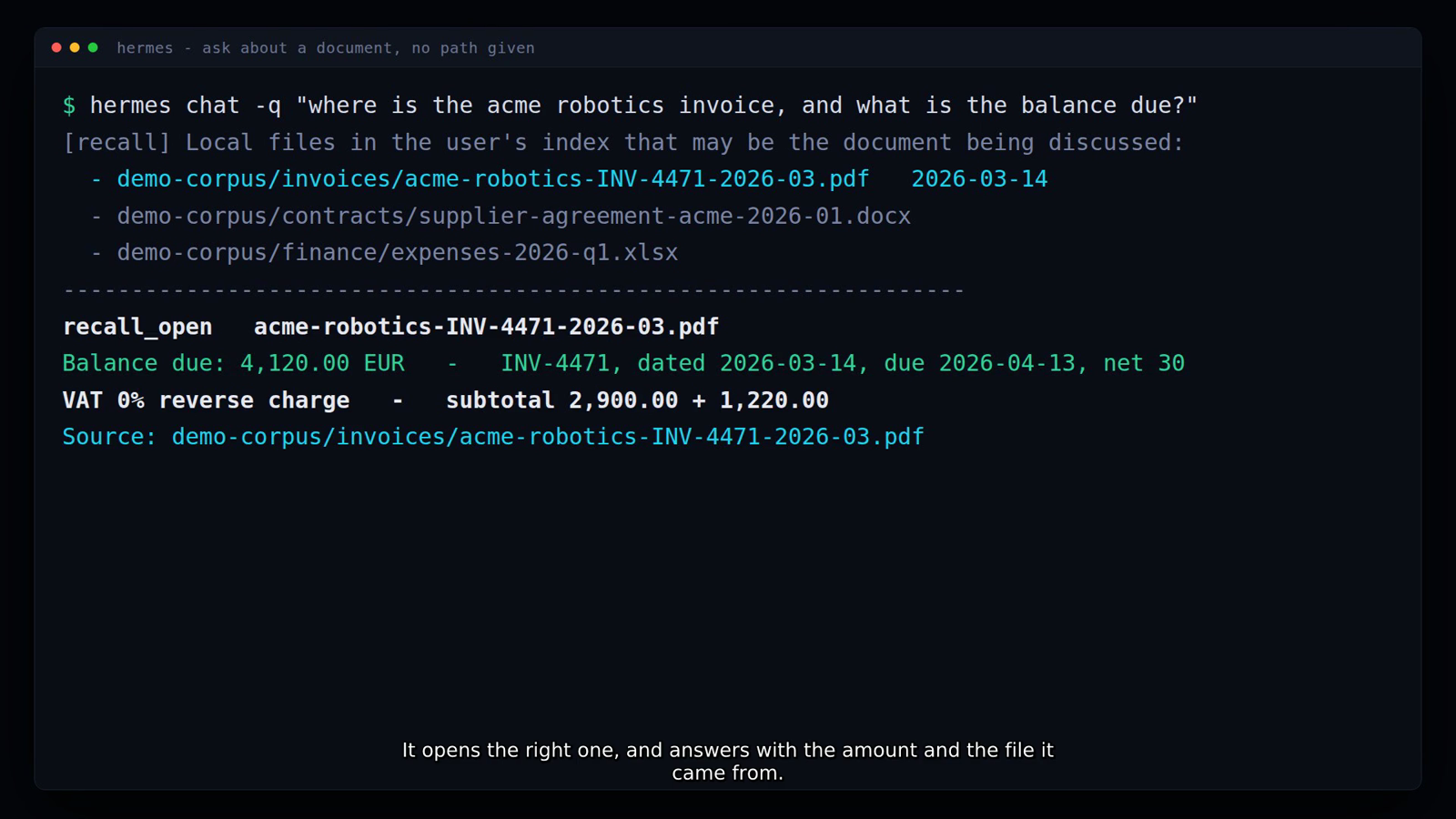
Your agent can search the web in one call and your own chat history in another. Neither one can find
the invoice sitting in ~/Downloads. recall indexes the documents already on your machine — content,
not filenames — and puts them in front of the model exactly when a message is about one of them.
Demo (58 s): recorded from this plugin end to end — ask a document question with no path, watch
the candidates arrive, then the answer plus the file it came from. The still above is a frame from it.
The gap it fills
| Question | Built-in answer | With recall |
| --- | --- | --- |
| "What does the lease say about visitor parking?" | nothing reads your disk | opens the lease, quotes the clause, names the path |
| "Where's the Acme invoice from March?" | search_files greps for an exact string you must already know | ranks by content + filename + recency, then recall_open reads it |
| "What did the powder coating price do?" | — | matches both the invoice and your cashflow notes |
| "Don't index ~/private" | — | recall_forget drops it; credential stores are refused by name |
Hermes' built-in search_files is exact-match search inside one directory; session search covers
conversations; memory providers store facts the agent wrote down. None of them answer "which of my
40,000 files is the one I'm thinking of?". That is the whole product.
What you get
One local index, three places it shows up:
- Tools —
recall_index,recall_search,recall_open,recall_stats,recall_forget.
Search returns path, modified date, score and a highlighted snippet;recall_openreads PDF, Word,
Excel, PowerPoint, OpenDocument, Markdown, CSV, email and source files as text, with
offset/max_charspaging so a long document is never silently truncated. @recall:context reference —@recall:acme invoice march(or an absolute path) expands the
matching passages inline into that turn.- Ambient hint (
pre_llm_callhook) — when a message reads like it is about a document, up to
three candidate paths arrive before the model answers, each with one highlighted line. The model
still has torecall_openthe file, so a hint can accelerate a real lookup and can never invent one.
Machine-generated turns (cron prompts, gateway notifications) are ignored.
Plus /recall in any chat surface:
/recall <query>               top matches with score and snippet
/recall index [path]          index or refresh; prints counts
/recall forget <path> | all   drop a folder, or clear the index
/recall stats                 files, chunks, last run, roots
Once an index exists, every new session starts a bounded background refresh (daemon thread, its own
connection, 25 s / 5,000 files by default), so a file saved yesterday is findable today without anyone
remembering to run a command.
Install
hermes plugins install memeshee/hermes-recall
hermes plugins enable recall
Then, once:
/recall index ~/Documents
or just ask: "index my Documents folder so you can find files for me." Repeat runs are incremental —
unchanged files are skipped by mtime + size.
A real exchange
you> where is the acme invoice from march, and what's the balance?
     [recall] Local files in the user's index that may be the document being discussed:
     - /home/me/Documents/invoices/acme-robotics-INV-4471-2026-03.pdf (modified 2026-03-14)
       — "Invoice INV-4471 Date 2026-03-14 Payment terms: net 30 … BALANCE DUE 4 120.00 EUR"
     ...
bot> Balance due is 4 120.00 EUR, due 2026-04-13 (net 30).
     Source: /home/me/Documents/invoices/acme-robotics-INV-4471-2026-03.pdf
Measured on one machine
Real numbers from the box this was built on — not a benchmark suite:
- 4,127 files → 101,483 passages indexed in 73 s, first run, single core, including 847 files
skipped for type (images, video, audio). - Queries: 187–536 ms each on that index, warm.
- Incremental re-run: 0 changed, 8 unchanged, 0.3 s — the cost of staying current.
- Extraction is standard library only: no
pypdf, nopython-docx, noopenpyxl, no embedding
service, no network call at any point. PDF text layers are read through a FlateDecode-aware stream
extractor; Office files through their OOXML text nodes.
What it reads, and what it refuses
Indexed: text and source files, PDF, .docx, .xlsx, .pptx, OpenDocument, HTML, CSV/TSV, .eml,
subtitles.
Never read — matched by name before a file is opened, and not removable by settings:
.env  *.env  .env.*  *.pem  *.key  *.p12  *.pfx  *.keystore
id_rsa*  id_ed25519*  *.kdbx  .netrc  .pgpass  .git-credentials
auth.json  credentials.json  state.db*  .npmrc  .pypirc
key.txt  keys.txt  tokens.json  api.json  *apikey*  *api*key*
*recovery*code*  *backup*code*  *seed*phrase*  *mnemonic*  *secret*  *credential*
*.ovpn  *.ppk  wallet*.dat  *.wallet
.ssh/  .gnupg/  .aws/  .azure/  .kube/  .docker/  .password-store/
node_modules/  .git/  .venv/  __pycache__/  dist/  build/  target/  .cache/
Library/  AppData/  .local/  .Trash/  site-packages/
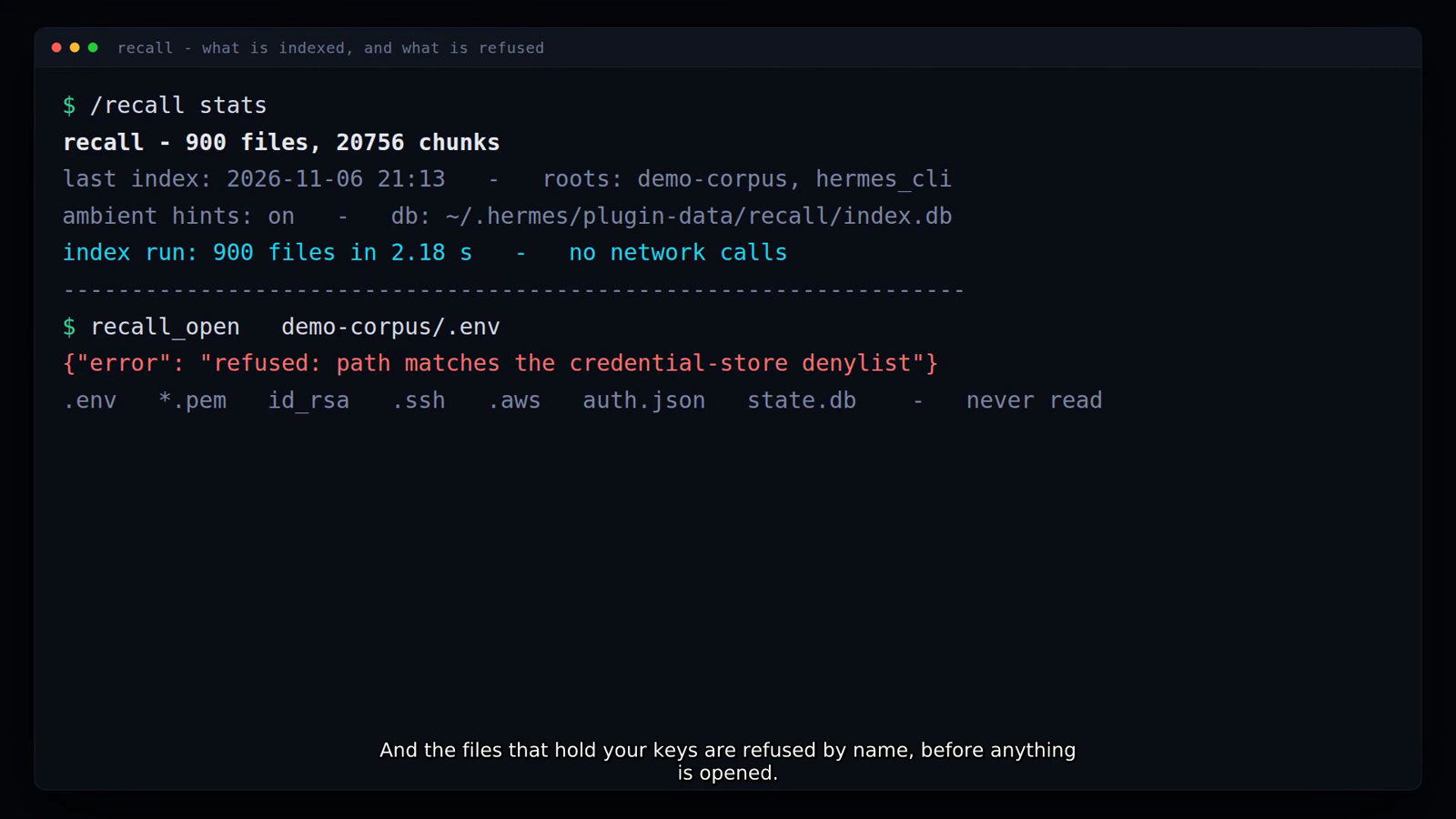
A file whose text cannot be extracted (a scan, an image, an encrypted PDF) is still findable by the
words in its filename, and recall_stats reports the skip reasons so the gap is visible rather than
silent.
Settings
Under plugins.entries.recall.settings (Desktop → Plugins → recall, or hermes config set):
| Key | Default | Meaning |
| --- | --- | --- |
| roots | ~/Documents | folders indexed when no path is given — deliberately not all of ~; name ~/Downloads or ~/Desktop yourself if you want them |
| excludes | [] | extra glob/substring patterns on top of the built-in denylist |
| ambient | true | allow the pre_llm_call hint |
| max_hints | 3 | candidate files per turn |
| max_file_mb | 8 | larger files are skipped and reported |
| chunk_chars | 1200 | characters per indexed passage |
| max_files | 20000 | files touched by one run |
| budget_s | 90 | wall-clock budget for one run; partial runs resume next call |
| refresh_on_start | true | background refresh when a session starts — scoped to the folders your own index run named, never the defaults, and a no-op when the index is empty |
| refresh_budget_s | 25 | wall-clock budget for one refresh |
| refresh_max_files | 5000 | files a refresh inspects |
Behaviour you can rely on
- Local only. No network, no API key, no account, no telemetry. The index is one SQLite file
(FTS5) under~/.hermes/plugin-data/recall/. - Hermes' own state is unreadable. Every read — the index walk,
recall_open,@recall:— goes
through one path policy that refuses, on the resolved path: anything inside Hermes' home
(.hermes: vault, session transcripts,mcp-tokens/,webhook_subscriptions.json, the dashboard
token, this plugin's own index), the credential-store denylist, and virtual filesystems such as
/proc(whoseself/environis a readable file full of API keys). A symlink namednotes.txt
pointing at~/.ssh/id_rsais refused too, because the resolution happens first. A root inside
Hermes' home is refused with a reason rather than silently walked, sorecall_index path=["~"]
indexes everything except~/.hermes. - Incremental.
(mtime, size)decides what to re-read; a deleted file is dropped on the next run
inside a scanned root; the background refresh keeps it honest — and it only ever re-reads the folders
your own index run named, so it cannot widen the index behind your back. - Bounded. Every run stops at
budget_s/max_filesand reportspartial: trueinstead of
hanging a turn. - Read before quote. Snippets are previews. The tool descriptions and the bundled skill tell the
model torecall_opena file before quoting it, and to say what it searched for when nothing matches. - Quiet. The ambient hint needs a document cue, two content tokens and a score threshold, never
shows the same path twice in a session, and ignores system-generated turns. - Reversible.
recall_forgetremoves a path or clears the index; the files themselves are never
touched.
Honest limits
- No OCR. A scanned PDF or a photo of a receipt is findable by filename only; its content is not
indexed, andrecall_statssays so. - Name filtering cannot be complete. The denylist refuses the habitual secret filenames (
.env,
keys, recovery codes, seed phrases, API token dumps) before anything is opened, but a password
written insidemeeting-notes.txtwill still be indexed if you pointrootsat the folder that
holds it. The rule that does hold absolutely is the home rule:~/.hermesand the credential
directories are unreachable no matter what a file is called. Pointrootsat document folders, not
at your whole home directory, and runrecall_forgetwhen something should not be in there. - Lexical, not semantic. Ranking is BM25 plus path/recency/phrase boosts. "The document where we
agreed the delivery date" works; "the thing that lawyer sent" only works if those words are in it.
No embedding model runs — which is why there is no key, no model download and no per-query cost. - First run costs time — measured at 16 ms per file on this machine over a mixed real tree
(3,000 files in 49 s, source code andnode_modulesincluded). Point it at the folders that hold
documents, not at/. - The index holds extracted text in plain SQLite. It is refused by its own path rules, but it is
not encrypted at rest — userecall_forgetfor anything you would not want sitting on disk. - One machine, one profile. Not a shared index; each Hermes profile gets its own database.
Demo corpus
python3 examples/make_demo_corpus.py /tmp/demo-corpus
Writes a realistic corpus — two invoices (real Flate-compressed PDF), a supplier agreement (.docx),
an expenses sheet (.xlsx), an office lease, cashflow notes, a fake scan, and a .env that must stay
invisible. Use it to try the plugin or to reproduce a bug without touching real documents.
Tests
python3 tests/selftest.py # standard library only, no Hermes install needed
Thirty behavioural checks: content ranking, PDF/Word/Excel extraction, the credential denylist
(including recall_open refusing a secret path, and the everyday secret filenames people actually
keep in Documents), name-only recall for an unreadable file, incremental re-index, thread safety of
the shared connection, phrase-over-scatter ranking, ext/path filters that narrow the query rather
than the candidate window, refresh scoping (including a folder whose name contains a comma),
forget/clear, the ambient hook's four rules (fires for a document question, silent on chit-chat,
silent on machine-generated turns, does not repeat itself, and stays inside its prompt budget), and
the read policy: a fake ~/.hermes installed for the run, a whole ~ indexed with the home pruned
out of it, recall_open and @recall: refusing the vault, session transcripts, mcp-tokens/,
webhook_subscriptions.json, state.db and the plugin's own index, a symlink named notes.txt
pointing at mcp-tokens/linear.json, /proc/self/environ, the ~/Documents-private vs ~/Documents
prefix case, and the caps that stop a .docx or a PDF from inflating without bound.
hermes plugins validate ./ passes locally — the same gate the catalog CI runs.
For reviewers: why a plugin and not a skill
A skill can tell the model to run grep; it cannot index anything, cannot survive across sessions, and
cannot see a turn before the model does. This plugin uses three public Hermes surfaces a skill has no
access to: ctx.register_hook("pre_llm_call") (ambient candidates), ctx.register_context_reference
(@recall:), and ctx.register_hook("on_session_start") (bounded refresh). It imports only the public
plugin API, patches nothing, holds no credentials, and makes no network calls.
Disclosure
recall reads files under the folders you point it at, stores the extracted text in a local SQLite
index under ~/.hermes/plugin-data/recall/, and injects short excerpts of that text into the model
prompt when a message looks document-related. Text it reads is sent to your configured model provider
during a turn, exactly as any file you show the agent — that is the only place it leaves the machine.
It never modifies, moves or deletes your files, and never persists anything outside its own data
directory.
MIT licensed.
README from the reviewed commit 99c9a6a; it updates when the author re-pins.