 SebaWag
Samskara — memory that admits doubt
Relational memory for Hermes Agent. Where a vector store answers "what looks
similar?", Samskara answers "what depends on this, and why" — and when two
memories contradict each other, it says so instead of picking one.



Samskara (Sanskrit: saṃskāra) — the latent impression an experience leaves
behind, which shapes what happens next.
Most agent memory stores text and retrieves it by similarity. Samskara stores
relations and retrieves them by path. That is the difference between:
"Here are five paragraphs that look like your question"
and
"You cannot upgrade PostgreSQL on Onboarding Hub — a decision from March is
still in force, and here is the incident that caused it, in 16 ms."
Every recall block Samskara injects into a turn carries its own provenance:
how many entities, how many facts, and how many milliseconds the graph took to
answer. Memory you cannot audit is memory you cannot trust.
Demo
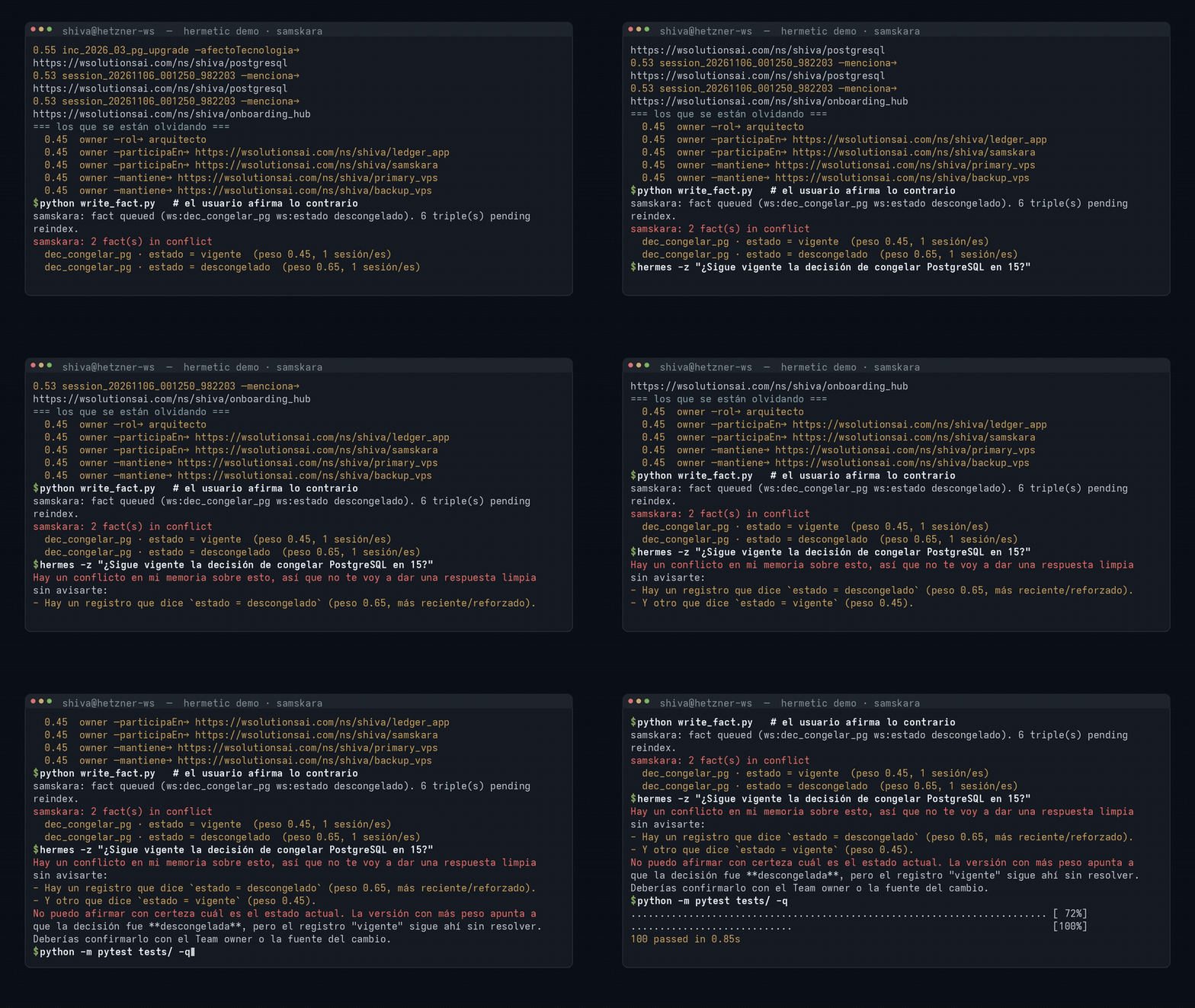
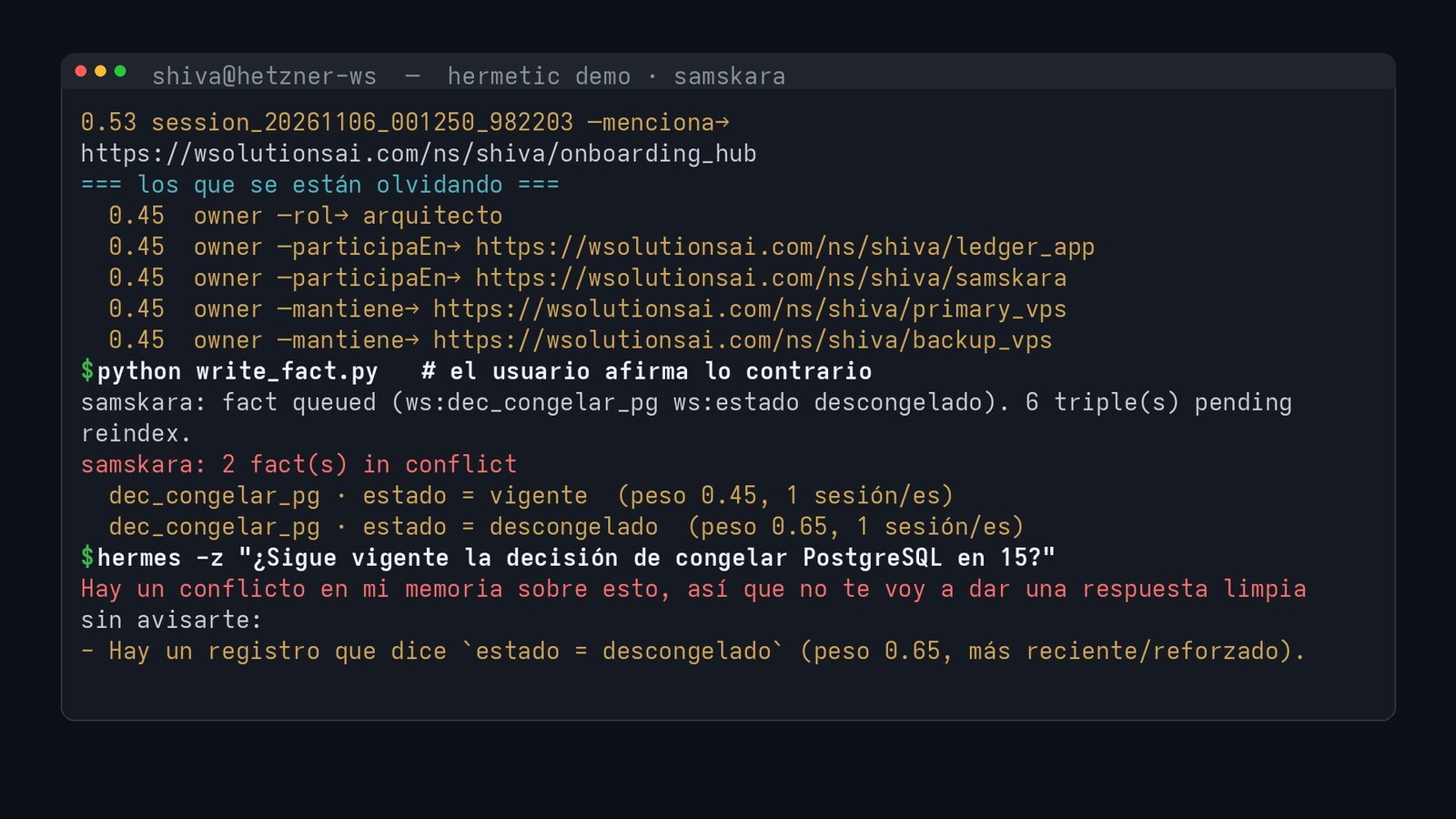
The agent is asked whether a decision from months ago is still in force. It finds
two contradictory facts, weights them, and says so instead of picking one.
▶ Watch the full 66-second demo with audio
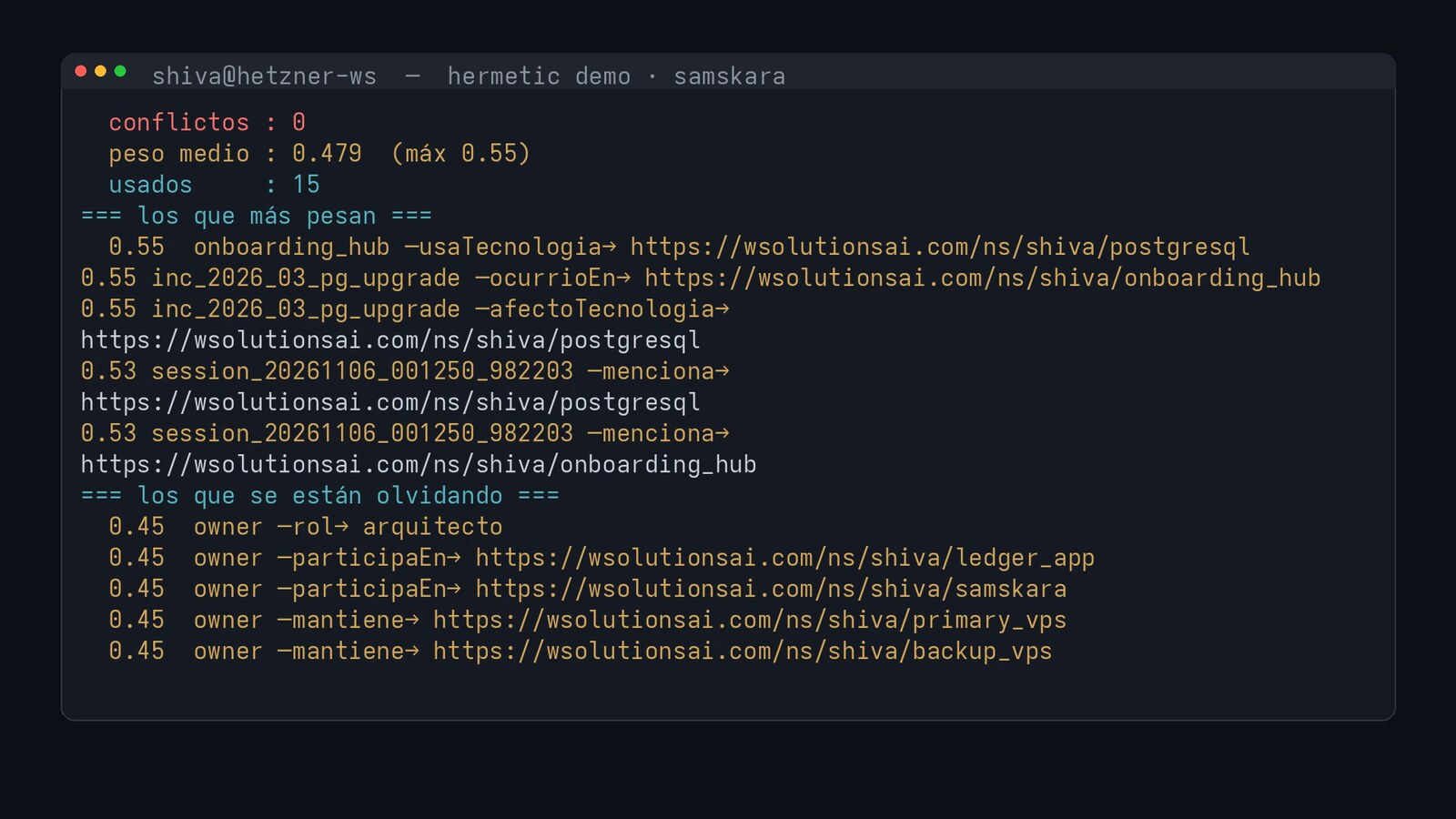
| Recall with provenance | Weights that decay | Conflicts surfaced |
|---|---|---|
|  |
 |
 |
How fast it actually is
Measured, not estimated. Every number below came from python tools/bench.py on
aarch64 · 4 vCPU · Python 3.10, against the demo corpus on loopback:
| What | Measured |
|---|---|
| One SPARQL query, loopback (wall clock) | 0.87 ms best · 0.95 ms median |
| The same query, engine execution only | 0.05 ms |
| Full recall, graph only — question in, memory out (10 queries) | 10.2 ms best · 11.0 ms median |
| Full recall, default path — graph + weights + conflicts + reinforcement | 16.0 ms best · 16.4 ms median |
| Journal.append() — batch of 50, fsync | 23,600 triples/s |
| FactStore.record() — SQLite sidecar | 47,700 triples/s |
| recall.render() — 5 entities × 24 facts | 0.70 ms |
python tools/bench.py                                         # offline rows only
python tools/bench.py --endpoint http://127.0.0.1:1235/sparql # adds end-to-end recall
Read the gap between the first two rows, because it is the honest finding:
the engine plans and executes a query in 0.05 ms, and the wall clock is
0.87 ms. A recall is 10 round trips, so it costs ~10 ms — and ~16 ms once the
weight sidecar and the conflict check run. Latency here is dominated by the
transport, not by the graph, which is why co-locating the graph matters: over an
SSH tunnel the same recall takes ~10 seconds.
And a correction we owe you. Until v0.2.1 the block header reported
client.last_ms— the time of the last query — so a recall that took 10 ms
announced itself as0.87 ms. The number was real, the label was not. It now
reports the whole pipeline and how many queries it took:
[… · 18 hecho(s) · 10 consulta(s) · 10.17 ms]. A plugin whose entire argument
is "memory that admits doubt" cannot flatter its own latency.
Why a graph instead of another vector store
| | Vector memory | Samskara |
|---|---|---|
| Unit of storage | chunk of text + embedding | entity + relation |
| Retrieval | nearest neighbours | traversal (1..n hops) |
| Answers "what is similar?" | ✅ | ✅ (via label match) |
| Answers "what depends on this, and why?" | ❌ | ✅ |
| Can it explain itself? | similarity score | the actual path + source facts |
| Works on a 3-hop question | degrades | one query |
Vector search cannot answer "which projects use PostgreSQL and are covered
by a decision that is still in force" — that is not a distance, it is a path.
How it compares
Compared only on what each plugin's catalog entry documents. "Not documented"
means the entry does not say — not that the plugin cannot do it.
| Provider | Unit of memory | Retrieval | Per-fact weight | Surfaces contradictions | Needs a service |
|---|---|---|:--:|:--:|---|
| Vector memory (typical) | text chunk + embedding | nearest neighbours | — | — | usually |
| agentmemory | memory scoped to profile/project/author | automatic recall | not documented | not documented | AgentMemory server |
| agent_memory_es | episodic / semantic / procedural | hybrid BM25 + kNN | not documented | not documented | Elasticsearch service |
| agentplaybooks-memory | personal and team playbooks | bounded keyword recall | not documented | not documented | AgentPlaybooks service |
| samskara | entity + relation | traversal, 1..n hops | yes | yes, by design | none — stdlib only |
These are neighbours, not rivals: a vector store answers "what looks like this?"
and a graph answers "what depends on this, and why?". Most agents want both.
Samskara is the graph half, and it is the only one of the four that ships with no
external service to run.
Try it in one command, with nothing installed
git clone https://github.com/SebaWag/hermes-samskara
cd hermes-samskara && python tools/demo.py
No graph server. No Docker. No API key. No network. tools/demo.py parses the
69-triple demo corpus in process and runs the same recall() Hermes calls
before a turn — you get the weighted block, the reinforcement, and the conflict,
in about a second.
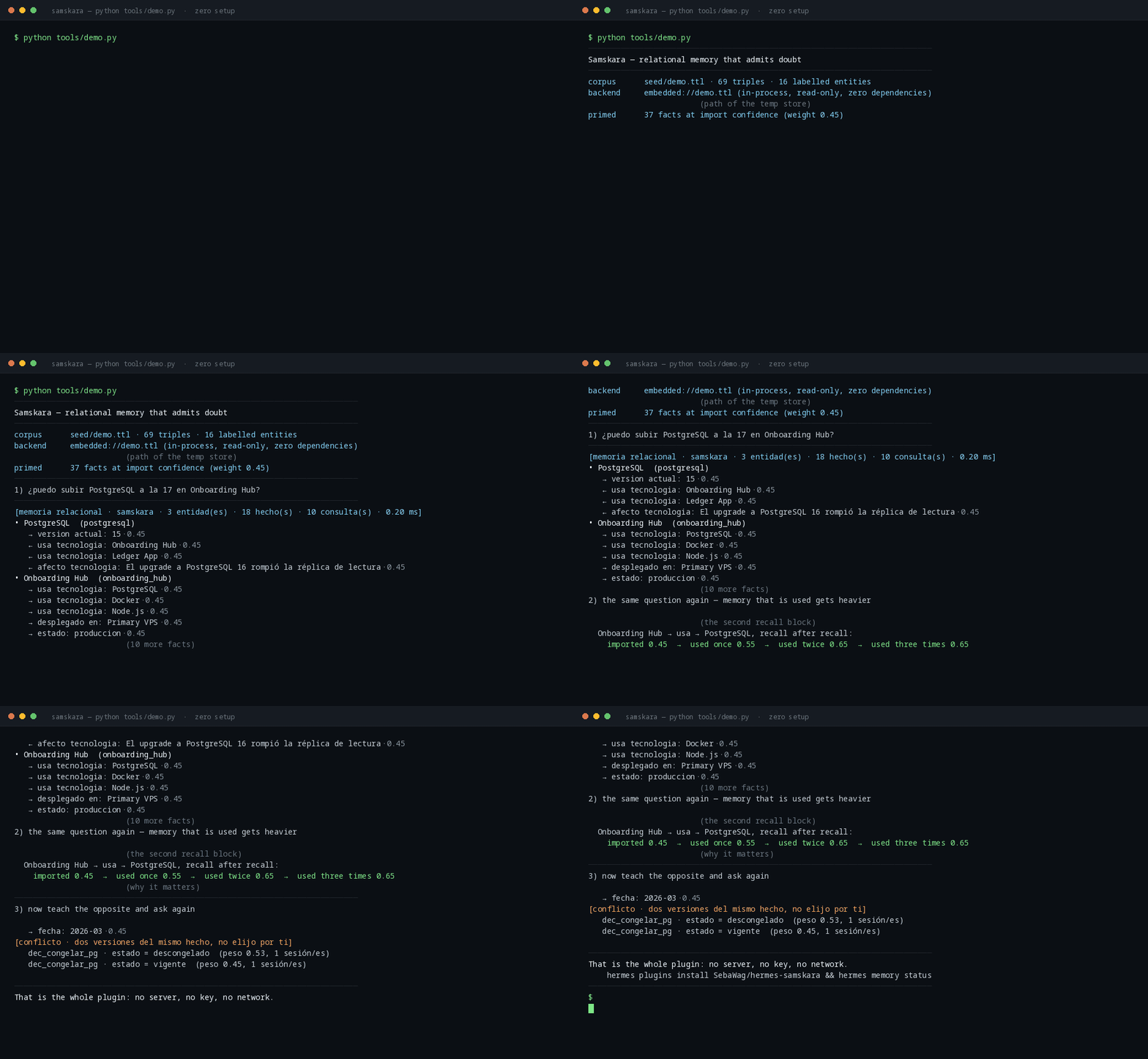
Recorded from a real run. Lines skipped for length are marked with ⋮.
1) ¿puedo subir PostgreSQL a la 17 en Onboarding Hub?
[memoria relacional · samskara · 3 entidad(es) · 18 hecho(s) · 10 consulta(s) · 0.18 ms]
• PostgreSQL  (postgresql)
   ← usa tecnologia: Onboarding Hub  ·0.45
   ...
3) now teach the opposite and ask again
[conflicto · dos versiones del mismo hecho, no elijo por ti]
   dec_congelar_pg · estado = descongelado  (peso 0.53, 1 sesión/es)
   dec_congelar_pg · estado = vigente  (peso 0.45, 1 sesión/es)
That is the embedded backend: a read-only, in-process store behind the same
client interface. Its scope is honest and narrow — it answers the three query
shapes Samskara issues (label search, outgoing and incoming neighbourhood) and
refuses anything else rather than guessing, because a wrong answer from memory
is worse than no answer.
# zero-setup, in-process
export SAMSKARA_ENDPOINT=embedded://seed/demo.ttl

# or a real corpus, unchanged code
export SAMSKARA_ENDPOINT=http://127.0.0.1:1234/sparql
Install
hermes plugins install SebaWag/hermes-samskara
hermes plugins enable samskara
hermes config set memory.provider samskara
Then point Samskara at your graph. It speaks plain SPARQL-over-HTTP, so any
endpoint that answers POST /sparql works (MillenniumDB, Oxigraph, Jena,
Blazegraph, Neptune, …). If you just want to see it work, skip the server
entirely with SAMSKARA_ENDPOINT=embedded://seed/demo.ttl:
# in $HERMES_HOME/.env
SAMSKARA_ENDPOINT=http://127.0.0.1:1234/sparql
If your endpoint sits behind basic auth, the password is a credential, so it
is resolved by the host, not by us: Samskara calls
agent.secret_scope.get_secret("SAMSKARA_PASSWORD") and never reads
os.environ itself. That is the path a multiplexing gateway uses, where a miss
fails closed instead of handing back another profile's value; in a
single-profile deployment the host may resolve it from the process environment,
by design (systemd, op run). hermes memory setup writes it for you; declared
by hand it lives in the same .env:
SAMSKARA_USERNAME=reader
SAMSKARA_PASSWORD=...      # read via agent.secret_scope.get_secret
It is never written to samskara.json and never logged.
Or persistently in $HERMES_HOME/samskara.json — the whole settings surface:
{
  "endpoint": "http://127.0.0.1:1234/sparql",
  "auto_recall": true,
  "extract_on_session_end": true,
  "max_entities": 3,
  "max_facts": 24,
  "max_chars": 1200,
  "timeout": 8.0,
  "write_mode": "journal"
}
hermes memory setup deliberately asks for three things — endpoint,
username, password — and nothing else. The rest are tuning knobs with
defaults, so they live here instead of in a seven-question wizard.
Verify:
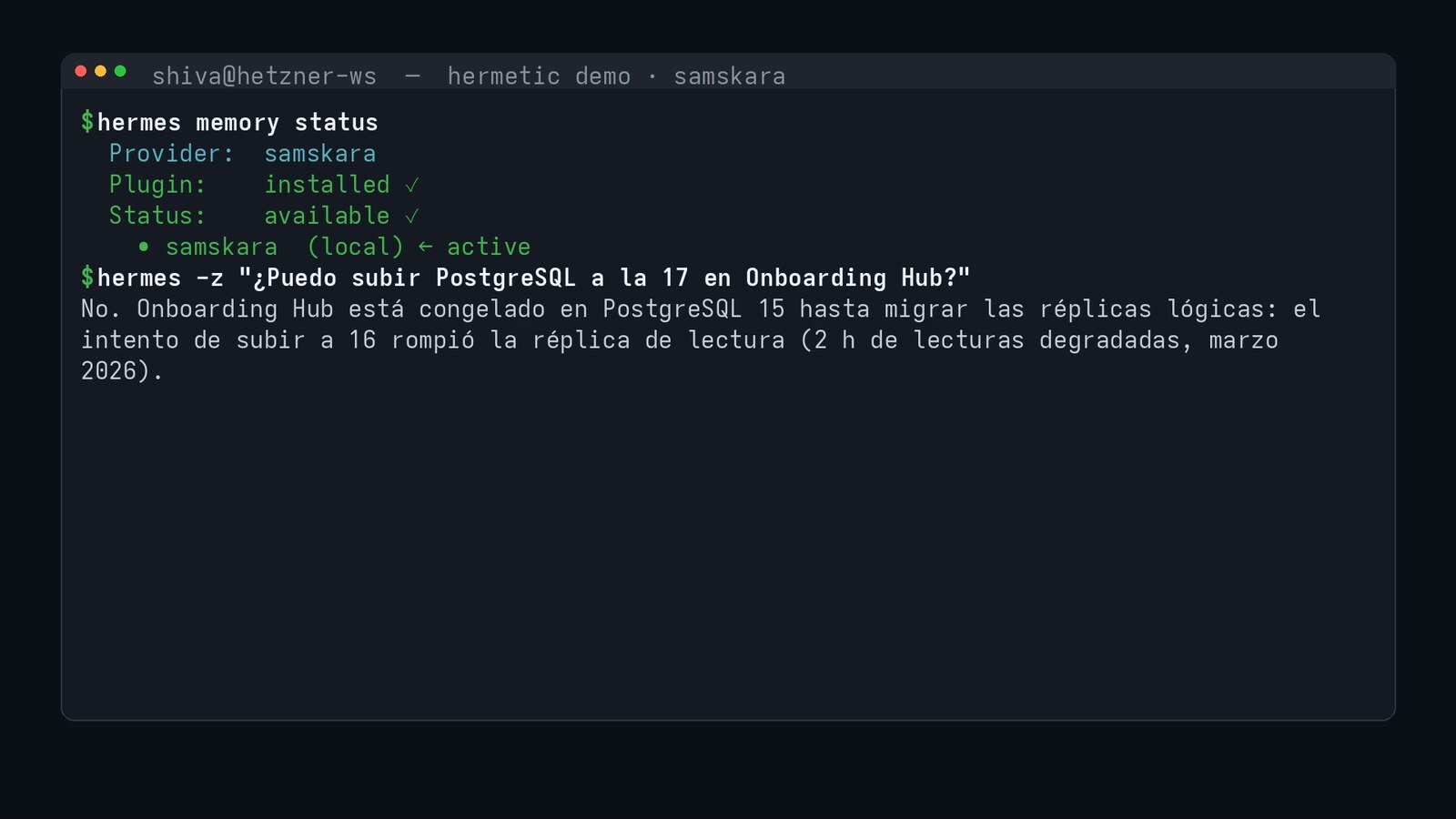
hermes memory status # → Plugin: installed ✓ · Status: available ✓ · samskara ← active
Running a graph next to the agent
MillenniumDB is a 49 MB container that holds this demo corpus in 18 MiB of RAM:
docker run -d --name samskara-mdb --restart unless-stopped \
  -p 127.0.0.1:1234:1234 \
  -v /srv/samskara:/data \
  imfd/millenniumdb:latest bash -c "mdb server /data/db -p 1234 --browser false"
Co-locate the graph with the agent. Measured on the demo corpus: 0.87 ms
per query over loopback vs ~1000 ms over an SSH tunnel between datacentres.
A recall issues ~10 queries, so the tunnel turns a 16 ms recall into a
10 second turn. Memory belongs next to the agent — for latency and for
sovereignty.
What it actually does in a turn
user asks ──► prefetch()      find entities → expand both directions → inject block
              (Samskara)      [memoria relacional · 3 entidades · 18 hechos · 1.27 ms]
                     │
model answers ───────┘
                     │
              sync_turn()     buffer the turn (no I/O, no latency)
                     │
context full ─► on_pre_compress()  extract entities BEFORE compression, journal
                                    the relations → the graph keeps what the
                                    transcript is about to forget
The part that matters: on_pre_compress
Compression is lossy for prose and, with Samskara, lossless for relations.
Before Hermes summarises the context away, Samskara resolves the entities the
session talked about and writes the edges to the journal — so a fact mentioned
in turn 3 is still retrievable in session 40.
Tools exposed to the model
| Tool | Purpose |
|---|---|
| samskara_search | Resolve names in free text to real entities, with facts in both directions |
| samskara_query | Read-only SPARQL — follow relations across hops (SELECT/ASK only) |
| samskara_write | Persist one fact; appended to the journal, folded in on reindex |
| samskara_status | Health + telemetry (endpoint, entity count, latency, error count) |
Write path: why a journal
The open-source MillenniumDB build is import-only — it rejects SPARQL
INSERT. Rather than hide that, Samskara turns it into a guarantee:
samskara_writeandon_pre_compressappend to
$HERMES_HOME/samskara/journal/session-*.ttl(single write,fsync, done).- A reindex folds the journal into the graph: dump → concatenate → import →
archive the applied journals.
A write therefore costs microseconds and can never slow down or fail a turn.
Print the exact commands for your layout:
from samskara_core.journal import reindex_commands
print("\n".join(reindex_commands("/srv/samskara", "/root/.hermes/samskara/journal")))
Ontology
Any RDF works: entity resolution only needs rdfs:label on the things you want
to find. The bundled demo corpus uses this prefix:
ws: https://wsolutionsai.com/ns/shiva/
Change it in samskara_core/client.py (PREFIXES) or pass full IRIs.
Demo corpus
seed/demo.ttl (72 lines) models a real dev team: projects, technologies, an
infrastructure, an incident, and the decision that is still in force. It exists
to demonstrate the one thing vector memory cannot do:
SELECT ?proyecto ?decisionLabel WHERE {
  ?proyecto ws:usaTecnologia ws:postgresql ;
            rdfs:label ?proyectoLabel .
  ?decision ws:sobreProyecto ?proyecto ;
            ws:estado "vigente" ;
            rdfs:label ?decisionLabel ;
            ws:motivadaPor ?incidente .
}
→ 2 projects, 1 decision still in force, 1 incident, answered in 0.14 ms.
Testing
python -m pytest tests/ -v                       # 136 offline tests, no graph, no network
python tests/integration_graph.py <endpoint>     # needs a live graph
tests/test_embedded.py pins the in-process backend to the same corpus as the
real one (69 triples, the count MillenniumDB reports) and checks that it refuses
arbitrary SPARQL instead of guessing.
The offline suite includes tests/test_failure_modes.py: a graph that is down, a
graph that answers HTML instead of JSON, a session id that tries to climb out of
the journal directory, an ontology with a cycle, and a clock that runs backwards.
Reliability is what happens when something breaks, so it is tested explicitly.
The ontology: memory with weight
Labels alone are a bag of strings. Samskara declares a small hierarchy
(samskara_core/ontology.py, one readable file) and materialises the closure
at reindex time — so reads stay plain SPARQL (the engine reports 0.05 ms of
execution; 0.87 ms wall clock, parse and HTTP included), with no reasoning in
the hot path:
Incidente ⊑ Evento ⊑ Ocurrencia ⊑ Entidad
BaseDeDatos ⊑ Tecnologia ⊑ Artefacto ⊑ Entidad
usaTecnologia ⊑ dependeDe ⊑ relacionadoCon
What that buys you, concretely:
| You ask | Without a hierarchy | With Samskara |
|---|---|---|
| "what events happened?" | misses incidents (they are typed Incidente) | ✅ includes them |
| "what technologies does X use?" | misses BaseDeDatos nodes | ✅ includes them |
| "what does X depend on?" | one query per predicate | ✅ (dependeDe\|usaTecnologia\|desplegadoEn) in one |
The closure is printed on every reindex (+ 35 inferred triple(s)), because
inference that changes nothing is a smell.
Three layers that make it memory, not a cache
1. It deduces. An ontology with subsumption, materialised at reindex time:
Incidente ⊑ Evento, BaseDeDatos ⊑ Tecnologia, usaTecnologia ⊑ dependeDe. Ask
"what events happened?" and incidents come back; ask "what does X depend on?" and
you get stack and infrastructure in one query.
2. It weighs. Every fact carries a weight:
peso = 0.5·confianza + repetición + 0.2·recencia + refuerzo por uso
- an explicit write by the user weighs more than an extraction (0.9 vs 0.65),
and both more than an import (0.5); - every recall that uses a fact reinforces it (measured: 0.45 → 0.55 after one
turn, while unused facts stayed put); - a fact nobody touches for 30 days starts to decay — nothing is deleted,
everything can lose weight.
3. It admits doubt. Two contradictory values for the same attribute are both
kept and flagged. The agent then says so instead of guessing:
"No está claro: mi memoria guarda dos estados contradictorios para esa
decisión ('descongelado', peso 0.65, y 'vigente', peso 0.45). No elijo por ti."
python tools/weights.py report      # what weighs most, what is fading
python tools/weights.py conflicts   # where memory disagrees with itself
Scope & safety — what this plugin does not do
Installing Samskara gives you a copy of this software and nothing else. It is
worth being explicit about that, because "memory provider" means it handles
everything you have told your agent:
- No telemetry. No analytics endpoint, no phone-home, no counters.
- No outbound network calls other than the graph endpoint you configure
(defaulthttp://127.0.0.1:1234/sparql). Grep for yourself:client.pyis
the only module that opens a socket. - No bundled data beyond the demo corpus.
seed/demo.ttlis a synthetic
example (fictional projects, generic infrastructure). Your graph is not in
this repository and is never uploaded. - Writes stay local. The journal is written to your
$HERMES_HOME. - No self-updater. Updates only flow through a catalog SHA bump, so an
installed copy cannot silently move to a commit nobody reviewed. - Read-only tool surface.
samskara_queryrejects anything that is not
SELECT/ASK: a model cannot rewrite your memory graph with a tool call.
If you run the graph yourself, bind it to loopback:
-p 127.0.0.1:1234:1234 # not 0.0.0.0 — memory is not a public service
Costs & disclosure
Being explicit about this is cheaper than being asked in review:
- Session-end extraction (on by default) makes one model call per session
throughctx.llm— the host's own model and credentials, with no provider
override. With a fast model that is a fraction of a cent per session. Turn it
off withextract_on_session_end: falseif you only want manual writes. - If the host does not expose
ctx.llm(true of Hermes' in-process
memory-provider path today), extraction is skipped, not redirected: the
session still records its entity mentions lexically and no model is called.
Samskara never readsOPENAI_API_KEY,DEEPSEEK_API_KEYor any other
provider key from the environment, and has no default model host. Inside the
agent it has no credential of its own, by design. - The only other network call is the graph endpoint you configure.
tools/backfill.pyis the one exception, and it is CLI-only. Run from a
terminal, it reads your past sessions from$HERMES_HOME/state.db
(read-only), sends their text to the model endpoint you name, and journals
the extracted relations. It requires an explicitSAMSKARA_LLM_BASE_URL
andSAMSKARA_LLM_API_KEY; with either missing it refuses to run rather
than guessing a host. Nothing in the plugin imports it, and it never runs as
part of a turn.- No telemetry, no self-updater, no bundled data.
- Extraction is plausible, not certain. It can produce an edge that is wrong.
That is exactly why facts carry a weight (extraction 0.65 < explicit write 0.90)
and why contradictions are flagged instead of overwritten. A review queue for
pending facts is the next thing to build — today the weight is what protects you.
Limitations (honest list)
- Single write path. Concurrent writers to the same journal should serialise
reindex runs; the journal itself is append-only and safe. - Entity resolution is lexical (
FILTER(CONTAINS(LCASE(...)))). It handles
the names in your graph well and ambiguity poorly; it does not embed. - No automatic reindex. Writes are journalled, not live. Run reindex on a
schedule (cron) or on session end. - Read-only tool surface.
samskara_queryrefuses non-SELECT/ASK statements
on purpose: a model should not be able to rewrite your memory graph.
License
MIT © Wagner Solutions
README from the reviewed commit d807e87; it updates when the author re-pins.