
 Johnlocke0347
A11Y Lens
Hermes doesn't just claim it fixed your accessibility bugs. It re-opens the page in a real browser and proves it.
A11Y Lens gives Hermes Agent the workflow of an accessibility test engineer:
- Scan the rendered page in headless Chromium with the axe-core engine
- Evidence for every finding (CSS selector, HTML, failure reason, measured contrast, screenshot)
- Repair with Hermes' normal file/terminal tools (the plugin never edits your code)
- Re-scan the same page
- Compare: which violations were resolved, which remain, which were newly introduced
No model-invented violations, no hard-coded scores, no "WCAG compliant" claims. Every number in a report is axe-core output from an actual browser run.
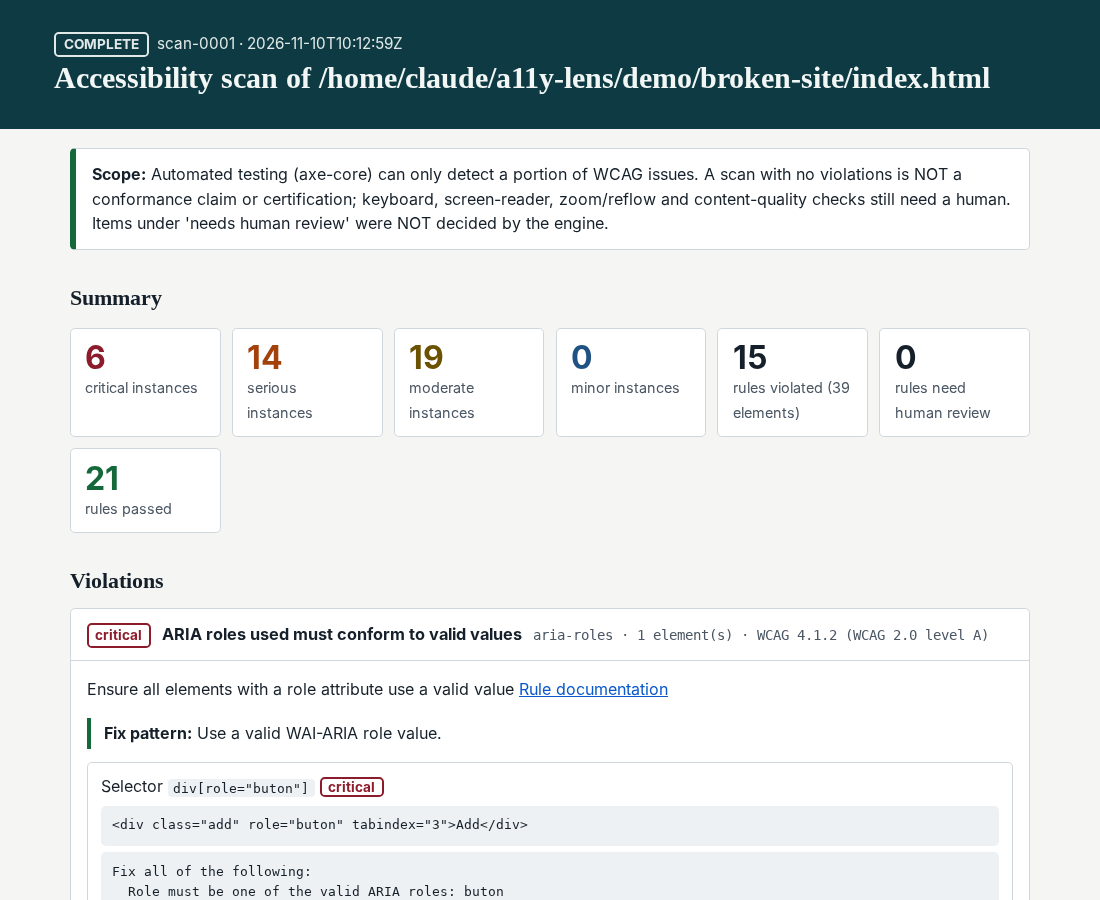
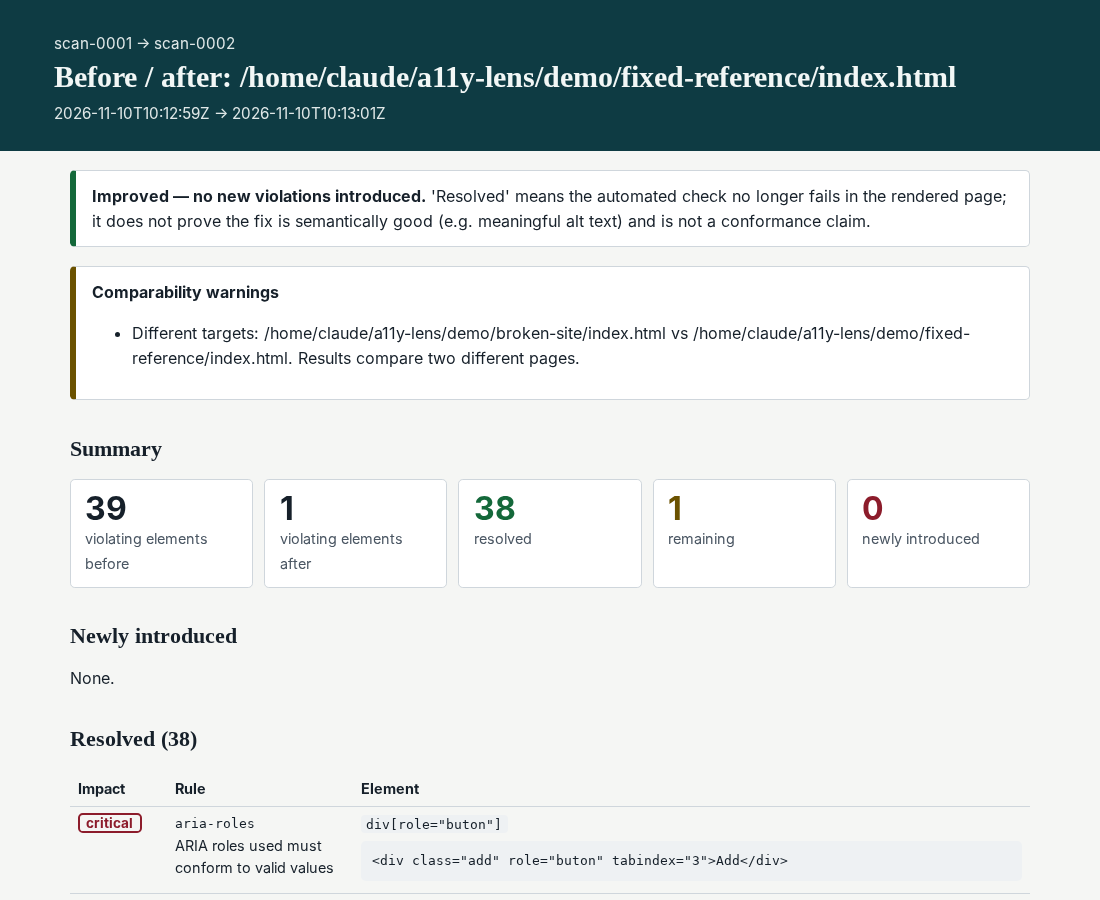
(Both images are real output from scanning the bundled demo site; live HTML in docs/sample/.)
Install (3 commands)
hermes plugins install Johnlocke0347/a11y-lens --enable
hermes a11y install     # one-time: downloads Playwright's Chromium (~150 MB, official Playwright CDN)
hermes a11y doctor      # real self-test: launches the browser, runs axe, must find a planted violation
Already have Chrome or Edge? Skip hermes a11y install; A11Y Lens falls back to system Chrome/Edge automatically.
90-second demo
hermes a11y demo                 # copies a deliberately inaccessible coffee-shop site to ./a11y-lens-demo
hermes
> Audit ./a11y-lens-demo with A11Y Lens, fix the issues in the source, rescan, and prove it improved.
Hermes runs a11y_scan (39 real violations on the bundled site), edits the HTML/CSS itself, runs a11y_scan again, then a11y_compare and reports exactly what changed, including anything it broke. Reset any time with hermes a11y demo --reset.
Tools
| Tool | What it does |
|---|---|
a11y_scan(url, viewport?, timeout_s?, note?) | Scans a localhost URL, or a local .html file / folder (served on a temporary loopback server). Returns scan_id, severity counts, top findings with selectors and fix patterns, and paths to the JSON + HTML reports. |
a11y_report(scan_id?, rule_id?, impact?, include?) | Full stored evidence of a past scan (violations, needs human review, passed rules). No scan_id lists history. |
a11y_compare(before_id, after_id?) | Resolved / remaining / introduced / severity-changed. before_id="previous" and after_id="latest" work. |
Also: a /a11y slash command, hermes a11y … CLI (install, doctor, scan, scans, compare, allow, origins, demo) and a bundled a11y-repair skill that teaches the scan → fix → rescan → compare loop.
Why this isn't "a prompt in a trench coat"
- Real browser, real DOM. Playwright + Chromium, axe injected into every frame (iframes are audited; if one can't be, the scan is marked
incomplete). - Honest status.
complete,incompleteorfailed. A 404, timeout, crash, blocked redirect or partially audited page is never reported as a finished audit, anda11y_comparerefuses to compare one. - Machine findings vs human review are separate. axe's "incomplete" results (e.g. contrast over gradients) are listed as needs human review and never counted as violations or passes.
- Regression detection that survives edits. Elements are matched by rule + selector, then normalised HTML, then tag + text, each element at most once, so a fix that shifts selectors isn't misreported as "fixed one, broke one". Every "remaining" item says which pass matched it.
- Persistent history in SQLite via Hermes' plugin storage; reports are self-contained HTML (and pass the checks they describe: landmarks, real headings, AA contrast in light/dark mode, text labels instead of colour-only severity).
Safety model (details in docs/SAFETY.md)
- Loopback only by default. Remote sites need a human to run
hermes a11y allow https://staging.example.com; the model cannot widen the allow-list from a tool call. - SSRF / DNS-rebinding guard. Hostnames are resolved once, validated (public IPs only for remote targets), and pinned inside Chromium with
--host-resolver-rules; every other host resolves to NOTFOUND, redirects and sub-resources to non-pinned hosts are blocked and recorded in the report. - Isolated worker process with a hard kill timeout, stripped environment (no API keys), service workers blocked, WebSockets closed, downloads refused, dialogs dismissed, forms are never submitted, nothing is typed or clicked.
- Local-file mode serves only
.htmlpages' own folder on127.0.0.1, refuses symlink/..escapes,/, your home directory and top-level system folders. - No credentials in URLs, no cookies/profile, evidence stays on your machine.
- axe-core is vendored and SHA-256-checked before every scan.
Limits (read these)
Automated testing finds only part of WCAG. A clean scan is not a conformance claim; keyboard, screen-reader, zoom/reflow and content-quality testing still need a human. "Resolved" means the automated check stopped failing, not that a fix is semantically perfect (an alt of "image" passes axe).
Single page per scan (no crawling), no login flows by design. Chromium's DNS pinning covers the page's own host; the plugin deliberately allows only pinned hosts, so CDN-hosted assets on a remote origin are blocked unless you authorise those hosts too.
Development
pip install playwright pytest && playwright install chromium
pytest -q            # 49 tests: policy, compare engine, store, reports, REAL-browser scans, failure & safety cases
hermes plugins validate .
A11Y_LENS_TEST_BROWSER=/path/to/chrome points the integration tests at a specific browser. Architecture: docs/ARCHITECTURE.md.
Third-party
axe-core 4.14.0 © Deque Systems, MPL-2.0 (see vendor/). The vendored file is the upstream axe.min.js re-printed with line breaks only; see vendor/VENDORED.json for hashes and the reproduce command.
MIT licensed.
README from the reviewed commit 9cf8cf3; it updates when the author re-pins.


