dolepee
CrashLab
For developers repairing web apps with Hermes, CrashLab checks that a repair
preserves the intended saved result when a submission is interrupted or the app
restarts. Keep the same regression for the next edit, conversation or checkout.
Start here: Install, then try a bundled case in Hermes
or test your own application.
See the measured external-app repair
for a complete example.
Prevent delivery, lose an acknowledgement after commit, or restart the app before
retry; inspect what was actually saved, repair the app and rerun the same frozen
behavior.
A legitimate-use control checks that fixing a retry still allows two deliberate
operations. The comparison freezes the contract and checks evaluator identity
across the before/after runs. Results cover the configured assertions, not every
possible application failure.
Current 0.5.10 replay
The corrected evaluator replays the published native Kist case:
acknowledgement loss and server restart each save two goals before repair and one
after the retained repair; all deliberate-use controls pass. A fresh checkout
imports PREPARED and earns its own result. The original model session remains
labeled 0.5.7. Replay with 0.5.10; the
0.5.9 replay instructions are preserved
separately, and historical bundles keep their original evaluator hashes. The
official installed Mac replay
is a 0.5.9 record; an installed 0.5.10 replay remains owner-owned.
Native workflow: app path to reusable repair
On the 0.5.7 evaluator, a normal interactive Hermes session received only a
pristine Kist checkout, intended behavior and runtime bindings. It inspected the
app, constructed the case, reproduced duplicate goals after acknowledgement loss
and restart, wrote a durable repair and reran the same frozen experiment. The
record includes actual Allow-once approvals and an initial control-wait correction
made while application source remained pristine.
| Same frozen operation | Original app | Model repair | Deliberate-use control |
| --- | --- | --- | --- |
| Acknowledgement lost after commit | 2/1 saved, FAIL | 1/1 saved, PASS | 2/2 in each run |
| Server restarted with database retained | 2/1 saved, FAIL | 1/1 saved, PASS | 2/2 in each run |
| Request stopped before delivery | 1/1; selected header check FAIL | 1/1, PASS | 2/2 in each run |
The before-delivery baseline already saved one goal. Its failure is the case's
configured Idempotency-Key requirement, absent from the original app; it is not
another duplicate or a missing real retry. The repair passes all three boundaries
and 274 application tests with no skips in a separate full test environment.
A separate Mac/operator imported the exported regression with new local bindings.
It started PREPARED, reproduced the pristine failure and earned VERIFIED after
applying the retained model patch. Re-export preserved the behavior and launch
hashes. That is a measured handoff, not a second model repair or unrelated-user
adoption. The native session's own fresh-checkout reuse occurred inside the same
Hermes conversation.
Inspect the actual case, tool events, patch and measurements,
or replay the current regression.
Earlier memory-only repair comparison
A fresh Hermes session constructed its own recovery case on public Kist Finance
with a deliberately injected memory-only fix. That negative control was supplied
by the operator, not an observed model mistake.
| Same frozen operation | Memory-only negative control | Hermes durable repair |
| --- | --- | --- |
| Prevent delivery, then retry | PASS · 1 saved | PASS · 1 saved |
| Lose acknowledgement after commit | PASS · 1 saved | PASS · 1 saved |
| Restart with database retained, then retry | FAIL · 2 saved | PASS · 1 saved |
| Two deliberate identical creates | PASS · 2 in each boundary | PASS · 2 in each boundary |
The model replaced memory receipts with an additive SQLite receipt table and an
atomic goal/receipt transaction. It reran the same experiment to VERIFIED; an
independent run of its application tests passed 279 tests. The full patch retains
its six new tests and identifies the frontend code supplied in the initial seed.
See the actual selected tool events, measurements and patch.
The historical 0.5.6 replay preserves this earlier
operator replay and its recorded evaluator. The current 0.5.7 case, repair and
separate-machine handoff are linked above; their evidence is not attributed to
the earlier session or patch.
The operator-controlled boundary comparison
also includes unmodified upstream Kist and the older retained repair. A separate
fresh-checkout replay of the new model repair reproduces the upstream failure and
passes all three boundaries. These are bounded engineering examples, not adoption,
general autonomous discovery, production safety or a measured speed advantage.
A reproduced external repair
On November 7, 2026, a fresh Hermes 0.23 session used CrashLab on the unmodified
Kist Finance savings-goal application,
then wrote a repair in a separate checkout:
- Before: retrying one interrupted create saved two goals, expected one.
- After: the same saved case produced one goal, and the control still
created two deliberate goals, including identical values. - A separate Hermes registry comparison reproduced both results using one frozen
contract. The evaluator and the agent's case remained unchanged.
The patch, selected tool events, screenshots and replay summary
are included. This is one measured application repair, not a general autonomous
repair claim. Kist goals are savings records, not payments or money movement.
A separate Flaskr guided repair starts from a project
and intended behavior, with Hermes constructing its own case. It reproduced a
native POST retry duplicate, repaired it, and verified the same experiment.
The record distinguishes the successful acceptance from a prior failed trial
that exposed a navigation race, and states the fresh-database limitation.
A second non-tutorial target, Shiori, exposes a
related recovery failure: the bookmark is saved, but its retry panics on URL
uniqueness. The retained guided model patch and unchanged case distinguish
successful recovery from merely counting one row. That session used a supplied
diagnosis and automatic approvals; its CrashLab runs were operator-executed.
Use it in Hermes
After installation, tell Hermes where your disposable local Git app lives and
what behavior you expect. For example:
Check the app at /path/to/my-app. Retrying one submission after its response
is lost should save one record; two deliberate submissions must remain allowed.
The bundled skill guides app inspection and case preparation. Review the intended
behavior and assertions, reproduce a failure, repair the application, then rerun
the same experiment ID. For the short first-run and own-app checklist, including
the Git, CHROME_PATH, replay and campaign boundaries, see
docs/FIRST_RUN.md. The dashboard shows whether that evidence is current and
lets you rerun the case or enable completion reminders.
A passing fault case must explicitly exercise recovery. A fault case must
declare recovery.success_statuses: terminal 2xx statuses only, with 202 and
3xx rejected. The default retry mode requires a repeated write after
interruption using the original method, URL and complete request payload (JSON
object key order is ignored), plus a terminal response in those statuses. A
changed intent token is rejected even when the database mapping omits that key.
Changing Retry to display a local success message fails. Selected
recovery.identity_headers are compared and retained only as digests. Native
POST redirects remain supported: the redirect is followed by the browser and
the actual terminal response is observed, rather than manufacturing a terminal
page at the original POST URL.
For an application that recovers by reading back its result, declare
recovery.mode: "reconcile", a GET route, the original initial_field and
readback query_parameter, plus response_id_path and record_id_field.
The captured successful response must match both the original intent and the
independently observed record ID. A query for an unrelated intent or a wrong ID
fails. For a JSON retry, pairing response_id_path and record_id_field adds
the same reply-ID check. Omit the pair for HTML redirects: those rely on the
actual terminal response and declared journey/state assertions, and the result
labels the missing response predicate explicitly. Results include the measured
request sequence and recovery decision; these are configured behavior checks,
not a security boundary against the app.
For a bundled first run, use cases/checkout-local.json to see the duplicate and
cases/checkout-local-fixed.json to see the passing implementation. These cases
start disposable local fixture apps automatically.
For your own app, configure its launch command or loopback URL, browser journey,
write endpoint and state assertion. SQLite observers read the database directly;
HTTP observers trust the state returned by the app. JSON request-field mappings
can bind stored rows to the submitted intent and payload. See the external Kist
example for a real application and the contract notes below for the supported
surface.
Follow a repair experiment
Tell Hermes the path to a disposable local Git application and the behavior you
expect. The bundled CrashLab skill guides app inspection and case construction.
Hermes calls crashlab_prepare with the app path, intended behavior and case
object; it stores the frozen case outside the editable app. Review the proposed
assertions before relying on them. Setup still requires the application's own
runtime and dependencies; this does not discover arbitrary application semantics.
Call crashlab_experiment_run with the returned experiment ID. A valid failing
run establishes REPRODUCED. After editing the app, rerun that ID: VERIFIED
requires a changed source fingerprint, a passing frozen case and a passing
legitimate-use control. An initial pass is PASS_WITHOUT_REPAIR_PROOF.
crashlab_experiment_status marks evidence STALE after project edits.
Freshness covers Git-tracked and nonignored untracked files, including deletions,
up to 5000 files / 100 MB. Ignored files, installed dependencies and runtime
configuration are outside this check. Symlinks and non-Git roots are unsupported.
These hashes detect drift in a trusted local workflow; they are not a security
boundary against an application or agent with the same filesystem privileges.
Test an operation across recovery boundaries
Set recovery_campaign to ["before_delivery", "after_commit", "restart_after_commit"]
in the prepared case. The same operation, stored-field assertions and deliberate-use
control run at each boundary:
| Boundary | Validity requirement | Recovery requirement |
| --- | --- | --- |
| Before delivery | The intercepted request is never forwarded; the scoped state remains empty | A real successful retry creates the intended record |
| After commit | A successful upstream response and an observed committed write precede the lost acknowledgement | The original-intent retry leaves the intended result |
| Restart after commit | The owned process stops and restarts on the same port/data directory; observed records survive | Recovery still works after process memory is lost |
Include one wait_for_fault step before retry. The restart variant inserts a
managed restart_app at that boundary. It does not replay initialization,
setup requests or reset. The startup command must preserve existing data; a
startup that erases the observed records is an error, not a passing fresh run.
Restart preservation requires record-level observations; numeric-only HTTP counts
are rejected because they cannot establish that the original records survived.
Each boundary uses a separate disposable initial app; only the restart inside
the third boundary retains that scenario's database. This is one operation's
recovery campaign, not three unrelated bug classes or statistical flakiness proof.
cases/checkout-recovery.json demonstrates the buggy fixture;
cases/checkout-recovery-fixed.json demonstrates durable protection. They are
explicit fixtures, not discovered external defects. To construct the same
campaign for the documented Kist application, add --recovery-campaign to
external/kist/run_kist.py.
Understand and reuse the result
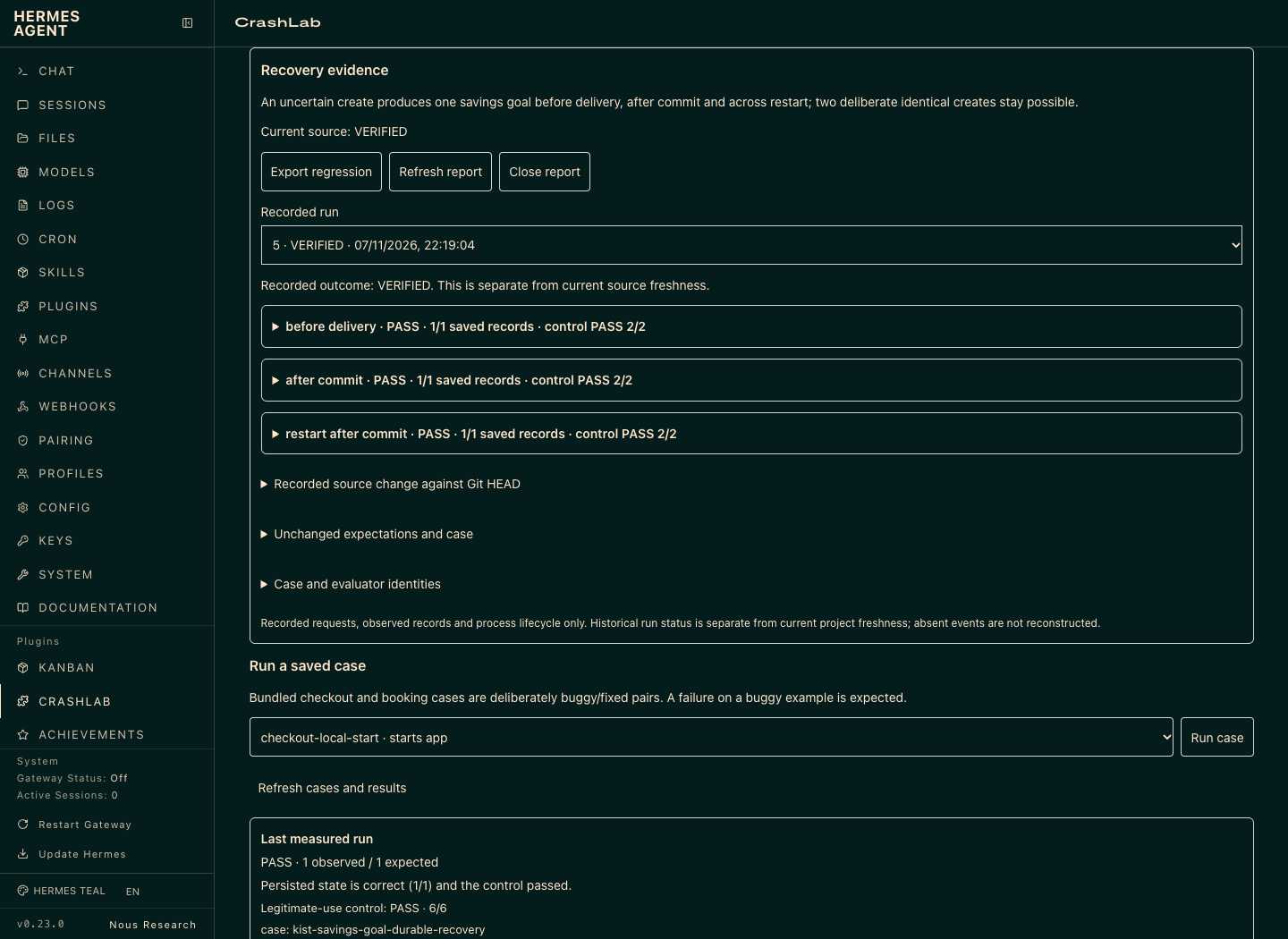
Choose Inspect evidence on an experiment. The report separates current source
freshness from a selected historical run and shows each measured boundary:
requests and intent/payload, interruption, independently observed records, actual
restart lifecycle, recovery decision and legitimate-use control. Missing historical
events are labeled absent rather than reconstructed. The source section contains
an actual bounded Git diff against that run's HEAD; it may include pre-existing
changes and does not include untracked file contents.
Use Export regression or crashlab_experiment_export to retain the test after
the conversation. The bundle stores frozen behavior and a launch template with
separate hashes. Local project/interpreter bindings live outside those assertions. Portable interpreter binding currently supports direct Python argv launches, including explicit Python executable paths; wrapper or other-runtime launches are rejected instead of silently ignoring the chosen interpreter.
It includes declared setup/environment values and can contain application data;
review it before sharing. It does not package dependencies, source repair, records
or a transferable VERIFIED status.
A fresh session can use crashlab_experiment_import with the bundle, disposable
project_path and absolute executable app_python. The evaluator must match;
otherwise install the recorded source pin or explicitly prepare a new experiment.
The import starts PREPARED. Reproduce the original failure, apply the repair to the
app, and rerun to earn new evidence. Binding paths does not rewrite journey steps,
record assertions or expected counts.
The same path is available without a model, from the installed plugin directory:
python crashlab_replay.py export --experiment EXPERIMENT_ID
# Copy the returned bindings.example.json and set project_path / app_python.
python crashlab_replay.py import --bundle /path/to/regression.json --bindings /path/to/bindings.json
python crashlab_replay.py run --experiment NEW_EXPERIMENT_ID
python crashlab_replay.py report --experiment NEW_EXPERIMENT_ID
run shows the exact frozen execution plan and requires an interactive terminal
approval. Piped or non-interactive invocations fail closed; approve the same plan
through the Hermes crashlab_experiment_run tool instead. The web dashboard
freezes the plan first (case file, launch command, working directory and
target), shows that plan in its confirmation, and executes the same snapshot
through a short-lived, single-use ticket; declining drops the ticket. These are
human-operator paths, not bypasses.
Use the same CRASHLAB_DATA_DIR when accessing an existing experiment. A measured
failing baseline returns a nonzero exit code as expected. Application runtimes,
dependencies and any external absolute launch paths remain your responsibility.
The dashboard shows your five most recent repair experiments and all watched
experiments, their current
source status, the last measured outcome and control. Use Rerun frozen case
after edits and Watch edits for completion reminders. Status refreshes when
you return to the browser tab or window or press Refresh cases and results.
Call crashlab_experiment_watch with the ID and enabled: true to request a
completion reminder while working on that project. After matching absolute-path
edits, the Hermes pre_verify hook requests current verification when evidence
is stale, failed or unavailable. Hermes caps continuation nudges; this is a
reminder, not an execution barrier. Set enabled: false to stop watching, even
if the frozen experiment has become invalid. Other projects are unaffected.
Included tools
crashlab_prepare: freeze an app-specific repair experiment.crashlab_experiment_run: reproduce or verify the same experiment.crashlab_experiment_status: check current source freshness.crashlab_experiment_watch: request project-scoped completion reminders.crashlab_experiment_report: inspect one recorded run and its real evidence.crashlab_experiment_export: save frozen behavior and a portable launch template.crashlab_experiment_import: bind that template to a fresh local checkout.crashlab_validate: validate a case without running it.crashlab_run: execute a saved browser case and persist its result.crashlab_compare: run one frozen case against broken and repaired URLs.crashlab_list: list bundled contracts.- Campaign list/validate/run tools: an optional, separate inventory-contention
experiment. See CAMPAIGNS.md; mixed browser campaigns remain
validation-only pending network confinement.
The checkout and booking apps are deliberately buggy fixtures. Historical
fixture reports remain in proof/ and the day-by-day development notes; they
should not be confused with the external Kist application.
Install
Requirements:
- Hermes Agent v0.23 or newer.
- Node.js,
npm, and Chromium available locally. playwright-coreinstalled for the runner.
Fresh install from the public repository:
hermes plugins install dolepee/crashlab --enable
# When Hermes asks to install the Node sidecar, answer yes.
# If installed non-interactively, finish the sidecar once:
cd "${HERMES_HOME:-$HOME/.hermes}/plugins/crashlab" && npm ci
# If no system Chromium/Chrome is available:
npx playwright-core install chromium
Then confirm:
hermes plugins validate "${HERMES_HOME:-$HOME/.hermes}/plugins/crashlab" --install-deps
hermes plugins doctor "${HERMES_HOME:-$HOME/.hermes}/plugins/crashlab"
The Desktop half is opt-in and appears in Capabilities → Plugins. It is
view-only: it reads CRASHLAB_DATA_DIR (default ~/.local/share/crashlab),
scans the bundled contracts/ plus CRASHLAB_CASE_DIR (default cases/), and
shows saved results. It never starts an execution. Run a case through the
crashlab_run tool or the dashboard, where the approval gate shows a bounded
summary of the case, command, working directory, environment variable names and
targets before you decide. Status, history and historical measured evidence are
available from /crashlab and /crashlab runs. /crashlab run <case.json> only
consumes an approval grant that already exists; it cannot acquire one.
Use the crashlab_run tool or the dashboard for a new approved execution — the
slash path directs you there when no grant exists.
Quote paths containing spaces: /crashlab run "/my project/case.json".
crashlab_list includes self-starting cases and setup requirements. A template
marked setup_required reports its instructions before launching anything;
remove that field after configuring the external application. Setup errors are
saved as ERROR, separately from measured assertion failures (FAIL).
Run a fixture
For a first run through Hermes with its normal approval flow, use the
bundled-case prompt.
The commands below are a manual runner example for developers inspecting the
sidecar; they do not demonstrate a Hermes-led repair.
Start the buggy and repaired checkout servers:
PORT=8765 BUGGY=1 CRASHLAB_DB=data/orders-8765.db python3 server.py
PORT=8766 BUGGY=0 CRASHLAB_DB=data/orders-8766.db python3 server.py
Run the saved contract against each:
CHROME_PATH=/usr/bin/chromium node crashlab_runner.js contracts/checkout-lost-response.json
CHROME_PATH=/usr/bin/chromium node crashlab_runner.js contracts/checkout-lost-response.json --base-url http://127.0.0.1:8766
For the second fixture:
PORT=8785 BUGGY=1 CRASHLAB_DB=data/bookings-8785.db python3 booking.py
PORT=8786 BUGGY=0 CRASHLAB_DB=data/bookings-8786.db python3 booking.py
CHROME_PATH=/usr/bin/chromium node crashlab_runner.js contracts/booking-lost-response.json
CHROME_PATH=/usr/bin/chromium node crashlab_runner.js contracts/booking-lost-response.json --base-url http://127.0.0.1:8786
BUGGY=0 is a prepared repaired fixture for comparison. The Day 3 gate is
different: a real Hermes agent edited the failing application and the unchanged
contract was rerun against that edit. DAY3.md records that run.
Contract format
A contract has:
app.base_urlorapp.start(command, cwd, Python, setup requests), and
optionalapp.reset_url.fault.route,fault.modeandfault.occurrence.journey— browser steps such asgoto,click,textandscreenshot.
Waits are declarative (wait_for_fault,wait_for_count,wait_for_value,
wait_for_any); contracts do not execute JavaScript on the host or in the
page.state— the expected length and the observer.mode: "sqlite"uses a
read-only database probe outside the app;mode: "http"uses the app's
/stateendpoint and is not independent of the application under repair.control— a separate journey and state expectation used to catch an
over-restrictive repair.
Recovery is explicit. A fault case must include recovery.success_statuses, a
non-empty list of terminal 2xx statuses (202 and 3xx are rejected). Redirects are
observed at their actual terminal response, not by manufacturing a terminal page
at the original POST URL. recovery.identity_headers selects the request headers
that must match between the original and retry; values are retained only as
digests. Pair recovery.response_id_path with recovery.record_id_field to check
a terminal JSON reply ID against the single observed record. Omit both for HTML
redirects: those rely on terminal success plus the declared journey/state
assertions, and the result says that no response identity predicate was
configured. Decimal-string IDs remain valid; unsafe JSON integer literals are
rejected rather than rounded.
The runner exits non-zero when the primary or control assertion fails, or when
the configured fault did not match and commit a write. A failed check is
evidence, not a pass.
Historical recordings
demo/kist-demo.mp4 is an earlier evidence replay and
demo/crashlab-kist-live.mp4 is an earlier browser recording. They concern the
historical repair, not the fresh November 7 patch, and are not final submission
videos. Recording plans and source are maintained privately.
External application example
The external/kist directory contains a browser contract against an
unmodified Kist checkout, the Hermes repair patch, before/after screenshots and
the exact replay command. It is an external application verification example, not evidence of user
adoption. The contract checks one recovery intent against one goal and two
deliberate goals against two goals; the Kist database is observed directly.
The contract now carries an app.start block. crashlab_run starts Kist
through the same local-app path as every other case; run_kist.py builds that
block and no longer runs a separate application launcher.
cases/checkout-local.json and cases/checkout-local-fixed.json are the
fixture transfer check. cases/flaskr-create.json is the independent application
check against Pallets' Flaskr tutorial at commit
49943b5a94413a530761350f04e896f76e8d620e; it registers a user, creates one
post and observes one row in SQLite through the same app.start path. See
external/flaskr/README.md.
See external/kist/README.md. Do not describe the
before run as repaired or the patch as a general autonomous repair.
The image above is the actual Hermes dashboard tab, reading saved evidence. The
Desktop pane is a separate surface and needs a running Hermes Desktop session to
capture.
Scope and limitations
- Two local fixtures plus the external Kist example; Kist is one external app
with a measured retry-failure repair, not proof of broad compatibility. - Flaskr is a public tutorial app with a guided native-form repair and a separate
historical passing workflow. Its retained repair covers fresh databases and
needs migration work for existing installations. The checkout cases are fixtures. - The Desktop pane was launched in Hermes Desktop for the earlier evidence view
indocs/desktop-pane.png; the newest run/comparison view is wired to the
persisted run but has not been visually recaptured. - The runner requires a local Chromium and
playwright-core. - Recovery covers prevented delivery, lost acknowledgement after commit and a
managed restart retaining observed state; this is not a general chaos testing
engine.mode: "http"is app-supplied and cannot prove the app did not
tamper with its own state; usesqlitefor the bundled fixtures. - The repair evidence covers Kist, Flaskr and the bundled checkout fixture. It is one
known defect class, not a claim of general repair. app.startruns a local command by design. It receives only PATH, LANG, TZ,
HOME, PORT and contract-declared environment values; it does not inherit the
agent's provider or API credentials.
Disclosure
CrashLab starts configured local applications, launches headless Chrome/Chromium,
and reads their state. Run summaries are stored under CRASHLAB_DATA_DIR
(default ~/.local/share/crashlab); launched apps use temporary data directories,
and screenshot locations come from the case. These files can contain application
data. CrashLab needs no hosted testing service, but the configured application
and browser journey can make network requests. Use trusted disposable apps and
cases; the browser runner is not a network-confinement boundary.
Browser verification guarantees
Fault cases require an empty independently observed scoped baseline. A dirty
baseline is INVALID, not a passing repair. record_fields checks exact stored
values; request_fields maps database columns to top-level JSON request fields
on the fault route, binding every observed row to a distinct captured request.
Checkout cases check both the intent key and item. These checks are configured
per application; cardinality alone does not establish full business correctness.
Comparisons snapshot the contract once, use it for both runs, record its SHA-256
and evaluator hashes, and reject evaluator changes during the pair. These are
integrity checks in a trusted local installation, not an operating-system sandbox.
Install a browser with npx playwright-core install chromium, or set
CHROME_PATH to an existing Chromium/Chrome executable. Run real-browser
regressions with CRASHLAB_BROWSER_TESTS=1 python -m unittest test_browser_integrity.
For development checks, install requirements-test.txt to enable the JSON Schema
contract checks, then run python -m unittest discover. Real-browser acceptance
requires the Node sidecar and CRASHLAB_BROWSER_TESTS=1. Runtime plugin tools do
not require the test-only schema package. Completion reminders log experiment ID,
session ID and current state through the Hermes diagnostic logger.
Frozen experiments retain their evaluator identity. Updating the evaluator can
make an earlier experiment unavailable; preserve its historical evidence and
prepare a new experiment for the new version rather than editing frozen hashes.
README from the reviewed commit 40932f8; it updates when the author re-pins.