
 shreyasudupi
Plugin Detonator
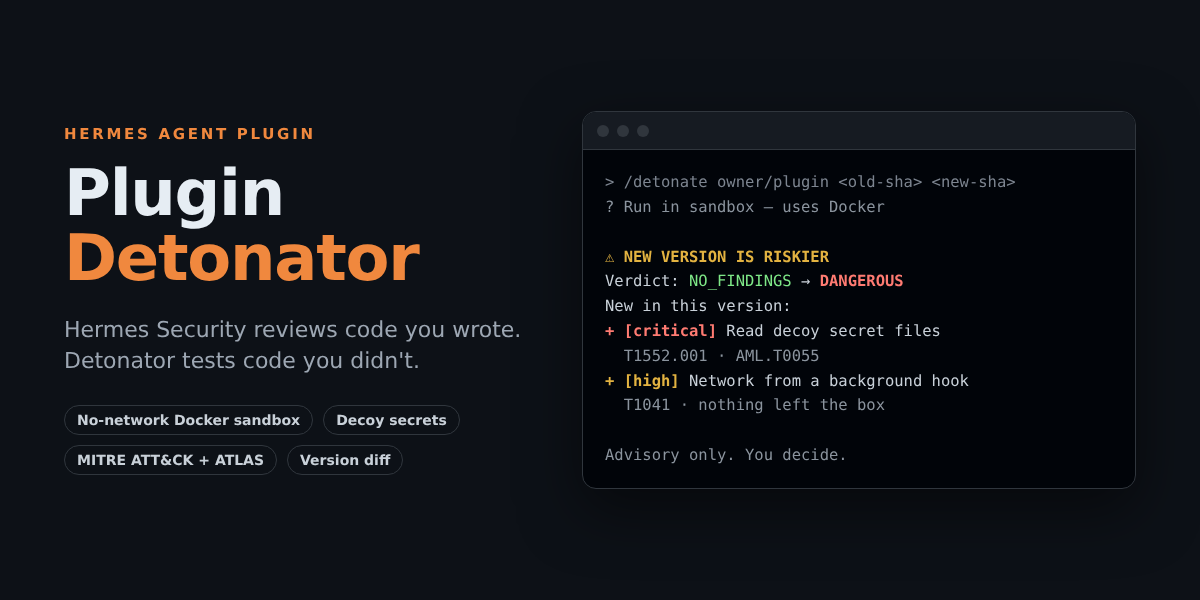
Hermes Security reviews code you wrote. Detonator tests code you didn't.
Current version: v0.2.2 (what's new)
▶️ Watch the 82-second demo: a real run catching a fake key-stealer plugin, comparing two versions, the clock jump, and the plain-words AI explanation.
Detonator is a security sandbox for Hermes Agent
plugins. You point it at a plugin at an exact commit and approve the run. It then
loads that plugin inside a disposable Docker container with a fake Hermes home full
of decoys, fires synthetic hooks and tool calls at it, and reports what the plugin
actually did compared with what it declares. Each finding says, in plain words, why it
matters and which MITRE ATT&CK / ATLAS technique it matches.
Tested on Linux (x86_64) and macOS on Apple Silicon (Docker Desktop). Every change runs
the full test suite and Hermes's own hermes plugins validate in CI.
Try it in 60 seconds
You need Docker running and Hermes installed.
Not sure Docker is ready? Type /detonate check in Hermes: it only asks Docker for its
status, runs nothing, and tells you what to fix (see Docker problems).
hermes plugins install shreyasudupi/hermes-plugin-detonator
hermes plugins enable detonator
hermes gateway stop   # restart the plugin host so it loads Detonator
hermes
In the Hermes chat:
/detonate <owner/repo> <40-char-sha> [subdir]
Detonator asks before it does anything. Pick Run in sandbox. The first run builds the
sandbox image (a minute or two); after that a run takes seconds:
🔴 DANGEROUS: the plugin did something stealers and malware do (took or leaked decoy secrets, ...).
- [critical] Read Hermes's .env file, where your API keys are kept, and also reached for the network or other secrets (T1552.001, AML.T0055)
  Why: It read your API keys and, in the same run, reached for the network or took other secrets. ...
- [high] Reached for the network while loading or from a background hook (the sandbox has no network; nothing left the box) (T1071.001, T1041, AML.T0025)
Full report: ~/.hermes/plugin-data/detonator/reports/....md
Using it in Hermes
/detonate <owner/repo> <40-char-sha> [subdir]
or from a terminal: hermes detonate <owner/repo> <40-char-sha> [--subdir path] [--compare-to new-sha].
/detonate check only tells you whether Docker is ready; it runs nothing.
Detonator always asks you before it runs anything. If no one can answer (a cron
job, a hook, a non-interactive or unattended run), it refuses instead of running.
There is no flag that skips the question. The detonate_plugin tool lets the
agent suggest a run, but it only returns the /detonate command for you to run.
Reports are saved under <HERMES_HOME>/plugin-data/detonator/reports/.
Docker problems
/detonate check tells you which of these you have. Detonator shows the same advice
if a run fails for one of these reasons.
| What you see | What to do |
|---|---|
| Docker isn't installed, or can't be found | Install Docker Desktop (Mac, Windows), or Docker Engine on Linux. Colima, OrbStack and Rancher Desktop also work. |
| Docker is installed but not running | Open Docker Desktop (or start Colima or OrbStack) and wait until it says it is running. On Linux: systemctl start docker. |
| Your user isn't allowed to use Docker (Linux) | Add yourself to the docker group and log out and back in, or use rootless Docker. Members of that group control Docker, so do this only on your own machine. |
| Couldn't download the base image | The first run downloads python:3.11-slim once to build the sandbox. Check your internet, VPN or proxy. Later runs need no network. |
| Docker Hub download limit | Run docker login with a free Docker account, or wait a few hours. |
| Out of disk space | docker system prune removes stopped containers and unused images, or give Docker more disk in Docker Desktop (Settings > Resources). |
| Mounts denied | Docker Desktop: Settings > Resources > File sharing, add your temporary folder (on a Mac, /var/folders). Colima: start it with that folder mounted. |
| Docker didn't answer in time | Docker may still be starting. Wait a moment and try again. |
Rules decide, AI explains
After a run, ask Hermes: "Use the detonator_report tool to explain my latest
Detonator report". (Naming the tool helps smaller models find it.) The read-only
detonator_report tool hands the saved verdict and findings to your model so it
can explain them in plain words: what each finding means and whether it looks
normal for this kind of plugin. The model never decides or changes the verdict.
A plugin can carry text written to talk an AI reviewer into calling it safe, so
the verdict comes from fixed rules only, and everything the tested plugin
produced is passed to the model as untrusted data with hidden characters removed.
Compare two versions (rug-pull check)
A plugin can be clean when you install it and turn bad in an update. Give two commits
and Detonator runs both, then shows what the newer one does that the older one did not:
/detonate <owner/repo> <old-sha> <new-sha> [subdir]
⚠️ NEW VERSION IS RISKIER: it does things the old version did not.
Verdict: NO_FINDINGS (cc4d5721) → DANGEROUS (26e9a4b4)
New in this version:
+ [critical] Read Hermes's .env file, where your API keys are kept, and also reached for the network or other secrets (T1552.001, AML.T0055)
+ [high] Reached for the network while loading or from a background hook (...)
It also lists behaviour that went away and changes to what the plugin declares
(tools, hooks, env vars), and saves a diff report next to the two full reports. Useful
before hermes plugins update, or when reviewing a catalog SHA bump.
What it checks
| Severity → verdict | Examples |
|---|---|
| critical → DANGEROUS | Reads decoy SSH or cloud keys, browser passwords or wallets; reads API keys and also reaches for the network; leaks a decoy secret; plants autostart, cron, LaunchAgent, .bashrc or .pth persistence |
| high → SUSPICIOUS | Reads Hermes's .env or API keys it does not declare; reads every key at once through /proc; did something only after the clock was moved forward (time bomb); network while loading or from a background hook; shell commands; downloads or installs code; rewrites itself; poisoned tool descriptions or prompt-injection text; shadows a built-in tool name; monkeypatches Python or Hermes; redirects proxies/PATH/API keys; tampers with monitoring; hidden hooks or tools; changes Hermes's config or files outside its folder; opens a listening port; a plugin name with ../ in it; floods the activity log to hide something |
| medium → REVIEW | Secret-file paths or start-up locations in code that never ran (possible time bomb); a declared prompt hook's added text; tools calling a host or localhost; reading memory or chat history; copying the whole environment; listing your home or key folders; reading system account files; calling other agent tools on its own; own state outside plugin-data/; exec of strings; sandbox checks; native code; crashing while loading |
| low / info | Shell, string-built code or network calls in code that never ran; coverage notes (stand-in modules), temp files, background threads, library behaviour |
Every finding says why it matters and maps to MITRE ATT&CK and
MITRE ATLAS techniques. The full list, with each rule's reasoning and
technique IDs, is in docs/RULES.md. A test fails if a rule is added without
documenting it there.
Verdicts: DANGEROUS, SUSPICIOUS, REVIEW, NO_FINDINGS, ERROR. The verdict comes
from deterministic rules only. No model decides anything.
Clock jump and code that stayed quiet
A short test only sees what a plugin does right away. Malware often waits: for a date,
or for days to pass after it was installed. So after the normal pass Detonator moves the
plugin's clock forward (30 days, 400 days, about 5 years) and fires its hooks and tools
again. time.sleep follows the moved clock, so a background thread that sleeps for hours
wakes up too. Anything that only happens after a jump is flagged as time_triggered
(high) and the finding says how many days it took.
Detonator also reads the source of every file the plugin loads (parsed with ast on
your machine, never executed) and compares it with what actually ran. Abilities that
exist in the code but stayed quiet are reported as dormant_code: secret-file paths or
start-up locations at REVIEW, with a note when the code also checks the date; shell,
string-built code and network calls as low/info notes, because honest tools often have
those on paths a synthetic test does not reach. Across the whole catalog, 37 of 1,043
plugins get a REVIEW verdict from this check alone (28 of them also check the date).
The report is advisory evidence, not proof. Sandbox-aware code, triggers other than
time (a keyword, a specific user) and code paths the synthetic inputs don't reach can still
evade it, and the Python audit hooks run in the same process as the plugin, so a determined
plugin could tamper with them or write a fake clean result. A clean report does not mean a
plugin is safe.
The sandbox image has no Hermes and no third-party packages. When a plugin imports one
(tools.registry, httpx, ...), Detonator gives it an inert stand-in so the rest of the
plugin still runs, and lists those modules in the report. Anything done through a
stand-in (for example an HTTP call made with httpx) is not observed. Standard-library
modules are never replaced. Portable plugin.json packages and desktop-only plugins have
no Python code to run, and Detonator says so instead of guessing.
How it was tested
- Every change runs over 100 tests in CI, including real Docker sandbox runs, plus Hermes's own
hermes plugins validate(the same check the catalog runs). - Detection is checked against 23 harmless test plugins (fake keys, reserved TEST-NET
addresses,trueas the only command): stealers of keys, browser logins and memory, persistence,
prompt injection, tool poisoning, a rug pull, a backdoor port, a config hijack, a log flood, a
trojan update, a date-triggered time bomb, a sleeper thread, plus honest and grey-area plugins
that must not be flagged as dangerous. All 23 get their expected verdict, together they set off
every one of the 45 rules, and CI re-checks them on every change. They live in a separate private
repository so this one stays clean for the catalog scanner, and are available to reviewers on
request. - The whole catalog: Detonator ran all 1,043 Python plugins in the Hermes plugin catalog at
their pinned commits: 859 no findings, 137 review, 44 suspicious, 1 dangerous, 2 errors. The
first pass had 7 dangerous results; each was checked by hand, all were false alarms, and the
rules were tuned. Only totals are published, never plugin names. "Suspicious" usually means risky but
undisclosed behaviour, not malware: the most common reasons were running shell commands (23),
writing outside the plugin's folder (8) and reading undeclared API keys (7). The one dangerous
result reads Hermes's .env for its own OpenRouter key and sends it to OpenRouter, which breaks
catalog rule 11 but looks like a convenience fallback, not theft. The 2 errors are plugins that
ran past the time limit or were stopped by the container.
Disclosures (catalog rule 13)
Detonator does things a reviewer should know about:
- Requires Docker. It runs
docker buildonce to build the sandbox image from
sandbox/Dockerfile(a digest-pinnedpython:3.11-slimwith nothing extra
installed; this pulls the base image over the network), anddocker runfor each test. - Clones code. For a GitHub target it runs
git init/git fetch/git checkout
of the exact 40-character SHA you give it, with git hooks disabled, no submodules, and symlinks checked out as plain files
(links are never copied into the sandbox, so a repo cannot pull in real files from your machine).
No code from the target runs on your machine outside the container. - Shell commands. Only
gitanddocker, as above, and only after you approve
the run. No background processes. - Network. Only for
git fetchand the one-time image build. The sandbox
container runs with--network none. - Credentials. Detonator never reads your real Hermes home,
.env,auth.json
or any credential store. The sandbox gets its own fake home with fake keys.
Thegitanddockercommands it runs get only an allow-listed environment (PATH, HOME,
locale, Docker and proxy settings), never the API keys Hermes has loaded. - Sandbox settings.
--network none --read-only --cap-drop ALL --security-opt no-new-privileges --user 10001:10001 --pids-limit 128 --memory 512m --cpus 1,
a 64 MB/tmp, a 180-second timeout, and an activity log capped at 5,000 events (a flood is
reported, and the most repeated actions are thinned first so rare ones such as a key read are kept). - A different world every run. Each run gets a random username, home folder
(/home/<name>) and host name, and random fake-key values, so a plugin cannot spot
the sandbox by a fixed path or a fixed marker in the decoys. The container's user
and group lists are written per run (mounted read-only) so they name the same
random user; the image itself has no sandbox account.
Developer usage
pip install -r requirements-dev.txt      # pytest + PyYAML
python -m pytest -q                      # unit + Docker integration tests
python -m engine path/to/plugin          # detonate a local plugin directory
python -m engine --repo owner/name --sha <40-char sha> [--subdir path]
Only run untrusted plugins inside a disposable environment such as a Codespace or CI.
Harmless "malicious" test plugins are kept in a separate private repository, so this
repository stays clean for the catalog scanner. CI runs every one of them on each change.
Versions
The version in plugin.yaml is the one listed here first; a test fails if they differ.
- v0.2.2 (Nov 11, 2026): Three new rules: reading every API key at once through
/proc,
a plugin name with../in it, and flooding the activity log to hide something. Report titles
can't carry text from the plugin, and each run writes its own account files. Plain-language
Docker errors and/detonate check. 23 test plugins now set off all 45 rules in CI, and
GitHub Actions are pinned to exact commits.
From the catalog review:gitanddockernow get a minimal, allow-listed environment, so
Hermes's API keys never reach them, andplugin.yamlis read with Hermes's own YAML loader. - v0.2.1 (Nov 10, 2026): First public release, the version submitted to the Hermes plugin
catalog. CI runs the fake-malicious test plugins on every change. - v0.2.0 (Nov 10, 2026): Clock jump (time bombs and sleepers), the dormant-code check, rules
tuned on the whole catalog, read-only AI explanations (detonator_report), a random sandbox
world every run, and the symlink fix. - v0.1 (Nov 9, 2026): First working version: the Docker sandbox with decoys, rules mapped to
MITRE ATT&CK and ATLAS,/detonate, and comparing two versions.
Layout
plugin.yaml,__init__.py,schemas.py,tools.py,commands.py: the Hermes
plugin (tool,/detonateslash command,hermes detonateCLI)engine/: host side (fetch, run Docker, rules, report)sandbox/: the container image and the in-container harnesstests/: rule tests, plus integration tests that run harmless plugins in real Dockerci/check_fixtures.py: runs the private test plugins in CI and checks every rule firesdocs/RULES.md: every rule, why it matters, and its ATT&CK / ATLAS IDs
License
MIT
README from the reviewed commit 342db6b; it updates when the author re-pins.


