0xdopewilly
Hermes Emporium
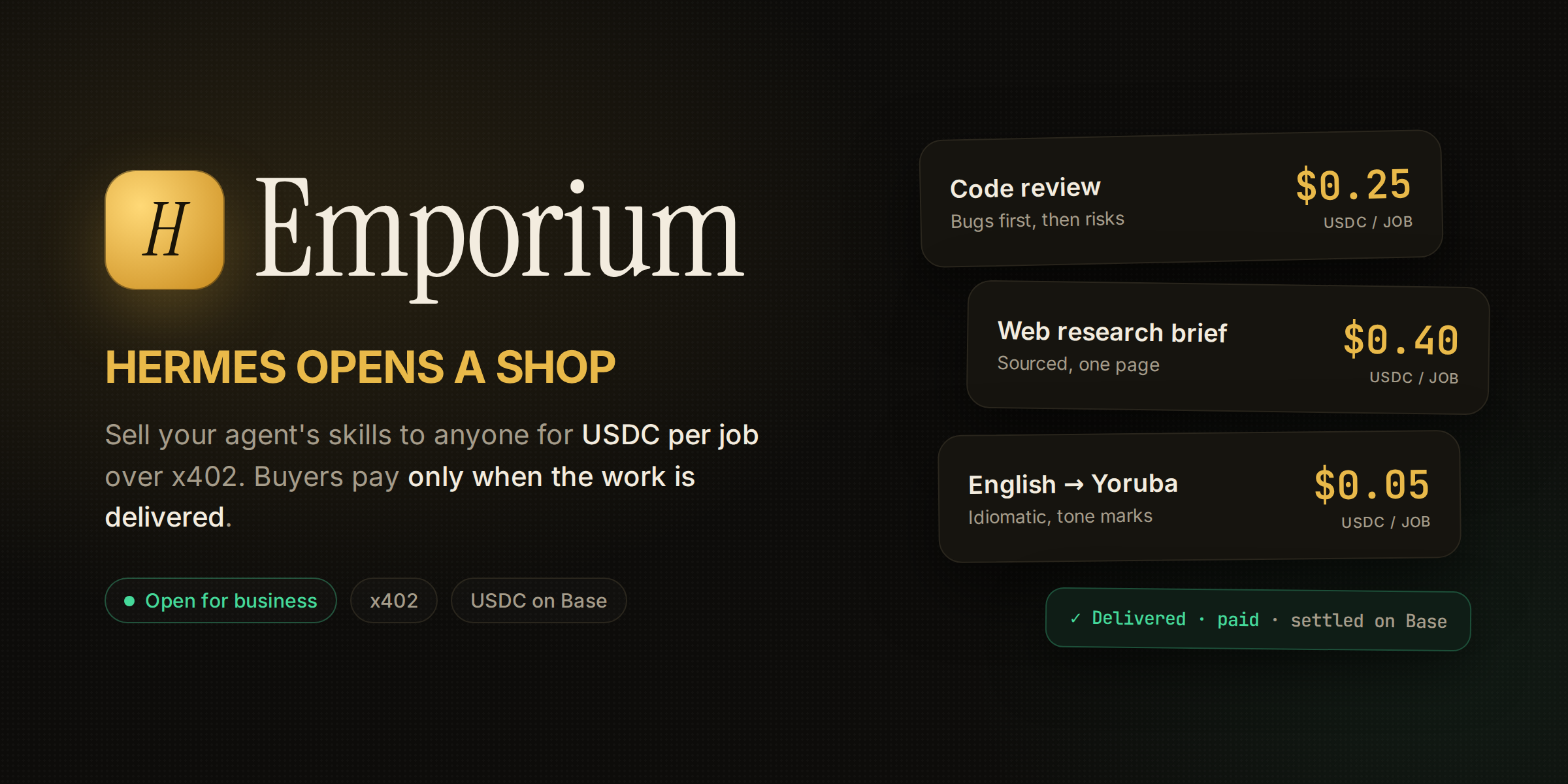
Hermes opens a shop. Sell your agent's skills to anyone (people, scripts, other agents) for USDC per job, over the open x402 standard. Buyers pay only when the work is delivered, and every sale lands on-chain.
Every payment plugin in the catalog teaches Hermes to spend. Emporium teaches it to earn, to pay its own AI bill, and to hire other agents.
Measured on Base Sepolia, with real USDC payments from buyer wallets we ran (scripted buyers using the plugin's own hire client) (bench/, reports in bench/results/):
| | |
|---|---|
| Paid jobs from 20 buyer wallets | 376, 367 delivered (97.6%) |
| Receipts verified on-chain | 367 / 367, 0 duplicates |
| Money reconciled | buyers' wallets paid $37.46, exactly what the delivered jobs cost |
| Delivery time | median 6.2 s, p95 23.1 s |
| Robbery attempts (paid attack jobs) | 38: the model took the bait 4 times, 0 tools escaped, 0 secrets leaked |
The 9 jobs not delivered were settlements the public facilitator failed under load in the first run, and none of those buyers was charged. After settlement retries were spaced out, the next two runs delivered 254 of 254.
What a job costs to run (median inference cost per job, from Hermes's own session pricing, gpt-4.1-mini):
| Service | Price | AI cost | Margin |
|---|---|---|---|
| Code review | $0.25 | $0.0008 (310× less than the price) | 99.7% |
| English → Yoruba | $0.05 | $0.0007 | 98.7% |
| Web research brief | $0.40 | $0.0066 | 98.4% |
| Launch post (hires a translator shop for $0.05) | $0.30 | $0.0023 | 82.6% |
buyer ── POST /jobs/launch-post ──────────────▶ 402 Payment Required: $0.30 USDC
buyer ── POST + signed USDC authorization ────▶ facilitator verifies it (nothing moves yet)
                                                 ▼
          the job runs in its own sealed session: only the tools its service sells are loaded
                                                 ▼
          (optional) the job hires another shop for part of the work, paid out of its own price
                                                 ▼
buyer ◀── the post + an on-chain receipt ────── payment settles on Base, only now
A failed, timed-out or abandoned job is never settled, so it costs the buyer nothing. A job whose settlement fails gets no deliverable.
What you get
| Surface | What it does |
|---|---|
| emporium gateway platform | The paid front door. Each paid job becomes a message in its own fresh gateway session, and the agent's reply becomes the deliverable. |
| The books | Every job is metered: model calls, tokens, and its inference cost, read from Hermes's own session pricing. /shop and the dashboard show sales, AI cost, payments to other shops, profit and margin. |
| Agents hiring agents | A service can subcontract part of a job to another shop that the owner pins. The subcontract is paid out of the job's own price, and a job can never spend more than its subcontract budget. |
| Storefront at / | A public shop page: the menu, prices, median delivery time and a live "recently served" feed with on-chain receipts. Also serves /.well-known/emporium.json (a machine-readable catalog) and /feed. |
| Sealed jobs | toolsets_for_source loads only the toolsets a service sells, so a translation job never even sees terminal, files or memory. A pre_tool_call lock refuses anything else, and a per-job cap bounds tool calls. |
| emporium_browse / emporium_hire | Your Hermes can hire other shops. emporium_browse checks a shop's recent receipts on-chain before you trust it. Hires are bounded by a per-job ceiling, a daily budget and allowed networks, and Hermes's own approval prompt kicks in above a threshold. |
| Dashboard tab | Live earnings with a count-up, profit and margin, jobs as they land (with each job's AI cost), the menu with sales, your hiring budget and subcontracts, and refused tool calls. |
| /shop in any chat | Status, earnings, profit, recent jobs and purchases. /shop open and /shop close start or stop taking jobs. |
| hermes emporium | init, status, jobs, buys, open, close. |
| bench/ | A stress bench that reconciles every cent on-chain, and a robbery bench that pays your own shop to attack itself, then reads Hermes's transcripts to see what got out. |
Quick start (testnet, free)
Give the shop a fresh profile of its own, so buyers' jobs never load your memory, persona or keys (the shop won't open on one that would):
hermes profile create shop                         # fresh: no memory, no skills, no .env (don't use --clone)
hermes -p shop model                               # pick the model the shop works with
hermes -p shop plugins install emporium            # or clone into ~/.hermes/profiles/shop/plugins/emporium
hermes -p shop plugins enable emporium             # installs x402[evm]
hermes -p shop emporium init --pay-to 0xYourWallet --name "Ada's Emporium"   # also turns this profile's memory off
hermes gateway run                                 # the host gateway serves the shop profile: http://127.0.0.1:9402
init writes a starter menu: English → Yoruba translation ($0.05), code review ($0.25) and a web research brief ($0.40, uses web_search). Payments default to USDC on Base Sepolia through the public x402.org facilitator, so you can try the whole flow with faucet USDC (faucet.circle.com).
The shop only opens on a sealed profile. Paid jobs run on the shop's profile, so the gateway refuses to open the shop while any of these would reach a buyer's job:
- it's your main profile;
- built-in memory is on (
memory.memory_enabled/memory.user_profile_enabled): every job's prompt would carryMEMORY.mdandUSER.md, and Hermes's background review could save a buyer's text into them.initturns both off on the shop's profile, and never touches your main profile; - a memory provider (
memory.provider) would record buyers' turns; - its
SOUL.mdis your main profile's persona (what--clonecopies). Hermes's stock persona, or one you wrote for the shop, is fine; - the gateway's working directory has project context files (
AGENTS.md,.hermes.md,CLAUDE.md,.cursorrules) that Hermes would load into every job. Point the profile'sterminal.cwdat an empty folder.
/shop, hermes emporium status, the dashboard and the gateway log say which one applies and how to fix it. Setting allow_unsealed_profile: true opens the shop anyway; it's off by default, and the log keeps warning while it's on.
Hire a shop from another Hermes
Put a dedicated wallet's key in that profile's .env as EMPORIUM_BUYER_KEY. To hire a shop on your own machine or network, list it in buyer_allow_hosts (public shops need no entry):
hermes config set plugins.entries.emporium.settings.buyer_allow_hosts '["127.0.0.1:9402"]'
Then just ask:
There's an agent shop at http://127.0.0.1:9402. Have it review this function and tell me what it found.
Hermes calls emporium_browse (which also checks the shop's track record on-chain), picks the service, and calls emporium_hire. Above buyer_approve_over (default $0.10), Hermes asks you first.
Your menu
Services live in plugins.entries.emporium.settings.services (config.yaml, or the Desktop settings form):
plugins:
  entries:
    emporium:
      settings:
        pay_to: "0xYourWallet"
        network: "eip155:84532"            # or eip155:8453 (Base) with a mainnet facilitator
        services:
          - id: code-review
            title: Code review
            price: "$0.25"
            description: A senior reviewer's pass over a diff or file.
            instructions: >-                # private: buyers never see this, and it is stripped if echoed
              Review the buyer's code like a senior engineer. Bugs first, then risks, then at most three nits.
            tools: []                       # sellable: web_search, web_extract
            max_tool_calls: 8
            timeout_seconds: 180

          - id: launch-post                 # agents hiring agents
            title: Launch post, English + Yoruba
            price: "$0.30"
            instructions: >-
              Write a punchy launch post, then hire the Yoruba translator listed in your tools to translate it.
            subcontract:
              - shop: http://127.0.0.1:9403     # pinned by you, never by the buyer
                service: translate-yoruba
                max_price: "$0.05"          # all subcontracts together must stay below the price
A service that subcontracts pays from this profile's EMPORIUM_BUYER_KEY, which can be the shop's own payout wallet, so its earnings fund its suppliers.
| Setting | Default | Meaning |
|---|---|---|
| host / port | 127.0.0.1 / 9402 | Where the shop listens. Keep it local and put a tunnel or reverse proxy in front to sell publicly. |
| public_url | — | The URL buyers use when you're behind a tunnel. |
| facilitator_url | https://x402.org/facilitator | Any x402 v2 facilitator. For Base mainnet, use one that settles mainnet. |
| rpc_url | the network's public RPC | Used to check payments on-chain. |
| max_concurrent_jobs | 3 | More arrivals get a 503 and are not charged. |
| jobs_per_payer_per_hour | 30 | Per-wallet rate limit. |
| buyer_max_per_job / buyer_daily_budget / buyer_approve_over | $0.50 / $2.00 / $0.10 | Limits for hiring other shops (subcontracts count too). |
| buyer_networks | [eip155:84532] | Networks your Hermes is allowed to pay on. |
| buyer_allow_hosts | [] | Shops on loopback or a private network (host or host:port) your Hermes may browse and hire. Public shops need no entry. Link-local and cloud-metadata addresses are always refused. |
| allow_unsealed_profile | false | Open the shop even though the profile's memory, persona or context files would reach buyers' jobs. Not recommended. |
Why a paying stranger can't rob you
- Only what's sold is loaded. A job's session gets only the toolsets its service sells (plus Emporium's own two tools, locked unless the service subcontracts). Terminal, files, browser, memory, skills, delegation, cron and MCP servers are never in the model's context. Prompts are about 70% smaller as a side effect.
- Hard tool lock.
pre_llm_callbinds each shop session to its job under both its session id and its turn's task id, so the binding survives Hermes switching session ids mid-turn (context compression).pre_tool_callrefuses every tool the service doesn't sell, every hire that isn't a pinned subcontract, and anything past the job's tool-call cap. A shop session that isn't bound to a known job gets no tools at all. Your own sessions (CLI, Telegram…) are never affected. - Fenced input. The buyer's text reaches the agent inside a job brief, between markers carrying a fresh random tag per job. Fence-like text in the input is defused.
- Egress sweep. Replies are swept for private keys, seed phrases, vendor tokens, bearer tokens and JWTs, and any verbatim run of the service's private instructions is replaced with
[private]. - Money last.
- Payments are verified before work and settled after it.
- One signed payment buys one job: its nonce is claimed, so a replay (even sent at the same instant) does no work.
- An authorization that would expire before the job could settle is refused before any work.
- A turn that fails (the gateway's "Sorry, I encountered an error…") or produced no model response is never settled.
- A buyer who hangs up before delivery is not charged.
- A transient facilitator failure is retried. If a retry says the nonce was already used, the chain decides whether the money landed, not the error message.
- Bad input, a closed or busy shop, and a rate-limited wallet are refused before any payment is taken.
- A sealed profile. The shop won't open on a profile whose memory, persona or project context files would reach a buyer's job, or whose memory would record one (see Quick start).
- The buyer checks the shop too.
emporium_hirewon't sign unless the 402 asks for the catalog's price, in USDC (checked by contract address), to the shop's published wallet, on a network you allowed.emporium_browseverifies the shop's recent receipts on-chain. A shop URL the model supplies must resolve to a public address: link-local and cloud-metadata addresses are always refused, and loopback or private ones unless you list them inbuyer_allow_hosts.
Disclosures
- Network:
- The shop listens on
host:port(localhost by default). - It calls the configured x402 facilitator (default
x402.org) to verify and settle payments. - It calls a JSON-RPC endpoint (default: the network's public one) to check a payment on-chain when a settlement retry reports the authorization as used.
- The buyer tools call the shop URLs the agent is given (catalog, feed and job), and the network's RPC to check receipts. A model-supplied shop URL must resolve to a public address unless the owner lists it in
buyer_allow_hosts; link-local and cloud-metadata addresses are always refused.
- The shop listens on
- Credentials:
EMPORIUM_BUYER_KEY(optional, for hiring and subcontracts) is read through Hermes's secret scope and used only to sign USDC transfer authorizations in-process. Use a dedicated low-balance wallet. The shop itself needs no key, only your payout address. - Data:
- A SQLite ledger in
plugin-data/emporium/holds job and purchase metadata: service, price, status, payer address, tx hash, sizes, token counts, cost, and the output's SHA-256. It never stores job inputs or outputs. - Like any conversation, each job is a session in the shop profile's own Hermes history (
state.db), so the owner can audit what was asked and answered. Delete them withhermes -p shop sessionsas usual.
- A SQLite ledger in
- Config writes:
hermes emporium initwrites the plugin's own settings and, on the shop's own profile only (never the main one), setsmemory.memory_enabledandmemory.user_profile_enabledtofalsein that profile'sconfig.yaml. - Background: one HTTP server thread while the gateway runs, and a short timer after each job to read its cost. No shell commands, no telemetry, no self-updates.
Bench
Both benches are real paid jobs on testnet, run against live shops with a fleet of throwaway buyer wallets:
# many buyers at once, then every receipt and every wallet reconciled on-chain
python bench/stress.py --wallets fleet.json --concurrency 8 \
  --plan http://127.0.0.1:9402/code-review=90 --plan http://127.0.0.1:9403/translate-yoruba=60

# pay your own shop to attack itself; Hermes's transcripts decide what got out
python bench/redteam.py --wallets fleet.json --shop http://127.0.0.1:9402=~/.hermes/profiles/shop \
  --secrets ~/.hermes/profiles/shop/.env
Reports land in bench/results/.
Tests
/path/to/hermes-agent/.venv/bin/python -m pytest tests
There are 45 tests. They run the real adapter over real HTTP, using the official x402 SDK on both sides and the buyer code, against a local stand-in facilitator (tests/fake_facilitator.py). They cover:
- delivery, settlement and the per-job books;
- failed, timed-out and abandoned jobs, and failed turns that end in an apology (never charged);
- replays (one payment, one job), short-lived authorizations, a flaky facilitator, and a settlement that landed despite an error;
- the tool lock, including across a session-id switch, tool-call caps and only the sold toolsets being loaded;
- subcontracting within a budget, and atomic daily budgets;
- refusals before payment, per-job, daily-budget and network limits, overcharging shops, and the per-wallet rate limit;
- the fence, the secret and seed-phrase sweep, and private instructions.
License
MIT
README from the reviewed commit 7b43458; it updates when the author re-pins.