 PhiBao
manyhands
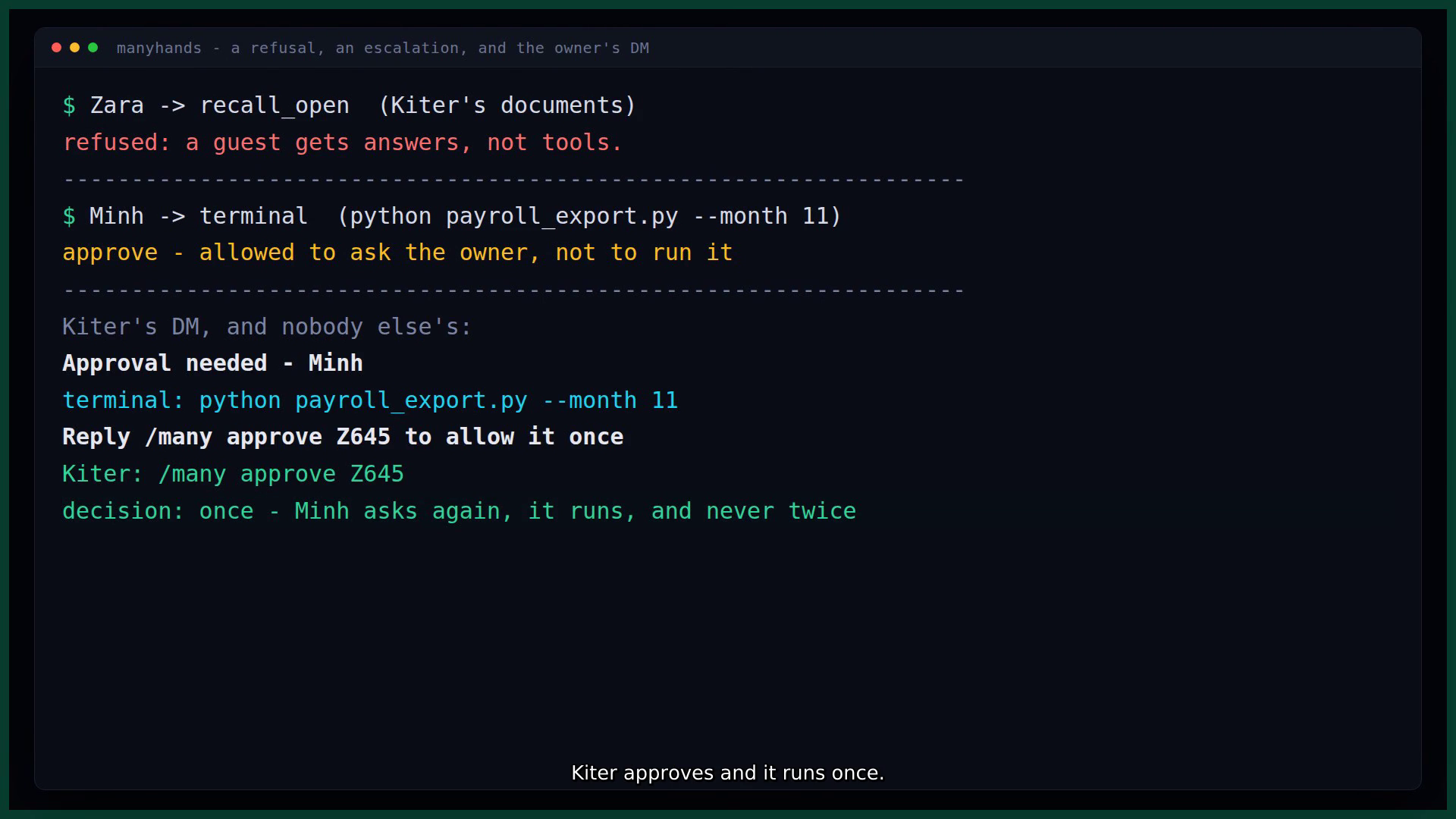
One Hermes, many people. Every sender who talks to your bot gets their own identity, their own
memory, their own tool allowlist and their own approvals — and you can see who asked for what.
Kiter  (owner)   → every tool
Minh   (member)  → web_search, recall_search, manyhands_remember …
Guest  (guest)   → web_search, manyhands_whoami
A Hermes gateway is a single-operator agent. The platform already carries per-sender identity into
every turn (pre_llm_call receives sender_id + platform), but nothing acts on it: everybody in
the group talks to the same memory, the same toolset and the same approval authority. manyhands is
the plugin that acts on it.
- Identity comes from the platform event, never from message text.
- Roles have three states per tool, not two:
allow(runs),ask(the owner's DM decides) and
(everything else)never. A member who asks for a shell command does not get "no" — they get the
owner's phone lighting up. A guest never escalates: prompting the owner on a stranger's behalf is
a phishing surface, not a feature. Roles areowner,member,guest,blocked. - Approvals for anything sensitive are parked under a short code that goes to the owner's DM,
not to whoever is in the room; the owner's/many approve CODEunlocks exactly one run. - Memory is per person — and the operator's own
MEMORY.md/USER.mdis withheld from
everybody else's system prompt, because "everyone gets their own Hermes" has to include not
handing a stranger your notes. - Audit: turns, tool calls, refusals, approvals and token usage, per person, in local SQLite.
Nothing leaves the machine. No network calls, no third-party dependencies, standard library only.
Try it in two minutes (no install, no API key, no network)
git clone https://github.com/PhiBao/manyhands && cd manyhands
python3 tests/selftest.py        # 68 tests, ~15 s, standard library only
That is the whole core loop, checked without Hermes, a bot token or a model key: a stranger refused,
an invite redeemed once, a member's dangerous tool parked under the owner's code, that code unlocking
exactly one retry, an expired code refusing, the operator's memory withheld from a non-owner's prompt,
and a cold session failing closed. Every assertion names the behaviour it pins.
To see it run inside the real host (needs a Hermes checkout; no key is used because no model is
called):
~/.hermes/hermes-agent/venv/bin/python tests/live_integration.py   # drives the real PluginManager
hermes plugins validate ./                                        # the catalog CI gate
The plugin itself needs no model, no network and no third-party package — it is a policy and context
layer for the agent that already runs there. The AI it governs is the host's: it decides which tools
the model may call, what of the operator's own memory reaches the model's system prompt, and whose
turn each token bill belongs to.
The gap it fills (measured, not assumed)
The public plugin catalog (https://hermes-agent.nousresearch.com/docs/api/plugin-catalog.json,
1,063 entries) has zero entries named manyhands, household, rbac, tenant, roster,
invite or permission. Nineteen entries use per-person language and every one of them is either
memory-layer storage scoping (severian, mnemostack, agent_memory_es, holographic, dexio,
hicortex, tam, xmemo) or dashboard login (dashboard-auth-feishu). No plugin in the catalog
registers an approval transport or a memory provider keyed on the sender.
Closest neighbours, and how this differs:
| Neighbour | What it does | Why manyhands is not it |
|---|---|---|
| airlock | taint tracking: once a session reads untrusted content, outbound actions need approval | different axis — content provenance, not human identity. It cannot tell your accountant from your intern. |
| approval-ledger | records approval prompts per rule/surface/day | metrics about approvals, not who may do what. |
| hermes-teammates, bot-forge, advanced-delegation, omh | rosters of subagents/bots | those are agents the operator owns. manyhands is a roster of humans the operator serves. |
| identity | edits SOUL/MEMORY/USER files, switches profiles | single operator, manual, no per-sender enforcement. |
| memory providers (severian, hicortex, …) | store memory per tenant/profile | storage scoping only: no roles, no tool permissions, no approvals, nothing audited. |
The claim this repo defends is narrow and true: human-side multi-tenancy inside one live gateway
conversation does not exist in the marketplace.
What it registers
| Surface | Name | What it does |
|---|---|---|
| tool | manyhands_whoami | the caller's name, role, exact tool list, fact count |
| tool | manyhands_people | the roster, read-only: names, roles, tool counts. Roster changes are human-typed /many verbs |
| tool | manyhands_remember | write a fact into the caller's own namespace |
| tool | manyhands_recall | search the caller's facts + shared facts |
| tool | manyhands_share | publish a fact to everyone (owner/member) |
| tool | manyhands_audit | turns, tool calls, refusals, approvals, tokens — your own trail, the whole house only for the owner |
| hook | pre_llm_call | resolve identity, apply the unknown-sender policy, enforce the daily budget, inject the person card, record turn_id → person_id (and the session fallback) |
| hook | pre_tool_call | three-state allow/ask/never per role; escalate to approval; fail closed on unknown sessions |
| hook | post_api_request | attribute token usage to whoever owns the turn |
| middleware | llm_request | withhold the operator's own MEMORY/USER blocks from a non-owner's system prompt, and put the person card where it belongs (the system prompt) |
| transport | manyhands | dangerous-command prompts to the owner's DM under a short code (plugin escalations are parked and DM'd by the hook itself) |
| command | /many | whoami · roster · audit [name] [hours] · invite [role] · claim [code] · add <platform> <sender_id> [role] · role <name> <role> · tools <name> [add\|remove] <tool…> · budget <name> <tokens> · remove <name> · pause · resume · approve [code] · deny <code> — a bare approve lists the queue, and only to the owner |
Tested on Hermes Agent v0.23.0 (2bd378ed), Linux.
Install
hermes plugins install https://github.com/PhiBao/manyhands   # or: git clone … into your plugins dir
hermes plugins enable manyhands
Then, once:
- Claim ownership from the bot's own terminal.
hermes chat, then/many claim. It prints a
one-time code. Send/many claim <code>from the chat account that should own the bot. Claiming
requires local access to the machine — a stranger in the group cannot make themselves owner. - Invite everybody else.
/many invite membermints a single-use code. They reply
join <code>in the chat. Nobody self-registers silently. - Let the plugin reach your DM — one setting, because a notification needs the gateway:
plugins:
  entries:
    manyhands:
      allow_gateway_injection: true
That is all a role-gated tool needs. manyhands parks the ask itself: it mints a 4-character code,
sends you the prompt in your own DM, and blocks the call — nothing runs on silence. You answer
/many approve CODE in your own chat and the asker's next attempt runs exactly once.
Why the plugin owns that hop
Hermes ships an approval-transport seam, and manyhands registers one (transport: manyhands is
still useful — see below), but the seam does not cover plugin escalations. In
tools/approval.py the gate a plugin escalation goes through is:
_ACTION_GATE = _GateSpec(noun="action", transport=False, ...)
# "Plugin-escalated tool calls / protected writes: no transport…"
Only the dangerous-command and execute_code gates set spec.transport=True. So a
pre_tool_call escalation never reaches a registered transport, and a prompt left to the host's
built-in surface appears in whichever chat asked for the tool — the exact thing this plugin exists to
prevent. Verified against hermes-agent at the pinned commit, live, on a two-account bot.
What the transport is still for: dangerous shell commands. If a person may use terminal and
the command trips one of Hermes' own Tier-2 patterns, that gate does consult transports, so:
security:
  approval:
    transport: manyhands
    transport_fallback: builtin   # keep the stock prompt for your OWN local/desktop sessions
Set transport_fallback: builtin if you also work from the CLI or the desktop app: a selected
transport replaces every approval surface, and with no gateway running there is nobody to DM, so
the honest answer is a deny — the fallback keeps your own approvals where they were.
Settings
All of these live in config.yaml under plugins.entries.manyhands.settings, and every one has a
config_schema entry, so hermes plugins config manyhands validates them. Behaviour belongs in
config.yaml; .env is for secrets and this plugin has none.
| key | default | what it does |
|---|---|---|
| unknown_sender_policy | invite | invite refuses until a code is redeemed, open auto-guests, closed refuses outright |
| invite_role | member | the role a redeemed invite grants |
| unknown_session_policy | guest | a session with no human turn on it: guest fails closed, operator trusts every caller with no identity |
| local_seat_policy | operator | the operator's own terminal (platform=cli + this machine's attested uid:<uid>): operator is the host's own seat, roster makes it join like any other sender |
| db_path | (empty) | where the SQLite file lives; empty = the host's plugin-data/manyhands/. Set it here, not in .env |
| approval_timeout_s | 120 | how long the owner's DM waits before the ask is denied |
| approval_tools | (unset) | replace the per-role ASK bucket with one list; leave unset so guests never escalate |
| max_person_facts | 8 | how many of a person's own facts go into their turn |
| max_shared_facts | 5 | how many shared facts go into every turn |
| scope_host_memory | true | withhold the operator's MEMORY/USER blocks from non-owners (the llm_request middleware) |
| paused | false | the persisted default for /many pause |
MANYHANDS_DB is still read as an escape hatch by the stdlib test scripts and one-off migrations,
and a configured db_path always wins over it.
Known host behaviour
A tool called from inside another tool has no identity on it. execute_code's kernel calls
hermes_tools.terminal(...) through a path that hands pre_tool_call an empty session_id and an
empty turn_id (observed live: the audit row for the nested call carries session_id = ''), so
there is nothing to attribute it to and the plugin fails closed at the guest allowlist. The refusal
says exactly that rather than claiming a guest asked. Anything you want a person to be able to do
should be asked for in a chat turn, not from inside execute_code; the owner can set
unknown_session_policy: operator to stop failing closed on those calls.
A plugin-triggered message reaches the gateway through
PluginContext.inject_message → PluginManager.inject_gateway_message, whose docstring is
"Submit a plugin-triggered turn to the live gateway." An approval prompt is therefore a turn in
your own conversation, not a side channel: it costs one model call in the owner's chat, and the agent
sees it as context on its next turn. Keep approval_timeout_s honest (the default 120 s) so a stale
prompt cannot sit in the chat for long, and read the code off a bare /many approve, which lists
what is waiting for you.
The safety contract
These are rules, not intentions. Each one has a test that fails if it stops being true.
- Identity comes from the platform event, never from message text. A message saying "I'm the
owner" changes nothing (test_identity_never_comes_from_message_text) — and neither does one that
starts with[cron]or[IMPORTANT:, which are prefixes any person can type
(test_a_machine_marker_in_a_guests_message_does_not_make_them_the_operator,
test_a_spoofed_marker_from_a_stranger_is_refused_like_any_stranger). - Fail closed on unknown state. A session with no human turn on it — a restart, a subagent, a
tool driven from the socket — gets the guest allowlist, not the owner's
(test_cold_session_map_blocks_restricted_tools), and the refusal says the call carried no
identity instead of pretending a guest asked (test_a_cold_session_refusal_says_why_instead_of_blaming_a_role). - Identity is keyed on the turn, not the session. Two people in one chat session (the
group_sessions_per_user: falsea household configures) are never confused for each other
(test_two_people_in_one_session_are_not_confused). - Refusals are polite, specific and non-disclosing. A blocked tool returns a plain-language
message naming the person's own role and never what somebody else has access to. The roster hides
platform ids from non-owners (test_the_roster_hides_platform_ids_from_non_owners). - An approval is one shot, for one person, for one tool.
/many approve CODEopens a
consumed_at IS NULLgrant bound to that person and that tool; the next call spends it and the
call after that asks again (test_owner_approval_unlocks_exactly_one_retry,
test_a_grant_is_bound_to_the_person_and_the_tool). - An expired code is not consent. A code past its deadline is not listed as pending and cannot be
approved, even if nothing swept the row (test_an_expired_code_can_never_be_approved). - A second ask supersedes the first. One live code per person and tool, so the owner's chat never
shows two prompts that disagree (test_a_second_ask_supersedes_the_first_code). - Nothing is silent. Every turn, tool decision, refusal, approval and token count is an audit
row;/many auditshows them. - The owner can always act, and can switch enforcement off with
/many pause— which writes a
loud audit row instead of quietly forgetting, and still tells the model who it is talking to. - Per-person memory is never merged. No query in this plugin can read another person's facts:
the namespace is a mandatory argument, not a filter. - The operator's own notes are withheld from everybody else.
llm_requestmiddleware strips the
host'sMEMORY/USER PROFILEblocks out of a non-owner's system prompt
(test_the_operators_memory_is_withheld_from_a_member, and for the owner's own prompt
test_the_owners_own_prompt_is_left_alone). - Only a human can approve — and only a human can change the roster.
/many approve CODEis a
slash command on the owner's own message; there is no tool, hook or prompt path that can approve an
escalation. An agent cannot talk itself into permission. The same holds for the roster:
manyhands_peopleis read-only, so the model cannot add a person, promote one, hand out a tool
or a budget, or remove anybody —add,role,tools,budgetandremoveare owner-typed
/manyverbs. A tool action would otherwise run on the model's say-so inside whatever turn it is
(an owner turn, a cron turn, a machine turn) with no human in the loop, so a prompt injection in the
owner's own turn could have added an outside sender as owner
(test_the_people_tool_cannot_change_the_roster_even_in_an_owner_turn, which tries
add role=owner,role <guest> owner,tools, andremovein one owner turn and asserts the
roster did not move). - A machine turn is a marker AND no sender. A cron prompt arrives with no sender at all, is
recorded as the operator and is not policed — otherwise the plugin would lock the owner out of
their own scheduled jobs (test_machine_generated_turn_skips_identity_resolution). A marker
attached to a sender is that sender's turn: a member's[cron] rm -rf /still parks an approval
in the owner's DM (test_a_machine_marker_in_a_members_message_does_not_skip_their_approval). The
[OUT-OF-BAND USER MESSAGE]marker is deliberately not on that list: the host uses it for
mid-turn steering from the same human, and trusting it as the operator would let a guest's steer
run with owner tools. - The operator's own terminal is the operator. Hermes hands a local turn
platform="cli"with
uid:<uid>as the sender, and the gateway's control socket only reports that subject for a peer
whose uid is this process's own (_posix_peer_subject), so it is the same seat as "no sender at
all" (test_the_operators_own_terminal_is_recognised_without_a_chat). It is an exact match on the
attested subject, never a prefix test, andlocal_seat_policy: rostermakes the terminal join
like anybody else (test_local_seat_policy_roster_makes_the_terminal_join_like_anybody). - Whitelist, not blacklist. A tool nobody named is refused, including tools that ship next year,
third-party plugin tools and MCP tools. A denylist fails open on every tool nobody thought of —
which is how a member's default tool list once included the tools that grep the operator's own
disk (seetest_a_member_cannot_reach_the_operators_files_by_default, which now pins that shut). - A slash command is attributed to the sender the platform names, and to nobody else. The
gateway hands a command handler theSessionSourceof the message that carried it
(invoke_plugin_command(..., source=…)), so/manyresolves identity exactly the way the turn
hook does — roster row, then the attested local seat, then guest. The session fallback is used
only by a source that carries no sender. That ordering is the property: a session is often
shared (group_sessions_per_user: false), so falling back to "whoever spoke last" inside the
owner's own chat handed a stranger the owner's role,/many approve,/many pauseand
/many invite owner(test_an_unrostered_sender_in_a_shared_session_never_inherits_the_owners_seat,
reproduced against the reviewed commit withtests/probe_command_actor.py). - A command answers only about its caller. A bare
/many approveis a listing, so it is gated:
the owner reads the whole queue with each asker's arguments, everyone else sees the asks that are
theirs and learns nothing about who else asked for what
(test_a_bare_many_approve_lists_only_your_own_ask)./many auditwith no name reads your own
trail unless you are the owner,/many rostershows platform ids to the owner only, and somebody
who is not on the roster gets neither
(test_the_house_wide_trail_and_the_platform_ids_are_owner_only). - A tool call is attributed by
task_id, and a shared session refuses to guess. The tool path
is not the hook path: the host dispatches a plugin tool withtask_id+session_idand never
turn_id, so the session row ("whoever spoke last") is not evidence. With the caller's task_id
the call is the caller — a member's ownmanyhands_recallin a session the owner also spoke in
returns the member's facts and nothing of the owner's
(test_a_members_tool_call_in_a_shared_session_acts_as_the_member). With no turn or task
identity in a session more than one person has spoken in, the call is an unidentified guest and
says so, rather than borrowing a neighbour's role, memory namespace and tools
(test_an_unattributable_tool_call_in_a_shared_session_fails_closed). The same rule makes the
llm_requestmiddleware withhold the operator's memory on an unattributable request in a
shared session instead of failing open
(test_an_unattributable_request_in_a_shared_session_is_withheld_not_failed_open).
The same rule holds on the tool surface, not just/many:manyhands_auditwith no person
named reports your own trail, and another person's parked code and tool never appear in it
(test_the_audit_tool_reads_the_house_only_for_the_owner).
How the pieces fit (the four gotchas that shaped it)
pre_tool_call has no sender identity. Its payload is tool_name, args, task_id, session_id, tool_call_id, turn_id, api_request_id, middleware_trace
(hermes_cli/plugins.py:1907, the _PreToolCallDirective gate). pre_llm_call is the only hook that
receives sender_id + platform (agent/turn_context.py). So identity is carried across in a map
written on every turn, keyed on turn_id first, then task_id, and persisted per session in
SQLite so a restart does not lose it. Both keys matter: with a session-only key, two people in one
shared chat session would be attributed to whoever spoke last, and one person's call would be judged
against the other's role.
A tool handler gets task_id, never turn_id. model_tools._execute_tool builds
dispatch_kwargs = {"task_id": ids.task_id, "session_id": ids.session_id} and tools/registry.py
narrows that to what the handler declares, so turn_id never reaches manyhands_remember. task_id
is effective_task_id — a fresh uuid per turn unless the caller supplied one — and it is handed to
pre_llm_call and to the tool call, which makes it the discriminator for the tool path. The session
map is used only when exactly one person has ever spoken in that session
(store.session_person_count); otherwise the call fails closed as an unidentified guest instead of
acting as its neighbour. tests/probe_tool_identity.py reproduces the alternative against any
checkout: at 0.4.0 a member's own manyhands_recall in a shared session answered with the owner's
private note.
The host's approval transport does not know who asked, and a plugin escalation never reaches it.
A transport receives a redacted ApprovalRequest (hermes_cli/approval_transport.py) — command,
description, pattern_key, timeout, allowed choices — and nothing about the person. Worse, the gate a
plugin escalation goes through is _ACTION_GATE, built with transport=False, so
ctx.register_approval_transport is never called for it. manyhands therefore owns that hop: the hook
parks the ask (who, which tool) in the approvals table under a short code and DMs the owner itself.
The transport stays registered for the prompts that do consult it — a dangerous shell command a
person is allowed to run — and names the asker from the newest parked row for that tool.
A hook cannot touch the system prompt, but middleware can. pre_llm_call only appends to the
user message, which is where the operator's own MEMORY.md/USER.md blocks would sail past it into
a guest's context. ctx.register_middleware("llm_request", cb) receives the full provider kwargs plus
session_id/turn_id/platform, and a returned {"request": {...}} replaces what goes to the
model. That is the seam this plugin uses to withhold the operator's memory from everybody else and to
put the person card in the system prompt where it belongs. It is deliberately fail-open (any
surprise ⇒ leave the request alone): it is a privacy filter, and pre_tool_call is what stops a tool.
The capability is declared in plugin.yaml as provides_middleware: [llm_request] — the manifest
parser warns unknown field about it while the validator fails without it. Declaring it wins.
Return values are directives, not booleans. pre_llm_call accepts {"context": …} (appended to
the user message) or {"action": "block", "message": …} (turn ends, no inference). pre_tool_call
accepts block / approve (escalate to the host's gate) / modify, precedence block > approve > modify — manyhands' ask state becomes the host's approve.
Data model
One SQLite file under plugin-data/manyhands/. WAL, no ORM.
people        person_id (platform:sender_id), platform, sender_id, display, name, role,
              tools_json, daily_tokens, created_at, last_seen
facts         per-person memory: person_id, topic, text, created_at, source
shared_facts  text, added_by, created_at
audit         ts, person_id, session_id, turn_id, kind (turn|tool|refusal|approval|policy|memory|tokens),
              tool, allowed, needs_approval, approved, tokens, note
sessions      session_id → person_id (survives a restart)
invites       single-use codes with the role they grant
approvals     code, person_id, tool, summary, request_id, digest, status, decided_by, choice,
              expires_at, consumed_at   -- consumed_at NULL = a grant still waiting to be spent
settings      key/value (pause flag, pinned owner, db path)
daily_tokens is enforced against the UTC day, from the post_api_request usage the host reports —
not an estimate. 0 means unlimited.
Honest limits
- Permissions are for the model-driven tool path. A tool call that never passes
pre_tool_call(a plugin dispatching straight into another tool, a subagent with its own scope)
is not seen by this plugin. It is a policy layer, not a kernel. - Delegation needs one config flip. A subagent's session never carried a human turn, so it fails
closed at the guest allowlist. If you usedelegate_task, setunknown_session_policy: operator
— and understand that it then trusts any caller with no identity. - The owner's DM is Telegram-shaped.
origin.chat_idis built from the sender id, which is the
private-chat id on Telegram. On Discord/Slack the DM channel has to be resolved first; where the
plugin cannot address a person directly it denies rather than falling back to the room. - Memory is this plugin's own store, plus a withheld host block. Per-person facts are injected as
context and exposed through tools; the host's ownMEMORY.md/USER.mdis withheld from
non-owners rather than rewritten per person, and an external memory provider's block (a different
renderer) is not stripped. Registering a per-person provider is the natural v2. - The token budget is per UTC day, and a single long turn can overshoot before the next check.
- In a shared session, a tool call the host cannot attribute is refused, not guessed. Hermes
dispatches a plugin tool withtask_id+session_idand neverturn_id. Normally the task map
names the caller; if a future host stops sendingtask_id(or a caller strips it),rememberand
recallanswer "there is no person attached to this conversation" in any session more than one
person has spoken in, instead of acting as whoever spoke last. Single-person sessions are unaffected. /many approveis only as strong as the platform's identity. If an attacker controls the
owner's chat account, they are the owner.- A guest can still read anything the model says. Refusing a tool is not the same as refusing a
sentence; shared facts are shared on purpose, per-person facts are not in a guest's context.
Disclosure — every read, write and network path
- Reads: the plugin config (
plugins.entries.manyhands.settings.*), the hook payloads listed
above, and its own SQLite file. It does not read your documents, your shell, your keys or the
host's memory store. - Writes: its own SQLite file under
plugin-data/manyhands/, and — only when
security.approval.transport: manyhandsis selected — one gateway message per approval prompt,
sent to the owner's DM throughctx.inject_message. Nothing else. No files outside that directory. - Network: none. No HTTP client is imported anywhere in this plugin.
- Data at rest: sender ids (
platform:sender_id), roster names you set, the facts people store
and the audit trail./many remove <name>deletes that person and their facts;manyhands_people
cannot delete the audit trail, on purpose.
Tests
python3 tests/selftest.py                                    # 68 tests, stdlib unittest, no Hermes install
python3 tests/probe_command_actor.py                          # /many identity + listing, this tree vs. any sha
python3 tests/probe_tool_identity.py                          # tool-call identity, this tree vs. any sha
python3 tests/bench_hooks.py 500                             # what the hooks cost per turn
~/.hermes/hermes-agent/venv/bin/python tests/live_integration.py   # loads the plugin in the real host
hermes plugins validate ./                                   # the catalog CI gate
tests/selftest.py drives the plugin with stub contexts and covers, among others: unknown sender
refused under closed; invite admitted once and only once; identity never taken from message text,
including a guest's [cron]/[IMPORTANT: message and a stranger's; the owner's own terminal
recognised from the attested uid while another account on cli is not, and local_seat_policy: roster opting out; a marker-shaped message from a person landing in the audit;
a guest refused with a role-naming message; a member's dangerous tool parked under an owner code rather than refused; the owner's
approval unlocking exactly one retry; an expired code refused; a second ask superseding the first;
an explicit grant beating the ask bucket; a member unable to reach the operator's files; the roster
hiding platform ids from non-owners; two people in one shared session never confused; a cold session
blocked; the session map surviving a restart; an old database upgraded in place; the approval prompt
going to chat_id == owner and timing out to deny; an approved code letting the tool run once;
delivery failure failing closed; the owner's memory withheld from a member and left alone for the
owner; per-person memory never leaking; shared facts visible to all; machine-generated turns skipping
identity resolution; pause dropping enforcement but keeping the person card; the audit counting
turns/tools/refusals/tokens; an unrostered sender in a session whose last speaker was the owner kept
out of /many approve/pause/invite; a bare /many approve listing only the caller's own ask;
the house-wide trail and the platform ids staying with the owner; the roster staying read-only to the
model in an owner turn (add/promote/tools/remove all refused, nothing moved); a member's own tool call in a shared
session staying theirs while an unattributable one fails closed instead of borrowing the last speaker;
and the daily budget blocking the next turn.
tests/live_integration.py is the half that unit tests cannot prove: it copies the plugin into a
throwaway HERMES_HOME, loads it through the real PluginManager, and drives the host's own
dispatch — hermes_cli.lifecycle.invoke_hook("pre_llm_call", …),
hermes_cli.plugins.get_pre_tool_call_directive(…), hermes_cli.middleware.apply_llm_request_middleware(…),
tools.registry.dispatch(…) and a real ApprovalRequest from hermes_cli.approval_transport — plus,
since 0.4.0, /many through the real invoke_plugin_command(…, source=SessionSource(…)) boundary that
the gateway uses, which is the only place a command learns who typed it. Last run:
member_card        [manyhands] This turn's speaker is Minh (member, id telegram:222) …
stranger           blocked by the invite policy
member+terminal    "approve" (escalated)   member+recall_open  "block"
member+web_search  None                   cold session        "block"
owner+terminal     None                   shared session      guest "block", guest web None
llm_request mw     member: memory withheld + card injected; owner: untouched
no gateway         deny in 0.0 s   no answer  deny at 5.0 s   prompt → telegram:111 (owner)
/many as a stranger in the owner's session: approve/pause/invite all "only the owner"
bare /many approve: stranger "nothing of yours", asker sees their code, owner sees code + args
tool dispatch in that session: last speaker telegram:333, with task_id → telegram:111 (the caller),
                                with no task identity → null (fail closed)
roster tool in an owner turn:  "manyhands_people is read-only …" and telegram:999 was never added
LIVE INTEGRATION: PASS
tests/bench_hooks.py, 500 iterations per hook on this machine (8 people, 96 facts, 4 shared,
248 KB SQLite), milliseconds:
pre_llm_call   (identity + policy + audit + context)   p50 0.53   p95 0.71   max 40.79
pre_tool_call  (turn map + allowlist + audit)          p50 0.15   p95 0.23   max 30.07
post_api_request (token attribution)                   p50 0.14   p95 0.22   max 107.50
→ a turn that calls one tool pays ~0.68 ms of manyhands overhead (p50)
The tails are SQLite committing audit rows, not the policy: the decision itself is a pure function
over a role and a tool name, and costs microseconds.
Provenance
MIT, written in November 2026 for the Nous Research Hermes Agent Plugin Hackathon. The AI-agent
assistance behind the code is disclosed in the entry form, not here. Three checks are the evidence
for every claim in this README: tests/selftest.py, tests/live_integration.py against Hermes
v0.23.0 (2bd378ed), and tests/bench_hooks.py for the overhead figures.
Development
__init__.py     register(): the tools, three hooks, the transport, /many
policy.py       role → tool decisions, as pure functions (no I/O at all)
identity.py     (platform, sender_id) → person; unknown-sender policy; machine-turn detection
hooks.py        the three hook bodies, each wrapped so it can never raise into a turn
store.py        the SQLite schema and every query
tools.py        the six tool handlers + schemas
transport.py    the owner-DM approval transport
tests/selftest.py
MIT. Written for the Nous Research Hermes Agent Plugin Hackathon, November 2026.
README from the reviewed commit bc5ec1c; it updates when the author re-pins.


