 vdimarco
Multiverse
Try a coding task several ways at once. Keep the one that passes.
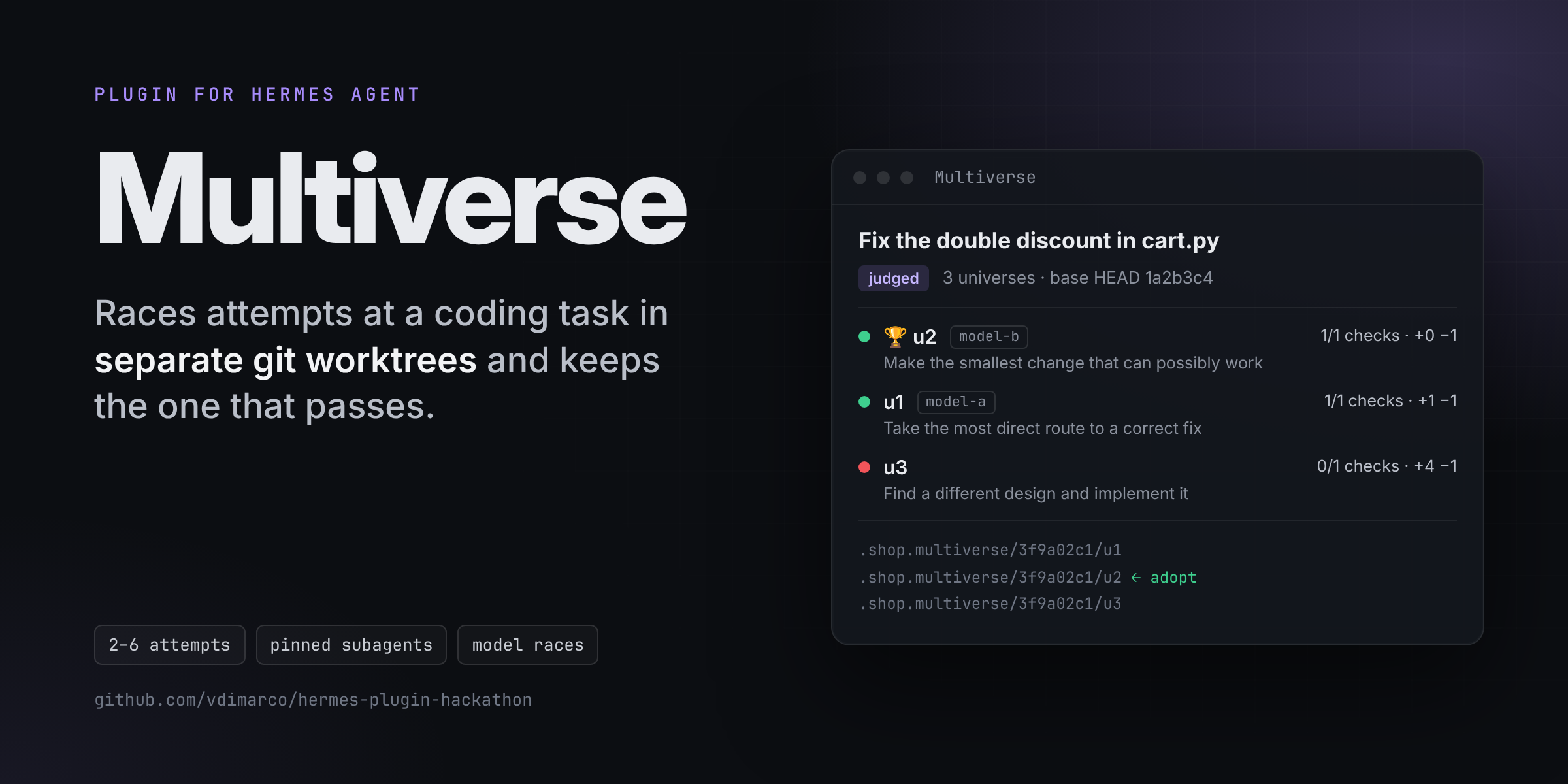
Multiverse is a Hermes Agent plugin. For a hard task, it makes one git worktree
per attempt, starts one subagent in each, runs the same checks in every
worktree, and gives you a scoreboard. One more call applies the winner to your
real working tree. Your files do not change until you adopt.
You:    The discount is applied twice. Race 3 fixes; the check is `pytest -q`.
Agent:  [multiverse_race]

Multiverse 3f9a02c1 · 3 universes · 1 checks · base HEAD 1a2b3c4d5e

|    | Universe | Model   | Approach                                  | Checks | Diff               |
|----|----------|---------|-------------------------------------------|--------|--------------------|
| 🏆 | u2       | default | Avoid the first idea; find a different…   | 1/1    | +0 −1 in 1 files   |
| 2. | u1       | default | Take the most direct route to a correct…  | 1/1    | +1 −1 in 1 files   |
| 3. | u3       | default | Make the smallest change that can…        | 0/1    | +1 −1 in 1 files   |

Winner: u2. Ask the agent to adopt it (multiverse_adopt).
Install
From a terminal:
hermes plugins install https://github.com/vdimarco/hermes-plugin-hackathon/tree/main/plugins/multiverse
hermes plugins enable multiverse
In Hermes Desktop, paste this link into your browser's address bar, or use
Capabilities → Plugins → Install from Git with the folder URL above. Hermes
shows what it found and asks before it installs anything.
hermes://plugin/install?repo=https%3A%2F%2Fgithub.com%2Fvdimarco%2Fhermes-plugin-hackathon%2Ftree%2Fmain%2Fplugins%2Fmultiverse&enable=1
Once multiverse is listed in the Hermes plugin catalog, the catalog card's Open in
Hermes Desktop button does the same at the reviewed commit
(hermes://plugin/install?catalog=multiverse).
How it works
- Worktrees.
git worktree add --detachmakes one copy per attempt next to
your repo, in.<repo>.multiverse/<run>/<label>/. The base isHEAD, or your
uncommitted tracked changes if there are any (git stash create, which does
not touch your tree or your stash list). - Subagents. One
delegate_tasksubagent per worktree, each with the same
goal, its own approach, and a marker in its goal that ties it to its worktree. - Pinning.
subagent_startbinds each subagent to its universe. Then
pre_tool_callrewrites that subagent's calls: the terminalworkdir, file
paths (relative or absolute), V4A patch paths and absolute repo paths in
commands all move into its worktree. Calls that reach into another universe,
and nested delegation, are blocked. This is enforcement, not a prompt. - Judge. The same check commands run in every worktree through the Hermes
terminal tool. Ranking: most checks passed, then a real change (an untouched
tree never wins), then the smallest diff. - Adopt.
git diff --binaryfrom the winner,git applyin your repo, then
the worktrees are removed.
Race models, not only approaches
Set the delegation backend and give each attempt a model:
delegation:
  backend: multiverse
Race this fix with two OpenRouter models and the default model.
{"attempts": [
  {"model": "vendor-a/model-a", "provider": "openrouter"},
  {"model": "vendor-b/model-b", "provider": "openrouter"},
  {"approach": "smallest possible change"}
]}
For tasks without a Multiverse marker, the backend acts like the default one.
Hermes Desktop
The package ships a desktop half (desktop/plugin.js). In Hermes Desktop it adds a
Multiverse race board: while the subagents work, each universe shows its status
and its tool-call count; after judging, it shows checks passed, the diff and 🏆 on
the winner. A status-bar chip shows racing 2/3 · 41 calls, and a toast names the
winner. Turn it on in Capabilities → Plugins (desktop halves ship off by default).
Tools and commands
| Tool | What it does |
|---|---|
| multiverse_race | All in one: worktrees, subagents, judge, scoreboard |
| multiverse_open / multiverse_judge | The same in steps, if the agent wants to change the subagent tasks |
| multiverse_adopt | Apply a universe (default: the winner) and remove the worktrees |
| multiverse_close | Remove the worktrees without applying anything |
/multiverse lists runs; /multiverse <run> shows a scoreboard.
hermes multiverse list prints the runs and the cleanup command for any run that
is still open.
Works well with Contract
Give the race the contract's check commands. Every universe is then judged by the
same definition of done you approved, and after adopt, contract_run writes the
receipt in the real tree.
Disclosure
- No network calls of its own, no credentials, no telemetry, no background threads.
- Runs
git(rev-parse,stash create,worktree add/remove/prune,
add -Ainside the worktrees,diff,apply),mkdir,rm -fof its own
.patchfiles andrmdir, plus your check commands, through the Hermes
terminal tool, so approvals and your terminal backend apply. - Starts subagents through
delegate_task. Each attempt costs tokens on the
model it uses. - Sends
plugin.multiverse.runsnapshots (goal, checks, and per universe: label,
model, approach, status, tool-call count, scores, diff stats; no subagent text)
to Desktop windows attached to the same Hermes process, at most once a second
while attempts run. The desktop half keeps the last 10 runs in Desktop plugin
storage. - Stores run metadata (goal, checks, worktree paths, scores, the last 1500
characters of each subagent summary) in its plugin state.
Limits
- Needs a git repository with at least one commit, and
bash-style shell
syntax (Linux and macOS). - New untracked files in your tree are not in the base (git stash create
covers tracked files). - Pinning covers Hermes' terminal, file, patch and code tools. An MCP tool that
writes files is not rewritten.
README from the reviewed commit a3e6c9a; it updates when the author re-pins.