 Mxhi-04
See the signal.
An unfamiliar connection. A sudden burst. A DNS pattern that deserves a second look. netScope gives Hermes structured evidence to investigate them: hosts, directional flows, conversations, protocol totals, and time buckets.
Analysis runs on your machine. The plugin makes no network requests and needs no third-party Python packages. The model you use with Hermes still follows your chosen provider’s data policy; capture-derived metadata returned to Hermes can enter that conversation.
Built for the investigation.
| Capability | What you get |
| :-- | :-- |
| Read the capture | Classic pcap in both byte orders, microsecond and nanosecond timestamps; pcapng sections, interfaces, timestamp resolution and offset. |
| Follow connections | IPv4 and IPv6 hosts, directional five-tuple flows, bidirectional IP conversations, top talkers, and protocol totals. |
| Find a starting point | Deterministic heuristics for traffic bursts, scan-like patterns, periodic connections, unusual DNS labels, many subdomains, and ports associated with cleartext protocols. |
| Ask follow-ups | Seven structured query types over a cached analysis, without reading the capture again. |
| Explore locally | A standalone HTML report with a draggable topology, protocol filters, host inspection, finding selection, and traffic replay at 1×, 4×, or 16×. |
The report, in focus.
A 69-second introduction.
Watch or download the 1080p film → · Captions · Storyboard
Original motion graphics, real report captures, and female narration generated with Sarvam Bulbul v3. Nous Research’s logo appears at the opening and closing. GitHub links the committed MP4 as a file; the GIF above plays directly in the README.
Quick start
Run the real tools locally
Python 3.11+ is recommended to match current Hermes. The analyzer itself uses only the standard library.
git clone https://github.com/Mxhi-04/Hermes-netscope.git
cd Hermes-netscope
python3 examples/make_sample_pcap.py sample.pcap
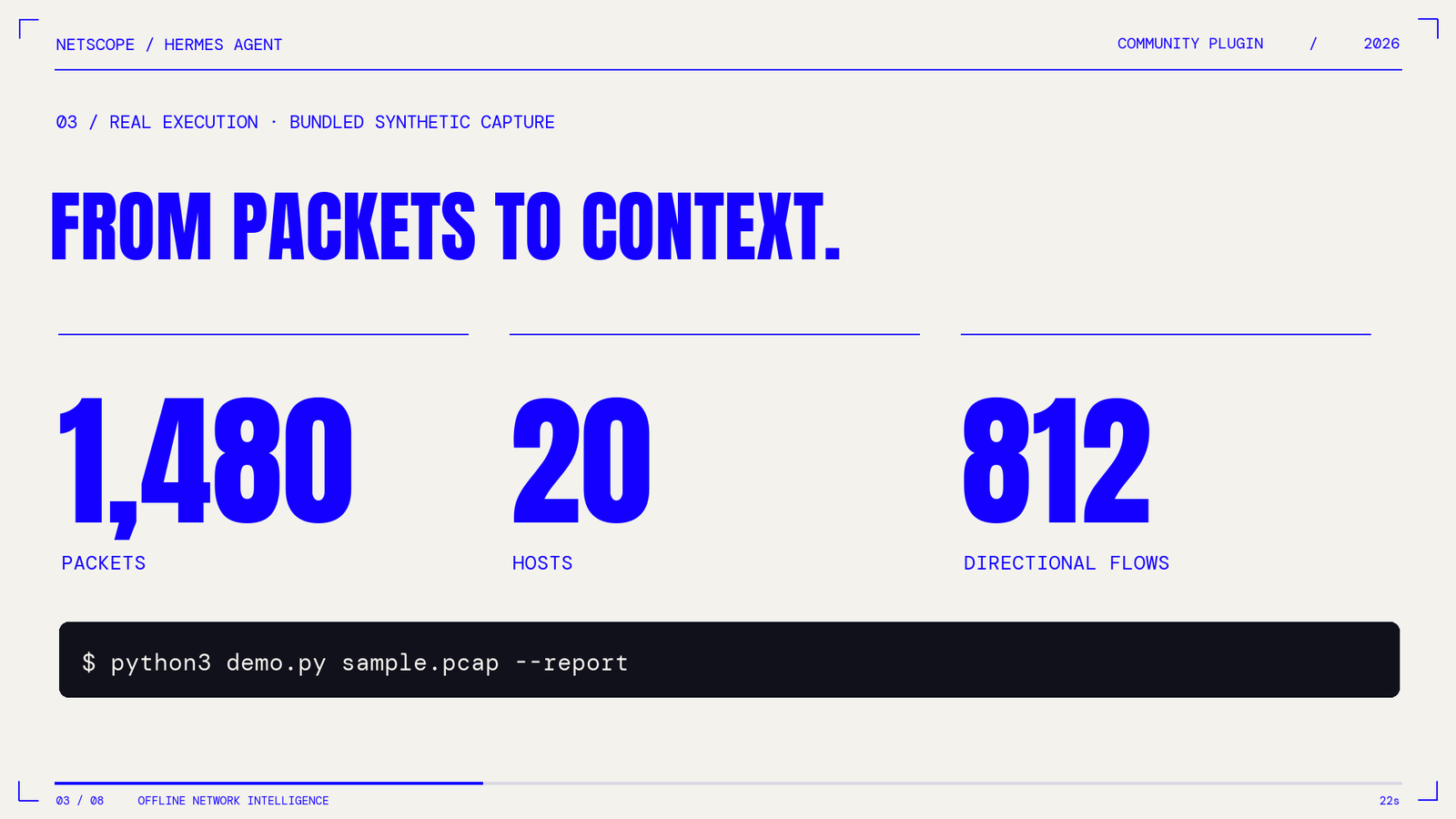
python3 demo.py sample.pcap --report
The demo calls the same handlers registered with Hermes. It prints JSON and writes the report under $HERMES_HOME/netscope/reports/, or ~/.hermes/netscope/reports/ when HERMES_HOME is unset. Open the returned report_path in a browser.
Observed output from the bundled capture, seed 42:
Packets          1,480
Wire bytes       526,635
Hosts            20
Directional flows 812
Conversations    53
Duration         278.957 seconds
The synthetic fixture deliberately contains scan-like probes, periodic connections, unusual DNS queries, bursts, and ports associated with cleartext protocols. It demonstrates the detectors; it is not an accuracy benchmark.
Use it with Hermes
Install directly from this repository; catalog acceptance is a separate review.
hermes plugins install Mxhi-04/Hermes-netscope
hermes plugins enable netscope
Then, in Hermes:
/netscope /absolute/path/to/capture.pcap
Paths containing spaces can be quoted. Example follow-ups:
Which hosts transferred the most data?
Show me the conversations involving 192.168.1.55.
Explain the periodic connection finding and generate a report focused on that host.
For a local development checkout, validate with the current Hermes plugin tooling:
hermes plugins doctor . --ci
hermes plugins validate .
Three tools. One investigation.
| Tool | Input | Result |
| :-- | :-- | :-- |
| netscope_analyze | pcap_path, optional max_packets | Summary, warnings, compact findings, and an analysis_id. |
| netscope_query | analysis_id, query, query-specific arguments | Structured answers from the cached analysis. |
| netscope_visualize | analysis_id, optional focus_host, protocol, start, end | An absolute path to a self-contained HTML report. Time bounds are Unix timestamps. |
import json
from tools import handle_analyze, handle_query, handle_visualize

analysis = json.loads(handle_analyze("sample.pcap"))
assert analysis["ok"], analysis
analysis_id = analysis["analysis_id"]

print(handle_query(analysis_id, "top_talkers", n=5, by="bytes"))
print(handle_query(analysis_id, "findings"))
print(handle_visualize(analysis_id, focus_host="192.168.1.55"))
Run this example from the cloned repository. Keep follow-up calls in the same process: the cache holds the five most recent analyses and is cleared on restart.
| Query | Arguments | What it answers |
| :-- | :-- | :-- |
| top_talkers | n, by="bytes" or "packets" | Which endpoints dominate the capture? |
| host_detail | ip | What traffic and conversations involve this host? |
| conversations | n | Which bidirectional IP pairs carry the most bytes? |
| protocol_breakdown | — | How many packets and bytes belong to each protocol label? |
| time_window | start, end | Which aggregate timeline buckets overlap these Unix timestamps? |
| findings | — | What patterns triggered, and why? |
| dns_names | — | Which endpoint names were observed via SNI or HTTP Host? |
n accepts 1–1,000. DNS question names are not treated as DNS answer-to-IP mappings. Protocol names are lightweight classifications, often based on ports.
From bytes to context.
flowchart LR
    A[Local pcap / pcapng] --> B[Validate & read]
    B --> C[Decode protocol metadata]
    C --> D[Aggregate hosts, flows & time]
    D --> E[Explainable heuristics]
    E --> F[Hermes tools & queries]
    E --> G[Standalone HTML report]
    style A fill:#f3f2ed,stroke:#1400ff,color:#1400ff
    style G fill:#1400ff,stroke:#1400ff,color:#fff
The plugin registers three tools, one slash command, and one bundled skill through public Hermes APIs. No hooks, middleware, core patches, model overrides, or telemetry.
Privacy, with visible limits.
- Local file access. The plugin can read the capture path you supply. Analysis leaves the source file unchanged and writes a report only when requested.
- Limited metadata extraction. DNS question names, TLS ClientHello SNI, HTTP Host headers, and SSH banners can be read. Credentials and packet bodies are not extracted into reports; raw packet buffers are released after decoding.
- Sensitive reports. Hostnames, addresses, and traffic metadata may still be private. Reports are written atomically with owner-only file permissions on systems that support them.
- Untrusted strings. Capture-derived names remain data. Embedded report JSON escapes HTML delimiters, and capture text is displayed through text nodes. The report blocks external resources with a Content Security Policy.
- Finite resources. Defaults: 256 MiB file size, 2,000,000 packets, and a 30-second reader budget. This is not an end-to-end timeout or a constant-memory parser; memory grows with packets, hosts, and flows. The graph shows at most 300 hosts.
- Lightweight inspection. No TCP stream reassembly, IP fragment reassembly, TLS decryption, checksum validation, full Wireshark dissection, or packet-exact replay. Replay shows conversation lifetimes and aggregate time buckets. pcapng simple packets lack timestamps and are excluded from timed analysis.
- Heuristics need context. Periodic retries, legitimate scanners, health checks, and unusual domains can trigger findings. Protocol ports do not establish encryption status. A quiet result is not a security guarantee.
Tested where it matters.
The audit added regression coverage for corrupt captures, protocol boundaries, false-positive scans, time buckets, unsafe strings, package isolation, and error handling. Current Hermes’s Plugin Doctor, catalog admission validator, and real registry dispatch were also exercised.
Read the audit and evidence → · Catalog validation · Runtime validation
python3 -m venv .venv
# macOS / Linux
source .venv/bin/activate
# Windows PowerShell: .venv\Scripts\Activate.ps1
python -m pip install -r requirements-dev.txt
python -m pytest -q
python -m ruff check . --select F
CI is configured for Linux, macOS, and Windows on Python 3.11 and 3.13. Local validation results and untested environments are recorded in the audit.
Credits & visual references
Built by Mxhi-04 for the Hermes Agent ecosystem. This is an independent community project; it is not an official Nous Research plugin or an endorsement.
The visual direction follows Nous Research: electric blue, warm paper, emphatic typography, and engraved artwork. The motion references include MotionVideo’s kinetic type, shape morphing, feature teaser, and engraving-style examples. These are design references; their videos are not incorporated into this project.
Media provenance, typography licenses, and reproduction notes →
MIT applies to the project code. Nous logos and artwork retain their respective rights and are credited separately. Bundled fonts carry their SIL Open Font Licenses.
README from the reviewed commit bd720ba; it updates when the author re-pins.