
 thedavidmurray
Receipts for Hermes 🧾
Your agent says it's done. Get the receipt.
Receipts checks what an agent claims against observed evidence—not a session-metadata summary. The completed task is the hero: did the declared required outcomes actually happen? Individual reply claims are the evidence units; the v2 plan rolls them up to projects and per-agent/per-model evidence-backed rates, with cost and tokens only a footer.
Available today (v1 release): turn-by-turn thermal-paper receipts for what Hermes observed. Ledger hooks see each tool call; historical receipts read this profile's existing state.db immediately on install. No LLM calls. v2 source under integration, not an accepted release: a local manifest can produce a scoped task PNG, an explicitly opted-in local fleet scan can produce a grouped statement PNG, and the existing Desktop pane shows an unverified current-session preview. Independent accuracy and outcome acceptance are pending; see PLAN-v2.md. Missing evidence is not proof of a lie, and a successful tool invocation alone is not proof that a task is complete.
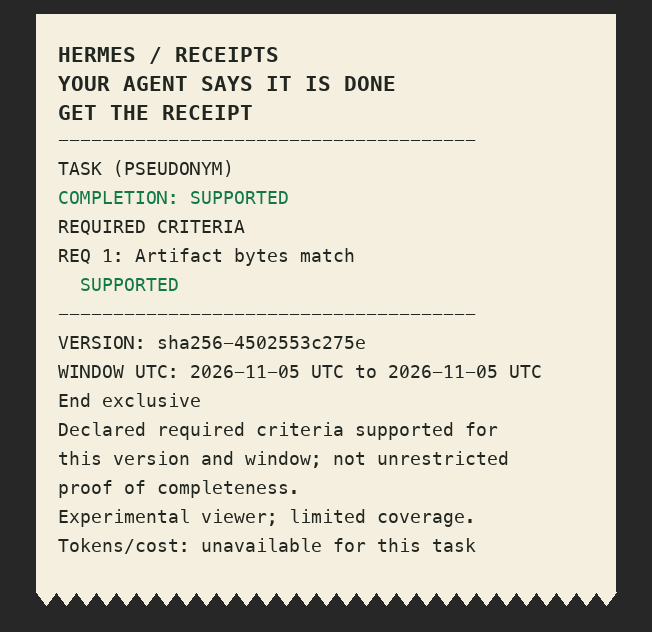
The example is generated from actual controlled artifact bytes by tests/create_demo.py. It is not real fleet telemetry or observed USB paper. A supported completion only means declared required criteria supported for the displayed version and window, not unrestricted proof of completeness. Controlled statement PNG shows the same small synthetic sample with counts only (n<10), not a population rate.
Install / use
hermes plugins install receipt-printer
hermes plugins enable receipt-printer
hermes receipt last --png receipt.png
hermes receipt verify <full 64-character ledger sha256>
/receipt in CLI/Discord/Telegram renders the latest persisted private v1 turn as text plus MEDIA: PNG; /receipt <final-message-id> selects a prior final answer. hermes receipt last --session <id> narrows a profile's session. Desktop has a Receipts pane and “Get the receipt” button for the active session: it requests a public v2 unverified preview only, since the pane does not accept a task manifest. Missing sessions fail closed, and requests from a prior session switch are discarded. The public Desktop SDK has no per-turn button contribution, so this does not patch transcript markup. Enable the Python plugin in Hermes and the Desktop component in Capabilities → Plugins; the latter alone cannot load the backend.
Experimental, local-only v2 commands (not an accepted release):
hermes receipt task --manifest /local/task.json --png /local/task.png
hermes receipt fleet --roots /explicit/local/hermes-root --start 2026-11-01T00:00:00Z --end 2026-12-01T00:00:00Z --report-db /local/report.db
hermes receipt report --report-db /local/report.db --group-by profile,model,source --png /local/statement.png
hermes receipt options            # kits, themes and field ids as JSON
task and report also take --kit, --fields, --sections, --theme,
--metrics FILE and --from-state STATE_DB [--session-id ID]; see
Receipt fields, kits and themes.
Task manifests must provide a linked done claim, explicit required criteria and [start,end) UNIX observation timestamps; the optional probes list explicitly names an artifact_digest file+SHA256 or remote_commit local bare remote+commit. It performs actual local readbacks; it does not trust supplied findings/evidence, execute manifest shell commands, or run network probes. Test-bound criteria require a trusted in-process runner and remain unverified via this CLI. Only explicit reviewed_labels from the built-in shareable alias vocabulary are rendered; everything else becomes Criterion N. Rates are supported/(supported+contradicted+unverified), with not_evaluable beside the denominator; n<10 shows counts only. Unknown model/source buckets and incomplete coverage remain visible. A digest is not a signature. Fleet reads are explicitly opt-in via local CLI, never through HTTP or chat.
≤90-second demo storyboard: 0–10 task-first hook; 10–25 local manifest and required scope; 25–35 missing push stays unverified; 35–50 show real observed paper if hardware is present, otherwise label PNG fallback; 50–65 perform real repair and independent artifact/test/remote readback; 65–80 group statement by profile/model/source or project; 80–90 report measured accuracy and coverage limits, with tokens/cost only in the footer. A controlled artifact is labelled a controlled demo, not a sampled agent session.
Optional: hermes receipt last --print-usb 0xVVVV 0xPPPP uses python-escpos>=3,<4 installed separately. It fails with a readable error if the package, printer or USB permissions are absent. This is never automatic.
The optional response stamp is off: runtime.stamp: true in receipts.yaml enables a legacy 🧾 n✓ m✗ suffix, not a v2 task judgment. transform_llm_output uses first-non-None-wins arbitration; other response transforms can conflict. The optional pre_tool_call gate is observe-only by default: runtime.gate: block blocks kanban_complete only when the last persisted answer of the same session has an unbacked v1 claim; missing session IDs and missing history fail open. This is a review prompt, not proof of current-turn failure, and does not approve any tool. Do not enable the legacy stamp or gate for the v2 demo; they can conflict with other transforms or block from stale answer text.
runtime:
  jev: false
  stamp: false
  gate: observe
YAML settings take precedence. HERMES_RECEIPTS_JEV=1, HERMES_RECEIPTS_STAMP=1
and HERMES_RECEIPTS_GATE=block remain deprecated fallbacks for 0.2.x only.
HERMES_RECEIPTS_CONFIG_DIR remains a deprecated bootstrap directory override;
it cannot live in the file it locates. Default configuration, trigger state and
receipts resolve under get_hermes_home() for the active profile, never another
profile's legacy directory. Local operator CLI commands may explicitly select
other history; chat /receipt [id] requires and stays within its caller session.
How to read this
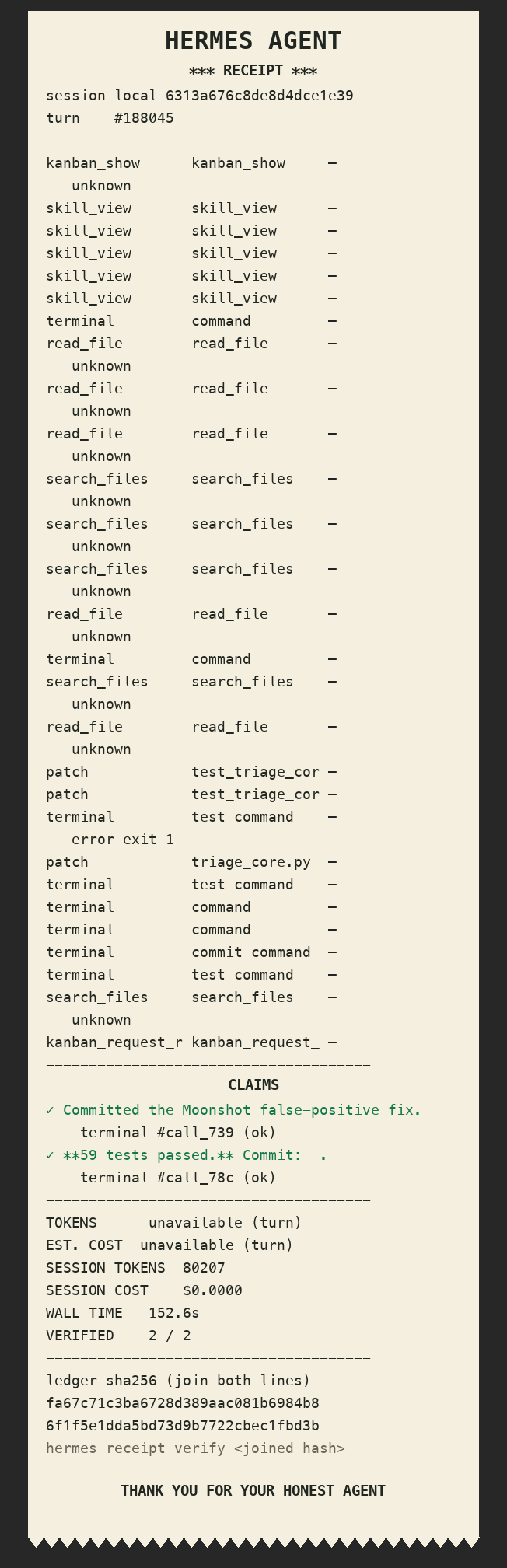
✓ means a matching tool call in the same user turn has an explicit success result. ✗ means a matching tool failed or was not recorded; it is not proof the action never happened. “not observed” denotes explicit subagent, CI or out-of-process work. Unknown tool results cannot be marked successful. Claims are conservative regex detections, not general natural-language entailment. In particular, a git push command exiting zero is evidence of command completion, not read-back proof that the remote branch changed; tests exiting zero are evidence of that process, not that all possible tests pass. A SHA-256 hash checks the canonical ledger rows reconstructed from state.db, not a signature, tamper-resistant audit log, or external attestation. No tool result bodies appear in the receipt.
The tool hook writes tool name, args SHA-256, a coarse action category, status, duration and session/turn/call ids to profile-scoped plugin_db('receipt-printer'). Raw args and results are not stored there. The history reader opens only this profile's state.db in SQLite mode=ro, and reconstructs turns lazily from the preceding user message, assistant tool_calls, matching tool responses and final answer. Existing turns need no import/migration. For historical turns Hermes records neither per-turn tool duration nor per-turn usage: these are shown as unavailable, with separate session token/cost totals if present. Wall time is the historical user→final interval. Ledger coverage is limited by persisted tool-call history; tool calls inside execute_code, subagents, shell children and separate CLI jobs are not attributed to a parent unless Hermes recorded them in that parent turn.
Disclosure (catalog rule 13)
- Outside reads: the current profile's
state.dbread-only and, for goal-mode detection, itskanban.dbread-only; an explicit localreceipt fleet --roots ...opt-in also reads state DBs under the selected roots, possibly including other profiles. Message text, conversation history, tool arguments and results can contain secrets and are processed in memory. The localtask --manifestCLI hashes explicitly named files and probes an explicitly named local bare Git remote read-only. It refuses test criteria: those need a trusted in-process caller. No browser login, implicit cross-profile scan or network remote probe. - Stored data and retention: v1 keeps a profile-scoped SQLite ledger and private PNGs under
plugin-data/receipt-printer/. Legacy v1/receipt,lastandverifyoutputs contain answer excerpts, basenames, ids and hashes: PRIVATE, review before sharing. The v2 fleet writes sanitized, versioned metadata and coverage to the user-chosen--report-db; reports and task PNGs remain at the user-chosen output path until the user deletes them. The current-session public pane PNG is generated in memory. Private manifest/DB files may identify sessions or tasks and should be kept separate from shareable PNGs; no automatic expiry/deletion or pseudonym map is provided. Args SHA-256 hashes in v1 may be guessable for low-entropy inputs. Do not distribute private manifest/report DB. - Network/telemetry/inference: deterministic v1/v2 receipt checks initiate no network requests, metrics export, model calls, remote attestation or self-update. The separately documented, default-off
runtime.jev: trueclassifier can send redacted in-memory context to an external API; see the opt-in disclosure below. Images use local bundled/system fonts. The Desktop pane calls only the authenticated local plugin route. - Subprocess/USB:
v2/fields.pyrunsgit -C <plugin-root> rev-parse --short=12 HEADfor the displayed plugin version (3 s timeout). Explicit local bare-remote probes inv2/evidence.pyrungit --git-dir <path> rev-parse --is-bare-repository(5 s) andgit --git-dir <path> rev-list --all(10 s), with no fetch. Its library-onlyrun_bound_testruns an argv supplied by a trusted in-process caller, not by the manifest CLI or agent text (no shell, 120 s timeout, output captured and discarded, artifact bytes must match before and after). No manifest test argv is executed by the CLI. Explicit fleet scans stream read-only transactions and may report partial/unavailable coverage. User-invoked--print-usbor an explicitly configured trigger printer destination accesses the specified device through optional third-partypython-escpos, requiring USB permission. Submission ACK does not confirm paper; without observed hardware the deliverable is PNG only. - Credentials: none stored or read from another client's login. Installing from GitHub is Hermes's normal plugin manager operation, not the plugin's own network call.
- Approvals: never approves tools. Optional
pre_tool_callblocking is off by default and only reviews the prior persisted answer for unbacked claims in the same session; it is not a current-turn proof. The legacy stamp is also off by default. - Desktop: SDK current-session pane and authenticated profile-scoped backend route; no per-turn DOM button or fleet web API. A missing/mismatched session is rejected; the pane cannot claim supported completion without an explicit task manifest.
Optional Jev classification — off by default
runtime.jev: true in receipts.yaml (deprecated fallback: HERMES_RECEIPTS_JEV=1)
explicitly opts the receipt-generation process into an
external API call with sampled assistant text, tool arguments (including
completion-tool claims) and tool results. Secret assignments are masked and
jevkit.privacy.redact runs before sending. Redaction is heuristic, not
complete DLP; do not enable it for confidential sessions. Jev must be separately
available/importable; no credentials, live profiles or core are changed by this
plugin. Import/timeout/privacy/malformed-response failures fall back to
deterministic categories. Without the flag no Jev import or network call occurs.
This experimental classifier selects applicable receipt sections using the
data-driven auto kit. It never overrides deterministic
contradictions or other outcome verdicts. Scores are uncalibrated, not
probabilities; judgment categories remain experimental pending independent
gold verification. receipt_from_state exposes classification/auto_fields
for the downstream configurable kits renderer, not a replacement renderer.
See API, privacy, decision rules, fleet measurements and blind-verifier runner.
Receipt fields, kits and themes
Three things a user can choose, and one thing they cannot. Content is a field
registry, kits are named field sets, themes are the visual layer — and the
verdict block prints for every kit, every field list and every theme.
Verdicts are coloured by their enum, never by their text
| verdict | ink | glyph (unicode / ascii) | meaning |
|---|---|---|---|
supported | green | ✓ / [OK] | the required readback was observed |
contradicted | red | ✗ / [X] | an observed outcome contradicts the claim |
unverified | amber | ? / [?] | nothing applicable was observed; not a lie |
not_evaluable | grey | – / [-] | no denominator for this claim |
Every verdict prints its glyph and its word, in every theme. COMPLETION is the
worst of the completion verdict and every required criterion — so it is green
only when all required criteria are supported, and no criterion can ever upgrade a
completion claim. In a monochrome theme a contradicted verdict is drawn as inverse
video (light text on an ink bar) so it cannot be mistaken for a supported one.
Statement counts (declared claims, and each report group) are coloured per
category, one line per verdict.
Fields
Each field declares the source it reads; a field with no data prints n/a and
never a guess (v2/fields.py, FIELDS). Selectable ids: verdict,
task_session_id, session, profile, agent, model, provider, turns,
tool_call_count, top_tools, tokens_in, tokens_out, tokens_total, cost,
cost_scope, duration, files_touched, claims_detected, verdict_per_claim,
evidence_locators, artifact_version, detector_version, matcher_version,
plugin_version, git_sha, receipt_hash, timestamp.
Telemetry is read read-only (mode=ro, PRAGMA query_only=ON) from a Hermes
state.db by v2/telemetry.py: session tokens/cost (labelled session totals (not per turn)), tool-call count and top tools, wall clock, turns, files written. The
receipt carries a receipt_hash: a SHA256 over its own content, re-checkable with
v2.public.verify_receipt_hash.
Kits
Built-in kits live in v2/kits/*.json and are selectable by name:
| kit | prints |
|---|---|
minimal | the verdict block plus the task/session id |
verify (default) | counts, per-claim evidence lines, id, claims, evidence locators, detector/matcher versions, receipt hash |
cost | counts, tokens in/out/total, cost + scope, tool calls, top tools, wall clock, model, provider |
ops | counts, tools, top tools, files touched, profile, agent, turns, model, provider |
full | everything the receipt can print |
auto | data-driven from the reviewed kits/auto.json rules and measured session categories; rules whose v1 field has no v2 equivalent are dropped, never invented |
A kit lists sections (counts, evidence — the verdict, criteria and footer
sections are mandatory and cannot be listed or removed) and fields. Add your own
by dropping kits/<name>.json into ~/.hermes/receipt-printer/ (or
$HERMES_RECEIPTS_CONFIG_DIR) with the same shape and selecting --kit <name>; a
user file with a built-in's name overrides it. An unknown kit or field raises
instead of silently printing less.
Evidence lines and fine print
The evidence section prints, per criterion, what was checked and — when the
criterion is not supported — why in the matcher's own reviewed words, e.g.
remote ref not found in this window, no test run after this version,
artifact bytes were not read in this window. The fine-print block prints the
fields the kit selects. The old hardcoded Tokens/cost: unavailable line is gone:
real data fills those fields, and missing data prints n/a.
Public receipts never print a raw run identifier: session, task_session_id,
profile and agent are replaced by a non-reversible sha256-<12> pseudonym
(the same rule already used for artifact versions), so two receipts can be
recognised as the same run without publishing which run it was.
Themes
v2/themes/*.json: thermal-classic (cream roll, coloured verdicts, torn edge),
minimal-mono (single ink, inverse video for contradicted), bold-branded (dark
poster, bright inks), ascii (7-bit only — for terminals, Discord code blocks and
plain printers; also renders a PNG) and dot-matrix (dotted 9-pin glyphs,
tractor-feed perforations, green bars). Themes also apply to the pane and to
--print-usb, where the ASCII glyph set is used for ascii/dot-matrix.
A theme chooses paper, ink, glyph set, font, typography (font_size,
line_spacing) and paper furniture (edge_style: torn, perforated,
tractor-feed or none). Drop your own theme JSON into the config dir's themes/
to select it with --theme after a reload. It cannot hide, soften, rename or
restyle a verdict: a theme file carrying any hide_*, soften_*, suppress_*,
mute_*, verdict_* or glyph* key is rejected on load, an unknown key is named
rather than ignored, non-monochrome themes must give every verdict its own ink, and
every verdict ink must reach a 4.5:1 contrast ratio against its own paper.
Monochrome themes may declare one ink only — a mono theme cannot smuggle a green in
for supported.
Customize your printer
Treat a receipt like a real receipt printer you configure. One documented
receipts.yaml in the plugin config dir (~/.hermes/receipt-printer, or
HERMES_RECEIPTS_CONFIG_DIR) covers paper, look, section order, shop branding,
your own fine-print fields and the USB printer options:
hermes receipt config --init    # write a commented example (refuses to overwrite)
hermes receipt config --show    # validate it and print the resolved values
hermes receipt task --manifest /local/task.json --png /local/task.png   # uses it automatically
Every key is optional and validated on load; a bad key is reported by name, e.g.
receipts.yaml: paper: unknown paper preset '99mm' (known: 58mm, 80mm, a4, letter, discord, roll, custom). --paper/--columns, --kit, --theme and --fields on
the command line override the file; the file overrides the manifest.
| Key | What it configures |
|---|---|
kit, theme, fields | content and look, exactly like the CLI flags |
paper, columns | 58mm (32 cols), 80mm (48), a4, letter, discord, roll, or custom + a column count; wrapping, truncation and the PNG geometry all follow it |
sections, order | which sections print and in what order; verdict and criteria are mandatory and order must list every section that prints, so nothing is dropped silently |
header, footer | shop name, tagline and "thank you" line |
extra_fields | your own fine-print lines: template over declared session data ("{tokens_total:,.0f} tok / ${cost_usd:.4f}") or a static value; a field with no data prints n/a |
logo, barcode | a logo dithered to 1-bit (Floyd–Steinberg) for thermal/dot-matrix heads, and a Code 128 barcode over the receipt hash or a verify URL; qr is offered only when a pure-Python QR provider (qrcode/segno) is already installed, otherwise validation rejects it with that reason |
printer | USB options: cut, feed_lines, density (ESC/POS DC2 '#', 0–15) and copies |
One invariant survives all of it: the verdict block is not configurable. A config
cannot switch verdict/criteria off, drop them from order, relabel a verdict, or
print a verdict word or glyph in a header/footer/user field — all of those are
refused by name. logo and barcode are drawn in pixels only.
Samples: assets/custom/ holds the "custom shop" example — receipts.yaml, its
logo.png, shop-58mm-dot-matrix.png, shop-80mm-thermal.png and the resolved
rendered.json. PYTHONPATH=/path/to/hermes-agent python3 scripts/render_custom_shop.py --state-db ~/.hermes/profiles/kilo/state.db
regenerates both PNGs from a real session's telemetry (profile/agent/session are
pseudonymised before they reach the paper).
Config surfaces
- CLI:
--kit,--fields a,b,c,--sections counts,evidence,--theme,
--metrics FILE,--from-state STATE_DB,--config FILE,--paper,--columns,
hermes receipt options, andhermes receipt config --init|--show. - Manifest: the same keys (
kit,theme,fields,sections,metrics,
categories,agent,from_state,session_id), so one manifest can pin its
own presentation. - Desktop pane: What prints and How it looks pickers, filled from
GET /options; an unsupported kit/theme/field returns 400 rather than being
ignored. The verdict block is not a surface: it has no off switch.
Samples: assets/kits/ holds the minimal/verify/full kits in thermal-classic,
ascii and dot-matrix for the unverified, supported and contradicted cases (plus
minimal-mono and bold-branded for the full kit) and contact-sheet.png.
python3 scripts/render_kits.py regenerates them from real local readbacks and a
real session's telemetry.
When receipts print
Receipts are automatic. receipts.yaml carries a triggers: block that says when
a receipt prints by itself, what it looks like and where it goes, and an include:
block that says what is in it. On-demand receipts (/receipt, hermes receipt last,
the pane button) go through exactly the same settings, so there is one configuration
to learn and one to trust.
Defaults
A fresh install is quiet: every trigger writes the local PNG history, and nothing is
sent to chat except the receipt you explicitly asked for. The only automatic chat
output a default config can produce is claim_check on an unestablished claim.
| Trigger | Real host hook | Default | when | Destinations | Notes |
|---|---|---|---|---|---|
on_demand | (the request is the trigger) | ON | always | local + chat | /receipt, hermes receipt last|task|triggers --on-demand, pane button |
task_complete | kanban_task_completed | ON | always | local | the hero: the agent says done, here is the receipt |
goal_complete | kanban_task_completed + on_session_end | ON | always | local | derived: a goal_mode card, or the end of a goal_mode session |
claim_check | transform_llm_output / post_llm_call | ON | exceptions_only | local | a full receipt only when a claim is unverified or contradicted; the one-line stamp is off |
unattended_session_end | on_session_end | ON | always | local | derived: platform or session key says cron/scheduled |
interactive_session_end | on_session_end | OFF | min_claims 1 | local | too noisy in a live chat; turn it on and an empty chat still prints nothing |
subagent_stop | subagent_stop | OFF | always | local | its claims roll up into the parent's receipt |
task_blocked | kanban_task_blocked | OFF | always | local | |
digest | (none: never self-schedules) | OFF | always | local | a fleet statement you schedule yourself, see below |
There is no goal-loop hook and no cron hook. Both triggers are derived from real
events, and the derivation is stated in the table above and printed by
hermes receipt triggers --show (a hook and a derived field per trigger). A
goal_mode column the host does not expose means no goal event — never a guess.
Configuring a trigger
Every trigger takes the same keys; triggers.defaults is inherited by all of them.
triggers:
  defaults:                       # inherited unless the trigger overrides it
    kit: verify                   # any kit: minimal | verify | cost | ops | full | auto
    theme: thermal-classic        # any theme, built-in or yours
    paper: 80mm                   # 58mm | 80mm | a4 | letter | discord | custom
    cooldown: 0                   # seconds between two prints of this trigger
    max_per_hour: 20
    quiet_hours: "22:00-07:00"    # UTC; empty means never quiet
    dedupe: true                  # one print per (session, version) — never twice
    profiles: {allow: [], deny: []}     # profile allow/deny; deny wins
    platforms: {allow: [], deny: []}    # platform allow/deny; deny wins
    destinations: {local: true, chat: false, printer: false, file: null}
  task_complete:
    enabled: true
    when: always                  # always | exceptions_only | "min_claims N"
    destinations: {local: true, chat: true}
  claim_check:
    enabled: true
    when: exceptions_only
    stamp: false                  # the one-line claim stamp; off by default
  on_demand:
    destinations: {local: true, chat: true, printer: true, device: [0x04b8, 0x0202]}
when: alwaysprints every time the trigger fires.when: exceptions_onlyprints
only when a detected claim is unverified or contradicted.when: "min_claims N"
prints when the text declares at leastNclaims (also spelled
when: {min_claims: N}ormin_claims: N).- Destinations:
localis the PNG history store
(get_hermes_home()/receipt-printer/trigger-receiptsunder the active profile) and is on for every trigger.chatreplies
in the origin chat — an ASCII code block on Discord, the PNG elsewhere.printeris
opt-in and requiresdevice: [vendor, product], so an automatic print can never
pick the wrong device.fileexports the PNG to a path. hermes receipt triggers --showprints every resolved setting as JSON;--outbox
prints chat deliveries a hook could not reply with inline.
Digest is reserved
digest is a reserved, disabled trigger with no runner and no hook. Enabling it
does not generate a digest. No scheduling command or cron entry is provided.
Use the explicit local receipt report command for stored report evidence.
What is in a receipt (include:)
include:
  claims: {tests: true, commit: true, push: true, send: true, deploy: true,
           write: true, run: true}
  experimental: {external: false, jev: false}   # both off by default
  tools: {preset: actions_only, include: [], exclude: [read_file]}
  redaction: public            # public | private (private is local PNG only)
  show: {cost: true, tokens: true, model: true}
  max_claims: 12
  evidence: summary            # none | summary | full
claimsswitches claim kinds off; a hidden claim still counts toward
hidden_claims, and the receipt says so.toolsfilters what TOP TOOLS lists (actions_onlyhides read-only tools). The
TOOL CALLS count is never filtered: a receipt does not under-report work.redaction: privatekeeps raw identifiers on the local PNG only; chat and printer
destinations are always rendered public.showgates the cost, token and model fields;evidencepicks how much of each
check prints.- The verdict block is not an include setting. No key can remove it, restyle it, or
make a hidden contradicted claim look supported — the completion verdict is
recomputed over every claim in the run, including the ones the settings hide. A key
that names a verdict is rejected by name.
Safety
- Triggers run off the hot path: the hook callback starts a daemon thread and
returns (0.2–5 ms measured byscripts/trigger_harness.py), and any one trigger
stops where it stands after 2 seconds. - Everything fails open: a raising renderer, an unreadable state.db or a bad config
is logged and the turn continues. The harness injects a failure to prove it and
tests/test_v2_triggers.pyasserts it. - Dedupe keys on
(session, version), so one event never prints twice;cooldown,
max_per_hourandquiet_hoursare enforced per trigger. - No network calls:
local,chat,printer(USB) andfileare the only
destinations, and none of them is remote.
Proof
PYTHONPATH=~/.hermes/hermes-agent python3 scripts/trigger_harness.py builds a
disposable HERMES_HOME, registers the plugin's real hook callbacks and fires the
host's own payload shapes. It writes assets/triggers/:
task_complete.png+.txt— SUPPORTED: all 285 tests pass, branch pushed;unattended_session_end.png+.txt— the cron session's own receipt;claim_check_caught.png+.txt— CONTRADICTED: an unbacked "deployed to
production" claim is exactly what prints a receipt;rendered.json— the decision, the delivery and the PNG hash for every case.
A fully backed answer (claim_check_clean) prints nothing at all, which the harness
asserts.
Local verification
PYTHONPATH=/path/to/hermes-agent python3 -m pytest -q --import-mode=importlib tests/
HERMES_HOME=/path/to/disposable-home hermes plugins validate . --install-deps
HERMES_HOME=/path/to/disposable-home hermes plugins doctor . --ci
Detection benchmark (not verdict accuracy)
python3 eval/score.py --profiles /path/to/profiles recomputes the test from eval/labels.json, eval/claim_labels.json, and local hive/kilo state.db files. We sampled 200 historical assistant finals from the two profiles: id divisible by 13, recent 3,000 qualifying finals per profile, then seeded stratification into 100 keyword-bearing and 100 other answers. Kilo, the implementing agent, labelled the answer excerpts (first 230–350 characters, checking later keyword contexts) for whether each asserted an affirmative past local action in the seven supported classes; critic independently spot-checked 30, agreeing on about 28/30. Kilo then reviewed each of the 66 extracted (kind, sentence) pairs and marked 5 incorrect; critic did not independently review these claim-level labels. The public JSON contains only message IDs, profile names, labels and hashed snippets, not private answer text. Results on this deliberately enriched, implementer-labelled sample: TP=47 FP=7 FN=47 TN=99; answer-level precision=87.04%, recall=50.00%; claim-level extraction precision=61/66=92.42%. This is not a claim that individual tool-evidence verdicts are correct; those were not independently labelled. Many paraphrases are missed. The corpus is development data, not an independent holdout. Keep the gate off unless you can tolerate false negatives and false positives.
Catalog: draft plugin-catalog/receipt-printer.yaml in this repo. Upstream PR and demo post are reserved for David; hackathon cutoff Nov 11, 1PM PT per the Typeform confirmation (earlier than the tweet wording).
README from the reviewed commit 99ba291; it updates when the author re-pins.


