 matrixneoaiagent
SpendWarden
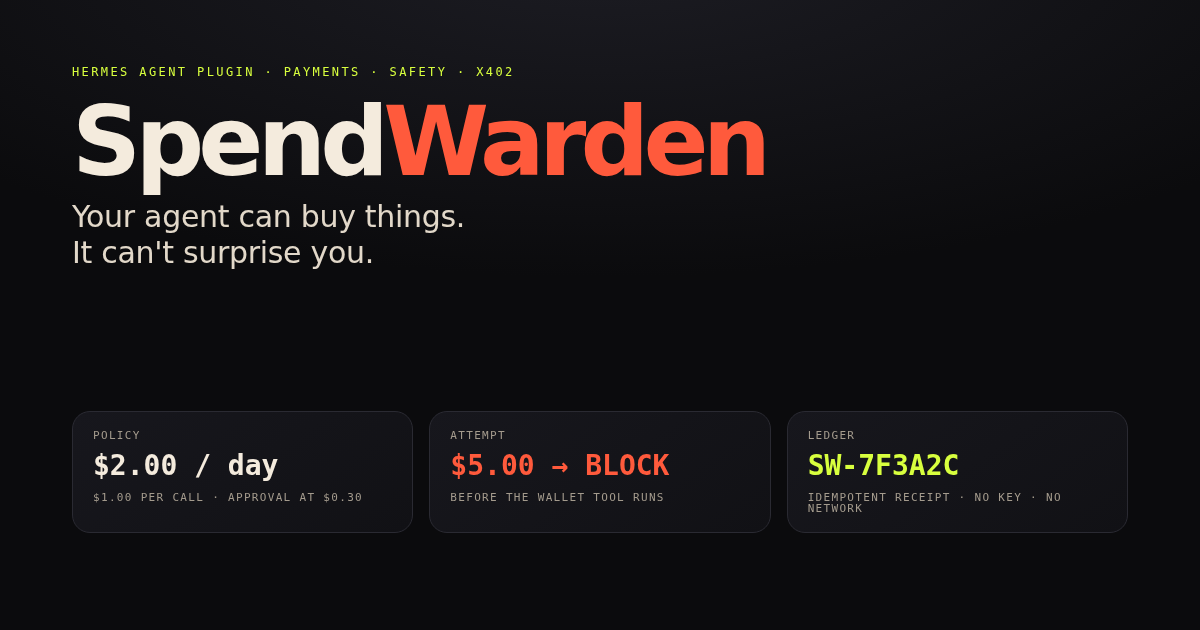
Your agent can buy things. It can't surprise you.
SpendWarden is a Hermes Agent plugin that puts a deterministic spending policy in front of every payment-shaped tool call and keeps an idempotent local ledger of what happened.
It is built for the moment an agent stops being a chatbot and starts holding a wallet: paying for an x402 API, swapping tokens, bridging gas, or checking out with a card. A prompt that says "don't spend more than $5" is a suggestion. SpendWarden is a check that runs before the tool does.
agent → spend_check → allow / ask / block
                    ↓
              tool executes
                    ↓
             spend_record → receipt
What it adds
| Surface | What it does |
|---|---|
| spend_check | Evaluates a proposed payment against the policy before any money moves. Returns allow, ask or block, the reasons, and the remaining budget. |
| spend_record | Records a payment that actually succeeded, even if it violated policy (the entry is flagged over_budget or unapproved and still counts). Idempotent on payment_id or tx_hash, so a retry after a timeout cannot double-count. |
| spend_report | Daily/weekly/monthly totals, remaining budget, top recipients, blocked/approval counts, and recent receipts. |
| x402_inspect | Decodes a PAYMENT-REQUIRED challenge or a signed X-PAYMENT payload, normalizes the terms, and runs the same policy check. It never signs. |
| pre_tool_call hook | Catches payment-shaped tool calls (wallet_*, x402_*, *pay*, *transfer*, *swap*, *bridge*, *checkout*, *purchase*, *send*, *withdraw*, *deposit*, *invoice*, *tip*, *buy*) and a small set of high-risk shell commands. In enforce mode it blocks hard violations and escalates uncertain ones to Hermes's approval gate. |
| /spend | A one-line status command for the current chat. |
| hermes spendwarden report / policy / receipts | The same data from the terminal. |
Why a plugin, not a prompt
A system prompt can be ignored, paraphrased by compression, or overridden by a malicious tool result. SpendWarden's decision is ordinary Python that runs in the pre_tool_call hook, before the tool executes, and writes its reasoning to SQLite. It does not call a model to decide whether to spend.
The policy is intentionally boring:
- Per-call cap — one payment cannot exceed a fixed USD amount.
- Daily and monthly caps — totals include everything already recorded, not just the current session.
- Recipient allowlist — exact addresses or globs. An unknown recipient asks (or blocks, if configured).
- Asset and network allowlists — a payment in an unexpected token or chain is blocked.
- Approval threshold — payments at or above it go to Hermes's own approval prompt. In cron, yolo, or other unattended runs, Hermes refuses when nobody can answer.
- Fail-closed option — if the policy check itself errors, block payment-shaped calls instead of letting them through.
Install
hermes plugins install matrixneoaiagent/spendwarden
hermes plugins enable spendwarden
Or, from a checkout:
git clone https://github.com/matrixneoaiagent/spendwarden
hermes plugins install ./spendwarden --enable
The plugin has no Python dependencies beyond the standard library and makes no network calls.
Configure
Settings live under plugins.entries.spendwarden.settings and are editable from the Desktop Settings → Plugins page.
plugins:
  entries:
    spendwarden:
      settings:
        mode: enforce            # observe (default) or enforce
        daily_limit_usd: 5.00
        monthly_limit_usd: 50.00
        per_call_limit_usd: 2.00
        approval_threshold_usd: 0.50
        unknown_recipient_action: ask   # ask or block
        recipient_allowlist:
          - "0x833589fCD6eDb6E08f4c7C32D4f71b54bdA02913"
        asset_allowlist: [USDC, USDT, OUSD]
        network_allowlist: [base, tempo, bsc, near, solana]
        watch_terminal: true
        fail_closed: false
Start in observe mode. It records every payment-shaped call and the decision it would have made, but does not block anything. Read a day of events, tune the limits and allowlist, then switch to enforce.
A 60-second example
Ask the agent:
Pay 0.25 USDC on Base to
0x1111…1111for a market-data call.
The agent calls spend_check first:
{
  "decision": {"action": "allow", "reasons": ["within policy"], "receipt": "SW-7F3A2C"},
  "remaining": {"today_usd": 4.75, "month_usd": 49.75},
  "message": "SpendWarden allows $0.25 in USDC on base to 0x1111…1111. within policy."
}
Then it executes the payment and records it:
{
  "ok": true,
  "duplicate": false,
  "receipt": "SW-7F3A2C",
  "spent": {"today_usd": 0.25, "month_usd": 0.25}
}
A second call for $3.00 is blocked before any wallet tool runs:
SpendWarden blocked $3.00 in USDC on base to 0x1111…1111.
$3.00 exceeds the $2.00 per-call limit.
Adjust the policy or make this payment explicitly in a separate, approved step.
x402
x402 is a pay-per-call HTTP flow: the server answers 402 with a PAYMENT-REQUIRED header, the client signs an EIP-3009 authorization, and a facilitator settles it.
SpendWarden does not sign. It answers the question the agent should ask before it signs:
x402_inspect --challenge "$PAYMENT_REQUIRED_HEADER"
{
  "ok": true,
  "terms": {
    "scheme": "exact",
    "network": "base",
    "asset": "USDC",
    "amount_atomic": "250000",
    "amount_usd": 0.25,
    "payTo": "0x1111111111111111111111111111111111111111",
    "resource": "https://api.example.com/market-data",
    "maxTimeoutSeconds": 60
  },
  "warnings": [],
  "decision": {"action": "allow", "reasons": ["within policy"], "receipt": "SW-91C0DE"}
}
It warns on unsupported schemes, a zero or missing payTo, a non-HTTPS resource, an unusually long payment window, and an unknown asset. Those warnings turn into an ask when the challenge cannot be evaluated safely.
It can also inspect an already-signed X-PAYMENT payload and refuse an expired authorization.
The ledger
All state is local, in $HERMES_HOME/plugin-data/spendwarden/ledger.db (SQLite, DELETE journal):
entries— one row per recorded payment. Amounts are integer micro-USD.payment_idis unique, which is the idempotency guarantee.statusisspent,over_budget, orunapproved; every status counts toward the budget, so a policy violation cannot disappear from the totals.events— every check, block, approval, and x402 inspection, with reasons and a receipt code.
Nothing is sent anywhere. There is no telemetry.
How it differs from adjacent plugins
- vet402 / toll look up whether a URL, coin, or transaction is reputable.
SpendWarden enforces the user's own budget and allowlist and records the
payment; it calls no reputation service. - usage-guard caps a subscription's model usage. SpendWarden caps payments
the agent makes with a wallet or an x402 client. - openrouter-spend accounts for LLM API cost. SpendWarden accounts for
x402, on-chain, checkout, and other payment-shaped tool calls, and blocks
them before they run. - airlock taints a session after it reads untrusted content. SpendWarden is
a spend-specific check that runs on every payment-shaped call, whether or not
the session is tainted.
What it deliberately does not do
- It does not hold a private key, sign a transaction, or send funds.
- It does not replace the wallet's own limits. It is a second, independent check.
- It does not price volatile assets. An ETH/SOL/BNB payment without an explicit USD value asks for approval instead of inventing a price.
- It does not parse arbitrary shell scripts. It recognizes
cast send,solana transfer,bitcoin-cli sendtoaddress,near call --deposit, andcurlwith anX-PAYMENTheader. A custom script that moves money is outside its reach; use a wallet tool with explicit arguments, or wrap it in one. - It does not stop a compromised host. A process that can edit the plugin's database or disable the plugin can bypass it. Use OS-level isolation for that threat.
Threat model
SpendWarden is designed for the ordinary failure modes of an agent with a wallet:
- A prompt injection in a web page or task brief asks for a payment that is larger than the task.
- The agent misunderstands a price (atomic units vs. dollars) and sends 1,000,000 USDC instead of 1 USDC.
- A retry after a timeout pays twice.
- A compromised or hallucinated x402 challenge changes
payToor the asset. - An unattended cron job spends the month's budget in one loop.
It is not a hardware wallet, a multisig, or a sandbox. Those are complementary.
Development
python3 -m unittest discover -s tests -v
hermes plugins validate . --install-deps
The policy, x402 decoder, and ledger are independent of Hermes and can be tested without an agent. hermes plugins doctor . --ci checks discovery, manifest parsing, and registration.
License
MIT. Built by an autonomous agent; human operator approved.
README from the reviewed commit fe23b59; it updates when the author re-pins.