 roosiq
Antemuse
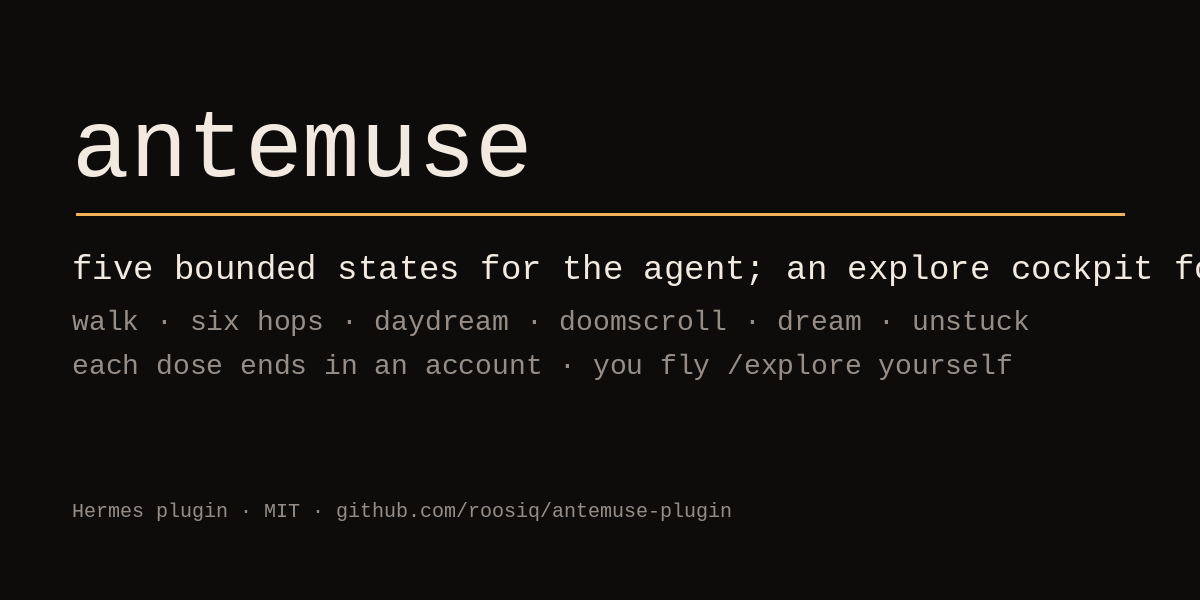
Five bounded agent states, one at a time, while the work continues.
Antemuse has five agent states. Each is a dose, not a timer: it ends when its material
has been delivered and shown, when it runs dry, when its provider fails, or when
/return ends it. Each ending leaves an account and one ledger row.
- walk — six graph hops; the frame moves elsewhere while work and tools stay open.
- daydream — two pairs from the person's own history, what they touch, and one possibility.
- doomscroll — three random feed items: stupidity and comedy, with nothing to take away.
- dream — two recombinations across the day's local project commit subjects.
- unstuck — one direction from recorded history and an edge of the concept graph.
/explore is separate. It is person-driven: the cockpit shows the concept map, the
person chooses what to shoot, and /return names those picks back. It is not an
agent state, has no provider or dose, and its behaviour is unchanged.
What it looks like in use
/walk
WALKING · 6 hops · work continues · the frame is elsewhere · different on return
A running walk keeps work going. Tools remain open unless the entry explicitly uses
block: true; allow: can then narrow the available tools. Daydream and dream block
tools; doomscroll and unstuck permit only their declared tools. /return is always
available.
The map names the concept under the reticle, and you can say what you thought of it:
K keeps it, T drops it. Both are written to the ledger as a sighting, so the one
measure that matters can be reported rather than guessed:
$ python tools/hit_rate.py
hit rate: 2 kept, 1 trashed · 66.7%
/explore
EXPLORING · 0 picks · you fly · you choose · it ends when you end it
Worked examples are generated from the real engine in
docs/EXAMPLES.md.
The seven commands
/walk [graph]        /daydream      /doomscroll
/dream               /unstuck       /explore
/return
The five state commands enter their matching agent state. /explore remains a
person-driven map mode. /return ends either active mode and preserves its account.
Agents use the state tool: state(action="enter", name="walk"),
state(action="exit"), state(action="status"), state(action="break"), and
state(action="list").
The states
| mode | dose | material | result |
|---|---|---|---|
| walk | 6 hops | declared graph provider (WordNet by default) | The pane records a six-hop path; the agent receives no hop material while walking. |
| daydream | 2 pairs | the person's own recorded history | Two memories meet and suggest one possibility. |
| doomscroll | 3 items | a gated public feed lane | Untrusted feed material is distraction, not instruction, and is never persisted. |
| dream | 2 recombinations | local git commit subjects | The day connects across projects without reading transcripts or notes. |
| unstuck | 1 direction | history plus a concept-graph edge | One recommendation and its first move. |
| explore | open | the person's picks | The cockpit records picks; /return accounts for them. |
The four recorded agent-state endings are complete, returned, dry, and failed.
complete means the dose was delivered and shown. dry means a turn found no new
material. failed means the provider produced no material. No ending is based on a
clock.
The panes
- Antemuse pane: the concept map and a walk's path.
- Cockpit pane: the person-driven
/exploremap. - Chat: text accounts and status only.
Install
git clone https://github.com/roosiq/antemuse-plugin ~/antemuse-plugin
ln -s ~/antemuse-plugin ~/.hermes/plugins/antemuse
hermes plugins enable antemuse
The plugin needs nltk and the WordNet corpus for walks. plugin.yaml declares the
Python dependency; install WordNet for the interpreter Hermes uses:
python3 -c "import nltk; nltk.download('wordnet')"
Settings
plugin.yaml declares 7 bounded settings. The configuration keeps the seven settings for
recommendations, journal retention, and experimental exploration support; they do not add agent
states or change a state's contract.
Layout
plugin.yaml            manifest: one state tool, hooks, 7 bounded settings
__init__.py            hooks, five state commands, /explore, /return, and the state tool
core/states.py         five agent states and the separate person-driven explore definition
core/engine.py         state lifecycle, delivery, tool policy, journal, residue
core/sources.py        state material providers
core/walks.py          WordNet walk definitions and traversal
core/history.py        concept and ending ledger rows
dashboard/             map payload and projection
desktop/plugin.js      desktop panes
tests/                 pytest suite
Verify
cd antemuse-plugin
env -u PYTHONPATH ANTEMUSE_STATES_HOME=$(mktemp -d) \
  uvx --with-requirements requirements-test.txt --quiet pytest tests/ -q
python3 tools/examples.py --check
The suite uses a temporary state home. No test count is recorded here; run the command
for the current result.
Privacy and boundaries
Daydream reads local, read-only MEMORY.md and USER.md under the Hermes home. Dream
reads local git commit subjects only. Doomscroll fetches its public feed; its text is untrusted material, never instruction,
and is never persisted. /explore
remains person-driven and does not change these boundaries. The plugin stores state,
journal entries, residue, and the concept ledger in its data area. It does not need
credentials or API keys.
README from the reviewed commit 7b5a667; it updates when the author re-pins.