NicWeinbrecht
Clotho for Hermes Agent
Spin every future. Keep one.
In Greek myth the three Fates spin, measure and cut the thread of every life. Nous named its RL framework
Atropos, the Fate who cuts. Clotho is her sister: she spins. This plugin spins every possible future of an
agent task (rehearsal + Forks), lets you measure them, and keeps only the one you choose.
What it proves (numbers: docs/EVAL.md, 72 task runs over 11 side-effecting tasks; the rest:
the test suite, tests/README.md):
- 0 escapes in 72 task runs: no request at the HTTP sink, no message at the SMTP sink, no change in the
workspace or in a sentinel folder outside it during a rehearsal. - Fails closed: a fault injected into the plugin blocks the call; the real tool does not run.
- The shell actually runs in a sandbox: inside a copy-on-write clone under macOS
sandbox-exec, with no
network and no writes outside it. - Apply with 0 model calls and drift checks: 0 model calls during Apply (counted four ways); sink, SMTP
and files exact after Apply 72/72; a file edited by hand stopped Apply, nothing changed, 14/14. - Forks compares full effect ledgers across models: one task on several models, every effect side by side.
- Try it, no API key, about 10 s:
hermes clotho demo
What it does
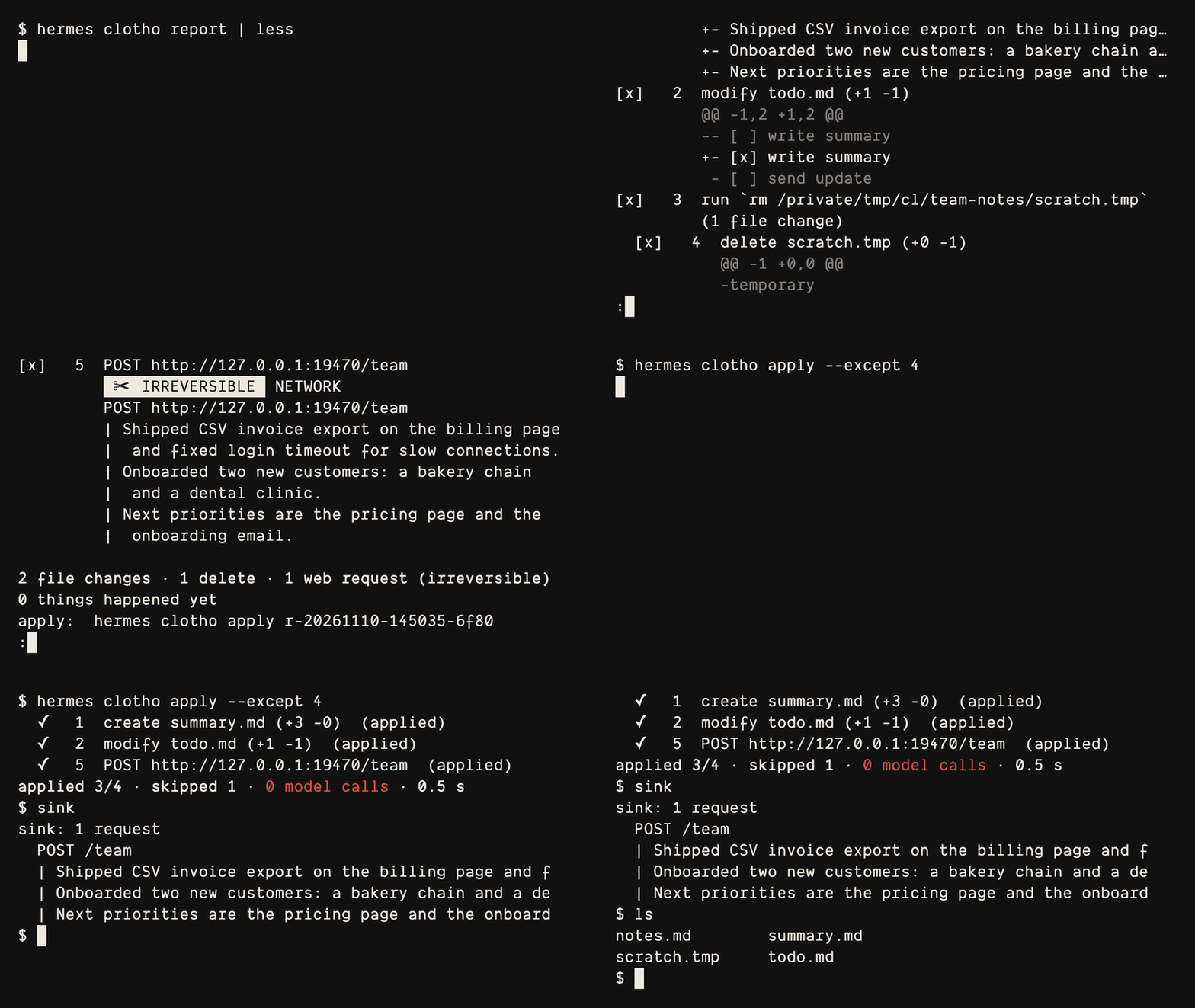
Rehearse any Hermes task, see every effect it would have, untick what you don't want, then apply.
Apply replays exactly the effects you kept, with no model calls.
hermes clotho run "tidy this folder and post a summary to the team webhook"
hermes clotho report            # numbered checkboxes, diffs, IRREVERSIBLE / CAN'T PREVIEW badges
hermes clotho apply --except 3  # replay the rest for real, drift-checked, 0 model calls
Inside a chat session: /clotho on, then work as usual, /clotho report, /clotho off.
Install
hermes plugins install NicWeinbrecht/hermes-clotho --enable
Needs Hermes Agent 0.23.0 or newer. Shell previews need macOS (sandbox-exec); elsewhere shell commands are
captured without a preview. To try it without an API key: hermes clotho demo (see Demo).
Measured
Nothing escaped, and Apply landed exactly what was ticked. 72 task runs over 11 side-effecting tasks
(webhooks, email, chat posts, file clean-ups, cron jobs, subagents, memory and skills), driven by a scripted
agent, deepseek-v4-flash, deepseek-v4-pro and Claude, every run measured at a local HTTP sink, a local SMTP
sink and by hashing the workspace and a folder outside it:
| result | |
|---|---|
| requests, emails or workspace changes that got out during a rehearsal | 0 |
| Apply landed exactly the ticked effects (sink, SMTP, files) | 72/72 |
| model calls during Apply (receipt, scripted endpoint, proxy trap, sandbox log) | 0 |
| a file edited by hand between rehearsal and Apply stopped it, nothing changed | 14/14 |
Apply wall time, median (deepseek-v4-flash, Hermes start included) | 1.5 s |
| runs that passed every check | 69/72 |
The three misses are the model, not a leak: two runs captured extra calls the model really made (a docs fetch
and hermes cron --help), and one model said it created a skill it never tried to create; the ledger showed
the truth. One Hermes housekeeping file (cron/dispatch_held.json, written by an idle gateway's cron ticker) is
counted as a state change and explained. Method, controls (positive controls for every instrument, 8 of 8
deliberately wrong ground truths caught), per-task tables, costs and limits: docs/EVAL.md.
Raw numbers: eval/results/*/results.json and headline.json; the harness is in eval/.
The test suite drives Hermes' real agent loop with scripted tool calls (no model, nothing leaves the machine).
Its escape tests make one call per tool class (reads, file writes inside and outside the workspace, shell
commands that write outside, hard-link out, run in the background or call osascript, execute_code, plugin
sends, unknown tools, web_extract, memory, skills, subagents, symlink tricks, multi-file patches) and check
that the workspace, a sentinel folder and Hermes' memory, skills and cron folders hash the same afterwards (the
skills folder's .usage.json aside, where Hermes counts reads) and
that the sink got nothing (tests/test_rehearsal.py T2Escape, tests/test_capture_escape.py). A fault
injected into the plugin blocks every call (T3FailClosed). How to run it:
tests/README.md.
What happens during a rehearsal
Read-only tools run for real: file reads and searches, skills, session search, web_search (so a search
reaches its provider and may be metered), clarify, todo. A rehearsed skill_view bumps Hermes' skill usage
counters (skills/.usage.json) as a normal read does. Page fetches (web_extract, vision_analyze and
similar) are held, because a fetch can trigger a webhook. Everything else is held:
- File writes land in a copy-on-write clone of your workspace. A write aimed through a symlink is resolved
first, the way the OS would resolve it, and recorded at the real target with aVIA SYMLINKbadge that
also names the path the agent used. A multi-file patch has every file header mapped the same way. - Files outside the workspace are not copied into the rehearsal. A read goes to the live file (Hermes' own
read deny-list applies). A write or patch works on a copy in a private temp folder that is removed when
the rehearsal ends; the rehearsal keeps only what changed, and the report makes the diff from the live
file. Apply rebuilds the change from the live file and checks it against the rehearsed content first. - A write, patch, delete or move aimed at a path Hermes' own write guard refuses (
agent/file_safety.py:
~/.ssh/authorized_keysand the SSH keys,.netrc,.pgpass,.npmrc,.pypirc, git credentials, the
credential folders, Hermes'.envand secret stores, anything outsideHERMES_WRITE_SAFE_ROOT, and
~/.ssh/config, which Hermes writes only after asking) is refused during the rehearsal too, inside the
workspace or outside it. The real path is checked before anything is copied: no copy of the file is made,
the tool does not run, the agent gets Hermes' own refusal, and the report shows aBLOCKEDrow that cannot
be applied. - Shell commands run inside that clone in a macOS sandbox with no network and no writes outside it, and with
a short allowlist of environment variables (paths, user, shell, terminal, locale,PYTHONPATH,
HERMES_HOME), so a rehearsedenvshows none of the keys or settings Hermes runs with. Their
HOMEis a copy-on-write mirror of your home: a write there (saymv old.zip ~/.Trash/) stays in the mirror
and shows up as anOUTSIDE WORKSPACEeffect, unticked: Apply makes it in your real home only when you name
it, or the command that made it, with--only. A write to an absolute path into your real home is blocked,
and so is a write to a credential file the mirror links instead of copying (the ones Hermes' write guard
refuses, such as~/.npmrc). A command whose file changes include a path the guard refuses isBLOCKED
and cannot be applied, with all its changes.
When a command returns, its process group is killed, and so is a child that started its own session
(the Disclosure names the one case this misses). execute_coderuns in the same sandbox. Every call gets a row with its code; code that names a network
module is shown as one it could not preview.- Messages, web requests, other plugins' tools, cron changes and memory writes are captured instead of sent.
The agent gets an honest result for each captured call and carries on:
[clotho] captured: <what it would do> - not executed. This is a rehearsal: the effect is recorded for review and happens only if the user applies it. Any reply is unknown during the rehearsal. Continue the task as if it succeeded. - Hermes' background memory and skill review can run during
hermes clotho run. It calls the model, so it
spends tokens; its memory or skill writes are captured like any other and labelledBACKGROUND REVIEW. - A write Hermes itself refuses (for example overwriting a file the agent has not read) changes nothing, live
or here, and still gets aBLOCKEDrow, so a report or a fork comparison shows the attempt.
The report
Clotho  r-20261110-064852-f4ca
task  In this folder: read notes.md, write a three-line
      summary of it to summary.md, delete scratch.tmp, th…
in    /Users/you/projects/team-notes
deepseek/deepseek-v4-flash · 4 model calls · 5 tool calls
$0.0052 · 29.2 s

3 effects · 1 irreversible · 0 happened yet
files 2 · web 1
ticked 3

[x]   1  create summary.md (+3 -0)
         @@ -0,0 +1,3 @@
         +Shipped invoice export and fixed the login time…
         +Two new customers signed.
         +Next up: price page and onboarding email.
[x]   2  run `rm scratch.tmp` (1 file change)
  [x]   3  delete scratch.tmp (+0 -1)
           @@ -1 +0,0 @@
           -temporary
[x]   4  POST http://127.0.0.1:18940/e2e/team
         [IRREVERSIBLE] NETWORK
         POST http://127.0.0.1:18940/e2e/team
         | Shipped invoice export and fixed the login
         |  timeout.
         | Two new customers signed.
         | Next up: price page and onboarding email.
         uses the output of #1

1 file change · 1 delete · 1 web request (irreversible)
0 things happened yet
apply:  hermes clotho apply r-20261110-064852-f4ca
choose: --only 1,2  --except 3  (numbers above)
- Every effect is ticked by default, messages and web requests included. Four kinds are unticked and run only
when you name them with--only: tools Clotho does not know, held fetches (web_extract,
vision_analyzeand similar), commands it could not preview (they needed the network, wrote outside the
workspace, read a secret or started a background process), and effects outside the workspace (OUTSIDE WORKSPACE). A command that changed a file outside the workspace is unticked with all its changes, so a move
out of the workspace never lands as its delete alone; naming the command applies every change under it. - A single plain
curlorwgetcall is shown as a web request (method, URL, headers, body) and is ticked like
any other effect; apply re-runs that exact command. One that saves to or reads from a file (-o,-O,
-T,-F field=@file, a config or cookie file) is shown as a command it could not preview instead. - A command it could not preview shows what it was seen doing in the sandbox before those changes were thrown
away (would delete 11 files); a blocked call shows what it tried to touch and why it was stopped. - Many similar effects collapse into one line with their number range (
2-215 move 214 files);--expand
lists each one. The ranges are the numbers--onlyand--excepttake. - Lines stay within 58 columns (
--width Nchanges that,--width 0uses the terminal's width). Colour is
used only on a terminal, never whenNO_COLORis set.--jsonprints the ledger and the default selection. - On a terminal the IRREVERSIBLE badge is
✂ IRREVERSIBLEin reverse video; without colour it reads
[IRREVERSIBLE]. The only colour is red, and it marks only the thread you keep: the applied timeline in a
fork comparison (with● keep; the others are dimmed) and the0 model callsof an apply receipt. - Dependencies are shown under the effect that uses them. "uses the output of #1" is certain (the same file,
or the command names the file); "may use the output of #1 (guess: …)" is a guess from file contents, folder
listings or what the agent read in between. Only certain dependencies stop an apply.
Apply
hermes clotho apply [ID] [--only 1,2,5-9] [--except 3] [--dry-run] [--force] [--json]
With no ID, report and apply take the newest rehearsal in this Hermes home, whatever the current folder. When
that one is a fork timeline or a cron run, apply stops (exit 3), changes nothing and lists the ids to name.
- It checks everything before it changes anything. Every file effect's real path (and a move's source) goes
through Hermes' own write guard first, the check its file tools make (agent/file_safety.py): if an effect
would write a path Hermes never writes (~/.ssh/authorized_keys,.netrc, Hermes'.env, the credential
folders;~/.ssh/config, which Hermes writes only after asking), it stops and names it (exit 3), and
--forcedoes not change that. If a file changed since the rehearsal, or a folder on an
effect's path has since been replaced by a symlink, it stops and names the file (exit 4); each write checks
the folder again just before it lands. If a ticked effect certainly depends on an unticked one, it stops and
names both (exit 5); tick the dependency too, untick the dependent, or pass--force. A guessed dependency
only warns: the receipt lists it as a guess and the apply goes on. - File effects are written byte for byte from the rehearsed content. Messages and web requests go through
Hermes' real tools with the stored arguments, so other plugins' hooks still see them. - It records each effect as it goes. If something fails, the receipt lists what was applied, what failed and
why, and what was not attempted (exit 1). Applying again never re-sends what was already sent. A failed web
request is retried only when its exit code shows it never left the machine; one that may have reached the
server, or that was cut off mid-send, is held until you name it with--only. - The receipt ends with
applied 4/4 · skipped 0 · 0 model calls · 0.4 s.
Exit codes: 0 applied, 1 failed or incomplete, 2 no such rehearsal or effect, 3 refused (inside a
rehearsal, no ID for a fork timeline or cron run, or a path Hermes' write guard refuses), 4 drift,
5 dependency.
Forks
A rehearsal has no side effects, so the same task can be run several ways at once and the outcomes compared
before anything happens. Forks compares the full effect ledgers, including captured messages and web requests,
and applies the chosen one with 0 model calls.
hermes clotho fork "My disk is nearly full; clean up this folder" --models pro,kimi,flash
hermes clotho fork "Clean up this folder" --variants variants.yaml   # one model, different instructions
hermes clotho compare                       # the last fork again; --json, --expand
hermes clotho apply f-20261110-101812-101f/claude-sonnet
-
Each timeline is its own
hermes clotho runprocess, all started at once, each with its own rehearsal
id, clone and ledger.--modelstakes[name=]model[@provider]. The aliasesflash,proandkimiare
deepseek/deepseek-v4-flash,deepseek/deepseek-v4-proandmoonshotai/kimi-k2.6on OpenRouter;claude
is sonnet on the Claude subscription. A model without@providergets the provider Hermes would pick for
it in your home, or OpenRouter when that one has no credentials there (in a home with no default provider,
Hermes sendsmoonshotai/kimi-k2.6to NVIDIA), and the fork prints which rule it used. A variants file lists anameand eitherinstructions(added after the task) orprompt
(replaces it) per timeline, with an optionalmodel:model: deepseek/deepseek-v4-flash variants: - name: tidy instructions: Tidy it up. - name: disk-full instructions: My disk is nearly full; keep only what I'd actually want. -
Spend: a fork of N timelines runs N model sessions at once, so it costs about N times one run. Each timeline
may make--max-callsmodel calls (default 25). A call over the cap is answered
with a "stop now" reply and never reaches the provider. At most one timeline may use the Claude-subscription
provider; its cap is--max-plan-calls(default 10), plus Hermes' own title call. -
A model that cannot drive the tool loop (for example a provider answering "No endpoints found that support
tool use") is dropped and named in the output; it is never replaced by a made-up timeline. A timeline that
fails is shown with its reason and left out of the comparison. Timelines that get in each other's way (a
locked database, a rate limit) run again one after another, and the output says so;--sequentialruns
every timeline that way. -
The comparison shows one block per timeline (effects by class, the IRREVERSIBLE count, deletes and moves,
model calls, wall time, cost), then the differences between the ledgers in words. From a real fork on a
cluttered Downloads folder:not in claude-sonnet: delete 10 files in Downloads/: Q3_report.xlsx, boarding-pass-KUL-SIN.pdf, invoice_2025_03.pdf +7 only in claude-sonnet: delete 6 files in Downloads/: Q3_report (2).xlsx, boarding-pass-KUL-SIN (1).pdf, invoice_2025_03 (2).pdf +3 only in kimi-k2.6: delete 3 files in Downloads/: apartment_inventory_photos.zip, old_backup_2019.tar.gz, presentation_draft.key -
apply <fork>/<timeline>is the normal Apply of that timeline's rehearsal: drift-checked, 0 model calls.
The other timelines never touched your folder, and nothing of theirs is applied. Applying a second
timeline of the same fork is refused (it would mix two futures); apply its rehearsal id if you mean it. -
Outcomes vary from run to run: on the same folder, prompt and model, deepseek-v4-flash deleted 13 files in
one fork and 45 in another. A fork shows a few real outcomes side by side; it is not a benchmark.
Demo
hermes clotho demo                     # about 10 s on an Apple-silicon Mac; no API key, no network
hermes clotho demo --apply kimi-k2.6   # apply another timeline instead
One command shows a whole fork: a seeded Downloads folder that is "nearly full" (99 small fake files, 10 of
them precious, and the model is not told which), three timelines at once, the comparison, Apply of one
timeline, then what a local sink received and what the folder looks like afterwards.
The model turns are a recording, and the screen says so before anything else. They come from one real fork of
this task on 2026-11-10: deepseek/deepseek-v4-pro and moonshotai/kimi-k2.6 on OpenRouter, and Claude
sonnet on the Claude subscription (it stopped at its cap of 5 calls). They ship in demo/recordings/ with
neutral paths (/Users/you/...), which the demo maps onto its temp folder. Each recorded answer is played back
in place of the provider; everything else runs for real: the capture layer, the sandboxed shell, the ledgers,
the comparison and Apply. The demo also checks that every tool result matches the recording (dates, sizes and
ids aside) and prints the count.
What the recorded fork did, as the demo shows it:
deepseek-v4-pro   deletes 29 files · 20 of 99 originals gone for good
                  precious lost: resume_v3_final.docx
kimi-k2.6         deletes 51 files · 42 of 99 originals gone for good
                  precious lost: resume_v3_final.docx
claude-sonnet     deletes 32 files · 0 of 99 originals gone for good · 23 moved to the Trash
                  precious lost: none
By default the demo applies the timeline that loses no precious file. Its "Trash" is the demo's own home
folder; nothing outside the temp folder is touched.
Nothing leaves the machine while it runs, and the last block of the output says how that was checked:
- every Python process of the demo runs with a network guard (an audit hook installed before Hermes is
imported) that refuses and logs any connection or name lookup other than 127.0.0.1, ::1 and localhost; HTTP_PROXY/HTTPS_PROXYpoint at a local trap that logs every connection it gets;- the model endpoint of the demo's Hermes home is a local stand-in that logs every request. Hermes asks it a
few metadata questions (/api/tags,/v1/models), which it answers 404; a model call there would mean the
replay failed; - shell commands run in the rehearsal sandbox, which has no network;
- each check is tested first: the guard must catch a test connection in every process, the trap a test request.
The demo runs in a throwaway Hermes home inside a temp folder (Hermes' runtime is cloned copy-on-write from
your home; no .env, no keys, title generation off) and leaves that folder in place so you can look at the
ledgers. It needs macOS, like the shell preview. --seed DIR writes just the seeded folder;
--record OUT --models ... records new turns from live models in the current folder (that spends real model
calls).
Cron
Rehearse a scheduled job before you let it run unattended:
hermes clotho cron                          # list the jobs
hermes clotho cron daily-digest --runs 3    # three runs, one after another
Each run is its own rehearsal, with its own id, ledger and report, so you can review and apply any one
of them. The job itself is left alone: its schedule, next and last run, run history, output documents and
notepad are not written, and a paused job stays paused (you can rehearse it before you resume it). Hermes
still counts the job's skills as used while it builds the prompt, as it does for a real run. The
result is not delivered; the report says where it would have gone and shows the text.
Clotho cron · live-digest (a920d43397ab)
2 runs: 1 identical, 1 differs: +1 web request, -3
commands, 1 file change with other content
run 1  r-20261110-101810-b6be  4 effects (baseline)
run 2  r-20261110-101849-3cec  +1 web request, -3
commands, 1 file change with other content
delivery: held on every run (the job delivers to telegram)
job state: untouched (schedule, history, outputs); next
run 2026-11-11T09:00:00+08:00
- The prompt is the one Hermes builds for a scheduled run of the job: the cron instructions, the run time,
its skills, notepad, upstream job output and script output. The run gets the toolsets a cron run gets.
hermes clotho cronrefuses to run, and says why, if Hermes' cron prompt builder has changed from the
version it follows. - A pre-run script runs inside the same macOS sandbox as shell commands, in the rehearsal's copy of the
workspace, and its output goes into the prompt. If the script needs the network, writes a file or does
anything else the sandbox stops, the run stops before the model is called and says why, and the later
runs are not started. Without the sandbox (not macOS), jobs with a script are refused. - Script-only jobs (
--no-agent), monitor jobs and jobs that pin their ownbase_urlare refused with
the reason: each of them does something before the agent starts that cannot be held. - It rehearses in the job's workdir, else the current folder (
--workspacepicks another). - Each run's report is printed and saved, with a roll-up, in
<Hermes home>/plugin-data/clotho/ cron-runs/<batch>/(run-1.report.txt,rollup.txt,batch.json). The roll-up compares the runs'
effects; the baseline is the most common set.hermes clotho report <id>andapply <id>work on
every run. - It is a command of its own because Hermes does not let a plugin add a flag to
hermes cron, and reports
are files because a plugin cannot post a message from inside a cron run. - A rehearsal of a job runs as a one-shot, not inside the gateway's scheduler, so it never shows up in
hermes cron runs, and Hermes' background memory and skill review can run during it (a real cron run
skips that review).
Chat sessions
/clotho report answers in the chat with the report as plain text. See the Disclosure for what session
mode can and cannot cover.
What it cannot do
The Disclosure in plugin.yaml lists it in full. The short version:
- Replies to captured messages and responses to captured web requests are unknown, so the agent carries on as
if they succeeded, and its final text may say things happened that did not. The report is the truth. - Commands that need the network, write outside the workspace, read a secret or start a background process
are captured without a preview; they run only if you name them with--only. - Shell previews and the demo need macOS (
sandbox-execand APFS clones). On Linux, shell commands are
captured without a preview; that path was not measured. - Memory writes and other calls that need the agent loop are shown but cannot be applied in this version.
/clotho onkeeps its state in the gateway's memory: a gateway restart or a failed plugin reload ends the
rehearsal, and later calls run for real.- Apply runs in a non-interactive terminal, where Hermes auto-approves its own dangerous-command prompt, so your
tick is the approval. web_searchruns for real during a rehearsal, so a search reaches its provider and may be metered.
hermes clotho run refuses to start the model when a provider can run tools outside Hermes' tool path
(ACP providers, and the Claude subscription provider unless it is version 0.3.4, whose native tools I checked
are off), whether you name it with --provider, set it in HERMES_INFERENCE_PROVIDER or configured it as
your default. hermes clotho check --provider NAME says
what it would decide.
What this unlocks (an idea, not built)
Nothing in this section exists yet. A rehearsal turns any real task into a safe training environment: the
agent acts on a real workspace with real tools, nothing it does happens, and the effect ledger records exactly
what it would have done. That ledger could be the reward signal for an RL environment framework such as Nous
Research's Atropos: score the effects (the right files changed, the right request sent, nothing irreversible
that was not asked for) instead of the agent's own account of what it did.
More
- docs/EVAL.md: the measurement, its method and every number.
- docs/RUNTIME_CONTRACT.md: what Hermes guarantees and what Clotho relies on.
- docs/TOOL_CLASSES.md: how each tool is treated during a rehearsal.
- Tests:
tests/run.sh(seetests/README.md). MIT licence (LICENSE).
README from the reviewed commit 9c47c5a; it updates when the author re-pins.