 vijaygopalbalasa
Contract Necromancer: Hermes's "done" doesn't count until your tests pass
Lock the tests that define done with one command. When Hermes says it's finished, the plugin runs them itself and
sends Hermes back with the failure named. Edits to locked tests are blocked, and a pass ends the reply with a receipt
anyone can re-check.
Why a plugin and not a prompt: a prompt or a skill can only ask Hermes to run the tests, and Hermes can skip them,
misread them or edit them. This runs your tests itself at Hermes's verify step, outside the model, and blocks writes
to the locked files before they land.
Quick start
-
Install it:
hermes plugins install vijaygopalbalasa/hermes-necromancer --enable -
In your project, type
/necro freezein the Hermes chat. It finds your tests and locks them. (If pytest
lives in your project's virtualenv, type/necro freeze .venv/bin/python -m pytest -q; in a repo over 20,000
files, first list the folders that matter innecro.toml, assources = ["src/**", "tests/**"].) -
Work as usual. Hermes isn't done until they pass; the reply says if it was sent back, and ends with a receipt.
To watch the whole story first, with no API key: hermes necro demo.
Why
- Models that can't solve a task often edit the tests instead. ImpossibleBench (arXiv 2510.20270)
measures this and recommends hiding tests or making them read-only while the agent works. - Hermes users have asked for it: #44637 asks for
runtime-enforced verification gates, and #131979
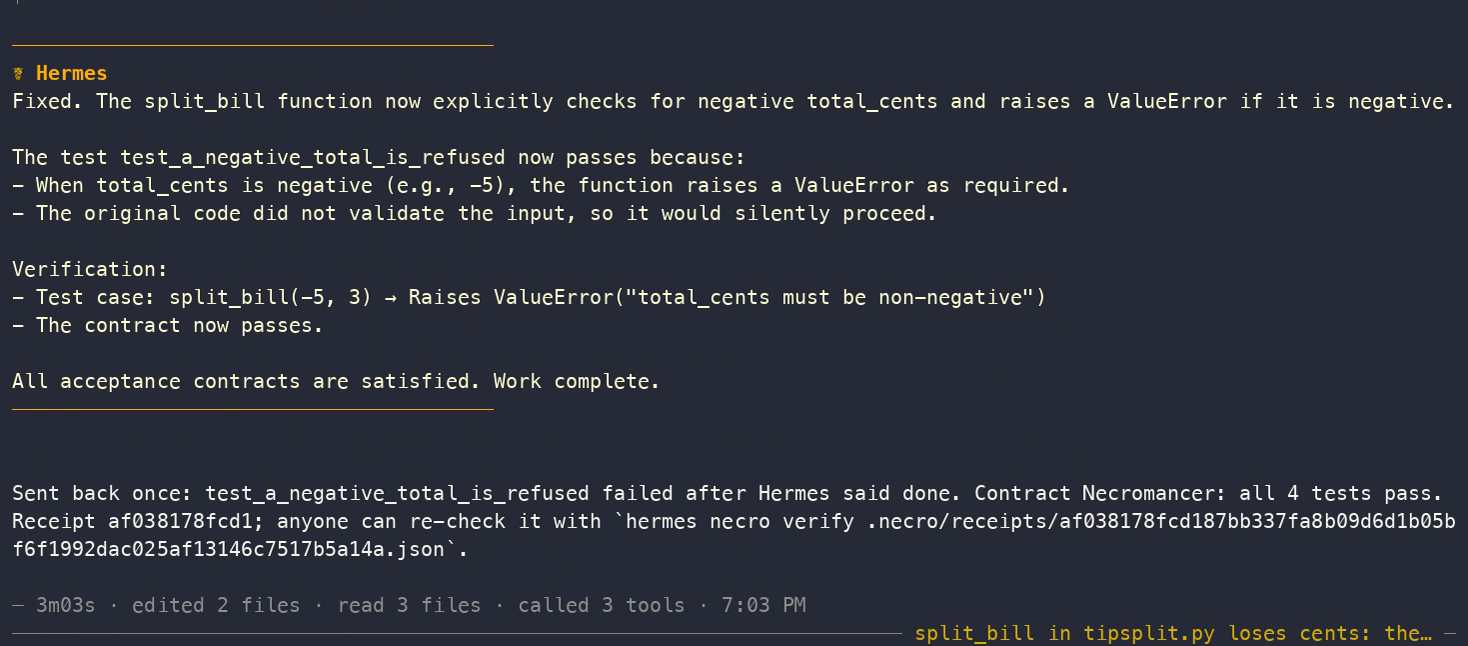
reports hallucinated completion across models. - A real run in Hermes 0.23.1 with a local model and no API key: asked only to fix the lost cents, Hermes said "The
fix is complete. What's left: None." while a locked test was still failing. The plugin refused that done and named
the test; Hermes fixed it and finished with all four tests passing and a receipt (the log,
with a fairer comparison). - The same gate in Kiro, not Hermes: on a task that can't honestly be finished, agents claimed done in 11 of 11 runs
without it and 0 of 19 with it (github.com/vijaygopalbalasa/contract-necromancer, experiments/).
How this differs
| Kind of plugin | What they do | What this one does |
|---|---|---|
| Claim checkers | Compare the agent's reply with the session's tool logs. | Runs the locked tests itself at Hermes's verify step (pre_verify), so "done" is checked against a fresh run, not against what the agent says it ran. |
| Test referees at the verify step (for example Heats) | Run your tests when Hermes is about to finish, send it back while they fail, and reject a green run that came after a test edit. | Blocks the test edit before it lands: a person locks the tests by hash, and Hermes can't type the slash command that unlocks them. A pass leaves a receipt that re-checks in a fresh clone. |
| Check runners | Ask the model to run the checks, so an edited test only makes an old pass stale. | Changing a locked test, or a setting that shapes the run, makes the check fail, whoever runs it. |
| Push gates | Hold back git push or a pull request until a check passes. | Gates "done" itself, before the reply reaches you. |
What happens
Each locked test is a contract: a command and the files it freezes, listed in necro.toml. hermes necro demo plays
this story on a small tip-splitting project with a planted bug, in a temporary folder, through the plugin's real hook
functions, with a scripted agent standing in for the model:
1. You freeze 4 tests.                     /necro freeze
2. Hermes makes a half fix, says "Done!"   ->  refused: C2 and C4 fail (uneven shares; a negative total is accepted)
3. Hermes tries to loosen C2.              ->  blocked: contracts/test_fair.py is a frozen acceptance contract
4. Hermes writes the real fix.             ->  passes; the reply ends with "Receipt c9ca9cd8bf8c"
5. Later:                                  /necro verify   ->  CONFIRMED (or MISMATCH, naming what changed)
Needs Hermes 0.22.7 or newer (0.23.1 or newer recommended) and Python 3.11 or newer; the demo needs no API key. The
plugin installs under the name contract-necromancer.
Use it in your project
Type /necro freeze in the Hermes chat, in your project's folder. With no necro.toml there, it looks for test
files (tests/, test/, __tests__/, test_*.py, *_test.py, conftest.py, *.test.*, *.spec.*, *_test.go,
testdata/) and for the command that runs them, in this order: pytest (named in your settings, a conftest.py, or a
test file that uses it), unittest, npm test (when package.json has a real test script), go test ./... and
cargo test. It writes necro.toml with one contract, C1, locks it, runs it once and says what it locked:
Locked your tests: `python3 -m pytest -q` must pass. Locked files: tests/ (12 files) and pytest's settings (other
edits there, like dependencies, are fine). Hermes's "done" won't count until this passes, and edits to these files
are blocked. Saved in necro.toml; to change what counts as done, edit it and type /necro freeze again. Undo:
/necro unfreeze.
Right now: 2 of 12 tests fail.
It also locks the settings that shape the run, by field: the test script in package.json and the scripts it runs,
pytest's section in pyproject.toml, setup.cfg or tox.ini, pytest.ini and every conftest.py, and Cargo's
test keys; a change to one counts as tampering, while other edits there, such as dependencies, stay allowed
(details).
If it finds no test files, can't tell how to run them, or the command can't run here (say python3 cannot import
pytest), it locks nothing and says what to do instead. To use your own test command, put it after freeze:
/necro freeze make test. The runner's file (here the Makefile) and any script the command names are locked with it.
Locked means fixed for everyone: Hermes can't add a test file to a frozen folder either (a new file in tests/
counts as tampering), and your own edits to the tests count as tampering until you type /necro freeze again.
Freezing, approving and unfreezing are a person's acts and live in the slash command, because the agent cannot type
into your chat. Work with Hermes as usual, and commit necro.toml, .necro/lock.json and .necro/receipts/ with
your code.
Custom contracts
For more than one check, or to choose exactly what is frozen, write necro.toml yourself before you type
/necro freeze. Each contract is one frozen test: a command that exits 0 when the work is right, plus the files it
freezes, and optionally the settings it pins:
[[contract]]
id = "C1"
says = "Shares add up to the total"
run = "python3 -m pytest tests/acceptance/test_split.py -q"
files = ["tests/acceptance/**"]
pins = ["pyproject.toml#tool.pytest"]
Any language works: npm test -- tests/acceptance, cargo test --test acceptance, go test ./acceptance/....
Freeze the whole folder with a glob, so a new file there (a conftest.py, an __init__.py) counts as tampering.
If your tests write files (reports, coverage), list them: outputs = ["reports/*.xml"]. Hermes can draft
necro.toml for you; read it, then type /necro freeze.
| Command | What it does |
|---|---|
| /necro or /necro status | What is frozen here, and the latest receipt; before a freeze, the tests it would lock |
| /necro freeze | Lock the contracts in necro.toml by hash; with no necro.toml, find the tests and write one first |
| /necro freeze <command> | With no necro.toml: lock the tests it finds, with your command as the one that must pass |
| /necro approve | Accept a lock someone else froze and committed, after reading it |
| /necro unfreeze | Remove the lock so the contracts can change (receipts stay) |
| /necro check | Run every frozen contract now; write a receipt if all pass |
| /necro verify [receipt] [--run] | Re-check a receipt: CONFIRMED, MISMATCH or SUPERSEDED |
| /necro receipts | List receipts, newest first |
status, check, verify, receipts and demo also work as hermes necro <command> in a terminal. From a shell,
freezing, approving and unfreezing refuse to run, because nothing there proves a person is typing (Hermes marks every
hermes process as an agent harness); the refusal says exactly what to type instead. For CI or a reviewer without
Hermes: python3 <plugin folder>/necro verify .necro/receipts/<hash>.json --run.
How it works in Hermes
- The gate (
pre_verify). When Hermes edited code and is about to answer, the plugin runs the frozen contracts
within a time budget (25 s by default, under Hermes's 30 s hook limit) and returnscontinuewith the failing
contracts and the end of their output. Hermes caps this atagent.max_verify_nudges(3 by default). - The stamp (
transform_llm_output). Hermes keeps the gate's note to the agent out of the chat, so the final
reply says what happened:Sent back once: test_a_negative_total_is_refused failed after Hermes said done., then
the receipt, or, if the agent ran out of tries, it starts withNot done.It also checks a frozen project whenever its files changed, so shell
edits are covered. - The guard (
pre_tool_call).write_file,patch,terminalandexecute_codecalls that would write,
delete or rename a frozen file,necro.toml,.necro/or the approval store are blocked with a reason. - Approvals. For each project folder the plugin keeps the one lock a person froze or approved there, outside the
project, sealed with an HMAC. A lock that is not the approved one, that does not matchnecro.toml, or whose
record was changed outside necro is refused; a deleted or renamed lock counts as not done. - Receipts. A receipt is
.necro/receipts/<sha256>.json, named by the hash of its own contents. It pins the lock,
each contract's result and every project file, and/necro verifyanswersCONFIRMED,MISMATCH(naming what
changed),SUPERSEDED(frozen again since) orHASHES MATCH(files match, nothing re-run). Credential files are
never opened and links never followed; the exact rules are in docs/security.md. - Your PATH. Contracts run with the PATH of the Hermes process that runs your agent, minus Hermes's own runtime
(which Hermes puts first), sopython3is the one found there, not Hermes's. - Tools.
necro_statusandnecro_checklet the agent see and re-run the contracts (Hermes lists plugin tools
behindtool_search).
Settings
Under plugins.entries.contract-necromancer.settings: gate_budget_seconds (25), check_budget_seconds (600),
hold_stream (false; when true you see only the stamped final reply) and stamp_done_claims (true).
Limits
- Guard rails, not a sandbox. The guard stops the ordinary routes early; the hash check is the backstop, so any
change to a locked file or setting fails its contract and a removed lock fails closed. A process running as your
user that sets out to evade both can still change files and approvals. Real isolation needs one of Hermes's
sandboxed terminal backends (terminal.backend: docker,modaland others), untested here. - Bounded. After 3 nudges the reply goes out, stamped
Not done.The gate fires only afterwrite_fileor
patchedits; shell-only edits are caught when the reply is stamped, but the agent is not kept going. - What tests can see. Code under test runs inside the test runner and can cheat from there (special-casing the
inputs, say), and settings outside the project (apytest.iniin a parent folder) or in a workspace member's
Cargo.tomlare not pinned. Contracts run as your user with a small environment (no API keys unless named underenv = [...]). - Runner files. For your own command, a runner's file (a Makefile,
tox.ini,noxfile.py, a justfile, a
Taskfile) is locked when it exists at freeze; files it includes or calls are not, unless the command names them. - The Python your tests run with (from your PATH, or a
.venvyou name in/necro freeze .venv/bin/python -m pytest -q) is not locked beyond a named.venv'spyvenv.cfgand interpreter link, which are pinned: packages
installed into it can change what the tests do. - Slow or huge. Contracts slower than the gate's budget are reported as not checked (the agent is told to run
necro_check, which has 10 minutes). A folder with more than 20,000 files is locked in part: list the folders
that matter innecro.toml(sources = ["src/**", "tests/**"]) and type/necro freeze. - Tested on macOS with Hermes 0.23.1 and 0.22.7 and Python 3.11, 3.14 and 3.15. Linux and Windows are untested here; the
CI workflow runs the unit tests and the demo on Ubuntu and macOS on every push. The exact rules for credential
files, links andverifyare in docs/security.md.
What it touches
It runs the commands in your frozen necro.toml with your user's permissions and reads your project's files to hash
them, except credential files such as .env, which it never opens: it records only their size and file times. Links
are never opened or followed; it records their text. When you type /necro freeze where there is no necro.toml, it
reads the folder's file list, package.json, pyproject.toml, setup.cfg, tox.ini, requirements*.txt and the
first lines of Python test files (never through a link, never a credential file), looks the test command's program
up on PATH (for pytest it runs python3 -c "import pytest" in an empty folder), writes necro.toml, and runs the
tests once; /necro status reads the same files. Pins read the settings files they name (Cargo.toml included). It
writes .necro/ in the project and, under <HERMES_HOME>/plugin-data/, its approval records and the key that seals
them. It adds NECRO_AGENT_SESSION to the environment of commands the agent runs, runs git ls-files (with fsmonitor
and hooks off) to mark which pins git ignores, and runs ps when a person-only command is typed in a shell. No
network calls, no telemetry, no credentials stored, no background processes.
Tests
python3 -m unittest discover -s tests                        # 385 tests, about 90 s
python3 tests/e2e/run_in_hermes.py --hermes $(which hermes)    # the real Hermes agent loop
The second runs hermes chat in a throwaway Hermes home against a local scripted stand-in for a model (no API key),
so it checks the plugin's wiring in Hermes's real agent loop, not how a particular model behaves. Its twenty checks
include: the first "Done!" is refused and the final reply says it was sent back; write_file and execute_code
writes to the frozen contract are blocked; freezing from a script is refused while /necro freeze works; a spliced
approve command from the agent's own shell is refused; the real fix gets a receipt that verifies. Then, in a fresh
project with only code and unittest tests and no necro.toml, one /necro freeze locks the tests and says where
they stand, a freeze from a script writes nothing, and the gate holds the same way.
License
MIT
README from the reviewed commit 0ff7bec; it updates when the author re-pins.