 DeseretSaint
Coursebook
Coursebook, learn anything. A Hermes Desktop learning workspace where a course is researched,
sequenced and governed, not a chat window with a topic in it.
Say what you want to learn, how long you want to spend and where you are starting from. Coursebook
researches the subject with the host's own tools, plans a course that fits the length you asked for,
starts at your level rather than at the most technical thing it knows, authors lessons with images
that are reviewed before they ship, keeps a specialist tutor beside every lesson, and grades with
typed checks instead of impressions. Textbook, game and parent modes; import a syllabus and it
builds the course around that instead.
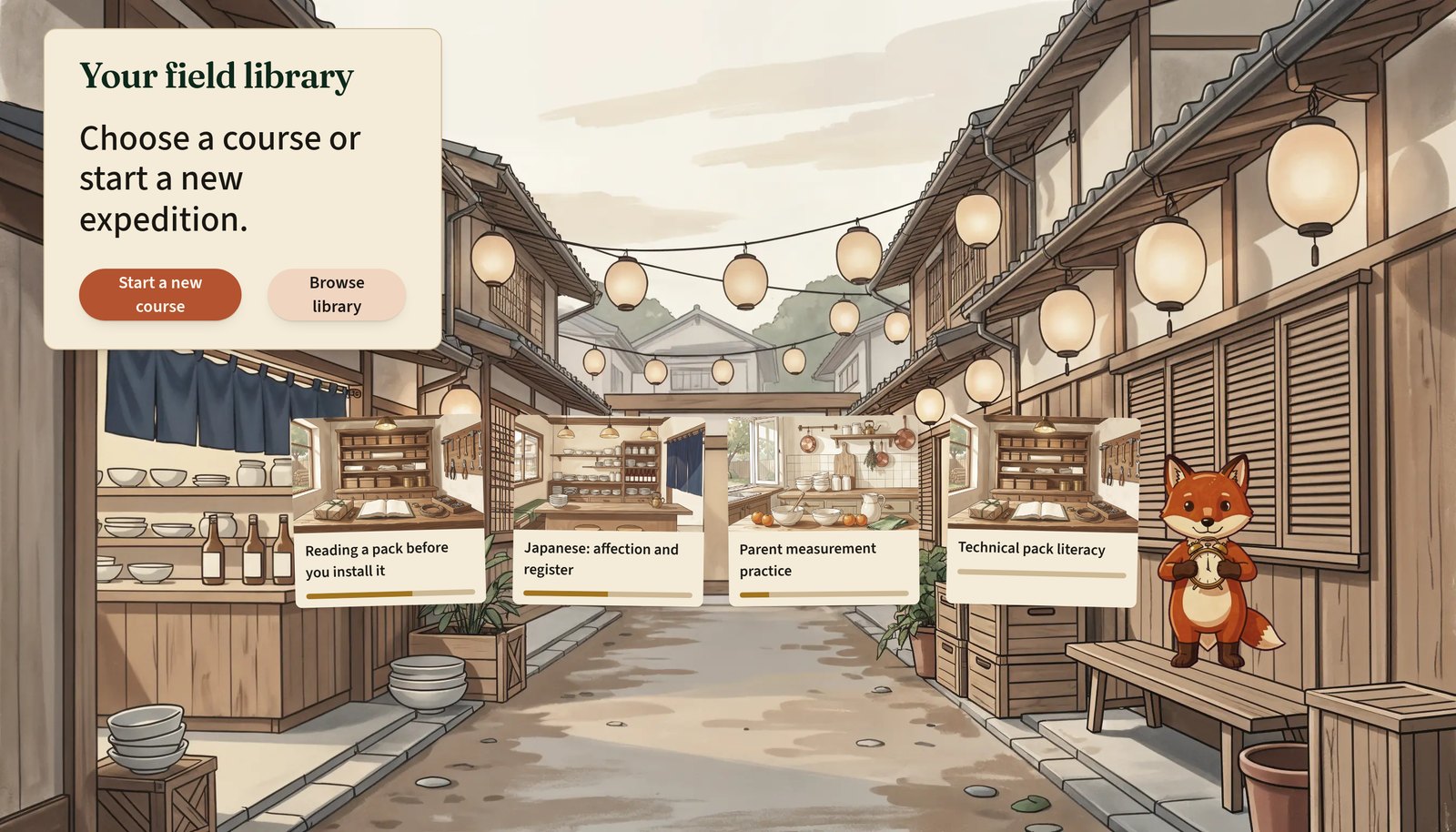
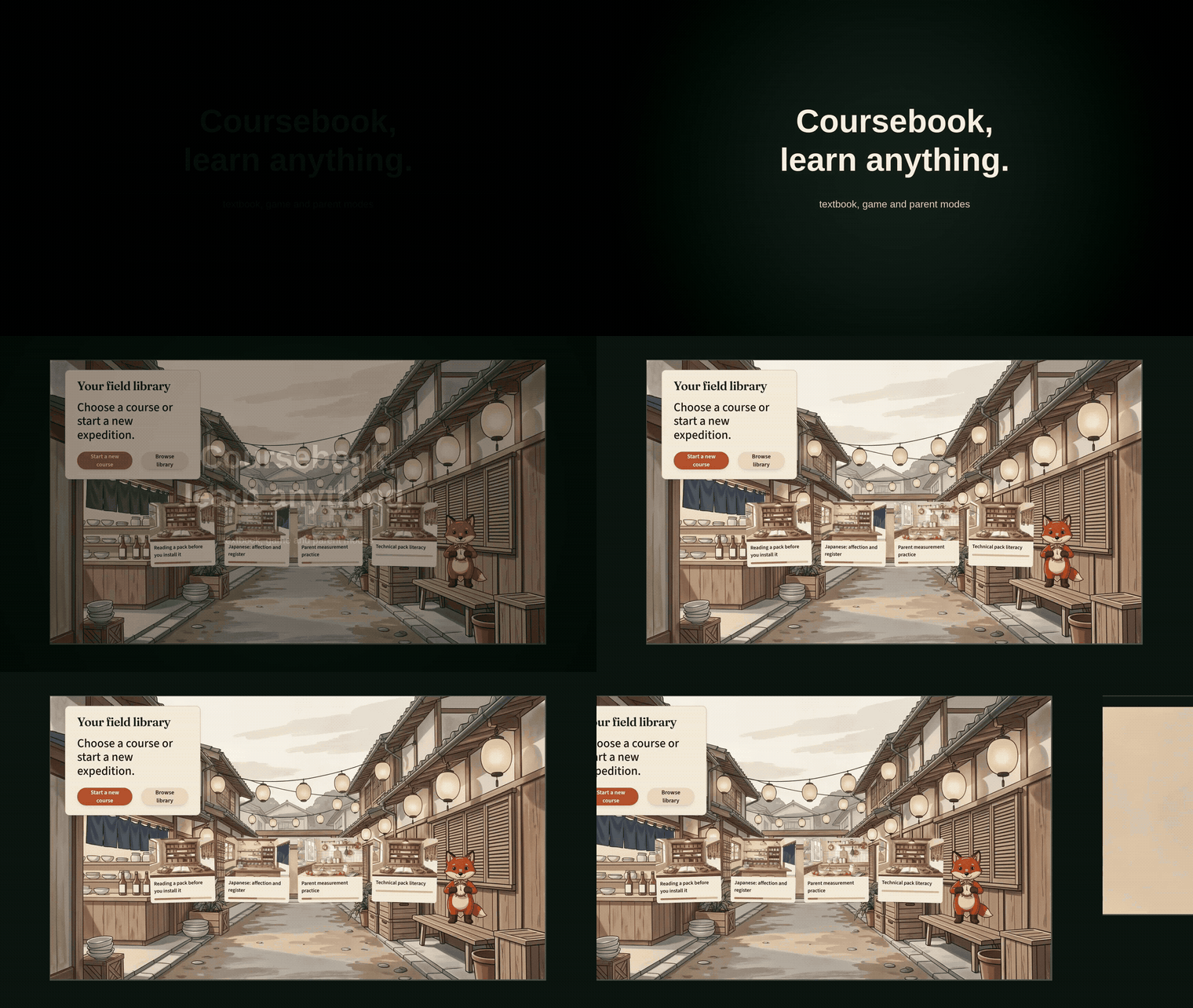
Thirty seconds, start to finish. The still frames below are from the same tree.
| Create | Plan |
|---|---|
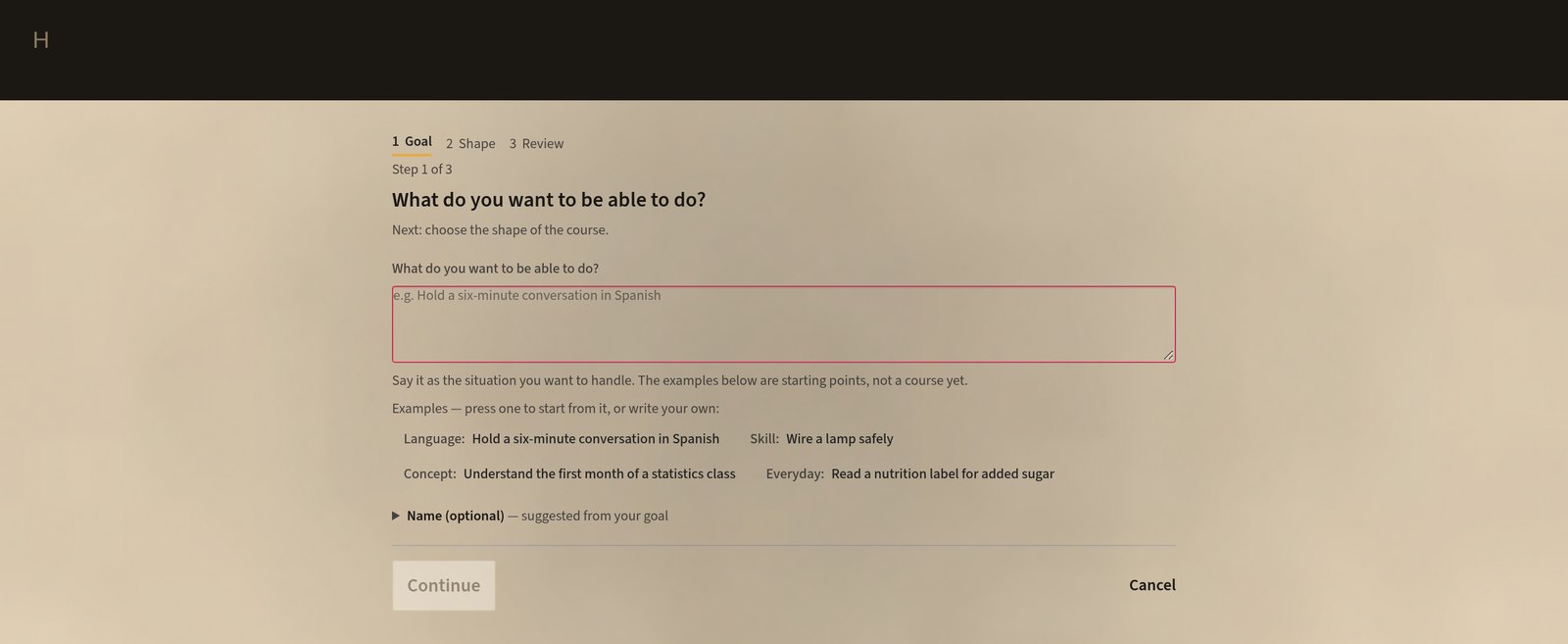 | 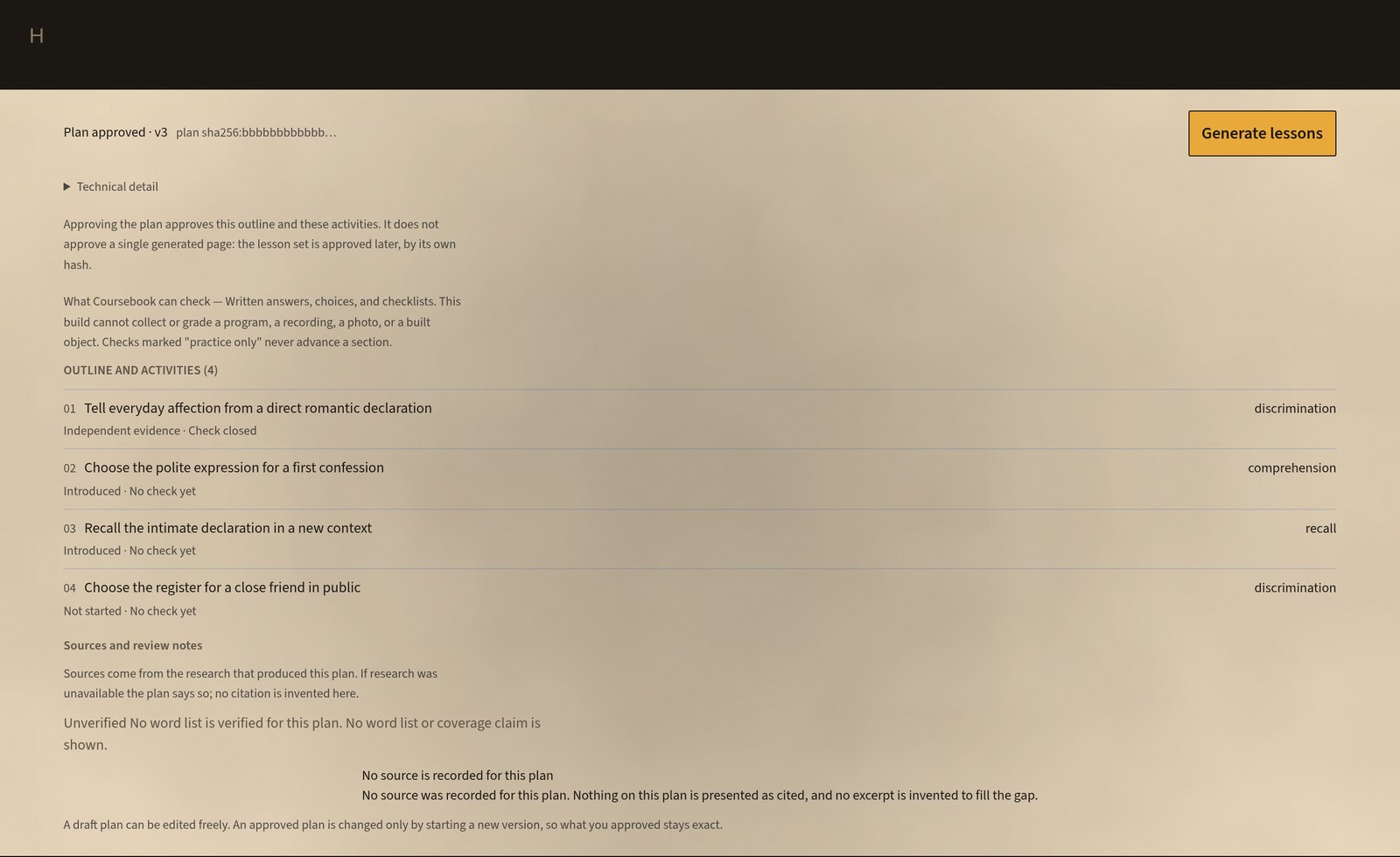 |
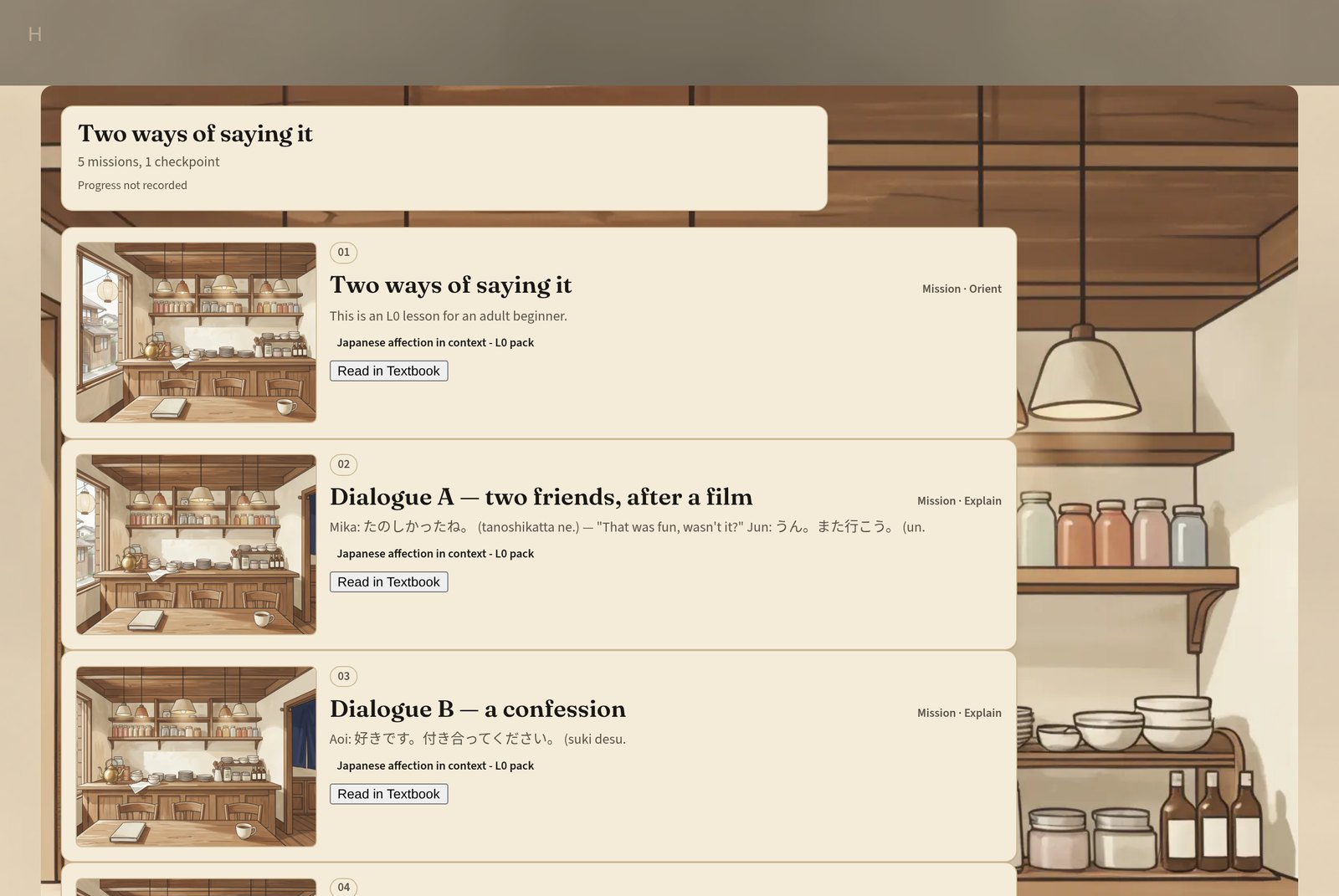
Captures of the current tree, not a mockup. Home and the course page are the owner's own renders of
the shipped UI; the lesson and game frames are being re-rendered after the last fixes, so they are
left out rather than shown stale.
What it does
- A course, not a thread. Research runs on the host's
web_searchandweb_extract, every
fetch is ledgered, and a claim may not carry a quote that is not in its source. - The length you asked for. Scope caps units, objectives, sections and weeks; an approved plan
is the shape you will get. - Your level first. A learner who declares none is never handed the hardest step first; the
first objective has to build the concept before the act is asked for. - Images that are checked, not decorative. Generated pictures pass a review gate that refuses
legible numbers, depicted procedures and off-subject frames; a procedure's authority stays a
deterministic schematic with values quoted from the source. - A tutor beside the lesson. Bound to one lesson run, it withholds an open answer, refuses a
mismatched run and drops citations that do not resolve. - Checks that are graded, and XP that is measured. XP is derived from the graded row: evidence
target times verdict times how independently the answer was given. Reading a page pays nothing. - Game and parent modes, on the same record. A game course lives inside its world; a parent
packs a lesson to teach; children never chat with Coursebook. - A syllabus in, a course out. Import a syllabus, approve the mapping, and the course is built
around it with your level and mode.
Install locally
# the repository is public; no credentials needed
git clone https://github.com/DeseretSaint/hermes-classroom && cd hermes-classroom
scripts/install-local.sh --home ~/.hermes/profiles/<your-profile>   # link, enable, verify
hermes gateway restart
Requirements: Hermes Agent 0.23.0 or newer, Python 3.11 or newer on the interpreter Hermes runs,
Node.js for node --check only. --home must be a profile or a disposable test home; the script
refuses the machine-level home on purpose. Full path, dependencies and the observed result:
docs/INSTALL.md.
Three things this tree can be held to
Each is asserted by a test in the suite; the measured run, its commit and its counts are recorded
in docs/RELEASE-EVIDENCE.md rather than repeated here, where they go stale. None of them is a
claim about learning outcomes, and none is a video.
- One answer, one transition.
tests/test_kernel_transitions.py(37 tests) asserts a pass
commits exactly one transition, a duplicate nonce is ignored, an idempotency replay returns the
persisted result, and two concurrent submits yield one commit and oneSTALE_REVISION— not two
transitions. - The answer key never leaves the backend.
check.openandcourse.outlinecarry
check_spec_withheldin place of the reference, andtest_criteria_observations_never_contain_the_reference
covers the committed row. Re-run here:python3 tests/adversarial/attack_state.py→
SUMMARY total=23 fail=0 pass=23, reference-leak scenarios included. - An export is hash-verified.
tests/test_course_export.pyre-hashes the zip bytes on disk and
asserts they equal the artifact's declaredcontent_hash("never trust the writer"), and that
the manifest carries teaching material rather than learner history.
Status
The source repository is public and clones without credentials: gh repo view DeseretSaint/hermes-classroom reports "visibility": "PUBLIC". GitHub keeps no visibility-change
timestamp for a user-owned repository, so this records when the public state was measured, not when
it changed.
The catalog entry plugin-catalog/coursebook.yaml is submitted in
NousResearch/hermes-agent#152920,
pinned to the master commit named in that pull request's body and docs_url pointing at
## Install locally below. The pull request has not merged, so the catalog hermes-agent ships
does not yet resolve coursebook; cloning is the install path that works today. No release tag
exists, and a LICENSE file records MIT.
The 30-second launch cut is docs/launch/coursebook-launch-30s.mp4
(H.264 High, 1920x1080, 30 fps, AAC stereo), built from captures of the current tree.
Merging the catalog pull request, tagging and announcing stay closed under docs/SUBMISSION.md §0,
which is the single authority for gate state; this file does not duplicate it. Everything below is
the measured record, limitations included. The end-to-end experience audit and the fix queue that
came out of it are docs/UX-AUDIT-E2E.md and
docs/UPGRADES.md.
Release record (0.1.0 and the product line)
Version 0.1.0. The release gates and the route evidence for the 0.1.0 tree are in
docs/CB017-RELEASE-VERIFICATION.md (CB-017 line, merged master 29bede7); the adversarial
review and the contest matrix are docs/REVIEW_CB017-FINAL.md, including Vellum's row-9 export
tail in §10. docs/CB016-RELEASE-VERIFICATION.md is the earlier record at e93b8c5, kept for its
two condition captures. The adversarial report on the previous candidate is docs/REVIEW_CB014.md
(candidate f4a42f34, NO-GO on the Desktop route, not on the backend).
master has since advanced beyond 29bede7 with the M0 host-media slice (3cead45) and the
M1-M3 product line (d28e7e3). The 0.1.0 evidence above is still the 29bede7 record and has not
been re-run on the newer tree. The last frozen release tree is
b9f4a197e42e4f033298d94608fcb5b63640b094 (the H-210-R2 merge over df052ea: the live pack round
trip that closed gate 4, plus its capture; the diff from df052ea is docs/ and audit/ only, and
the M4 audit is pinned to module cd862140…c516, which is unchanged on that tree). That
release-tree audit measures 62 frames, 15/15 claims PASS, 2,120 text nodes and 298 AX controls at
plugin cd862140…; those are still the record's M4 numbers. master has
advanced past it: the module at the head is e87a2e01… (UI-K9's cover provenance, f766d1c6,
merged as 88a88744; before it the VQ-011 Home tag-aspect merge dccb532c over the aside
check-control merge 0a4683f7, merged as 165d7da0, had put 9015b84c there), and the audit
committed at audit/visual/m4-visual/audit.json was regenerated for that module on 2026-11-12
(15/15 claims PASS). That regeneration did not reproduce the record's measurements:
the trunk audit measures 62 frames, 15/15 claims PASS, 2,172 text nodes, 320 AX controls and 158
full-motion animated nodes, against the record's 2,120 / 298 / 70 — the text-node count moved at the
CB-trunk re-pin (d6d85566), and every re-pin after it (the Gate 5 artwork module 52dac9ed, the
0.2.1 module 28bc081c, 9015b84c, then e87a2e01) changed only the pin, the branch and
generated_at. So the
committed audit describes the head, not the b9f4a19 record; re-pinning this
record's module field to it is the remaining freeze step. The suite count and the
contract/schema rows in this README are measured on the master tree their row names; every other
pin and health row is the b9f4a19 measurement, recorded in docs/RELEASE-EVIDENCE.md, with
python3 scripts/check-docs-truth.py failing when a document drifts from that record. It is not a
green release: the demo gate t_6a32ffe9 is still open and no live Desktop window has driven this
tree; publication remains gated by docs/SUBMISSION.md §0.
Product line after 0.1.0
This tree also carries the post-0.1.0 product line from docs/VISUAL_MEDIA_PLAN.md: M0 on master
at 3cead45, M1-M3 merged on master at d28e7e3, and the M4 visual/accessibility/media evidence
regenerated on the settled H-209 tree ab6dc7e (H-208's union plus H-182/D8 and H-206), against
desktop/plugin.js sha256
cd862140…c516 — reproducibility is
checked with python3 scripts/m4v-repro-check.py, which reports 62/62 identical screenshots and an
identical audit.json (modulo generated_at) on two consecutive runs at this pin; that output is
pasted in docs/M4-VISUAL-MEDIA-AUDIT.md. Phase-to-commit mapping, per-phase evidence and the gated
remainder: docs/PRODUCT-LINE-RELEASE-NOTES.md.
The 0.1.0 rows below are the release record for 29bede7 and are deliberately not rewritten to
describe this tree. The product-line rows are separate, and they use two weaker words:
- Rendered — the shipped Desktop module was mounted and measured in headless Chromium against a
stub host transport. Real paint, real layout and a real accessibility tree; no backend, no chat,
nolesson.pageRPC. - Working (live) — a mounted Desktop window reached a real isolated backend and the state was
read back from it. Neither word means "recorded as a demo", and neither is a release claim.
| Product-line surface | State on this tree | Evidence |
|---|---|---|
Contracts cb.rpc v28 and cb.db v15, with cb.jobs v5, cb.errors v4, cb.projection v2 and the v1 cb.pack and cb.vocabulary | Working at this commit: 93 declared methods and 93 handlers. observation.record was frozen by cb.rpc v14 in H-53 and wired by H-54, so the registry test allows no gap: any declared method that loses its handler fails the suite. cb.rpc v28 is one additive amendment over v27, composed from two E2E lanes (a passed generated section reopens as a revisit clone of the newest closed authored check, revisit on check.open/check.get/progression.challenge_out, and library_item.next_step.kind gains review_lesson, complete and repair_lesson, with sections_total on a page section and the optional reasons on lesson.regenerate; every new key is optional and no method moves); cb.rpc v27 is one additive amendment over v26 (W2-6: one optional lesson_document_media.labels array of at most 8 {text, x, y, anchor} records, so a label-free media child keeps its exact v26 bytes, and no method moves); cb.rpc v26 is one additive amendment over v25 (CP-052: one optional world_brief.route_anchors array, no method moves); v25 is one additive amendment over v24 (CP-005: seven required library_item shelf facts — sections_done, sections_total, checks_recorded, is_new, subject_label, cover_artifact_id, last_studied_at — no method moves); v24 is additive over v23 and appends ten methods — GM-004's world.read, world.style.preview, world.generate, world.approve plus course.mode.set, GM-007's homework.read, homework.create, homework.complete, homework.skip, and GM-018's takehome.html; v23 added the Parent Studio take-home pack family (takehome.sources, takehome.preview, takehome.create, takehome.approve, takehome.export, takehome.read) whose artifact is bound to the source lesson version and content hash; v22 added GM-011's lesson-bound tutor (tutor.ask, tutor.history); v21 added GM-009's game-only engagement methods (engagement.read, engagement.award); v20 added the parent.blueprint.read sections[] identity a fine-tune call needs and the optional validation approval provenance a plan review reads before offering approval; v19 itself added the fine-tune commands (plan.edit, plan.undo, lesson.revise, lesson.regenerate, parent.review.read, parent.final.approve). Schema 15 from migrations 0001-0015 (v13 adds GM-001's Game Mode storage, v14 scopes a take-home pack's revision to the pack instead of its source slot, v15 adds the checks.revisit flag that marks a check as a revisit clone) | contracts/rpc.v28.json, contracts/db.v15.json; parity asserted by the suite (4577 tests OK (skipped=12) on master 7e7a54fe); coursebook/api.py implemented_methods() returns all 93 declared methods |
| Textbook view | Working (live): a real document served over the real RPC; the frame set covers Textbook and Guided (13 frames) | audit/visual/m1-guided-authoring/README.md |
| Guided view | Working (live) on a newly authored document (state=complete, views.guided=true). The older demo course still reports textbook_only because its stored page predates lesson-prompt.v5; it was not rewritten | audit/visual/m1-guided-authoring/ |
| Field Desk cockpit (Continue, path, stats, Field Notes, sources, all courses) | Working (live): the cockpit, its opened sources drawer, and its backend-off, empty and loading states were read from an isolated window at plugin sha 638e0f5e… | audit/visual/m2-field-desk/README.md, live-evidence.json |
| Field Notes (save from a block, search, return to the exact block) | Working (live): 15 live frames including 460 px and exact-block return | audit/visual/m2-field-notes/live-evidence.json |
| Field Quest | Rendered: 14 static frames and 56 render/parity tests, plus a live availability capture. No live Quest frame exists, because the stored lessons in every reachable home predate authored short | audit/visual/m2-field-quest/README.md, live-availability.json |
| Procedure lens (typed header, numbered steps, hazard callout, schematic rows, source permission) | Authored and Rendered: the lesson schema and lesson-prompt.v10 produce the typed procedure header, and tests/test_procedure_authoring.py drives the real lesson job with a fake model and asserts the served document renders the header, hazards, numbered steps, schematic rows and source card. The 7 visual frames and 28 validator/render tests remain fixture-based; no live provider run has authored one | docs/M4-PROCEDURE-LAYOUT.md, docs/GENERATION.md, tests/test_procedure_authoring.py |
| Pronunciation Studio (listen, record, compare, dispute) | Rendered: 14 frames and 15 jsdom interaction tests. It is inert on every existing section because none has a narration media child; no live attempt was walked | docs/M3-PRONUNCIATION-UI.md, tests/test_desktop_pronunciation.py, audit/visual/m3-pronunciation/ |
| Media generation and preview | Working for the host adapter (one real PNG and one real MP3 through docs/M0-MEDIA-PROBE.md) and Rendered in the lesson (50 decoded images, 12 audio elements, 0 autoplay, text equivalent for each). The preview route is covered by tests, not driven live on this tree | docs/M0-MEDIA-PROBE.md, docs/M4-VISUAL-MEDIA-AUDIT.md, audit/visual/m4-visual/audit.json |
| M4 visual, contrast and accessibility gate | Rendered: 62 painted frames, 15/15 claims pass, 0 plugin-authored contrast failures over 2,172 text nodes (worst authored 5.93:1), 0 unnamed of 320 accessibility controls, no clipped text or horizontal overflow. Two consecutive m4v-repro-check.py runs at the release-tree module cd862140… are identical: 62/62 screenshots and audit.json modulo generated_at; that pair has not been re-run at the head's module | audit/visual/m4-visual/audit.json (the release-tree record is pinned to plugin cd86214… at b9f4a19, measured on ab6dc7e; the same file at this head is regenerated against the module this tree actually ships (scripts/check-audit-pin.py names it, and fails when the audit and the module disagree)), docs/M4-VISUAL-MEDIA-AUDIT.md, scripts/m4v-repro-check.py |
| 460 px narrow width | Partial: the module itself reflows at 460 px with no horizontal overflow, but the shipped host still gives the route 101 px when the chat rail is docked. The host patch that fixes the grid is neither merged nor installed | audit/visual/m1-narrow-width/DECISION.md §Residuals; audit/visual/m4-visual/*-460-*.png |
Nothing in the product line changes install status. The catalog entry pins the master commit the
pull request body names and is open awaiting maintainer review, and no release tag exists.
0.1.0 surface table (release record, post-release changes named)
Three states are used in this table. Working means a command was run against that build and
passed.
Implemented, unverified in the UI means the backend path is implemented and tested, and the
Desktop surface exists, but this release pass did not drive it through the UI. Absent means
there is no code path at all. Unless a row names a later commit, the row describes 29bede7.
| Surface | State in this build |
|---|---|
| One installable package (agent half plus Desktop half) | Working: scripts/install-local.sh installs both halves; hermes plugins validate and hermes plugins doctor pass |
coursebook_status agent tool (read-only health) | Working: one of the two registered tools |
coursebook_due agent tool (read-only next step) | Working: reads the same profile-scoped store as the Desktop (library.list next step plus the derived review.queue). Writes nothing, makes no provider call, and reports an unavailable database as available:false with a reason instead of an empty list |
Backend routes /health, /schema, /rpc, /runtime, /packs/*, /artifacts/<handle>, /media/<artifact_id> | Implemented: the first six were re-driven by scripts/probe-backend.py (31/31). /media/<artifact_id> is an M0 addition (3cead45), covered by tests/test_manifest.py and tests/test_media_generation.py; it does not exist at 29bede7 |
Frozen contracts at 29bede7: cb.rpc v7, cb.db v4, cb.jobs v2, cb.errors v2, cb.pack v1, cb.projection v1, cb.vocabulary v1 | Working in that build: 52 declared methods, 52 handlers, no contract problems from /runtime. This tree has moved to cb.rpc v25 and cb.db v14 with 93 declared methods and 93 handlers; the product-line row above carries the current numbers |
Profile-scoped SQLite schema and migrations 0001-0004 at 29bede7 | Working: health.get answers db.ready: true, schema_version: 4 on a fresh home. This tree ships migrations 0001-0015 and answers db.ready: true, schema_version: 15 on a fresh home |
Desktop route #/coursebook, sidebar entry, pane, command palette, settings page | Working with a reachable backend: mounts the library, New course, Parent Studio and a course card (docs/CB017-RELEASE-VERIFICATION.md §2). A window with no gateway renders no route page for any hash — host shell degradation, reclassified P3-operational by Atlas (docs/REVIEW_CB017-FINAL.md §3.1) |
Desktop keybinds coursebook.focus (Mod+Shift+K) and coursebook.tutor (Mod+J) | Registered through KEYBINDS_AREA, rebindable defaults, never synthetic key events: coursebook.focus opens #/coursebook; coursebook.tutor (GM-012 §7.3) fronts the tutor rail and puts the caret in its composer — navigation only, it never sends the draft |
| Course creation, plans, lessons, grading, transitions, evidence | Implemented, unverified in the UI: 685-test suite at 29bede7, plus adversarial S01/S02/S10-S12 (duplicate submit, stale revision, invalid/hung/throwing grader) all pass in that build. The suite measured 2724 tests at ab6dc7e |
| Replan of an approved plan, then lessons, then export | Working end to end for this tree: replan → plan approve (v10) → lessons job start → 4 lessons authored → lesson-set approve → export, with the UI and the backend agreeing on the approved content hash (sha256:ccf69462…e5a5), export.ready: true and no blocked_reason. Evidence: docs/REVIEW_CB017-row9-ui.json, docs/REVIEW_CB017-FINAL.md §10 |
| Notebooks, quiz history, review queue, usage accounting | Implemented, unverified in the UI: notebook.save/list/update/delete, quiz.history, review.queue/action and usage.summary are in the mounted registry |
| Pack import and export, Parent Studio authoring | Implemented, unverified in the UI: pack.import/export/preview/inspect/list/delete and eight parent.* methods; P17/P18/P20 pass, and export reproduces the reviewed content hash |
| Research | Implemented inside plan jobs: bounded, query-capped and ledgered through the host web_search/web_extract seam; records unavailable rather than inventing a source. No standalone RPC |
| Image and speech generation | Implemented on master since 3cead45 (M0): the host's configured image/TTS providers are called through ctx.dispatch_tool; generated visuals and narration are stored as content-addressed artifacts with text equivalents and honest degraded states. Absent at the 0.1.0 release commit 29bede7. Pronunciation scoring is not shipped yet |
| Reminders | Absent: no RPC, no job runner, no storage |
Every method declared by cb.rpc v7 had a handler in the 29bede7 build. On this tree all 93 of
cb.rpc v28's declared methods have handlers, observation.record included — frozen by H-53 and
wired by H-54, with the H-53→H-54 registry allowance removed. The count comes from
coursebook/api.py's implemented_methods() after importing every registering module
(coursebook.domain, coursebook.engagement, coursebook.pack_flow, coursebook.pronunciation,
coursebook.syllabus, coursebook.tutor, coursebook.world), not from a text search, and
tests/test_kernel_v2.py asserts the registry covers every declared method. So there is no command that answers a plausible success for work it cannot do. A method
outside the contract is refused with VALIDATION_FAILED; a declared method with no handler answers
NOT_IMPLEMENTED; a handler that cannot answer returns a contract error rather than a fabricated
result. evidence.inspect no longer carries an open check's reference answer: criteria
are projected through PUBLIC_CRITERION_FIELDS with a check_spec_withheld marker, so the
check_spec that holds the reference never leaves the backend. That closes CB-QA-10 on the wire
(docs/HARNESS-STATUS.md §4; S07 passes in tests/adversarial/attack_state.py). One backend
defect remains open and is recorded in docs/REVIEW_CB014.md: the optional auxiliary grader cannot
yet distinguish a persuaded pass from an honest one (CB-QA-11).
Requirements
- Hermes Agent 0.23.0 or newer, with the Desktop app.
- Python 3.11 or newer (the repository tests run on the interpreter Hermes ships).
- Node.js, only for the
node --checksyntax gate. The plugin itself needs no build step.
Install from a local checkout
These commands were run against this checkout before they were written down. Run them from the
repository root.
bash scripts/install-dev.sh
hermes plugins enable coursebook
hermes gateway restart
scripts/install-dev.sh symlinks this checkout into $HERMES_HOME/plugins/coursebook and prints
the next steps. It refuses to replace a real directory and refuses to run outside a Coursebook
checkout. It does not enable anything.
scripts/install-local.sh is the scripted equivalent: it installs both halves into one dedicated
home, enables the plugin, and verifies the install with hermes plugins validate and
hermes plugins doctor.
Then enable the Desktop half in the app: Capabilities, Plugins, Coursebook, on. The two halves
are enabled separately; the pane detects the mismatch and says so.
Verify:
hermes plugins doctor coursebook
bash scripts/validate.sh
Cloning from GitHub is the supported install path: the repository is public, and the clone in
## Install locally above is the path the catalog entry's docs_url points at.
hermes plugins install coursebook — the catalog path — does not work yet. The entry is submitted as
plugin-catalog/coursebook.yaml in NousResearch/hermes-agent#152920, an open pull request awaiting
maintainer review, and the catalog hermes-agent ships does not resolve coursebook until that
merges. The entry pins the master commit named in that pull request's body and is validated with
hermes-agent's own catalog validator and its pinned-source gate at that sha, including the
symlink-confinement check that rejected an earlier pin. Gate state lives in docs/SUBMISSION.md
and is not repeated here. Owner: Harbor and DeseretSaint.
First run
Open Coursebook in the Desktop sidebar. The plugin loads: the sidebar item, the pane and the
command-palette entries register, and the settings page registers when the host exposes a
settings-page seam. With no chat bound to an enrollment, the pane offers Open Coursebook and
reports that no durable chat is bound yet. The backend it reads answers health.get with
db.ready: true and schema_version: 14.
In a window that reaches a gateway-backed backend, #/coursebook mounts the course library, the
New course action and Parent Studio (docs/CB017-RELEASE-VERIFICATION.md §2). A window whose
isolated home has no gateway shows the session home for every hash instead — that is the shell,
not the plugin, and Atlas reclassified CB-QA-09 as P3-operational on exactly that evidence
(docs/REVIEW_CB017-FINAL.md §3.1). A demo that shows the chat side still needs a composer, which
means recording on the profile that owns this host's gateway.
Ask the agent to run coursebook_status to get the health block as JSON, or coursebook_due to
get the learner's next step from this profile's local store. If the backend is not
mounted, the pane names the enable path and offers Check again instead of showing an empty
course list.
Step-by-step install, uninstall and troubleshooting: docs/INSTALL.md.
Privacy and egress
Coursebook holds no vendor credentials and reads no provider key. Provider calls go through a
seam the Hermes profile already configures:
- lesson chat uses the selected chat provider and any configured external memory provider;
- plan and lesson generation use the host plugin LLM route; the optional auxiliary grader uses
the same route and is disabled in this build; - research uses the host
web_searchandweb_extracttools, so the user's configured backend,
egress rules and SSRF checks apply; - pack import and export are local files and perform no upload, and there is no telemetry.
Two operations do make a direct outbound HTTP request of Coursebook's own, both outside that seam:
- Provider image download. When the host binds
ctx.dispatch_toolandimage_generate
returns an artifact URL, Coursebook downloads the bytes itself from an allowlisted
*.fal.media/*.fal.runhost (coursebook/media.py). The URL is the provider's own
artifact URL, never one supplied by the model or a learner; the redirect target is re-checked
against the same allowlist, and a provider or download failure degrades to the text equivalent. - First-use speech-model download. The first pronunciation attempt with an empty cache
downloadsfaster-whispermodel weights from Hugging Face into<plugin data>/stt-models
(coursebook/stt.py). Weights only: no audio or learner data is sent, and the take is deleted
after local scoring.
Neither request carries a schoolwork payload, and neither uses a credential Coursebook holds.
State lives in profile-scoped SQLite at $HERMES_HOME/plugin-data/coursebook/data.db and
migrates on first use, through migrations 0001-0015 (schema v15) on this tree. Usage rows are
recorded locally, and only for a session this process observed as bound to an enrollment. "Local"
describes storage, not inference.
Full text, including what Coursebook refuses to do with schoolwork and what it cannot control at
the host level: docs/PRIVACY_EGRESS.md.
Limitations
This candidate is not shippable as a Desktop product.
- CB-QA-09 is a host gateway binding, not a plugin defect (P3-operational, Atlas ruling in
docs/REVIEW_CB017-FINAL.md§3.1). This host runs one gateway for profiledefaultand refuses
a second, so an isolated window has no composer; the plugin's ownBackend off/Offline
states are proven separately. The demo's chat surface therefore needs the operator to record on
the gateway-owning profile, or to stop that gateway first. - Row 9 is closed on this tree (replan → lessons → export, §"Status"); the demo still cannot be
recorded on this host for the gateway reason above, and that is a process blocker, not a product
one. - Image and speech generation now use the host's configured providers through the plugin seam;
pronunciation scoring and reminders remain absent. - The auxiliary open-response grader is disabled. Closed checks are graded against a stored
reference; with the lane enabled, an answer that persuades an obedient grader is accepted
(CB-QA-11). evidence.inspectwithholds an open check's reference on the wire (CB-QA-10 closed). The L2
projection carriesid,description,check_idand acheck_spec_withheldmarker from
coursebook/evidence.py'sPUBLIC_CRITERION_FIELDS, so the spec that holds the reference never
reaches the caller;tests/test_review_evidence.py:378,384assert its absence and S07 passes;
the state matrix on this candidate isSUMMARY total=23 fail=0 pass=23with S13BLOCKED
(auxiliary grader lane disabled).
The product line adds surfaces with limits of their own; these are not the 0.1.0 rows above.
- Narrow width is a host gap, not a plugin claim. At 460 px the shipped host gives the Coursebook
route 101 px while the chat rail is docked. The fix (narrowLeavesGrid) lives on
DeseretSaint/hermes-agentbranchwt/host-narrow-rail(5900b6e7a0), is neither merged nor
installed, and the M4 frames measure the module in a 460 px viewport rather than through the host
grid (audit/visual/m1-narrow-width/DECISION.md). - Field Quest has no live frame. Stored lessons predate authored
short, soviews.field_questis
false on every section a window reached; the lens is proven by render and parity tests
(audit/visual/m2-field-quest/README.md). - The procedure lens has no authoring path. The validator, contract and renderer are proven against
a contract-valid fixture; the lesson prompt does not emitprocedureyet
(docs/M4-PROCEDURE-LAYOUT.md). - The Pronunciation Studio is inert until a section carries narration media, and no existing section
does. With no recogniser configured it says "Practice only, not graded" and records nothing; a
take ismodel_assessedevidence, never verified pronunciation or mastery
(docs/M3-PRONUNCIATION-UI.md). - Media proof is split. Generation is real (one host PNG and one host MP3 in
docs/M0-MEDIA-PROBE.md); the lesson renderer is measured statically, and audio is checked for
attributes and decode, not audibility (docs/M4-VISUAL-MEDIA-AUDIT.md). - No user-facing text-only or reduced-data preference ships. The text-only path exercised is the
no-artifact fallback. - Reduced motion is measured, not vacuous: H-152 ships real transitions, so the four reduced-motion
frames paint 0 animated nodes while the full-motion frames paint 70; the preference suppresses the
motion rather than there being none to suppress. - Accessibility names come from the Chromium accessibility tree, not from a screen reader.
- A failed audio preview is typed
visualin the internaldata-cb-media-kindattribute while its
visible label and transcript stay correct (t_acd97416, low, open). - The product line is not demo evidence and not a release: no video exists, the demo gate is NOT
MET (docs/DEMO.md), the catalog pull request is open and draft and has not merged, and no tag or
contest submission was made (docs/SUBMISSION.md§0).
There is no learning-style diagnosis, no "2 sigma" claim, no guaranteed mastery, no child safety
or COPPA certification, and no efficacy claim. Educational research motivates the design;
Coursebook has not established that it improves learning. Parent observations are labeled
parent_reported and are never combined with automated mastery.
Documentation
docs/INSTALL.md: install, enable, verify, uninstall, troubleshooting.docs/ARCHITECTURE.md: verified SDK seams, spec to SDK corrections, failure states, and the
stored-lesson-text repair marker.docs/CONTRACTS.md: the seven frozen contracts and their open questions.docs/GENERATION.md: the plan and lesson pipeline, research ledger and validation pass.docs/WORK_PACKAGES.md: file ownership and merge order.docs/PRIVACY_EGRESS.md: per-operation disclosure.docs/DEMO.md: the demo script and its precomputed/live split.docs/PRODUCT-LINE-RELEASE-NOTES.md: phase-to-commit map for the post-0.1.0 product line and what
is still gated.docs/VISUAL_MEDIA_PLAN.md: the product-line direction that M0-M4 implement.docs/M0-MEDIA-PROBE.md,docs/M4-VISUAL-MEDIA-AUDIT.md,docs/M4-PROCEDURE-LAYOUT.md,
docs/M3-PRONUNCIATION-UI.md: measured evidence for media, the visual/a11y gate, the procedure
lens and the pronunciation studio.docs/CB017-RELEASE-VERIFICATION.md: gates, clean install, the clean-export run and the route
finding as reclassified (CB-017 line, merged master29bede7).docs/CB016-RELEASE-VERIFICATION.md: the earlier record ate93b8c5, including the two route
condition captures.CHANGELOG.md: what 0.1.0 contains and what it does not.docs/SUBMISSION.md: submission checklist, owners and gates.docs/REVIEW_CB014.md: the release-gate report on this candidate.PREBUILD_SPEC.md,UX_SPEC.md,PLAN.md: the frozen design, interface contract and plan.AUDIT.md: adversarial audit, including the product and demo corrections.VAULT_LEARNING.md: research leads behind the design.
Development
bash scripts/test.sh            # unit tests, then node --check desktop/plugin.js
bash scripts/validate.sh        # pre-merge gate: tests, syntax, admission on an export, doctor, probe
bash scripts/validate-plugin.sh # release gate: admission on a git archive export of HEAD
Run scripts/validate.sh before any merge into master. It is the pre-merge gate; it passed on the
0.1.0 commit with 685 tests, node check OK and 31/31 backend expectations. The suite measured
2724 tests at ab6dc7e (python3 -m unittest discover -s tests -t ., Ran 2724 tests in 533.270s,
OK). Its admission step validates
an export of the tracked tree (scripts/lib/gate-export.sh), not the checkout root, so the
gitignored .worktrees/ farm is never scanned and an uncommitted edit to a tracked file still fails
that step. scripts/validate-plugin.sh is the release gate for one pinned commit.
desktop/plugin.js is a single ES module with no relative imports and no JSX, because the
Desktop runtime loader refuses everything else. It is a single-writer file; see
docs/WORK_PACKAGES.md.
License
MIT. The terms are in LICENSE at the repository root, copyright 2026 DeseretSaint. The owner chose
MIT on 2026-11-10 in board card t_6f2d2080; that card's docs follow-through (this section, gate 9
in docs/SUBMISSION.md, CHANGELOG.md and the catalog's known_issues) lands in the same commit.
Publication — merging the catalog pull request, tagging, announcing — stays closed under
docs/SUBMISSION.md §0: a license makes redistribution lawful and a public repository makes the
source clonable, and neither authorises announcing the release.
README from the reviewed commit 14a2dbb; it updates when the author re-pins.