 vigohan95
docs-drift
A plugin for Hermes Agent. When the agent
edits code, the plugin checks whether the README and the other Markdown docs still describe
that code: command-line flags, environment variables, stated defaults, npm scripts, make
targets and links to files. If the edit left a doc line behind, the result of that edit says
so, with file and line on both sides, so the agent can fix the docs in the same turn.
It parses files and runs git. It makes no model call and no network request and needs no
API key.
hermes plugins install vigohan95/hermes-docs-drift --enable
Needs Hermes 0.21.6 or later. No Python packages are installed.
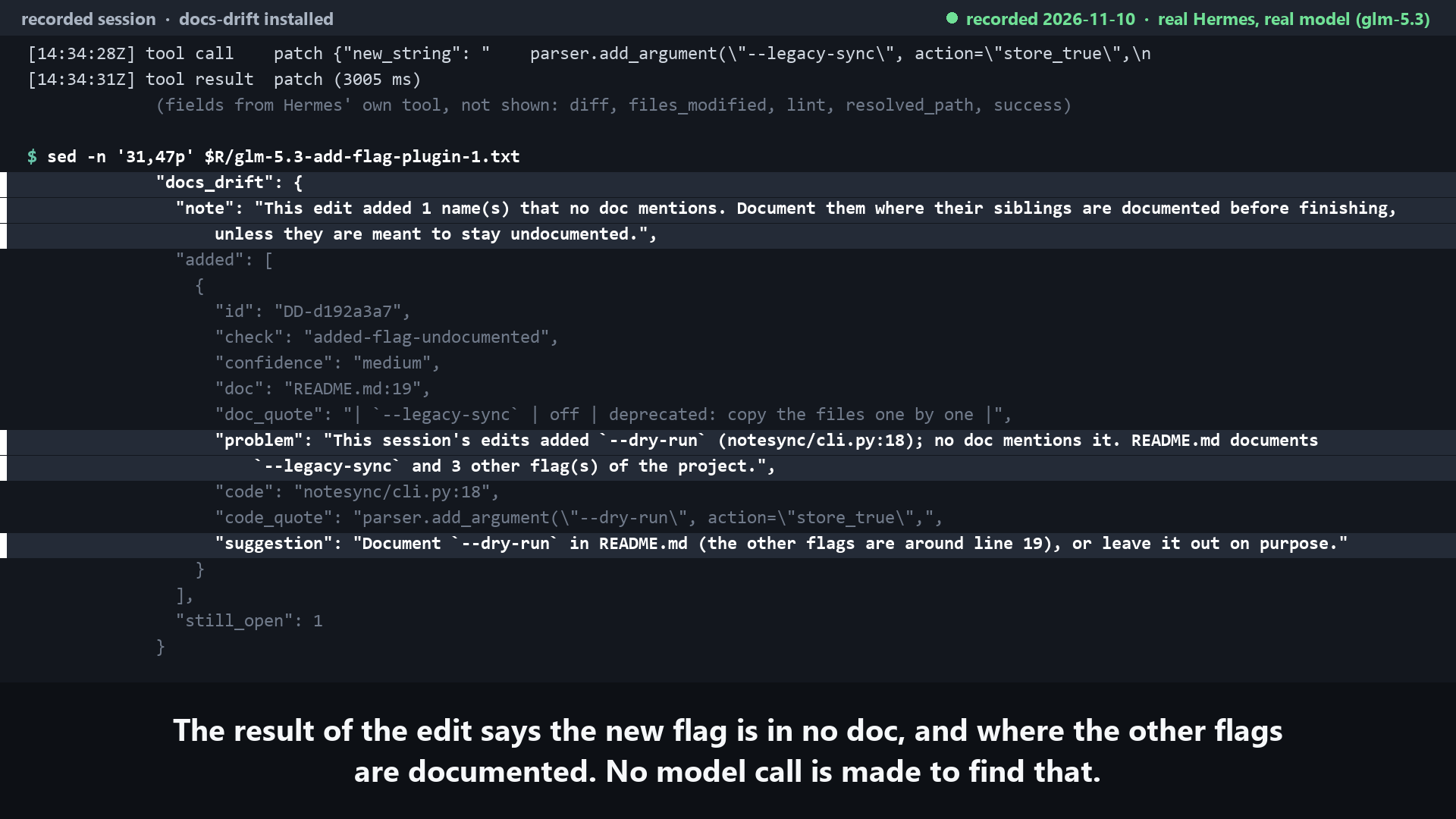
A frame of the demo video. The terminal lines are lines 28 to 47 of
evidence/real-model/round3/glm-5.3-add-flag-plugin-1.txt, a session recorded on 2026-11-10
with glm-5.3, the first of them cut at 135 characters; the header and the caption bar were
drawn by the video script. Five more frames are in media/.
Does it change what the agent does? Measured with a real model
106 sessions in real Hermes with a real model, in two sets on 2026-11-10. Each session got
one plain change request that says nothing about documentation, for example
Add a --dry-run flag that prints what would be copied. Every request was run with the
plugin installed (default settings) and without it, from the same starting files; nothing
else differed. After each session a script read the files it left and decided whether the
docs still agree with the code: after a rename, a removal or a changed default, no doc line
still has the old name or value; after an addition, some doc file mentions the new name. The
models are glm-5.3 and the smaller qwen3.8-27b, both on Vultr Serverless Inference.
| Model | Request | Project | With the plugin: docs consistent / sessions | Without the plugin: docs consistent / sessions | Sessions with the plugin in which it told the model something |
| --- | --- | --- | --- | --- | --- |
| glm-5.3 | add a flag, first batch | example | 5 / 5 | 2 / 5 | 5 |
| glm-5.3 | add a flag, second batch (a replication) | example | 5 / 5 | 0 / 5 | 4 |
| glm-5.3 | add a flag, both batches together | example | 10 / 10 | 2 / 10 | 9 |
| glm-5.3 | add a flag | encode/uvicorn | 5 / 5 | 1 / 5 | 5 |
| glm-5.3 | add an environment variable | example | 5 / 5 | 5 / 5 | 5 |
| glm-5.3 | change a default | example | 5 / 5 | 5 / 5 | 2 |
| glm-5.3 | remove a flag | example | 5 / 5 | 5 / 5 | 4 |
| glm-5.3 | remove an environment variable | example | 5 / 5 | 5 / 5 | 2 |
| glm-5.3 | rename a flag (first set) | example | 5 / 5 | 6 / 6 | 5 |
| qwen3.8-27b | add a flag | example | 5 / 5 | 5 / 5 | 5 |
| qwen3.8-27b | rename a flag | example | 5 / 5 | 5 / 5 | 5 |
The plugin changed the outcome for one kind of request with one of the two models:
glm-5.3 asked to add a flag. Without the plugin this model added the flag to the code and
usually stopped there. The new flag ended up in the docs in 2 of 10 sessions on the example
project and in 1 of 5 on encode/uvicorn. With the plugin, the result of the code edit said
that no doc mentions the new flag and where the other flags are documented, and the flag
ended up in the docs in 10 of 10 and 5 of 5 sessions. In 14 of those 15 the model had not
touched a doc file before the plugin's note; in the other one it documented the flag in the
same answer as the code and the plugin had nothing to say.
For every other request the outcome was the same with and without the plugin, and so it
was for the second model on both of its requests, the added flag included. In all 20
glm-5.3 sessions of the second set that ran those requests without the plugin, the first
thing the model did was search the project for the name or value it had been asked about
(legacy-sync, retry, timeout, NOTESYNC_TOKEN_FILE); the search showed the doc lines,
and the model updated them itself. Those rows are not evidence that the plugin makes an
agent fix docs it would otherwise have left.
What to keep in mind about the one difference:
- It is one model and one kind of request, in two projects, with 5 sessions per arm and
batch.qwen3.8-27bgiven the same request on the same project read the README before
editing and documented the flag itself in 5 of 5 sessions without the plugin. - The note about an added name was written on the day of the measurement, after the first
set had shown no difference and before the sessions that measure it. It is the newest and
least measured part of the plugin; see "Names an edit added" under
What it adds to a session. - The example projects were written by the plugin's author. encode/uvicorn is the only real
repository, with one request, and is one of the 24 repositories the scanner was tuned on. - The second batch of five per arm was decided after the first had been seen (5 of 5 against
2 of 5 could have been chance). That decision was committed before the second batch ran,
and the table gives both batches separately. - The rule only asks whether a doc file mentions the new flag, not whether what the model
wrote about it is right. - In one of the 5 uvicorn sessions with the plugin, the plugin told the model something
false. The model's patch had leftuvicorn/main.pyunparsable, the plugin could read no
flag from it, and it answered that the open note was resolved. The model repaired the
file, was told about the flag again and documented it, so the session counts as
consistent; had it stopped at the false message, the doc would have stayed stale because
of the plugin. The cause was fixed after the sessions and is covered by unit tests only;
see One wrong message from the plugin.
The first set also ran 5 sessions with the plugin in reminder-only mode
(report_after_edit: false) on the rename: 5 of 5 consistent, and the plugin said nothing in
any of them. In no session with the plugin, in either set, was the reminder before the end
of a turn delivered, because no session reached the end of a turn with something still open.
What the plugin is for does not depend on these numbers: the check runs on every edit
whether or not the model thinks of the docs, it is the same check every time, and it costs
no model call. Whether a given model needs it is what the table is about, and for most of
the table the answer was no.
Plans written before the counted sessions, every transcript and the per-session tables:
the first set (16 counted sessions and 3 more, 148 chat
requests) and the second set (90 sessions, 777 chat
requests). One of those 90 transcripts is not on this branch. It is kept unchanged on the branch
evidence-raw,
because Hermes' install scanner flags a shell command the model issued in it, and with that
file in the tree the install command above asks for confirmation. The session is counted in the
table as before; the file left in its place
says what the line is and why the finding is a false positive.
Limits, in short
- It checks names and paths, not meaning: flags, environment variables, defaults, npm
scripts, make targets and links, in Markdown and MDX only. - The hooks see edits made with Hermes'
write_fileandpatchtools. A file changed by a
shell command is seen at the next such edit. - A rename spread over several edits is reported when the last use of the old name is gone
from the code, not before. - A scan of a whole repository with no edit to compare against (
/drift, or the command line
without--since) is often wrong on a repository it was not tuned on: 15 findings, 2 of
them true, on 12 repositories it had never seen. The hooks do not work that way; they
report only what an edit changed. - The edit-time path was measured on the same 12 repositories with changes made by a
script (a flag, variable, script or target renamed, a linked file removed; the docs left
alone): 211 of 221 such changes were reported, and no finding was about anything other
than the changed item. Of the 131 flag and variable reports, the first doc line of each
was read: 5 are lines that use the same name for something else (the shell'sPATH, an
example in a note). Scripted renames are not the edits a person or a model makes; see
Injected drift. - Documentation generated when the docs are built (Sphinx directives, embedded
--help
output), man pages and reStructuredText are not read. - The test suite passes in CI on Linux, macOS and Windows with Python 3.11, 3.12 and 3.14,
and the validator, the install and both scripted example sessions pass in real Hermes on
Linux in CI. The real-model sessions and the precision and injection measurements were
run on one Windows machine.
The longer list is under What it does not do.
What the agent is given
From one of the sessions above
(evidence/real-model/rename-with-plugin-3.txt),
as Hermes printed it:
[12:37:07Z] tool call    patch {"new_string": "    parser.add_argument(\"--dest\", default=\"./out\", help=\"where the copies go\")", "old_string": "    parser.add_argument(\"--output-dir\", ...
[12:37:10Z] tool result  patch (2985 ms)
             (fields from Hermes' own tool, not shown: diff, files_modified, lint, resolved_path, success)
             "docs_drift": {
               "note": "This edit left 2 place(s) where the docs no longer match the code. Update the docs (or the code) before finishing; docs_drift_explain <id> shows both sides.",
               "new": [
                 {
                   "id": "DD-5fb3c36f",
                   "check": "cli-flag-undefined",
                   "confidence": "high",
                   "doc": "README.md:8",
                   "doc_quote": "notesync ./notes --output-dir ./backup",
                   "problem": "`--output-dir` was removed from the code by the edit, but the docs still use it.",
                   "code": "notesync/cli.py:12",
                   "code_quote": "parser.add_argument(\"--dest\", default=\"./out\", help=\"where the copies go\")",
                   "suggestion": "The same edit added `--dest` (notesync/cli.py:12). If this is a rename, replace `--output-dir` with `--dest` in the docs.",
                   "also_at_lines": [
                     16
                   ]
                 },
   (cut here: the second finding, docs/configuration.md:7, has the same shape)
               ],
               "still_open": 2
             }
   (cut here: a second edit of cli.py)
[12:37:15Z] assistant    Docs still reference the old flag — updating them.
   (cut here: four patch calls on README.md and docs/configuration.md)
[12:37:24Z] tool result  patch (2815 ms)
             (fields from Hermes' own tool, not shown: diff, files_modified, lint, resolved_path, success)
             "docs_drift": {
               "resolved": [
                 "DD-6d2fee65"
               ],
               "still_open": 0,
               "note": "1 docs-drift finding(s) resolved by this edit; 0 still open."
             }
The lines marked "cut here" replace parts of the transcript; the first patch line is cut at
the right. Nothing else is changed. The model's own search at the start of the session had
already listed the doc lines, so this transcript does not show that the entry is what made
it edit the docs.
Install
hermes plugins install vigohan95/hermes-docs-drift --enable
Needs Hermes 0.21.6 or later. That is the oldest numbered release, and its source already
has the three hooks and the registration calls used here
(evidence/requires-hermes.txt); the plugin itself was run
on Hermes main only: the recorded sessions at commit b7db40d (2026-11-10, after v0.23.1),
and the two scripted sessions in CI at b7db40d and at 3d4dd10, 986 commits later. No
Python packages are installed: the plugin uses the standard library only. git should be on PATH; without it
the plugin walks the directory and cannot compare with an earlier state.
Hermes scans every file of a plugin repository before it installs it, and with a verdict of
caution it asks for confirmation, or refuses where it cannot ask. For this repository the
verdict is safe (evidence/validate.txt), and the same command,
given a local clone in place of the GitHub name, installed it with no --force and no terminal
(evidence/install-without-force.txt). To keep it that
way, one recorded session transcript is not on the default branch: the scanner reads a shell
command the model issued in it as a pipe into an interpreter. It is unchanged on the branch
evidence-raw, and
a note in its place says
where and why. The same evidence file shows the commit before that change being refused.
Hermes defers plugin tools behind its tool_search and tool_call tools by default, so the
model finds docs_drift_scan by searching for it. The hooks do not depend on that: they run
whenever the plugin is enabled.
What it adds to a session
Hooks (automatic).
| Hook | When | What it does |
| --- | --- | --- |
| pre_tool_call | before the first write_file or patch in a repository | Scans the repository once and keeps the result as the session's baseline. |
| transform_tool_result | after each write_file or patch that succeeded | Scans again. If the edit caused drift that was not in the baseline, adds a docs_drift entry to the tool result. Adds nothing otherwise, except a short note when an edit resolves drift it reported earlier, and, once per session and repository, a not_checked note when an edit could not be checked (for example because the scan ran out of its time budget). |
| pre_verify | when the agent is about to finish a turn in which it changed files | If drift from this session is still open, asks the agent once to continue, and lists it. With report_after_edit: false this is the only thing the plugin says (reminder-only mode): it scans here by itself. |
A finding that was already there before the session started is never reported by the hooks.
Names an edit added. The checks look for docs that say something the code no longer does.
The opposite case, code that gained something the docs do not have yet, is reported by the
hooks only, and only for what the session itself added: when an edit adds a flag definition
or a read of an environment variable, no doc file mentions the new name, and the docs already
document a sibling (another flag of the project; another variable with the same prefix), the
edit result gets an added list ("This session's edits added --dry-run (cli.py:14); no doc
mentions it"), pointing at the place where the siblings are documented. It stays open, and is
part of the reminder before the turn ends, until a doc mentions the name. It runs inside the
same scan and the same time budget. report_added: false turns it off.
This was added on 2026-11-10 after the measurements under "Measured precision" were made. It
is not one of the nine checks and it is not part of any precision or injection number in this
README: docs_drift_scan without a session edit, /drift, changed_only and the command
line never report it. It has unit tests, and it is what the "add a flag" and "add a variable"
rows of the table at the top of this README measure: on an example project written for that
purpose and, for the flag, on encode/uvicorn. How often it is wrong on other real
repositories has not been measured. Two cases where it will be wrong are known: docs
generated from the code at build time (the name is not in any file yet), and a flag that is
meant to stay undocumented but is not marked hidden in the code. A third was seen in one
recorded session and fixed afterwards: an edit that left the Python file unparsable made
the plugin call the open note resolved. Such a file now keeps the flags read from it when
it last parsed, for as long as their names are still written in it.
Tools (the model calls them).
docs_drift_scanscans a repository. Arguments:path,changed_only(only drift caused
by uncommitted changes, compared withgit HEAD),checks,min_confidence,
max_findings.docs_drift_explaintakes afinding_idand returns the doc lines, the code lines, the
reasons the finding was reported and a suggested fix.
Slash command (you type it).
/drift [path]            scan the repository (default: the working directory)
/drift --changed [path]  only drift introduced by uncommitted changes
/drift --all [path]      also run the opt-in checks
/drift explain <id>      show one finding with both sides
/drift checks            list the checks
Command line (no Hermes needed). From a checkout of this repository:
$ python -m docsdrift /path/to/project --since HEAD
docs-drift (new since HEAD): 2 findings (2 doc files checked against 4 code files, 109 ms)

README.md:8  cli-flag-undefined  [high]  DD-5fb3c36f
  `--output-dir` was removed from the code by the edit, but the docs still use it.
  docs: README.md:8  notesync ./notes --output-dir ./backup
  code: notesync/cli.py:12  parser.add_argument("--dest", default="./out", help="where the copies go")
  also at lines: 16
  fix:  The same edit added `--dest` (notesync/cli.py:12). If this is a rename, replace `--output-dir` with `--dest` in the docs.
...
The exit status is 1 when there are findings, so it can be used in CI. Other options:
--json, --checks, --min-confidence, --max-findings, --explain, --list-checks,
--no-git, --exit-zero.
Checks
| Check | Default | Reports |
| --- | --- | --- |
| path-missing | on | A Markdown link or image points at a file that is not in the repository. |
| cli-flag-undefined | on | Docs show a command-line flag that the code no longer defines. |
| env-undefined | on | Docs name an environment variable that nothing in the code reads. |
| default-mismatch | on | Docs state a default value that differs from the default in the code. |
| npm-script-missing | on | Docs tell the reader to run a package.json script that does not exist. |
| make-target-missing | on | Docs tell the reader to run a make target that no Makefile defines. |
| path-ref-missing | opt-in | A file path written in inline code does not exist in the repository. |
| cli-flag-undocumented | opt-in | The code defines a flag that the docs listing its siblings do not mention. |
| env-undocumented | opt-in | The code reads an environment variable that the docs listing its siblings do not mention. |
The three opt-in checks are off because they were wrong too often on real repositories (see
Measured precision). Turn them on with /drift --all or the checks
setting.
What the code side understands:
| Fact | Where it is read from |
| --- | --- |
| Flag definitions with line and default | Python (argparse, click, typer), JavaScript and TypeScript (commander, yargs), Go (flag, cobra/pflag) |
| Flag names, any language | every --name literal in a non-doc file, and identifiers and strings that spell the name |
| Environment variables | read calls in Python, JavaScript, Go, Rust, Ruby and shell with line and default; any NAME_LIKE_THIS token in a non-doc file |
| npm scripts | every package.json in the repository |
| make targets | every Makefile, makefile, GNUmakefile and *.mk |
| Files | git ls-files, plus untracked and git-ignored files on disk |
The docs side is Markdown and MDX: links, images, inline code, fenced code blocks, tables
and lists. Changelogs, release notes, migration guides, translated READMEs and vendored
directories are not checked.
How a finding is decided
There are two kinds of evidence, and they are not equally strong.
An edit. The hooks, changed_only and --since compare the code before and after. If a
flag, variable, script, target or file was defined before, is in no non-doc file now, and
the docs still use it, that is reported with high confidence. When the same edit added one
new name of the same kind, the finding says so and suggests the rename. This is the main
use of the plugin.
The repository as it stands. A plain scan has no "before". A flag in the docs that the
code does not define might be another program's flag, a placeholder, or a flag defined in a
way the scanner cannot read. So a plain scan reports only when it is hard to be wrong:
- a flag must be used with this project's own command, or sit in an option list most of
which the code defines, and its name must not survive anywhere in the code, even as an
identifier or a string; - a variable must carry the project's prefix or a prefix the code reads at least two other
variables with, and the name must be in no non-doc file; - a default must be stated on a line that names exactly one option, and the code must
define exactly one static default for it; - a link must be relative, stay inside the repository, and its target must be neither
tracked, on disk, git-ignored nor inside a submodule.
Everything that fails one of these tests is counted, not reported. The text output ends
with the count and the reasons, for example withheld as uncertain: 2 (flag-has-loose-trace: 2).;
in JSON it is the not_reported field.
The cost is recall. A plain scan of a repository where a flag was renamed last month, and
whose old name still appears in a variable somewhere, says nothing. The numbers below show
how much is lost, and how often a plain scan is still wrong.
Measured precision
This section is about scans of a whole repository with no edit to compare against, which is
the hard case. The hooks do not use it.
Method: 36 open-source repositories, each cloned and pinned to a commit
(evidence/targets.txt), scanned with all nine checks. Every finding
was read by hand against both files at that commit and labelled true or false with a
one-line reason (evidence/labels.json). "True" means a reader who
follows the doc line is misled about the code. Anything arguable is labelled false.
The repositories were used in four sets. The tuning set (8) was scanned while the checks
were being written. Held-out 1 (8), held-out 2 (8) and held-out 3 (12) were each scanned for
the first time with a fixed commit of the scanner, and that first run is the only unseen one
for that set. The checks were changed after held-out 1 and after held-out 2. They were not
changed after held-out 3 until version 0.1.1 (below the table).
| Run | Scanner commit | Set | Seen before? | Default checks: found / true | Opt-in checks: found / true |
| --- | --- | --- | --- | --- | --- |
| round 1 | 974f7f2 | tuning | yes | 0 / 0 | 5 / 0 |
| round 1 | 974f7f2 | held-out 1 | no | 4 / 0 | 4 / 0 |
| round 2 | 806d448 | tuning | yes | 0 / 0 | 5 / 0 |
| round 2 | 806d448 | held-out 1 | yes | 0 / 0 | 0 / 0 |
| round 2 | 806d448 | held-out 2 | no | 5 / 1 | 9 / 1 |
| round 3 | 8ff4f2c | tuning, held-out 1 and 2 | yes | 1 / 1 | 14 / 1 |
| final | b7ba05d | tuning, held-out 1 and 2 | yes | 1 / 1 | 14 / 1 |
| round 4 | 4a1d964 | held-out 3 | no | 15 / 2 | 48 / 2 |
The checks at 4a1d964 are the checks of the final run: docsdrift/checks.py, facts.py
and docs.py did not change in between.
Version 0.1.1 replaced regular expressions in those three files with ones that take linear
time (SECURITY.md). That was not meant to change what a check reports, and
scanned again with 0.1.1 all 36 repositories give the findings of the runs in the table
(evidence/rescan.txt).
Read plainly:
- The number for a repository the scanner has not seen is the last row: 15 findings from
the default checks, 2 true; 48 from the opt-in checks, 2 true. That is the scanner as it
is shipped, on 12 repositories (501 Markdown files) chosen by a rule that was written down
before anything was cloned (evidence/heldout3-rule.md, the
walk through the search result is in
evidence/heldout3-selection.txt). Nothing was tuned
afterwards. - Over the three first-time runs together (28 repositories, three versions of the scanner)
the default checks reported 24 findings and 3 were true; the opt-in checks reported 61 and
3 were true. - The "1 / 1" of the final run on the first 24 repositories is a number on repositories the
rules had been adjusted to. Held-out 3 shows that it did not carry over. - The 15 default findings of held-out 3 are in 4 of the 12 repositories; 10 of them are in
one (mvanhorn/cli-printing-press, 226 Markdown files of skills, retrospectives and design
notes). The 13 false ones, by cause:- 5: a shell variable that a bash snippet in the docs sets and reads itself
(PP_GO_VERSION_INPUT,CLI_SOURCE_ZIP), reported as an environment variable the
program does not read; - 2: a comment marker in a bash snippet (
# PRINTING_PRESS_SKILL_UPDATE_START), read as a
variable name; - 2: a dated retrospective or design note that proposes a flag or says a flag is
deliberately absent; - 1: a flag registered with default
0meaning "not set", while the effective default the
docs state (50) is applied elsewhere in the code; - 1: a link written relative to a skill's root directory, not to the page;
- 2: links in a source file that is compiled into the program and published under another
directory, where the links resolve.
- 5: a shell variable that a bash snippet in the docs sets and reads itself
- The two true ones: medialab/xan
docs/cookbook/dataviz.md:862links tosigmajs.org/
withouthttps://, so it opens a path inside the repository; CLIUtils/CLI11
book/chapters/formatting.md:45shows an image that is inbook/images/, not next to the
page. The true one from held-out 2 is junegunn/fzfREADME.md:776, which names
FZF_EXPANSION_OPSwhere the code readsFZF_EXPANSION_OPTS. - The opt-in checks were right 2 times in 48 on held-out 3 (alexellis/arkade: the pasted
help of one command lacks a flag the code registers; cli-printing-press: an instruction
namesdocs/CHANGELOG.md, the file is at the root). The usual causes of the false ones:
the page describes files of a program that this repository generates, not of the
repository (9); a pasted help of one subcommand compared with flags of other subcommands
(8 in arkade); dated notes; option lists written by a Sphinx directive when the docs are
built (3 in tmux-python/tmuxp). - One label was corrected on 2026-11-10. psf/black
--bind-host(opt-in check, tuning set)
was labelled true in the first rounds because the page source never spells the flag. The
page embeds the output ofblackd --helpwhen the docs are built, so the published page
does show it. The table above uses the corrected label; before the correction the opt-in
column read 5 / 1 for the tuning set and 14 / 2 for the 24.
The table is printed by benchmarks/precision.py (evidence/precision.txt).
The script fails if a finding has no label. The scan results it reads are in
evidence/scans/.
Well-kept projects have little drift for a plain scan to find, which is why the true counts
are small. To measure the edit case, drift was injected.
Injected drift
benchmarks/inject.py changes the code in memory and leaves the docs alone: it renames a
flag (as a string, and again as a refactoring that also renames the identifiers), renames an
environment variable, renames an npm script or a make target, or removes a linked file. The
candidates are chosen with a fixed seed from names that both the code and the docs contain,
without asking the scanner. A mutation counts as detected when the scan of the changed tree
has a finding of the matching check with that name and the scan of the original tree did
not.
| Run | Scanner commit | Set | Injected | Detected, edit-aware | Detected, plain scan |
| --- | --- | --- | --- | --- | --- |
| round 1 | 974f7f2 | tuning | 248 | 238 (96.0%) | 166 (66.9%) |
| round 1 | 974f7f2 | held-out 1, unseen | 165 | 122 (73.9%) | 79 (47.9%) |
| round 2 | 806d448 | held-out 2, unseen | 121 | 118 (97.5%) | 54 (44.6%) |
| final | b7ba05d | tuning | 248 | 238 (96.0%) | 81 (32.7%) |
| final | b7ba05d | held-out 1 | 165 | 147 (89.1%) | 47 (28.5%) |
| final | b7ba05d | held-out 2 | 121 | 118 (97.5%) | 54 (44.6%) |
| final | b7ba05d | all 24 | 534 | 503 (94.2%) | 182 (34.1%) |
| round 5 | 35e6564 | held-out 3, unseen | 221 | 211 (95.5%) | 83 (37.6%) |
All runs are in evidence/recall.txt. The last row was run once, on
the 12 repositories of held-out 3, after everything above it, and nothing in the scanner was
changed because of it. Three of those 12 repositories gave no candidate (no name that both
the code and a checked doc contain), so the 221 come from 9. Repeated with version 0.1.1,
the final run and round 5 give the same rows
(evidence/reinject.txt).
"Edit-aware" is what the hooks and changed_only do. "Plain scan" is a whole-repository
scan of the changed tree with no knowledge of the edit. The gap between the two columns is
the recall given up for precision, as described above. The plain-scan column fell between
round 1 and round 2 on the tuning set (166 to 81) because the rules added after the first
unseen run stop a plain scan from reporting a flag whose name still appears anywhere in the
code.
In the final run no injection produced a finding about an unrelated item, with one
exception that is correct: removing the Makefile of nektos/act made 10 make commands in
its docs point at targets that no longer exist. (Those runs recorded at most ten such
findings per injection, so "10" there may be a cut-off list. The round 5 run records all of
them.)
On held-out 3 the count of findings about an unrelated item is 0 in all 221 injections. The
211 detections came with 455 findings, since a renamed name is usually on several doc lines;
all 455 name the changed item. A finding with the right name is still not always a useful
message. The first doc line of each of the 131 flag and variable detections was read: for
the 93 flag detections every one is the project's own command or flag description; of the
38 variable detections, 5 point at a line that uses the name for something else (PATH of
the user's shell three times, a shell test in a skill file, an example error message in a
requirements note). The remaining lines of the 455 were not read. The notes are in
evidence/injected/round5-heldout3/READING.md.
The misses are listed by python benchmarks/summarize_inject.py <dir> --misses.
The Hermes repository itself
After the first 24, the scanner was run on Hermes Agent at commit b7db40d (1,180 Markdown
files, 21,805 other files). It is a hard case: a monorepo that ships documentation for many
third-party tools as skills.
The first run (scanner 8ff4f2c) gave 147 findings from the default checks. 109 of them
were links inside two pages that had been exported from another documentation site, whose
links were never relative to this tree (optional-skills/mlops/training/unsloth/references/). Five rules were added after reading that run
(commit b7ba05d), so Hermes is a 25th tuning repository, not a test.
The run after that gives 33 findings from the default checks. All 33 were labelled by hand
(evidence/hermes-self/labels.json):
- 5 are true.
apps/desktop/BUILDING.md(lines 149, 353, 394, 399) and
scripts/build/README.md(line 5) link to../../docs/<page>.md. The repository has no
docs/directory at its root; the pages are inwebsite/docs/developer-guide/. - 18 are false and come from pages that document another tool's command line (comfy-cli,
hyperframes, darwinian-evolver, page-agent) insideoptional-skills/and their copies
underwebsite/docs/user-guide/skills/. The scanner compared them with Hermes' own code. - 3 are links in a skill page that are written relative to the skill's root directory, not
to the page. Arguable; labelled false. - 6 concern options or variables of plugins and programs that live in other repositories
(--skill-conflict,--oss-llm,BUZZ_ACP_RELAY_OBSERVER). They cannot be decided from
this repository; labelled false. - 1 misreads a sentence about
--toolsetsas a statement of its default.
So on this repository the default checks were right 5 times in 33. The 138 findings of the
opt-in checks in the same scan were not labelled. ignore_paths is the setting for leaving
directories such as optional-skills/ out.
Speed
Measured on one Windows 11 machine, Python 3.11, single runs.
| What | Time |
| --- | --- |
| First scan in a process, each of the first 24 repositories, files already in the OS file cache (final run) | 0.1 to 3.2 s |
| The largest of them, prettier/prettier (9,218 non-doc files): first scan / rescan | 3.2 s / 0.7 s |
| Rescan of each of the other 23 with the in-memory cache | 0.3 s or less |
| Held-out 3, 12 repositories: first scan / rescan | 0.4 to 32.4 s / 0.45 s or less |
| First scan right after cloning, files not in the OS file cache (round 1: 16 of the repositories, an earlier commit of the scanner) | 0.8 to 89.7 s; prettier 89.7 s, vitejs/vite 24.7 s, yt-dlp 14.8 s |
| Hermes Agent (21,805 non-doc files): first scan / rescan | 52.2 s / 3.9 s |
| docs_drift_scan with changed_only on the example project, inside Hermes | 193 and 184 ms (two runs) |
| docs_drift_explain, inside Hermes | 37 ms |
| Hermes' patch tool on the example project, plugin not installed: first edit / later edits | 3774 ms / 3032 and 2926 ms |
| The same with the plugin's hooks, two runs: first edit / later edits | 3328 and 3542 ms / 2866 to 3067 ms |
The last two rows are one run without the plugin and two with it
(evidence/demo-without-plugin.txt and the two demo
transcripts). The first edit with the plugin includes the baseline scan. Hermes' own patch
call takes about three seconds on this machine and varies by several hundred milliseconds
from run to run, which is more than the hooks add on a project of this size; these numbers
do not show a cost and do not rule out a small one.
One call of a hook has one time limit, hook_time_budget_s (default 8 seconds, never less
than 1). The limit covers everything the call does: waiting for another docs-drift scan in
the same process, the git children and the scans. No git child is started after the limit,
a git child still running at the limit is stopped, and the checks look at the clock between
doc files. A regular-expression search that has started cannot be stopped, so a call can
run past the limit by the time one search takes; SECURITY.md says how the
patterns were timed. Hermes stops waiting for a pre_tool_call hook after 30 seconds and
blocks the tool call, which is why the limit is far below that.
When the limit is reached, nothing is reported for that edit. The first time that happens
in a session the tool result gets a not_checked note saying so; after that the hook adds
nothing. Files already parsed stay cached, so on a large repository the first edits of a
session may go unchecked and later ones are checked. On a repository the size of Hermes
Agent the first scan does not fit in that budget.
Settings
Under plugins.entries.docs-drift in the Hermes config:
| Setting | Default | Meaning |
| --- | --- | --- |
| checks | [] | Checks to run. Empty means the defaults. Use ids, all, or +id / -id relative to the defaults. |
| min_confidence | medium | Lowest confidence to report: high or medium. |
| report_after_edit | true | Add the docs_drift entry to edit results. Set to false for reminder-only mode. |
| nudge_before_finish | true | Ask the agent to continue once if it finishes while drift it introduced is open. |
| report_added | true | In a session, also say when an edit added a flag or environment variable that no doc mentions (see "Names an edit added"). |
| hook_time_budget_s | 8 | Seconds one call of a hook may take: the wait for another scan, git and the scan together. Whole seconds, at least 1. |
| max_reported | 8 | Findings listed in one hook message. |
| ignore_names | [] | Flag, variable, script or target names never to report. |
| ignore_paths | [] | Glob patterns of doc files never to report on. |
What it does not do
- It does not read prose for meaning. "Uploads are retried three times" is not checked
against anything. - It does not check function signatures, API endpoints, config-file keys or code samples.
- It reads Markdown and MDX only. reStructuredText, AsciiDoc, man pages and docstrings are
ignored. - It does not edit the docs. It reports; the agent or you decide what is right.
- It does not know about documentation that is generated at build time.
- In a monorepo that also ships documentation about other tools, a plain scan reports that
documentation against the wrong code. Useignore_paths. - A page on which eight or more relative links are dead, and they are at least half of
its links, is taken to be written for another tree, and its links are not reported
(except links to a file the current edit removed). A page of this repository that is
really that broken is missed. - A flag that is deprecated but still accepted, or reachable only through an alias the
scanner cannot see, can be reported as undocumented by the opt-in checks. - Hooks watch Hermes'
write_fileandpatchtools. A file changed by a shell command is
seen at the next edit or by/drift --changed, not at once.
Known weaknesses that were found and not fixed
These were seen in the measurements above, or while preparing them, and left as they are, so that the numbers stay
the numbers of the code that is shipped.
- When a name is removed over several edits, the hooks report it only at the edit after
which no non-doc file contains it. If one use is left in the code (a test, a comment, a
string), nothing is reported at all. - A plain scan does not recognise a variable whose name starts with an underscore
(zoxide's_ZO_MAXAGE) or one thatclickortyperbinds to an option withenvvar=
(llm'sLLM_TOOLS_DEBUG) as an environment variable of the program. Until 2026-11-10 the
edit-time path missed them as well: in copies of ajeetdsouza/zoxide and simonw/llm,
renaming those two names in the code gave no finding. The hooks,--sinceand
/drift --changednow report such a name when an edit takes it out of the code and the
docs still have it; the same two renames now giveenv-undefinedatREADME.md:431and
atdocs/usage.md:134. That change was made after every measurement in this README,
the real-model sessions included, and is covered by unit tests and those two checks only.
Man pages are still not read as docs. - A documented default is read in two places only: the
Defaultcolumn of a table row, and
the words "default", "defaults to" or "default is" followed directly by a number, a quoted
value, a code span or true/false, on a line that names exactly one option. Anything else
is not compared with the code. That includes the form encode/uvicorn uses,
**Default:** *5*at the end of a list item, where the emphasis marks stand between the
word and the value: in a clone of uvicorn, changing the default of
--timeout-worker-healthcheckfrom 5 to 15 in the code gave no finding, although
docs/settings.md:79still says 5. - Plain scans report variables that a bash snippet in the docs sets for itself, and comment
markers in such snippets, as environment variables of the program (7 of the 13 false
default findings on held-out 3). - Plain scans treat dated retrospectives, decision records and design notes as current
documentation. - A flag registered with a placeholder default (
0meaning "not set")
is compared with the documented effective default and reported as a mismatch. - Links written relative to a skill's root directory, and links in a source file that is
published under another directory, are reported as dead. - The opt-in checks compare a pasted
--helpof one subcommand with the flags of every
subcommand, and do not know when a page's option list is written by a Sphinx or MyST
directive at build time, or when a page describes files of a program that the repository
generates. - The reminder before the end of a turn was delivered in no session with a real model, in
either set, because none reached the end of a turn with drift or an undocumented new
name still open. It is exercised by the scripted demo and by unit tests only.
What it runs and reads
- Runs
git ls-files,git status,git cat-file blob,git diff --cached --name-only,
git check-ignoreandgit config --get-regexpin the repository being checked. It runs
no other program. - Does not let that repository's git config start a program. Every git child gets
-c core.fsmonitor=false,-c core.hooksPath=the null device,
-c core.untrackedCache=falseand everyprotocol.<name>.allow=never; the filter drivers
the config names are set to empty;diffruns with--no-textconvand--no-ext-diff,
and submodules are ignored. - Gives git a small environment:
PATH,HOME,LANGandLC_ALLfrom the parent (on
Windows alsoSYSTEMROOT,TEMP,TMPandUSERPROFILE), plusGIT_OPTIONAL_LOCKS=0,
GIT_TERMINAL_PROMPT=0,GIT_NO_LAZY_FETCH=1,GIT_ALLOW_PROTOCOL=:and a
GIT_WORK_TREEthat is the repository being checked. No API key and no inherited
GIT_DIRreaches it. - Reads text files in that repository and
.git/config(for the repository name). It never
opens.envfiles, key files or credential stores; the list is indocsdrift/repo.py. - Follows a symbolic link (on Windows also a junction) only when the file it leads to is
inside the repository, outside every.gitdirectory, and not one of those names. The
same holds for a file below a linked directory. Anything else is treated as a file that
cannot be read. - Writes nothing. The baseline and the cache live in memory for the session.
- Makes no network request and sends no telemetry.
SECURITY.md has the details and the tests behind these lines, what text from
the repository reaches the model through a finding, and how to report a problem.
The demos
There are three drivers. Each runs an unmodified Hermes (agent loop, patch tool, plugin
loading, hooks) against a copy of an example project and prints a transcript.
With a real model: demo/run_real.py. The model is any OpenAI-compatible endpoint with
tool calling, named by three environment variables. The script is not part of the tests or
of CI, because it needs a key and costs money: without DOCS_DRIFT_API_KEY it prints one
line starting with skipped: and exits with status 0.
export DOCS_DRIFT_BASE_URL=https://api.vultrinference.com/v1    # any OpenAI-compatible endpoint
export DOCS_DRIFT_MODEL=glm-5.3
export DOCS_DRIFT_API_KEY=...                                    # read from the environment only
HERMES_HOME=<a Hermes home with or without the plugin> python demo/run_real.py --toolsets file
The prompt is the plain request and nothing else. Whether the plugin takes part depends only
on the Hermes home in use. The key is given to demo/relay.py, a local relay that adds it to
the outgoing request, counts the requests and logs what the model was sent; Hermes is started
with a placeholder key, so the real one cannot appear in Hermes' output or session files.
--project DIR --prompt TEXT --old NAME runs another request on another checkout, and
--max-requests N stops the relay after N requests.
--task NAME runs one of the fixed requests of the measurement at the top of this README:
rename on examples/notesync; default, remove-flag, remove-env, add-flag and
add-env on examples/notesync-tasks, a second small project with docs in three files; and
uvicorn-add-flag, which also needs --project with a checkout of encode/uvicorn at commit
a99c1b7. The requests and the rule that decides the outcome of each are in demo/tasks.py.
After the session the driver reads the files it left, prints OUTCOME: and one SUMMARY:
line, and python benchmarks/summarize_real.py <directory> makes the tables from those
lines.
The recorded sessions of the first set (16 counted, 1 on simonw/llm, 2 extra; 148 chat
requests in all, including a first trial session) are in
evidence/real-model/, and those of the second set (90
sessions, 777 chat requests) in
evidence/real-model/round3/. The result table of both
is at the top of this README. In the session on simonw/llm the model
changed the code and the docs in one batch of four patches, so nothing was stale after it
and the plugin added nothing. The same rename applied to the code only, without a model,
gives the 2 findings the plugin would have reported:
evidence/real-model/real-repo-code-only-rename.txt.
With a scripted model: demo/run_demo.py rename and demo/run_demo.py forget. The
session talks to demo/scripted_model.py, a local stub that returns a fixed list of tool
calls whatever it is sent. This needs no key and is what CI runs. It shows that the plugin
loads in Hermes, that the hooks fire and what the agent is given; it does not show how a
language model reacts. forget is the only place where the reminder before the end of a
turn is delivered: the stub answers "Done" after the code edit, and Hermes' pre_verify
hook sends it the list of open findings once. Recorded runs:
evidence/demo-rename.txt and
evidence/demo-forget.txt.
Typed into the interactive chat: demo/type_drift.py. Starts hermes chat --cli in a
pseudo-terminal, in a copy of examples/notesync in which the flag has been renamed in the
code only, types /drift and /drift --changed one key at a time, presses Enter and prints
what Hermes printed in answer. No model is contacted; Hermes handles slash commands itself.
If the Hermes home has never been started, Hermes first asks whether usage data may be
shared; the script answers no and waits for the input field.
It needs the pseudo-terminal package Hermes depends on (pywinpty or ptyprocess), is not run
in CI, and has been run on Windows only. Recorded run:
evidence/slash-command-typed.txt. An earlier record, in
which the handler Hermes registered for /drift was called through Hermes' plugin manager
without a terminal, is evidence/slash-command.txt.
Development
python -m pytest                      # 301 tests; needs pytest and nothing else
python -m docsdrift . --checks all    # this repository checks its own docs
python benchmarks/run_scans.py <clones_dir> <out_dir> owner__name ...
python benchmarks/precision.py evidence/scans evidence/labels.json
python benchmarks/inject.py <clones_dir> <out_dir> owner__name ...
python benchmarks/summarize_inject.py evidence/injected/final-tuning
python benchmarks/summarize_real.py evidence/real-model/round3
python benchmarks/compare_scans.py <clones_dir>     # scan again, compare with evidence/scans
python benchmarks/regex_timing.py                   # time every pattern on long repetitive input
<clones_dir> holds one clone per repository, named owner__name, checked out at the
commit in evidence/targets.txt. evidence/README.md
says which file comes from which run.
The output of hermes plugins validate is in evidence/validate.txt.
The workflow in .github/workflows/ci.yml runs the tests on Linux, macOS and Windows with
Python 3.11, 3.12 and 3.14 and then, on Linux, validates and installs the plugin and runs both
scripted demos in two Hermes checkouts: b7db40d, the commit the recorded sessions were made
with, and 3d4dd10, which was upstream main on 2026-11-10 at 17:13 UTC, 986 commits later.
Each of those two jobs fails if the validator's security scan line says anything but safe,
and installs without --force and without a terminal. They do not run demo/run_real.py or
demo/type_drift.py. All eleven jobs passed on commit dd5df40, the last commit of
version 0.1.0 that changed code. A file cannot name the run of the commit that contains it:
the runs of later commits are listed at
https://github.com/vigohan95/hermes-docs-drift/actions/workflows/ci.yml. The first run, on
35e6564, failed in the nine test jobs: pytest imported the entry point under the name of
the checkout directory, which is not a Python identifier there. That is fixed in 2eb97cd and tests/test_layout.py guards it. The
real-model sessions and the precision and injection measurements were run on one Windows
machine and nowhere else.
License
MIT. See LICENSE.
README from the reviewed commit ba8dcce; it updates when the author re-pins.


