All plugins

glide

Kevin Rajan's Hermes frontend for Tern, built on alt-glitch/hermes-tern (MIT) and carrying about 890 commits of its own. One install gives hermes tern, which draws the chat as native Tern UI, plus /glide, a guided setup that makes Hermes learn from you and run more of its work locally. Added over the original: charts from Markdown tables, OpenUI and ephemeral-ui answer cards, 3D artifacts beside the chat, written artifacts and session links, LSP diagnostics cards, live wait tiles for subagents, fork-a-session panes, /rewind, /undo and /tree, native /settings and a /models provider hub, a Vim composer, a command palette and shortcut preferences, queue-or-steer busy input, opt-in live voice with helper lanes beside the thinking orb (role, model and real state from a local lane broker), a work dock, a thinking-orbs indicator, frontend channels (hermes tern --channel), and tool cards that report refusals, truncation and partial failures instead of hiding them. /fleet (with /hosts and /portfolio) shows read-only cards of local hosts, agents, GPU/CPU gauges, k3s pods and open issues and pull requests for named repositories; /intel shows read-only local intelligence (hill-climb results, skills, memory, failures, traces). Inactive on released Hermes: Tern browser blocks, image delivery across hosts, plan review with a todo HUD, native /btw side questions and read-only MCP/SSH report sheets need plugin gateway methods (ctx.register_gateway_method) that released Hermes does not have yet; they turn on when it does. Glide guards two scarce resources: your attention and the agent's context window. /glide focus shows your current phase, next deep-work window and usual stop time, learned from your own local session timestamps (or from z0intelligence's circadian and a loopback Flowkit flow estimate when installed); a deep-work block holds non-critical agent notifications and approval asks for one digest at the end while critical ones still pass, and one wind-down card saves a resume note for the next session. /glide (also hermes glide onboard) is a chain of approve cards: detect the machine and local runtimes (and z0intelligence if installed); build a corrections memory from your past local sessions (your messages that start "no,", "actually," or "correction:") and quote up to three matching corrections into each new turn through a pre_llm_call hook, using deterministic BM25 with no embeddings or model calls; a skill router catalog; a measured CPU hill climb whose referee says KEEP, REVERT or INCONCLUSIVE; offload of small tasks to an installed Ollama model with estimated savings; and an optional Taste board pane beside the chat. Disclosure — Derived from hermes-tern (alt-glitch/hermes-tern, MIT). Network: GitHub's API with the optional GITHUB_TOKEN (and GITHUB_ENTERPRISE_TOKEN only to the Enterprise hosts the user lists) for the pull request view, and through gh for /fleet repository cards; the user's own auxiliary model for live process and table charts; the frontend downloads image URLs from tool results and public 3D-model URLs it shows beside the chat, refusing private, loopback and link-local addresses on every redirect hop; /glide taste talks only to a loopback Taste Atlas server (127.0.0.1:8789 by default); /glide focus reads a Flowkit server (127.0.0.1:8787 by default, GLIDE_FLOWKIT_URL overrides) if one answers; live-voice helper lanes poll only a loopback lane broker (127.0.0.1:8791 by default) and stay off unless you name its token file in the plugin's lanes_token_file setting; no telemetry. Commands: runs the tern CLI to open files and splits, open/xdg-open for http(s) links the user clicks, and !cmd shell commands the user types in the composer; /glide runs nvidia-smi, ollama list/ollama run and, if installed, z0int doctor --json and circadian show --json, each only on an approved step, and while corrections are on it runs z0intelligence's corrections reader on every turn; /fleet runs ps, nvidia-smi, tailscale status --json, read-only kubectl get/describe and gh issue list/gh pr list, and /intel reads local snapshot files; every child gets a timeout and a minimal environment plus only that tool's own credentials (gh token, KUBECONFIG), never provider keys; the hill climb runs a local CPU benchmark; nothing is installed or downloaded. Tools and prompt: when the user grants tools.override in the profile it replaces Hermes's browser tools with a Tern-pane browser (needs plugin gateway methods); it adds system-prompt sections for pull requests and answer cards and, once turned on, quotes up to three of the user's past corrections into each turn. Reads outside its data: the profile's Hermes session database, read-only (local sessions only; cron, delegated and hidden sessions skipped), the session's background-process output, and for /fleet and /intel read-only local workspace and z0intelligence state files and /proc. Writes only under the profile. Install this or hermes-tern, not both: both register hermes tern.

kvnloo2Desktopv0.2.0Updated 3 days ago

About

Kevin Rajan's Hermes frontend for Tern, built on alt-glitch/hermes-tern (MIT) and carrying about 890 commits of its own. One install gives hermes tern, which draws the chat as native Tern UI, plus /glide, a guided setup that makes Hermes learn from you and run more of its work locally. Added over the original: charts from Markdown tables, OpenUI and ephemeral-ui answer cards, 3D artifacts beside the chat, written artifacts and session links, LSP diagnostics cards, live wait tiles for subagents, fork-a-session panes, /rewind, /undo and /tree, native /settings and a /models provider hub, a Vim composer, a command palette and shortcut preferences, queue-or-steer busy input, opt-in live voice with helper lanes beside the thinking orb (role, model and real state from a local lane broker), a work dock, a thinking-orbs indicator, frontend channels (hermes tern --channel), and tool cards that report refusals, truncation and partial failures instead of hiding them. /fleet (with /hosts and /portfolio) shows read-only cards of local hosts, agents, GPU/CPU gauges, k3s pods and open issues and pull requests for named repositories; /intel shows read-only local intelligence (hill-climb results, skills, memory, failures, traces). Inactive on released Hermes: Tern browser blocks, image delivery across hosts, plan review with a todo HUD, native /btw side questions and read-only MCP/SSH report sheets need plugin gateway methods (ctx.register_gateway_method) that released Hermes does not have yet; they turn on when it does. Glide guards two scarce resources: your attention and the agent's context window. /glide focus shows your current phase, next deep-work window and usual stop time, learned from your own local session timestamps (or from z0intelligence's circadian and a loopback Flowkit flow estimate when installed); a deep-work block holds non-critical agent notifications and approval asks for one digest at the end while critical ones still pass, and one wind-down card saves a resume note for the next session. /glide (also hermes glide onboard) is a chain of approve cards: detect the machine and local runtimes (and z0intelligence if installed); build a corrections memory from your past local sessions (your messages that start "no,", "actually," or "correction:") and quote up to three matching corrections into each new turn through a pre_llm_call hook, using deterministic BM25 with no embeddings or model calls; a skill router catalog; a measured CPU hill climb whose referee says KEEP, REVERT or INCONCLUSIVE; offload of small tasks to an installed Ollama model with estimated savings; and an optional Taste board pane beside the chat. Disclosure — Derived from hermes-tern (alt-glitch/hermes-tern, MIT). Network: GitHub's API with the optional GITHUB_TOKEN (and GITHUB_ENTERPRISE_TOKEN only to the Enterprise hosts the user lists) for the pull request view, and through gh for /fleet repository cards; the user's own auxiliary model for live process and table charts; the frontend downloads image URLs from tool results and public 3D-model URLs it shows beside the chat, refusing private, loopback and link-local addresses on every redirect hop; /glide taste talks only to a loopback Taste Atlas server (127.0.0.1:8789 by default); /glide focus reads a Flowkit server (127.0.0.1:8787 by default, GLIDE_FLOWKIT_URL overrides) if one answers; live-voice helper lanes poll only a loopback lane broker (127.0.0.1:8791 by default) and stay off unless you name its token file in the plugin's lanes_token_file setting; no telemetry. Commands: runs the tern CLI to open files and splits, open/xdg-open for http(s) links the user clicks, and !cmd shell commands the user types in the composer; /glide runs nvidia-smi, ollama list/ollama run and, if installed, z0int doctor --json and circadian show --json, each only on an approved step, and while corrections are on it runs z0intelligence's corrections reader on every turn; /fleet runs ps, nvidia-smi, tailscale status --json, read-only kubectl get/describe and gh issue list/gh pr list, and /intel reads local snapshot files; every child gets a timeout and a minimal environment plus only that tool's own credentials (gh token, KUBECONFIG), never provider keys; the hill climb runs a local CPU benchmark; nothing is installed or downloaded. Tools and prompt: when the user grants tools.override in the profile it replaces Hermes's browser tools with a Tern-pane browser (needs plugin gateway methods); it adds system-prompt sections for pull requests and answer cards and, once turned on, quotes up to three of the user's past corrections into each turn. Reads outside its data: the profile's Hermes session database, read-only (local sessions only; cron, delegated and hidden sessions skipped), the session's background-process output, and for /fleet and /intel read-only local workspace and z0intelligence state files and /proc. Writes only under the profile. Install this or hermes-tern, not both: both register hermes tern.

Glide

An agent workspace that guards two scarce resources: your attention and the agent's context window. Glide is a Hermes Agent plugin with a native Tern chat frontend.

  • Your attention. /glide focus shows your phase, next deep-work window, and bedtime. A deep-work block holds non-critical agent asks and hands them back as one digest. At wind-down it saves where you left off, and the next morning's first turn starts there. It learns your best hours from your own local sessions and uses z0intelligence's circadian schedule and a Flowkit flow likelihood when they are installed. Attention
  • The agent's context. Opt-in corrections memory quotes up to three matching past corrections into a turn, so you stop repeating yourself; offload sends small tasks to a local model. Memory implementation

Derived from alt-glitch/hermes-tern (MIT). This fork adds the Glide memory backend, onboarding cards, a skill-ranking catalog, a benchmark referee, and local-model offload code. Submission · Fork details · License

Install

Use a current Hermes Agent with standalone-plugin and gateway support, Tern, and Node.js. The plugin manifest requires Hermes ≥0.23.0. Manifest · Launcher

Hermes scans community plugins before installing them. It rates this one CAUTION, the same verdict it gives alt-glitch/hermes-tern itself. The HIGH findings are text matches in the Tern frontend: the sudo-password prompt UI and the Markdown code-span parser. Review them, then answer y at the prompt (or pass --force in a non-interactive shell). This guide does not bypass the check. Hermes installer

hermes plugins install kvnloo/glide

After a successful install, accept Hermes' plugin-enable prompt. One install includes the Tern frontend and Glide. The installed plugin is named glide (earlier releases used hermes-tern; its data folders move to the new name on first load, and settings under plugins.entries.hermes-tern must be set again under plugins.entries.glide). Do not also install the standalone glide/ subdirectory into the same profile. Registration

In a Tern pane, outside tmux, screen, or zellij:

hermes tern

The frontend needs Tern's Surface Protocol. An ordinary terminal cannot render it. Launcher contract

Guard your attention

In the attached Tern chat:

/glide focus
  1. Focus card. Phase, flow likelihood (only with a live Flowkit estimate; an estimate, not a diagnosis), next deep-work window, bedtime, and how many asks are held.
  2. Start block. Approve a 50-minute block. Hermes keeps replies short and holds non-critical questions. Notices routed through glide.route wait; critical still passes.
  3. End block. One digest card lists everything held.
  4. Wind-down. /glide focus wind-down saves your last session's open asks; tomorrow's first turn quotes them once.
  5. Your hours. /glide focus hours shows the two-hour windows you worked in most over the last 30 days.

With no wearable and no z0intelligence, everything comes from your local session timestamps. How it decides

Guard the context window

In the attached Tern chat, enter:

/glide

The card flow presents these steps. Each write or benchmark waits for its approval button.

  1. Detect. Inspect CPU, RAM, GPU, local runtimes, and optional z0intelligence health. Detection installs nothing.
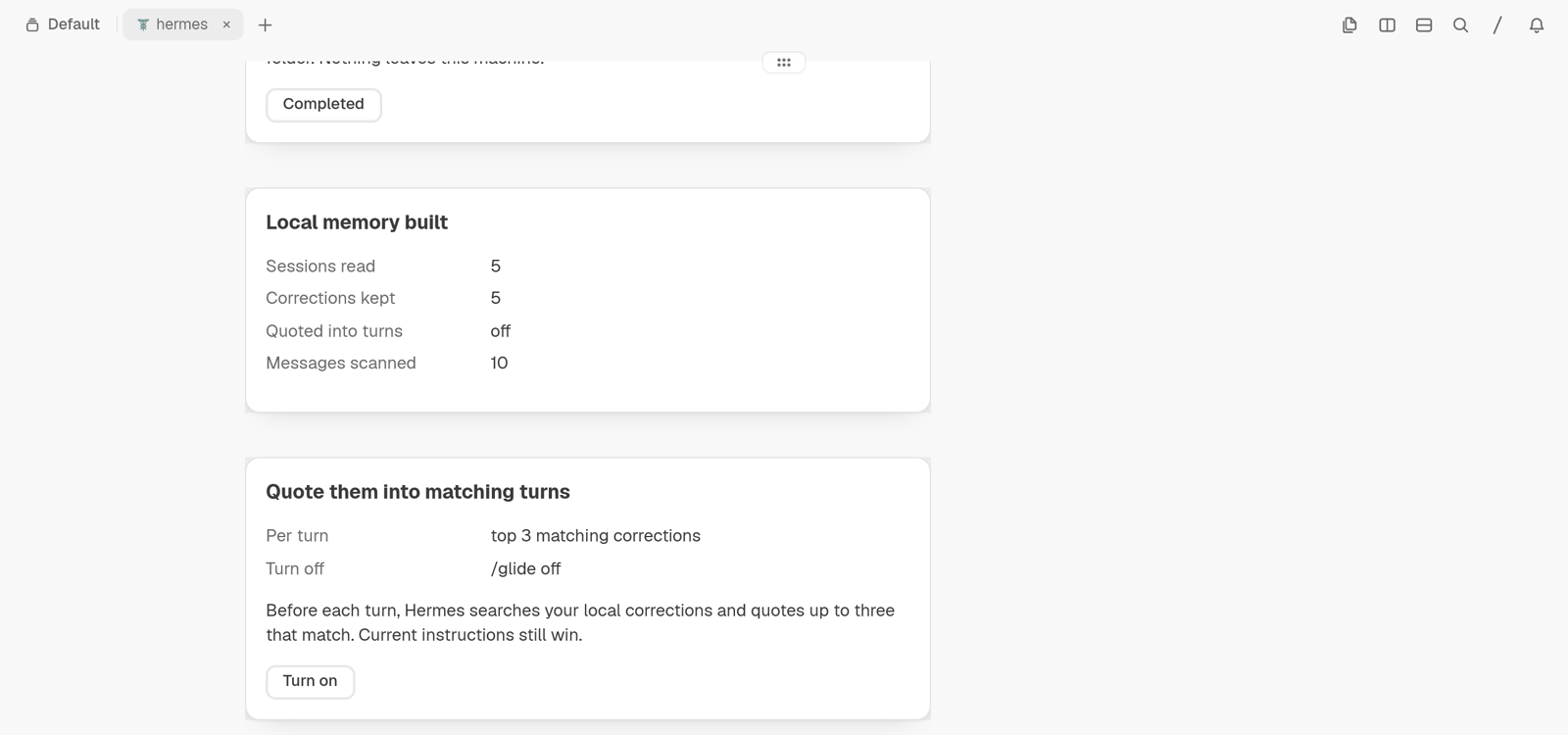
  2. Build memory. Approve a read of up to 100 recent eligible local sessions, excluding the current session. Glide keeps user messages that begin with Correction:, Actually,, or No,. Review the counts on the proof card. A new profile needs prior corrections before recall can return a match.
  3. Turn on. Approve the recall hook. Current instructions take precedence over quoted history.
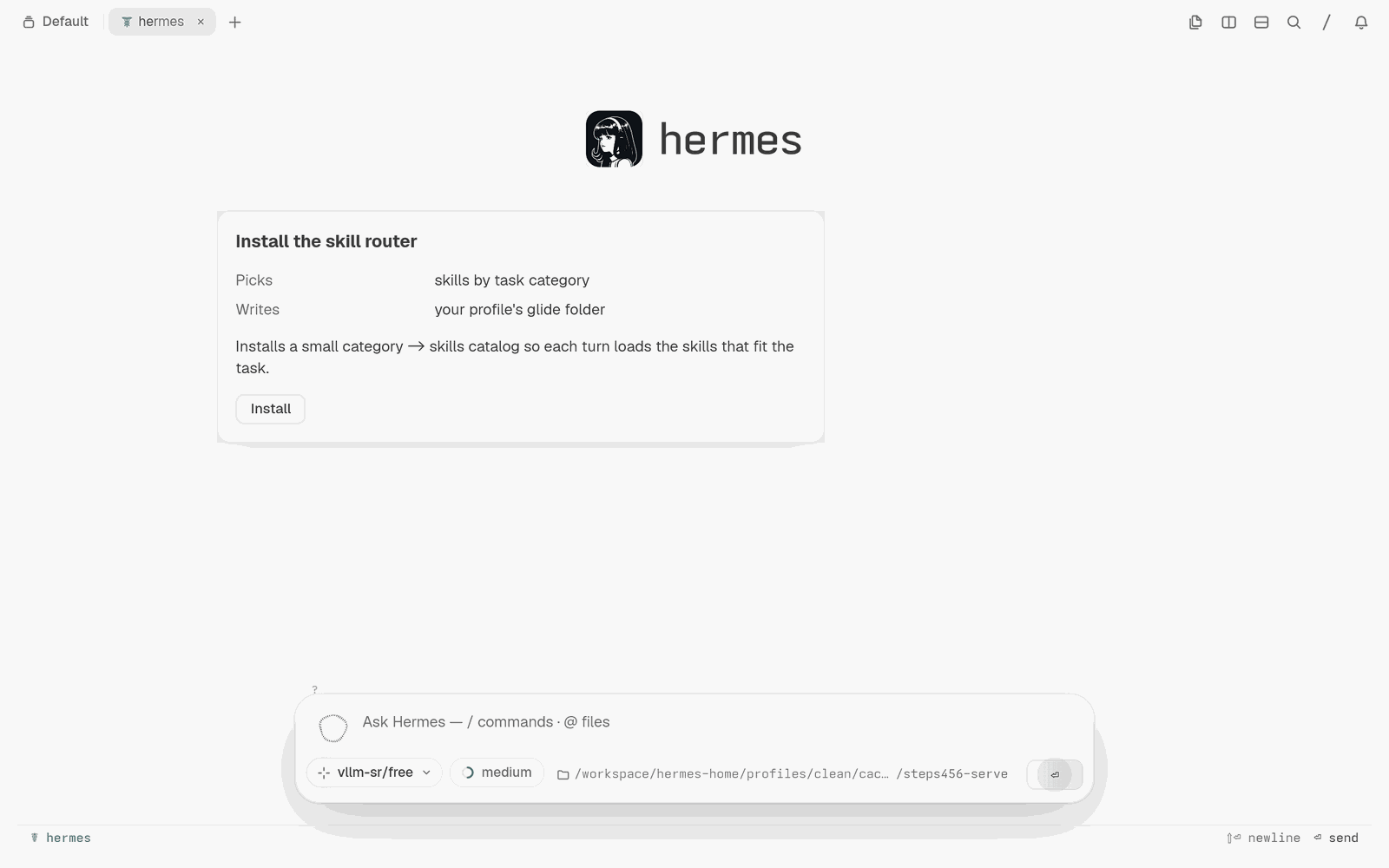
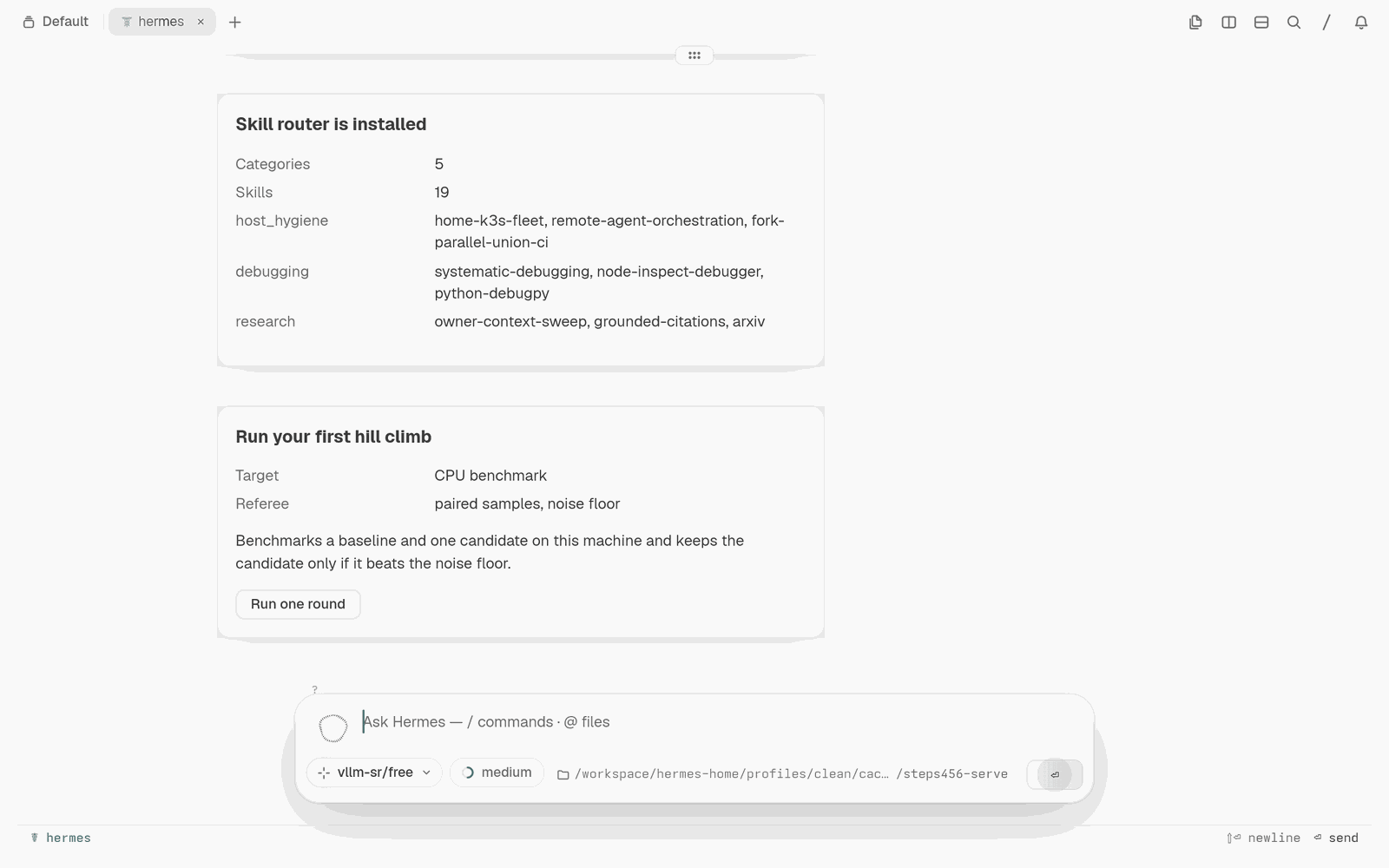
  4. Skill router. Approve Install to save the built-in category-to-skills catalog. This installs ranking metadata, not the referenced skills or an automatic per-turn skill loader.
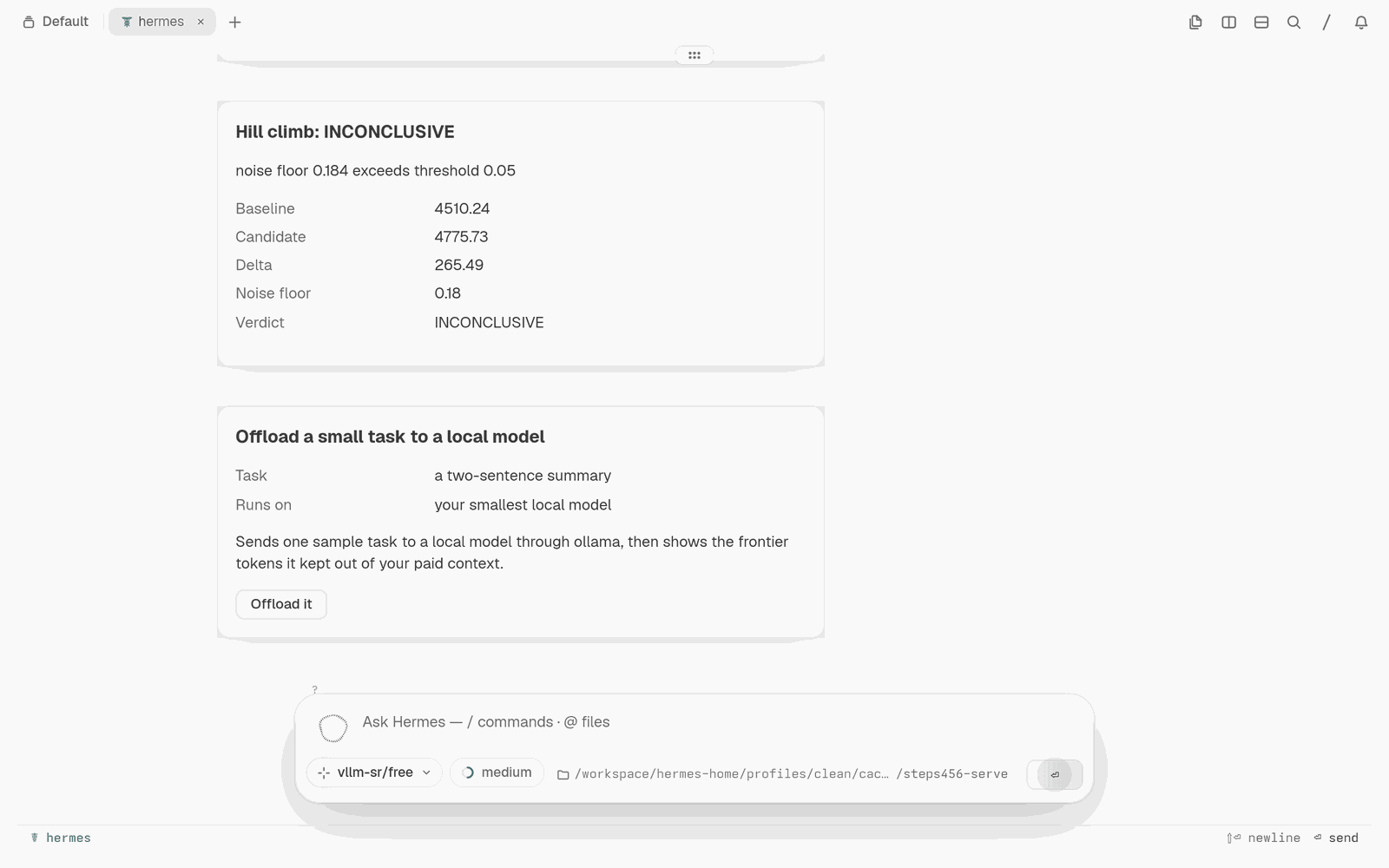
  5. Hill climb. Approve Run one round to repeat the same CPU benchmark command for baseline and candidate samples to demonstrate noise handling. The referee can report KEEP, REVERT, or INCONCLUSIVE. This demo does not edit code or train a model.
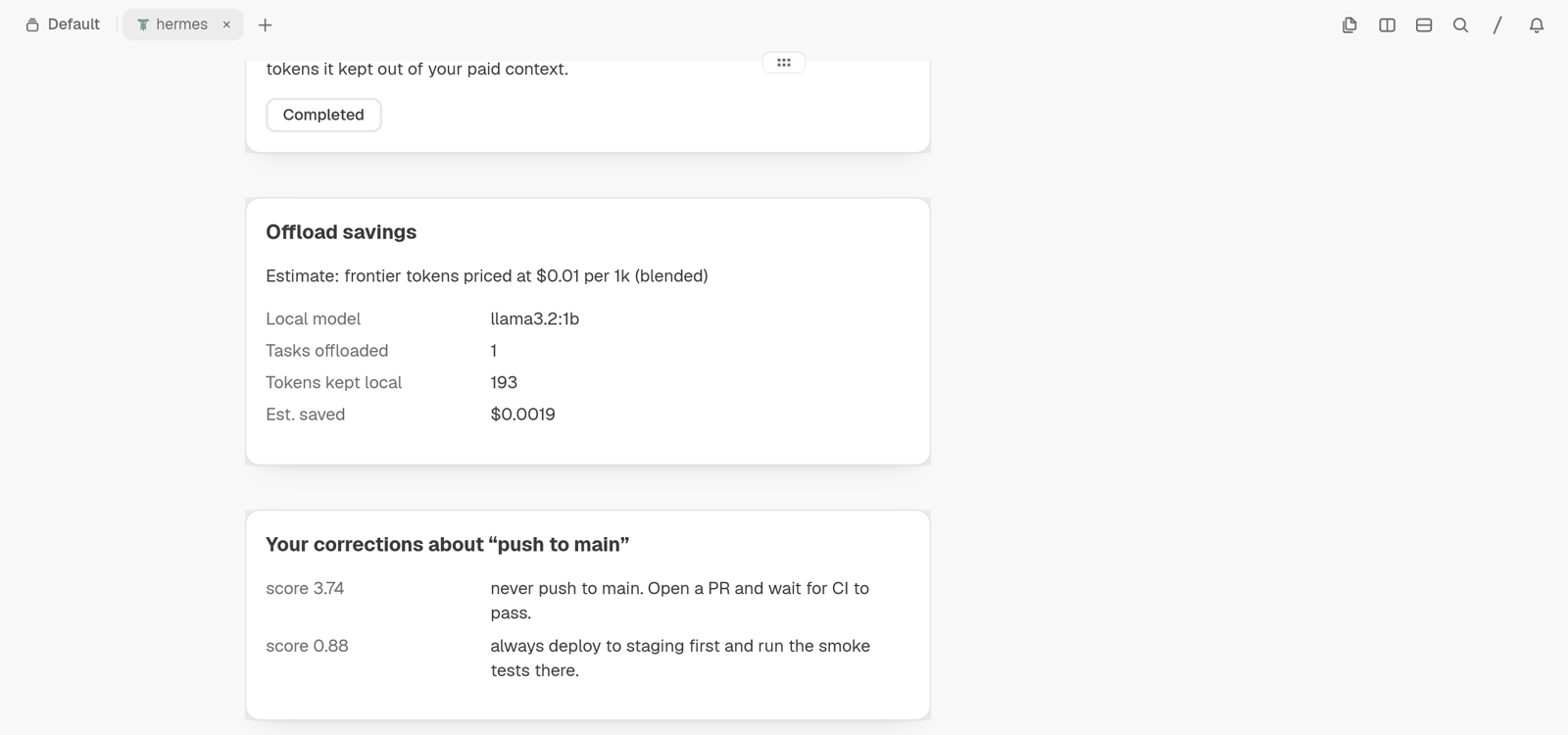
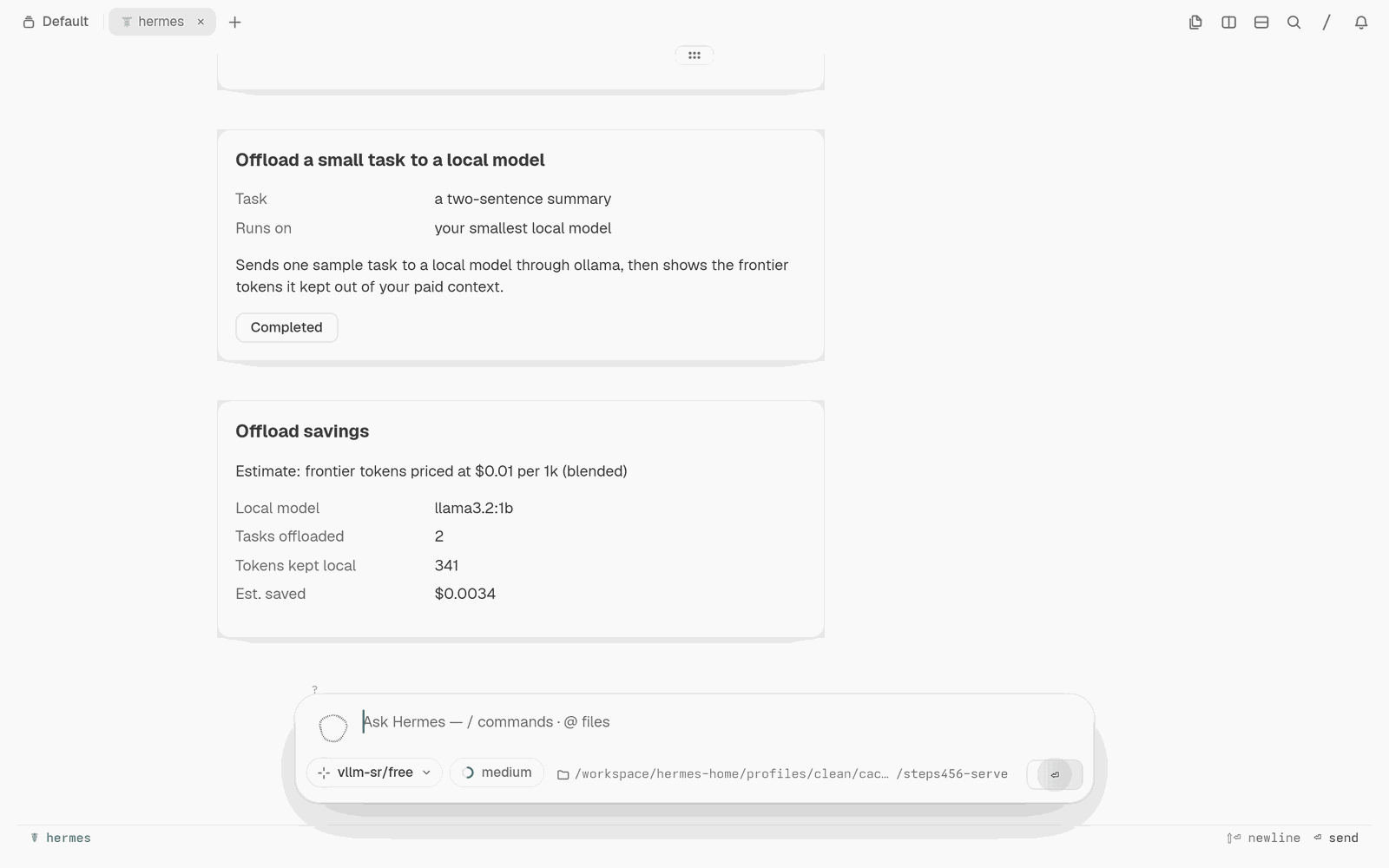
  6. Offload. With Ollama and an existing local model available, approve Offload it to send one sample summary task to that model. The savings card reports estimated tokens and cost, not a measured billing reduction. No model is downloaded for you.

For a correction about frontend work, inspect the matching history:

/glide recall frontend

Disable automatic quoting:

/glide off

Memory extraction and BM25 ranking make no model calls. If an existing z0intelligence corrections reader returns matches, recall prefers those and otherwise falls back to Glide's store. Recall selection Glide opens the source database read-only and writes derived memory under the active profile's glide/ directory. Once you enable recall, excerpts enter Hermes' model context and can reach your configured remote provider. Do not enable it for history you do not want that provider to receive. Storage and privacy contract

Real Tern screenshots

Captured from a fresh HERMES_HOME after hermes plugins install kvnloo/glide, with six synthetic sessions seeded by demo/seed.py. No personal history appears.
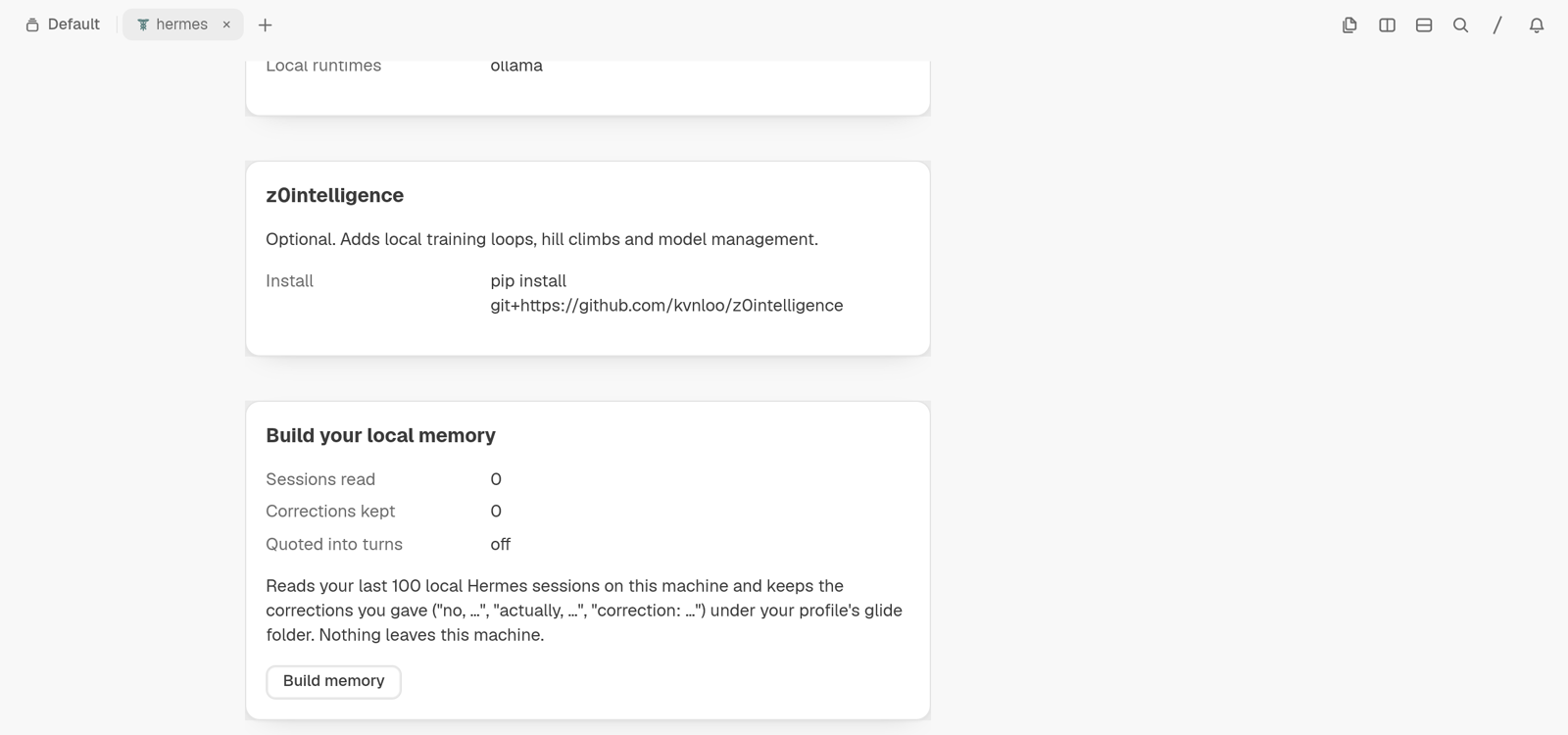
Detect: hardware, local runtimes, and the memory-build approval
Memory built from five synthetic sessions, with the turn-on approval
/glide recall returns the matching correction
Skill router approval
Skill router receipt and benchmark approval
Benchmark verdict and offload approval
Local offload estimate

The inherited base chat is shown below, not a Glide onboarding capture.
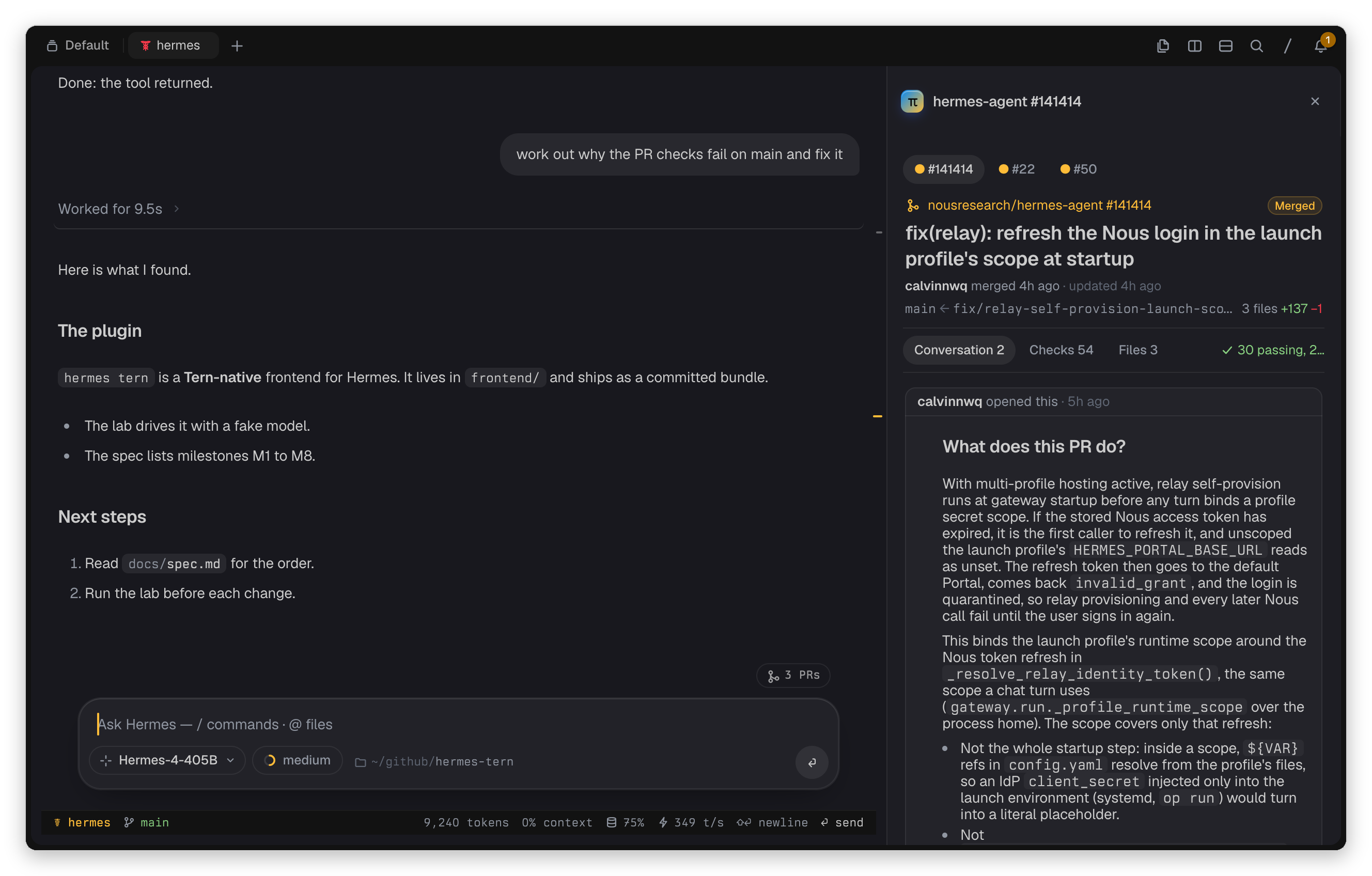
Native Tern chat and pull request view

Check a fresh install yourself

bash scripts/e2e-fresh-install.sh installs kvnloo/glide from GitHub into a throwaway HERMES_HOME, validates it, and runs every /glide command against synthetic sessions through Hermes' real plugin loader. It never touches your real profile. Details

What runs beyond a prompt

  • Python memory backend, source reader, and atomic storage resolve eligible message generations and build a bounded local BM25 index.

  • The registered hook and command add matching corrections before model calls. Session-bound gateway methods would validate parameters and serve the cards, but they need ctx.register_gateway_method, which released Hermes does not have yet, so they are inactive for now; the cards run through the /glide command instead.

  • The TypeScript flow renders native cards and handles approval actions. Router, benchmark, and Ollama offload modules persist their own results.

  • Opt-in live voice (/live or Alt+Shift+V) shows helper lanes beside the thinking orb. They read real state from a local lane broker on 127.0.0.1:8791 and stay off without its token file. Live voice needs a Hermes gateway with the voice.live methods; the pinned Hermes may lack them, which shows a visible activation failure. Voice and lanes

Optional z0intelligence health detection does not install or configure z0intelligence. The optional Taste pane needs a separately running Taste Atlas app and is not part of the basic memory flow. Fresh native-pane proof is pending for this documentation change. Core · Taste requirements

See the upstream project for the base frontend and frontend development for build instructions.

Credits and license

Derived from alt-glitch/hermes-tern (MIT), by alt-glitch. Glide additions are by Kevin Rajan. The frontend began as can1357's ui-tsp, and some UI patterns come from T3 Code.

MIT. See LICENSE and the Glide license.

README from the reviewed commit 3db11c6; it updates when the author re-pins.

More by kvnloo

2 plugins by kvnloo in the catalog.

Developer Mode

Explore built-in Hermes toolsets and actions.

HermesAgent

Developer?

Create a Hermes extension for Desktop or agent workflows.

Developer Section