kumaxs
hermes-federated-search
Federated web search backend plugin for
Hermes Agent. It fans out each
search request to multiple configured sub-backends (Tavily, SearXNG, custom
HTTP endpoints, ...) and ranks the combined results by relevance — keyword
scoring by default, optional LLM re-ranking.
Provider name: federated — selected with web.search_backend: federated.
It plugs into the existing web.search_backend config key; no changes to the
tool chain are required.
Why Federated?
- Multi-backend resilience. If one backend is down or rate-limited, results
from others still come through. Configure Tavily for English search and a
custom backend (e.g., MiniMax) for Chinese search — both contribute to every
query. - LLM-based ranking. An auxiliary LLM reranks merged results for relevance.
Falls back to keyword-based scoring automatically if the LLM is unavailable. - Zero tool changes. The
web_searchtool passes results through the same
pipeline; the provider boundary is transparent to the agent.
What's New in Phase 2
Two additions on top of v1.0.0 (branch feat/p2-config-multicard):
- Settings-page exposure. The plugin declares seven keys (
backends,
timeout,max_results,min_backends,ranking_mode,pool_strategy,
ranker)
through the officialconfig_schemamechanism (manifest v2), so
Settings → Plugins renders an editable form and saves them under
plugins.entries.hermes-federated-search.settings. Values merge per
top-level key with the legacyweb.federatedblock (settings win) — no
migration required. - Multi-card credential pools. A
customline can list several
environment variable names undercredentialsand rotate them with
fill_first/round_robin/random; a failing card cools down and the
request fails over to the next usable card. Key values stay in the runtime
environment — only names ever go into configuration.
What's New in Phase 3
A human-facing card editor on top of the Phase 2 settings exposure
(branch feat/p3-card-config-ui):
- Card-per-line config page under Settings → Plugins → 「聚合搜索」
(desktop/plugin.js, registered viactx.registerSettingsPage): one card
per line with two levels of membership — L1 参与聚合 (member ofbackends)
and L2 参与 (member of that line'scredentials); add/remove lines and keys;
every edit serializes and writes straight back through
plugins.manage settings, then re-reads. The manifestconfig_schemaform
stays available as the entry's Agent settings sub-page. - String ↔ UI parity. The page shows the current settings string (YAML/JSON
for agents) and takes a pasted string back; the settings tree stays the one
source of truth — unchecking a box removes the member from the string, with
no private residue. - Credential policy unchanged and visible: the page records environment
variable NAMES only — no value input, no value echo. Values go through
Settings → Keys (PUT /api/env). Seedocs/agent-config.md. - No migration. Whatever is already in the settings tree (or legacy
web.federated) loads into the card page as-is; nothing is rewritten behind
your back — an explicitkthat mismatches the line count shows a warning
bar only. Registered-provider lines stay single-card; multi-card remains
custom-only.
Install & Enable
The plugin is a plain directory plugin (no Python packaging step). Install it
into a Hermes home/profile and enable it:
# from GitHub (recommended) — enables the plugin in the same step
hermes plugins install kumaxs/hermes-federated-search --enable
# ... or, for an already installed plugin:
hermes plugins enable hermes-federated-search
Or copy/symlink this directory into the plugin directory yourself:
- global:
~/.hermes/plugins/hermes-federated-search/ - profile-scoped:
~/.hermes/profiles/<profile>/plugins/hermes-federated-search/
Pinning an exact revision works from a checkout or archive:
hermes plugins install <source> --ref <40-hex SHA> --enable — the phase-3
branch head was installed this way in the local drill (byte-identical install,
same live reload as below).
Desktop half (phase 3). The plugin ships a desktop package
(desktop/plugin.js). The desktop app reconciles it into the app-level root
~/.hermes/desktop-plugins/hermes-federated-search/ (marker
.hermes-package.json; source = the agent half's desktop/ directory).
Measured: the settle lands within seconds once the app's reconcile pass runs —
touching ~/.hermes/desktop-plugins/ triggers it. If the settings entry does
not appear, use ⌘K → "Reload desktop plugins" (or open Capabilities → Plugins);
a load failure shows an error toast. Rolling the agent half back prunes the
desktop half on the next reconcile pass.
Validate note. hermes plugins validate passes on a clean export with a
clean security scan (no findings). Earlier revisions printed one
security scan caution: dump_all_env line — the key-row label fallback's
|| text read as a shell pipe by the scanner's literal heuristic. The
fallback now uses an equivalent ternary, so the warning is gone.
Activation semantics (opt-in user plugin):
- With a running gateway,
hermes plugins install … --enableasks it to
reload plugins live — measured message:Gateway reloaded plugins; nothing of this plugin needs a session or restart.No gateway restart is
required. - If the gateway is not running, or reports
reloaded=false(older builds),
start/restart it and open a new session so the provider registry sees the
plugin. web.search_backend,web.federatedand
plugins.entries.hermes-federated-search.settingsare read on each search
call — config edits (including settings-page saves) take effect without a
restart.
After enabling — expected signals:
hermes plugins show hermes-federated-search→Status: enabled.- Config readback (
grep -n federated <profile>/config.yaml):
search_backend: federatedplus thefederated:block — or the
plugins.entries.hermes-federated-search.settingstree when the keys were
saved from the settings page. - Gateway log lines:
Plugin 'hermes-federated-search' registered web provider: federated, and per-query
Federated search: '<query>' (N/M backends active, …). - A fresh search succeeds through the
federatedprovider (success=true,
at least one result). - Desktop (phase 3): Settings → Plugins → 「聚合搜索」 opens the card page —
one card per line with two membership levels (L1 参与聚合 = member of
backends; L2 参与 = member of the line'scredentials), add/remove for
lines and keys, a per-line 「Key 轮换策略(pool_strategy)」 select and the
当前配置字符串 box with paste-import. Every edit serializes and is written
back throughplugins.manage settings; reopen the page to re-read the saved
string. The seven-keyconfig_schemaform stays available as the "Agent
settings" sub-page. - Desktop half is opt-in: the
.hermes-package.jsonbundle ships it disabled
by default — enable it via 桌面 Hermes → 设置 → 技能与工具 → 插件 → open
hermes-federated-search, then 设置 → 插件 →「聚合搜索」 (full path and the
⌘K →「Reload desktop plugins」 fallback:docs/agent-config.md).
Disable / roll back:
- Point
web.search_backendback at your previous backend (e.g.tavily), or
remove the key — takes effect on the next search call. - Fully remove:
hermes plugins remove hermes-federated-search— add
--allow-live-gatewaywhen the gateway keeps running (a guard blocks
removal otherwise; measured to deregister the provider live, no restart
needed). The phase-3 desktop half is pruned by the app's next reconcile pass.
Requirements: httpx (present in Hermes environments). Config reading uses
hermes_yaml when available (Hermes checkouts) and falls back to PyYAML.
Quick Start
Enable federated search with two backends:
# ~/.hermes/config.yaml
web:
  search_backend: federated
  federated:
    backends:
      - name: tavily
      - name: minimax
        type: custom
        base_url: "https://api.minimaxi.com"
        api_key_env: MINIMAX_CN_API_KEY
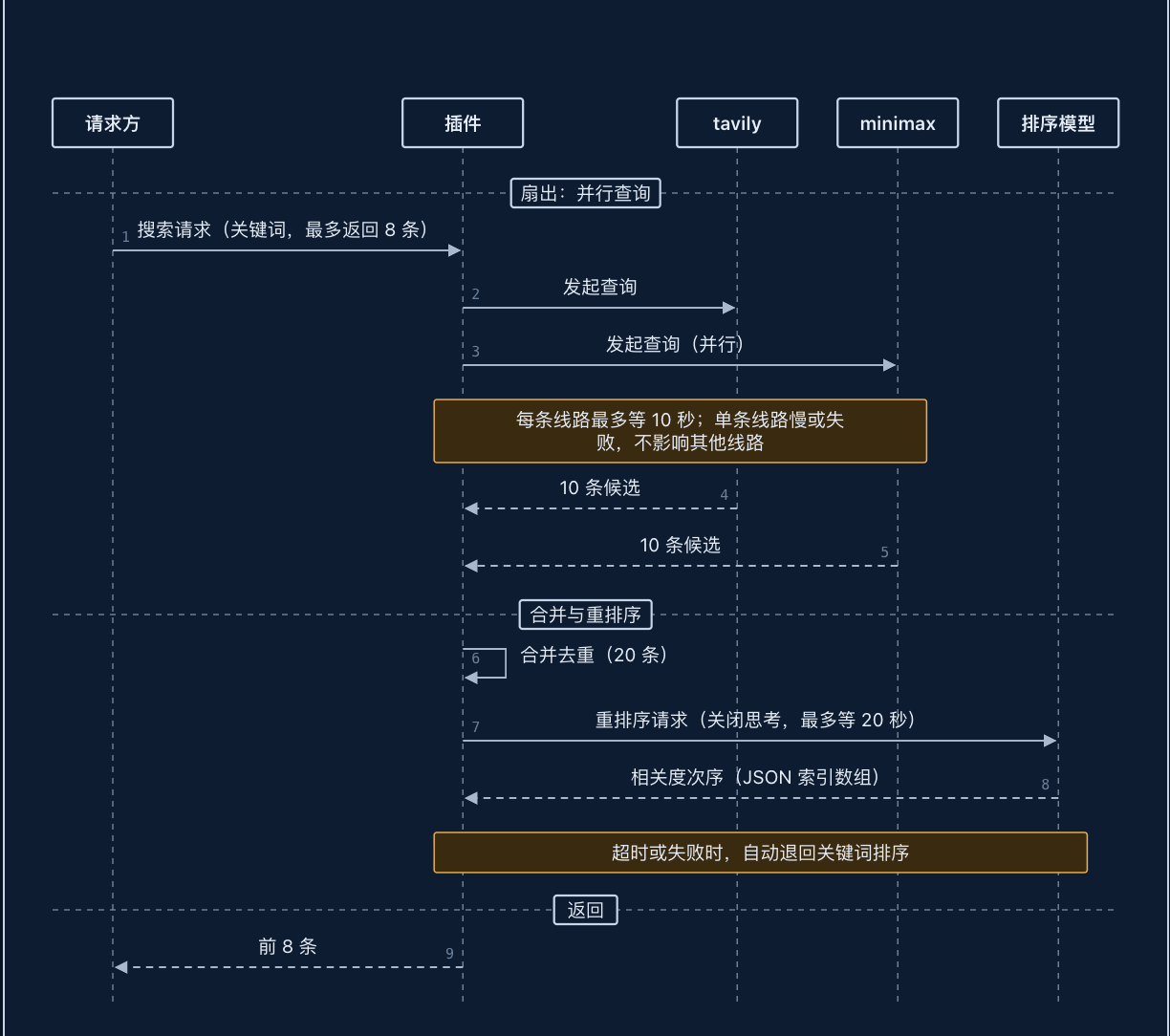
With this configuration, every web_search call queries both Tavily and MiniMax
in parallel, merges results, ranks by keyword scoring, and returns up to 8
results.
Agent: configure by string
Both doors edit the same tree, so an agent can do the whole configuration by
editing the string (or by pasting it into the card page):
plugins:
  entries:
    hermes-federated-search:
      settings:
        backends:
          - name: tavily
            type: custom
            base_url: "https://api.example.invalid/search"
            credentials: [TAVILY_API_KEY, TAVILY_API_KEY_2]   # names only
        min_backends: 1
        ranking_mode: auto
plugins.entries.hermes-federated-search.settingsis the single source of
truth; legacyweb.federatedstill works and merges per top-level key
(settings win). The card page never rewrites the legacy block.credentialslists environment variable names (^[A-Z][A-Z0-9_]{0,127}$)
and nothing else — a pasted key value is rejected at config validation
without echoing it. Key values belong to Settings → Keys (PUT /api/env).- An explicit
kmust equal the number ofbackends; leave it out (the UI
does) and the line count is used. A mismatched explicitkis shown as a
warning bar — never rewritten automatically. - After a string edit, reopen the page to see it (open = refetch). Full guide:
docs/agent-config.md.
Configuration Reference
Federated configuration can be written in two places; they merge per
top-level key, with the official settings tree winning:
- Settings → Plugins (official form). Values are stored under
plugins.entries.hermes-federated-search.settingsinconfig.yaml. The
seven keys declared by the plugin (plugin.yamlconfig_schema):
backends,timeout,max_results,min_backends,ranking_mode,
pool_strategy,ranker. web.federatedinconfig.yaml— the legacy location, still fully
supported; no migration is required.
Notes: the settings form does not shadow legacy values by itself — the old
web.federated values keep applying until the matching key is saved on the
settings page. web.federated is an unrecognized nested path for
hermes config set (needs --force) and never appears in the desktop form;
use the settings page (or edit config.yaml directly) instead.
Top-level Options
| Key | Type | Default | Description |
|-----|------|---------|-------------|
| timeout | int | 10 | Total deadline for all backends. Lines that miss it are dropped; lines that already returned contribute their partial results. |
| max_results | int | 8 | Maximum number of results returned after ranking (ceiling). The caller's limit parameter is still respected — the actual output count is min(limit, max_results). |
| k | int | len(backends) | K-way aggregation. Must equal the number of configured backends. When explicitly set, the plugin validates len(backends) == k. Maximum 32. |
| min_backends | int | 1 | Minimum number of backends that must return results for the search to be considered successful. A line succeeds when it answers with a result-bearing response within the deadline. Must satisfy 1 ≤ min_backends ≤ k; required lines must always succeed. |
| ranking_mode | str | auto | Ranking mode: auto (follows ranker.provider as before), keyword (force keyword scoring), llm (force LLM ranking; uses the default auxiliary model when ranker.provider is unset). The ranker dict stays usable alongside. |
| pool_strategy | str | fill_first | Global default rotation for custom lines with credentials: fill_first (use one card until it fails), round_robin (rotate per request), random. Overridable per line (the card editor exposes the select inside each line card); the key itself is kept and stays read+write for compatibility. |
| ranker | dict | — | Optional LLM ranking configuration (see below). |
| health_check | dict | — | Optional cached health probing (see below). When absent, all backends are dispatched directly (backward compatible). |
| backends | list | — | Required. List of sub-backend configurations. |
Ranking (ranker)
The ranker section controls how merged results are ordered by relevance.
| Key | Type | Default | Description |
|-----|------|---------|-------------|
| ranker.provider | str | — | LLM provider for ranking. Set to "none" (or omit) for keyword-based scoring (fast, zero cost). Use a real provider (e.g., "opencode-go") for LLM ranking. |
| ranker.model | str | — | Model name for the ranking LLM (e.g., "deepseek-v4-flash"). |
| ranker.prompt | str | — | Optional custom system prompt for the ranking LLM. Inject preferences like "prefer Chinese sources" or "prefer official documentation". When omitted, a default prompt is used. |
Ranking modes:
- Keyword (
provider: "none"or unset): Scores results by query term
frequency in title + description. Fast, no API cost. - LLM (real provider): Sends results to an auxiliary LLM for relevance
ranking. Falls back to keyword mode automatically on timeout, rate limit, or
parse failure.
Recommendation: Use a non-main-model provider for ranking to avoid
concurrency contention. When ≤ 3 results, ranking is skipped entirely.
Thinking is disabled on the ranking call. The ranking request always
carries extra_body={"reasoning_effort": "off"}: re-ranking is a mechanical
ordering step, and on routes that default to thinking (e.g. DeepSeek V4 on
CommandCode) the model would otherwise spend the small output budget on hidden
reasoning — producing an empty response or hitting the 20 s timeout, then a
keyword fallback. Providers that reject the field are retried without it by the
auxiliary client's parameter-strip path.
Backend Configurations (backends)
Each entry in the backends list represents one search source.
Registered Providers
Use an existing Hermes web search provider (e.g., Tavily, Firecrawl, SearXNG):
backends:
  - name: tavily
  - name: firecrawl
| Key | Type | Required | Description |
|-----|------|----------|-------------|
| name | str | ✅ | Registered provider name. Must match an available provider (tavily, firecrawl, searxng, exa, parallel, ddgs, brave_free, xai). |
| required | bool | false | When true, this backend's failure causes the entire search to fail, regardless of min_backends. |
Registered providers use their existing credentials (.env API keys). No
additional configuration needed.
Custom HTTP Backends
Connect any search API that accepts a query parameter and returns JSON:
backends:
  - name: minimax
    type: custom
    base_url: "https://api.minimaxi.com"
    api_key_env: MINIMAX_CN_API_KEY
    search_path: /v1/coding_plan/search
    query_param: "q"
    auth_style: bearer
| Key | Type | Required | Default | Description |
|-----|------|----------|---------|-------------|
| name | str | ✅ | — | Display name for logging and error messages. |
| type | str | ✅ | — | Must be "custom" to enable custom HTTP mode. |
| base_url | str | ✅ | — | Base URL of the search API (e.g., https://api.minimaxi.com). |
| api_key_env | str | — | — | Single-card mode: environment variable that holds the API key (e.g., MINIMAX_CN_API_KEY). Set in .env. Use credentials instead for a multi-card pool. |
| credentials | list | — | — | Multi-card pool: list of environment variable names (e.g., [MINIMAX_KEY_1, MINIMAX_KEY_2]). Values live in the runtime environment, never in config.yaml. A failed card cools down and the line fails over to the next usable card. |
| pool_strategy | str | — | inherited | Per-line override of the top-level pool_strategy (validate: fill_first | round_robin | random). |
| search_path | str | — | "/v1/coding_plan/search" | API path appended to base_url. |
| query_param | str | — | "q" | Query string parameter name. |
| auth_style | str | — | "bearer" | Authentication style: "bearer" (Authorization header) or "x-api-key" (x-api-key header). |
| required | bool | false | — | When true, this backend's failure causes the entire search to fail, regardless of min_backends. |
Supported response shapes: The custom backend parser handles three common
API response formats:
{"organic": [{"title", "link", "snippet"}, ...]}{"data": {"web": [{"title", "url", "description"}, ...]}}{"results": [{"title", "url", "content"}, ...]}
Multi-Card Credential Pools (credentials)
Give one custom line several keys of the same vendor; a failing card is
cooled down and the request fails over to the next usable card:
backends:
  - name: minimax
    type: custom
    base_url: "https://api.minimaxi.com"
    search_path: /v1/coding_plan/search
    query_param: "q"
    credentials: [MINIMAX_KEY_1, MINIMAX_KEY_2]   # env var NAMES only
    pool_strategy: round_robin                    # optional, per-line
Rules and semantics:
- Names only.
credentialsitems must match
^[A-Z][A-Z0-9_]{0,127}$. Values are resolved from the runtime
environment (per-profile.env); a pasted key value is rejected at
validation with a "looks like a secret value" error, and error messages
never echo the item. Duplicate names are deduplicated (warned). - Value shapes. Empty / whitespace-only values and values containing a
line break are skipped as not configured; a card whose env var is missing
is never dialed. If no card on the line is usable, the line fails without
network traffic. - Strategies.
fill_first(default) uses the first usable card and only
switches when it fails;round_robinrotates one card per request
(process-local cursor);randompicks uniformly among the usable cards. - Switching. A card that fails — HTTP error (401/403/429/5xx) or a
network/timeout error — is cooled down and the request continues with the
next usable card. Each card is dialed at most once per request. When every
card is exhausted, the line fails as a whole (same
(results, status_code)contract as single-card lines). - Cooldowns (aligned with the Hermes credential pool): 401 → 300s,
403 → 300s, 429 → 3600s, anything else (5xx / network / unknown) → 300s;
401/403/429keep their values. When the line has a single usable card,
transient cooldowns are capped at 60s (hostsole_credential
alignment). The legacyapi_key_envsingle-card path is not capped. - State is process-local. Cooldowns and the round-robin cursor live in
memory; restarting Hermes clears them. - Registered providers cannot be pooled. The host resolves a registered
provider's key internally (search(query, limit)takes no key parameter),
so acredentialslist on a non-customline is ignored with a warning
and the line keeps working exactly as before. Multi-card requires
type: custom. - Tavily as a custom line (migration path for pooling a registered
provider):base_url: "https://api.tavily.com",search_path: /search,
query_param: query,auth_style: bearer— its
{"results": [{title, url, content}, ...]}response is already supported.
Health Checks (health_check)
Cached availability probing for custom HTTP backends. When configured, the plugin
sends a lightweight HEAD request to each custom backend's base_url before
dispatching searches. Results are cached for ttl_seconds to avoid consuming
provider quota on every call.
When health_check is absent, all backends are dispatched directly (backward
compatible).
| Key | Type | Default | Description |
|-----|------|---------|-------------|
| health_check.ttl_seconds | int | 300 | How long probe results are cached (seconds). Set higher for providers with strict rate limits. |
| health_check.timeout | int | 5 | Per-probe HEAD request timeout (seconds). |
Caching and cooldown:
- Cache hit: backend dispatched immediately (no network request).
- Cache miss / expired:
HEADprobe → cache result → proceed. - Real search failure (HTTP 401/403/429): backend immediately marked unavailable
with provider-specific cooldown (5 min for 401/403, 1 hour for 429).
Execution Flow
For each search request:
- Parallel fan-out. All backends are queried concurrently via
ThreadPoolExecutor. Each backend runs in its own thread. - Timeout enforcement.
concurrent.futures.wait()with the configured
timeout bounds the total wait time. Backends that haven't finished are
cancelled; completed results proceed. - Merge & rank. Results from all successful backends are combined. If a
rankeris configured, the merged set is ranked by relevance (LLM or keyword). - Top N truncation. Output count is capped at
min(limit, max_results)—
the caller's requested limit is respected, withmax_resultsserving as a
ceiling.
Full Configuration Example
web:
  search_backend: federated
  federated:
    # Wait up to 15 seconds for all backends
    timeout: 15

    # Return at most 10 results after ranking
    max_results: 10

    # K-way aggregation: exactly 3 backends, at least 2 must succeed
    k: 3
    min_backends: 2

    # Health checks: cache probe results for 5 minutes
    health_check:
      ttl_seconds: 300

    # LLM ranking with custom preference prompt
    ranker:
      provider: opencode-go
      model: deepseek-v4-flash
      prompt: |
        Prefer Chinese sources and official documentation.
        Prefer results from the last 6 months.

    backends:
      # Registered provider — critical, must succeed
      - name: tavily
        required: true

      # Self-hosted SearXNG — optional
      - name: searxng
        required: false

      # Custom HTTP backend — MiniMax Chinese search
      - name: minimax
        type: custom
        base_url: "https://api.minimaxi.com"
        api_key_env: MINIMAX_CN_API_KEY
        search_path: /v1/coding_plan/search
        required: false
Troubleshooting
| Symptom | Likely Cause |
|---------|--------------|
| federated search not configured | web.federated section missing from config.yaml or the plugin not enabled |
| no search backends configured | web.federated.backends is empty or not a list |
| backend '<name>' not registered | name references an unavailable provider. Check hermes tools to see registered providers. |
| All backends failed | Every backend returned errors. Check credentials and network. The gateway log shows per-backend details. |
| No backends available | Health checks marked all backends unavailable. Check the gateway log for per-backend probe failures. |
| Required backend(s) failed | A backend with required: true returned no results. Check its credentials and availability. |
| Only N/M backends succeeded | Fewer than min_backends backends returned results. Increase min_backends or investigate failing backends. |
| k=N but M backend(s) configured | The k value doesn't match the number of backends entries. Either adjust k or add/remove backends. |
| Custom backend timed out | The configured API didn't respond within 15s. Verify the base_url and search_path are correct. |
| LLM ranking failed, falling back to keyword ranking | Normal fallback — the ranking LLM was unavailable. Results use keyword scoring instead. |
| credentials[N] is not a valid environment variable name / looks like a secret value | Fix the credentials list: it takes environment variable names only (uppercase, digits, underscores). Put the key value in the runtime environment (.env), never in config.yaml. |
| no usable credentials among N configured card(s) | Every listed env var is missing, empty or multi-line. Set the values in the profile .env; missing-card names are logged as they are skipped. |
| pool_strategy must be one of: ... / ranking_mode must be one of: ... | Invalid enum value in web.federated (the settings page dropdown only offers legal values). |
Note: the provider reads raw YAML for web.federated and for
plugins.entries.hermes-federated-search.settings (the standard config loader
strips unknown keys from the web section). Config changes — including
settings-page saves — therefore take effect on the next search call without a
restart.
Known Limitations
- No content extraction.
supports_extract()returnsFalse. Use another
provider (e.g., Tavily or Firecrawl) forweb_extractby setting
web.extract_backend. - No nested federation. Sub-backends are leaf nodes; you cannot chain
federated providers. - Thread-pool overhead. Each backend runs in a thread. With many backends
(>10), consider using fewer, higher-quality providers instead. - Health checks are optional. Without
health_checkconfigured, failing
backends are dispatched and time out — same as the original behavior.
Enablehealth_checkto avoid waiting on dead backends. - Custom ranking prompt requires LLM ranking. The
ranker.promptfield is
only used when a real provider (not"none") is configured for ranking. - Registered providers stay single-card. Multi-card pooling needs
type: custom— the host's provider interface takes no key parameter, so a
credentialslist on a registered line is ignored (with a warning). The
koption also stays out of the settings form (its existing validation is
unchanged). - Pool cooldowns are in-process. Restarting Hermes clears cooldowns and
the round-robin cursor.
Status
v1.0.0 base plus the phase-2 and phase-3 improvements:
- Included (v1.0.0): parallel aggregation with
k/min_backends/
requiredsemantics; timeout with partial results; keyword ranking plus
optional LLM re-ranking with a custom prompt; custom HTTP backends (three
response shapes); cached health checks with failure cooldowns; per-backend
configuration. - Included (phase 2, branch
feat/p2-config-multicard): official
Settings → Plugins exposure of six config keys (plugin.yaml
config_schema:backends,timeout,max_results,min_backends,
ranking_mode,pool_strategy; merged with legacyweb.federated);
per-line multi-card credential pools (fill_first/round_robin/
random) with automatic failover and pool-aligned cooldowns;
ranking_mode(auto | keyword | llm). - Included (phase 3, branch
feat/p3-card-config-ui): desktop card editor
(desktop/plugin.js,ctx.registerSettingsPage) — one card per line with
L1/L2 membership checkboxes, add/remove lines and keys, current-settings
string with paste import, string ↔ UI parity (unchecking removes the member,
no private state); the schema form stays as the Agent settings sub-page;
plusdocs/agent-config.md(agent-side configuration guide) and the
desktop-widget test harness (tests/test_desktop_widget.py,
tests/widget_harness.cjs). - Included (phase 3 revision, v1.1.0): agent guidance aligned with the
real enable path (opt-in desktop half,docs/agent-config.md+ in-page 指引
dialog); type select/badge removed — typeless lines stay typeless, new
cards arecustom, legacy cards keepapi_key_env/required/unknown keys
verbatim; a ranker model picker on the card page (rankerjoins
config_schema, written as a whole tree viasettings.ranker); the pool
strategy select moved into each line card (pool_strategyper line, the
global key stays a read+write default); timeout / min_backends wording
aligned with the runtime semantics. - Included (v1.1.1): the ranking call pins
reasoning_effort=off
(extra_body) so thinking-capable routes (e.g. DeepSeek on CommandCode,
which defaults to thinking) cannot spend the small output budget on hidden
reasoning; the pin is stated in the card UI and theplugin.yamlranker
description, and documented in README +docs/agent-config.md. - Not included: multi-card on registered providers (host interface takes
no key) and direct credential-pool (auth.json) consumption — future
increments; per-backendtimeout/weight/result_limit—
intentionally not implemented.
Development
The plugin is plain Python (no packaging step). Tests exercise the provider
through the real WebSearchProvider ABC, so they run against a Hermes Agent
checkout with the checkout on PYTHONPATH:
PYTHONPATH=/path/to/hermes-agent python -m pytest tests/ -q
Requirements: the dependencies of the checkout you test against (httpx,
jiter / Hermes runtime deps) plus pytest.
License
MIT — see LICENSE.
README from the reviewed commit 566b3cc; it updates when the author re-pins.