wesleymatosdev
hermes-hyperframes
A Hermes community plugin that drives Hyperframes — Apache-2.0 HTML/JS video compositions — from Hermes: six hyperframes_* agent tools plus a dashboard tab with a managed Studio preview, frame snapshots, and an agent chat bound to the composition on screen.
The plugin wraps a pinned local Hyperframes CLI (no npx, no network fetch): bin resolution is the bin setting / HERMES_HYPERFRAMES_BIN > PATH > <project>/node_modules/.bin/hyperframes.
Project confinement: every project_dir must resolve under a configured projects root (projects_roots setting > HERMES_HYPERFRAMES_PROJECTS_ROOTS env > the workspace <hermes home>/projects > the tilde defaults). The project-local node_modules/.bin/hyperframes fallback runs the project's own binary on the host, so directories outside the roots — a cloned, untrusted repo, say — are refused outright.
Minimal subprocess environment: the CLI subprocess inherits only PATH, HOME, locale vars, TMPDIR, and their Windows equivalents (plus $PWD normalization) — never os.environ, so no provider key reaches the Node binary. Extra names can be opted in via the env_passthrough setting.
Render output confinement: hyperframes_render output must resolve inside the project dir — .. segments, outside absolute paths and symlink escapes are refused, and an existing non-video file is never overwritten.
What it adds
Agent tools (available in any session with the plugin enabled):
| Tool | Purpose |
|---|---|
hyperframes_lint | Lint a composition, structured error/warning summary |
hyperframes_preview | Start / status / stop the managed Hyperframes Studio preview |
hyperframes_preview_context | Studio selection bridge — what the human has selected on the canvas |
hyperframes_timeline | Read back the composition timeline (clips, spans, duration) |
hyperframes_snapshot | Capture contact sheets / frames for visual verification |
hyperframes_render | Render the composition to MP4 |
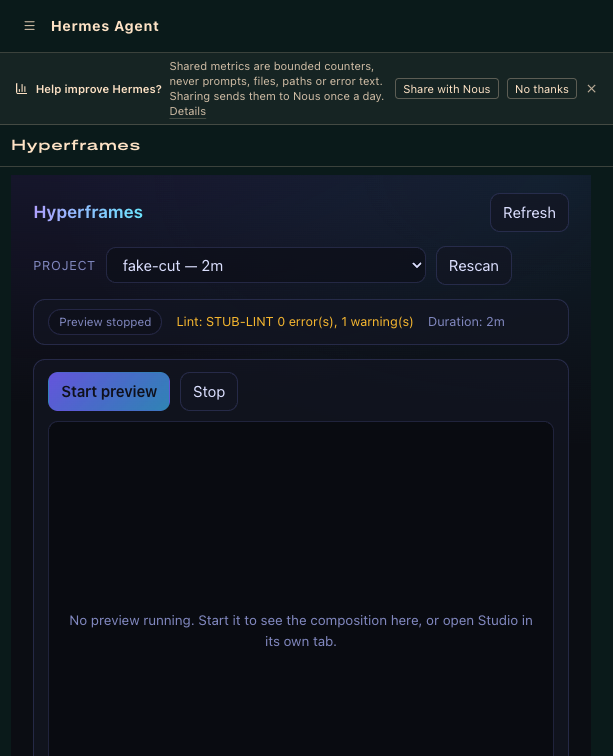
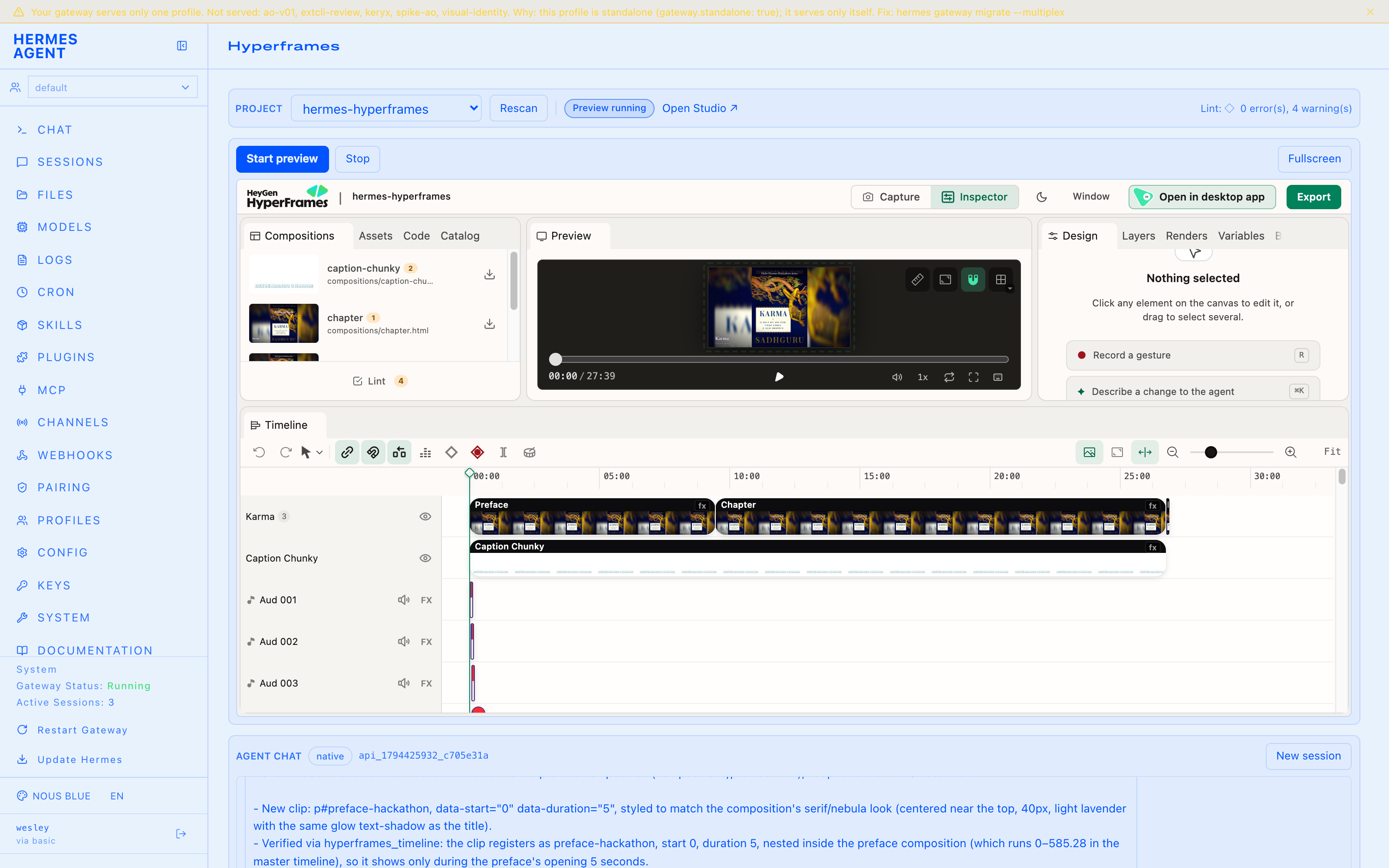
Dashboard tab (/hyperframes, after Skills): project switcher (scans your project roots), one-toolbar-row status (preview state, lint, duration), the Studio preview embedded live, and an agent chat. The tab consumes the dashboard's own theme variables, so it follows whatever theme is active.
Agent chat: two lanes, native by default
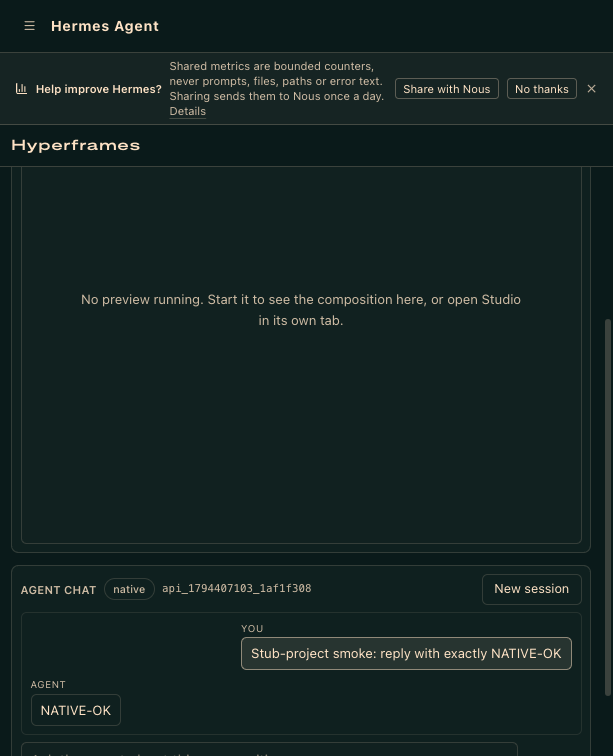
The chat panel drives a real Hermes gateway session — the same conversation a terminal sees via hermes chat --resume <session-id>:
- Native lane (default, zero config): the plugin auto-derives the local gateway's
api_serverlistener from~/.hermes/gateway_state.jsonand authenticates withAPI_SERVER_KEYread through Hermes's secret API (agent.secret_scope.get_secret— the profile secret scope the gateway itself installs, then the process env). Each message is one synchronous gateway turn carrying the current project path + preview state as context, so the session can act on the composition with itshyperframes_*tools. - CLI fallback: only when no gateway credential resolves at all — one local
hermes chat -qper message (slow).
Resolution order for the credential: plugin api_server_key setting > HERMES_API_SERVER_KEY env > agent.secret_scope.get_secret("API_SERVER_KEY"). The .env file is never parsed by the plugin itself. URL: plugin api_server_url setting > HERMES_API_SERVER_URL env > gateway_state.json listener_base (loopback 127.0.0.1:8642).
Heavy actions — disclosure
This plugin spawns and stops local processes and talks to the local gateway. Specifically:
hyperframes_previewstarts and kills the Hyperframes Studio preview process for the selected project.hyperframes_renderruns the pinned Hyperframes CLI to encode MP4 output (inside the project dir only).- The chat lane creates sessions in your local Hermes gateway (
POST /api/sessions) and may runhermes chat -qas a subprocess in the fallback lane. Every message costs a real model call. - The chat credential is read through Hermes's secret API (
API_SERVER_KEYonly) — never parsed out of.env, never logged or echoed.
Everything is loopback/local: the plugin talks to the local stack — your Hyperframes CLI, your gateway, your disk. No third-party network calls, no telemetry.
Configuration (config_schema)
| Setting | Default | Purpose |
|---|---|---|
projects_roots | ["~/projects/personal", "~/projects/clients"] | ALLOWLIST — the only dirs the tools and the tab may touch (the project-local bin runs on the host); the tab scans these roots (depth 1) for projects |
api_server_url | "" | Override for the gateway api_server base URL; empty auto-derives |
api_server_key | "" | Override for the gateway key; empty auto-derives through agent.secret_scope.get_secret |
bin | "" | Optional absolute CLI path, replaces the HERMES_HYPERFRAMES_BIN env lookup |
project | "" | Optional default project dir for the tools (must still sit under projects_roots) |
env_passthrough | [] | Optional env var names the minimal CLI subprocess may additionally inherit |
Requires
- A local Hyperframes install (the CLI comes from your project's
node_modules). - Hermes >= 0.21 with the dashboard; the agent chat's native lane additionally wants the gateway
api_serverplatform enabled.
Install
hermes plugins install wesleymatosdev/hermes-hyperframes-plugin --ref <full-40-hex-sha> --enable
Screenshots
Before/after the v0.3.0 de-clutter (nebula theme removed, tab follows the dashboard theme, snapshot gallery moved to agent tools):
Tests
HERMES_SRC=~/.hermes/hermes-agent ~/.hermes/hermes-agent/.venv/bin/python -m unittest discover -s tests
The suite runs against a fake loopback gateway (http.server on port 0), a stub hyperframes bin, a stub hermes CLI, and a temp HERMES_HOME per test — no real composition project is ever touched. The auto-derivation suite (tests/test_native_autoderive.py) was proven RED against the pre-fix behavior before the native lane landed.
License
MIT — see LICENSE.
README from the reviewed commit 481176a; it updates when the author re-pins.