
 Nico Estrem
Hermes Model Switcher
Choose your models without hunting through config files.
Model Switcher is a community plugin for the Hermes Web Dashboard. It brings the
supported model routes in your profiles into one searchable table. Pick a model,
review the changes, then Apply. Save setups as presets and use guarded Undo when
you need to revert.
Hermes keeps model choices in several places: main models, delegation, auxiliary
tasks, judges/reviewers, fallback chains, Mixture of Agents, cron automation and
specialist routes like speech. Model Switcher puts them together so you can see
what is configured and check a change before writing it.
What you can do
- Inspect supported routes across profiles in one filterable matrix. Configured
routes stay separate from recorded usage; an open session may still use its old model. - See what you could switch to in the model catalog: a bird's-eye, provider-grouped
view of the host-listed models, with list prices per 1M tokens, free and unknown-price
entries marked distinctly, and which slots already use each model. A listing is not a routability test. - Select individual slots or a matching group, pick a provider and then one of
its models from plain dropdowns (or choose "Other" for an exact pair), then preview the change.
Filters change the view; checkboxes choose edit targets. - Save reviewed choices as named presets and reuse them after a fresh preview.
- Check per-profile results in the operation drawer and use revision-guarded Undo.
If a write fails, the engine attempts to restore completed steps and flags any
unresolved conflict asrecovery_required.
Built for the Hermes Dashboard, using its themes and authenticated transport. MIT licensed.
Screenshots
Current 0.3.2 captures, taken 2026-10-21 at 1280x800 (the last one at 390x844).
Boundary: Dashboard SDK fixture with the plugin's real backend and Hermes' own
/api/model/* routers over an isolated lab home. That is not a live Dashboard
deployment and not provider execution: the plugin's real FastAPI backend performs
real saves against a throwaway lab home, and no production configuration is
touched. The lab uses two synthetic profiles (default, research); no private
profile data, credentials, host paths or ports appear in the images. Every capture
is a viewport screenshot at device scale 1, and the run asserts no console errors,
no failed requests and no page-level horizontal overflow.
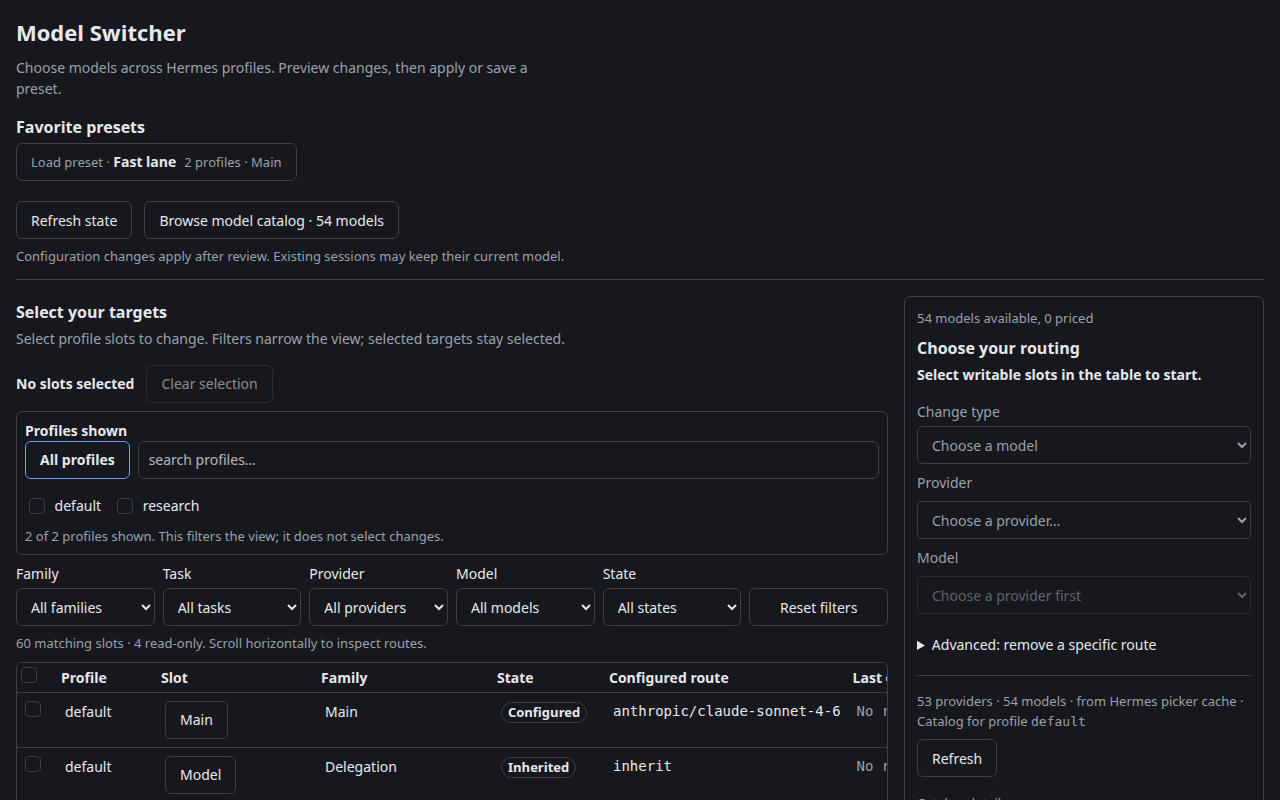
Idle workspace in the host's dark theme: the profile filter, the routing matrix
and the change editor before any target is selected.
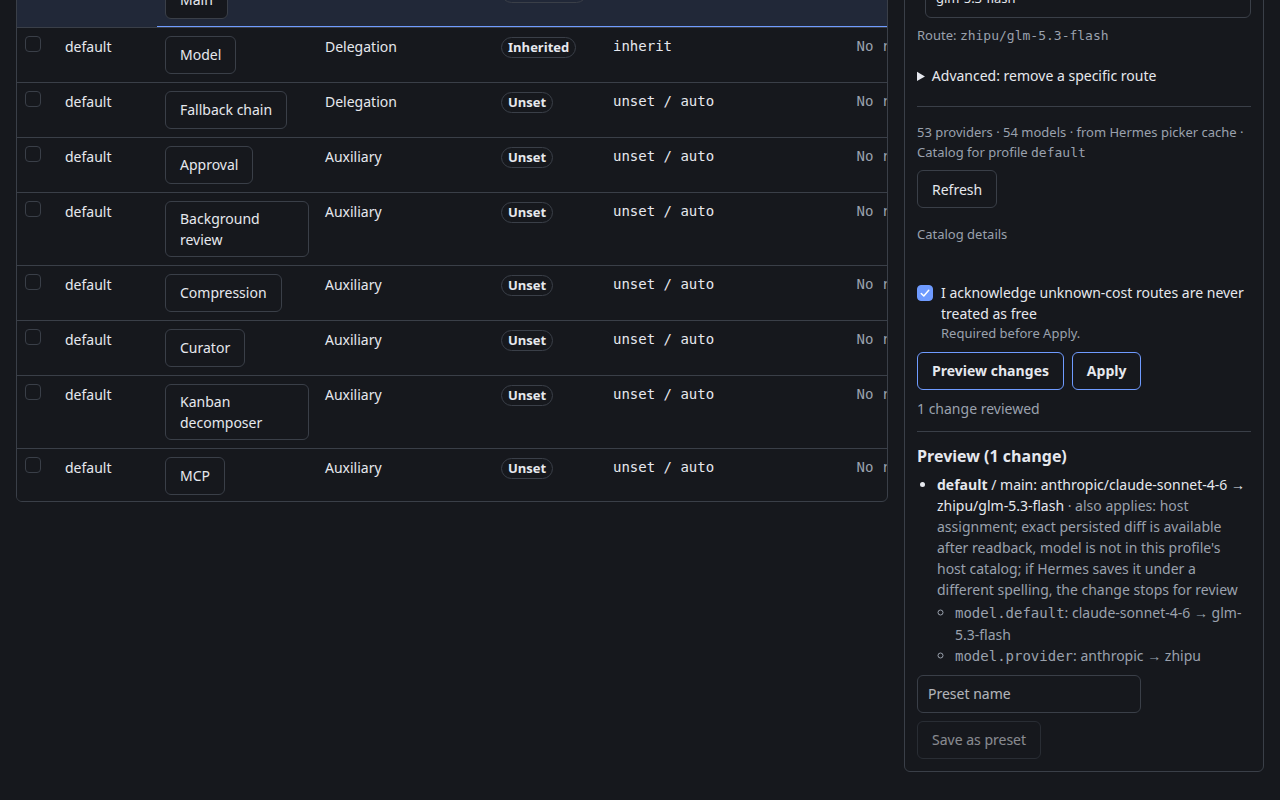
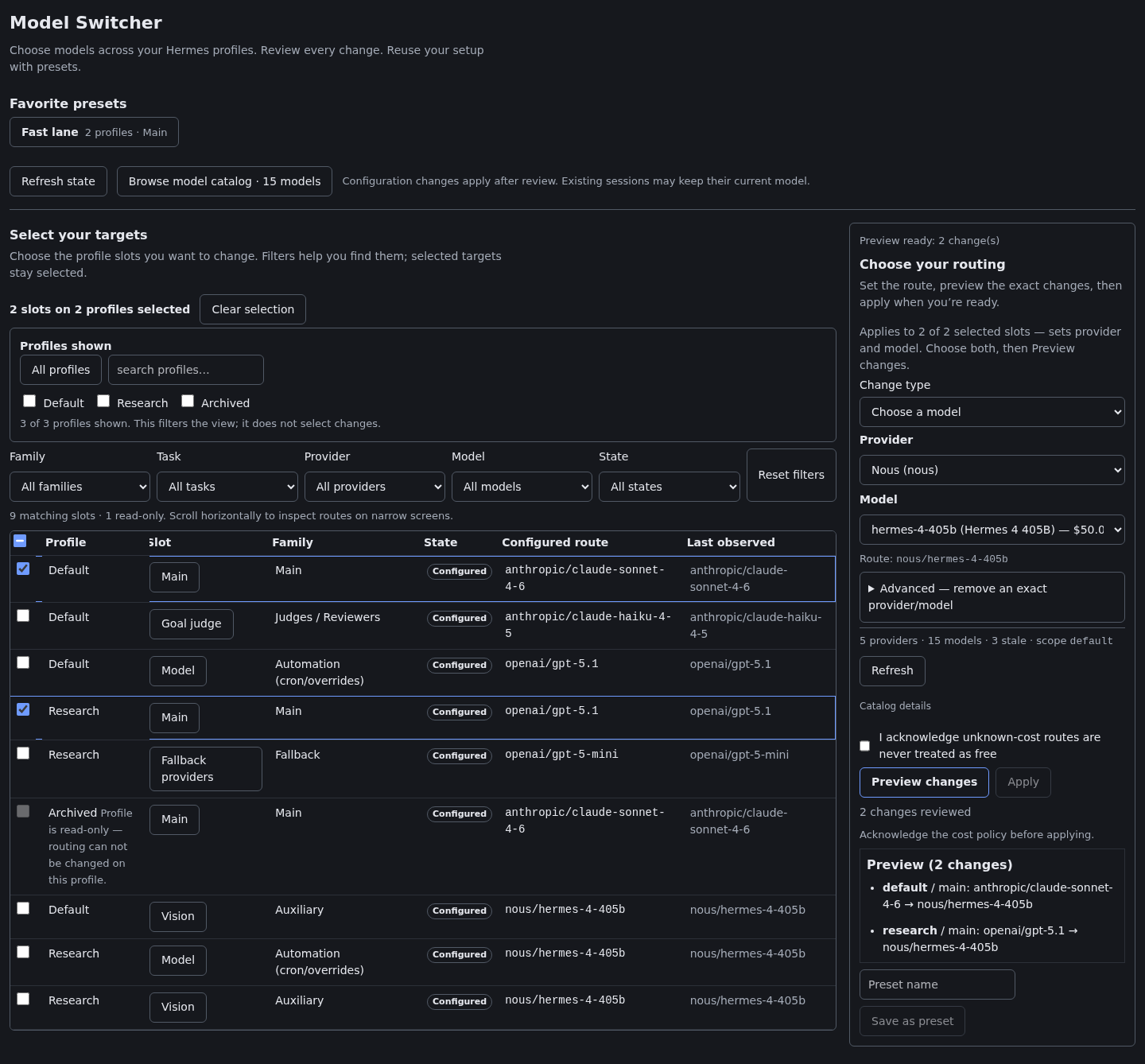
Preview before Apply: the exact before → after route for default/main plus the
persisted config diff, with the unknown-cost acknowledgement in place.
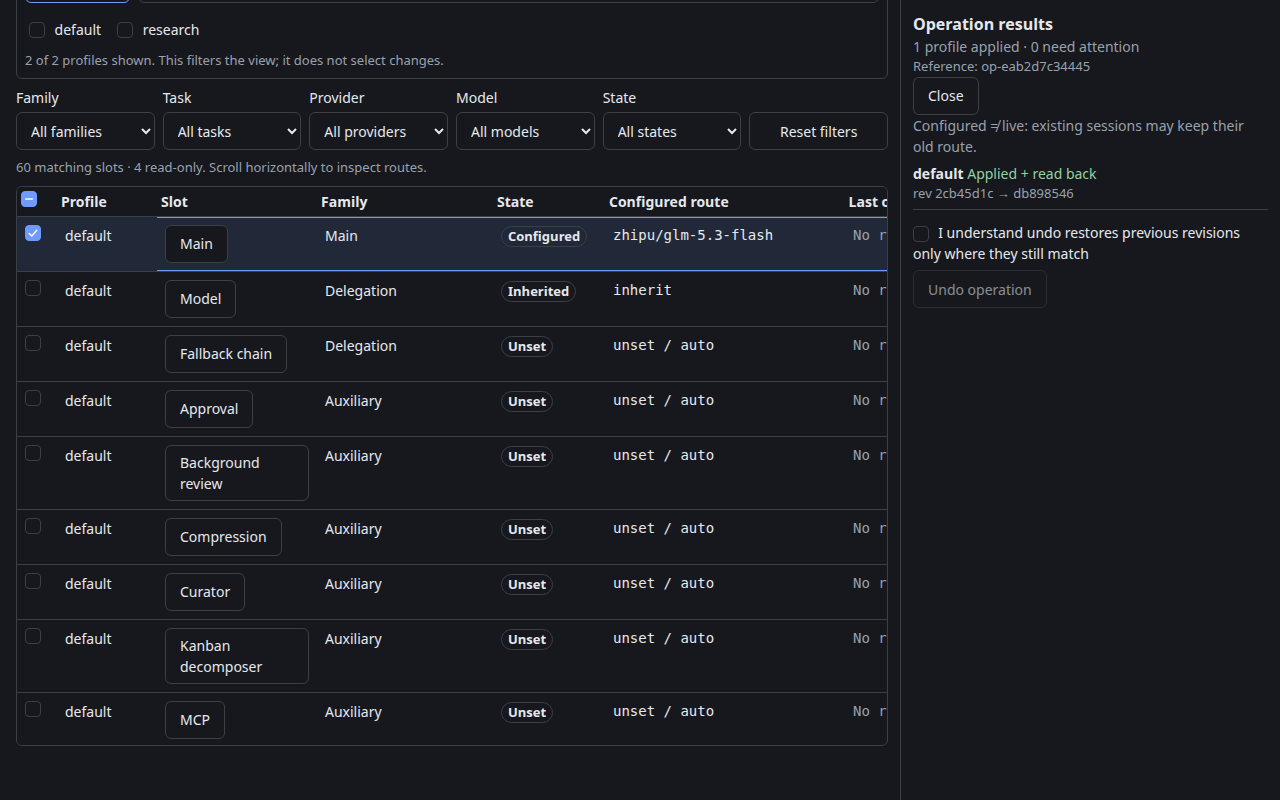
After Apply: per-profile Applied + read back, the operation reference, the
revision transition, and the guarded Undo control.
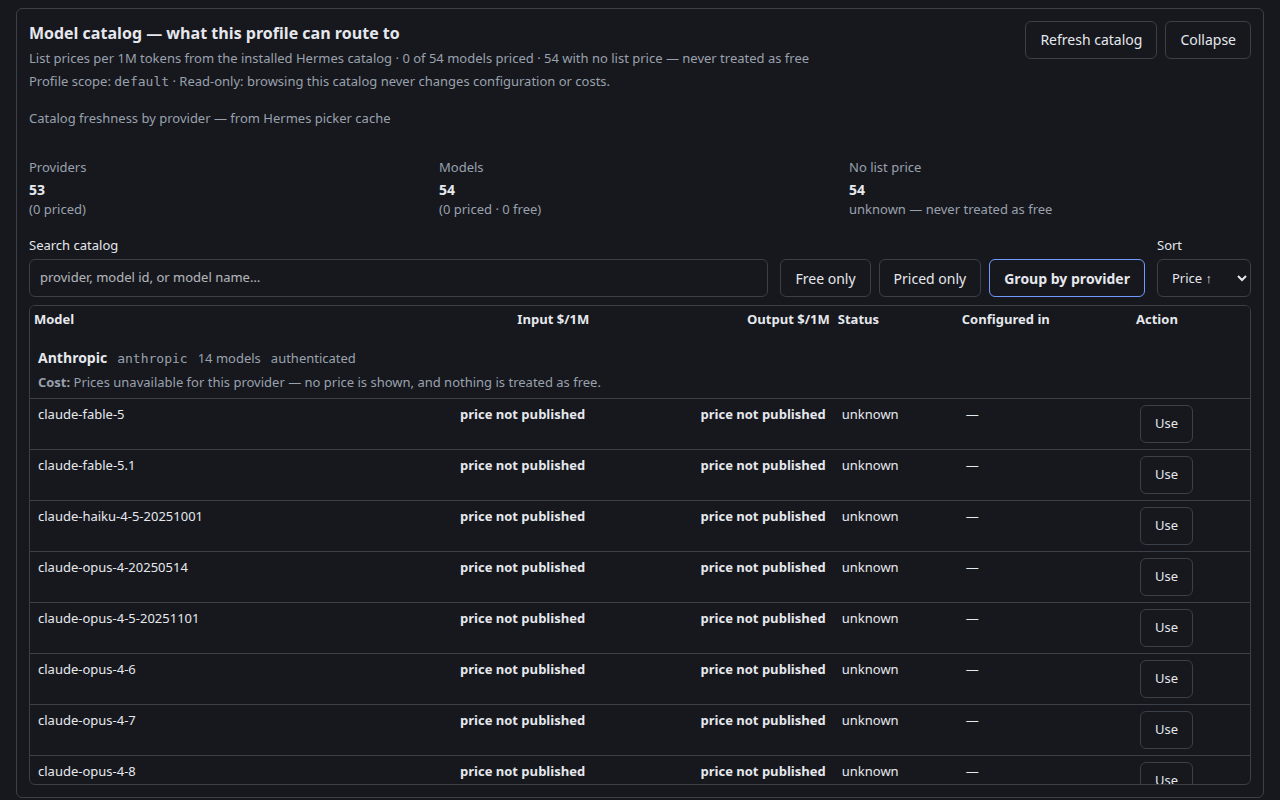
The bird's-eye catalog, grouped by provider, with input/output price columns and a
status per row. This offline lab host publishes no pricing fields, so rows read
"price not published" — unknown is never treated as free. Prices, when a host
supplies them, come from the public host options payload.
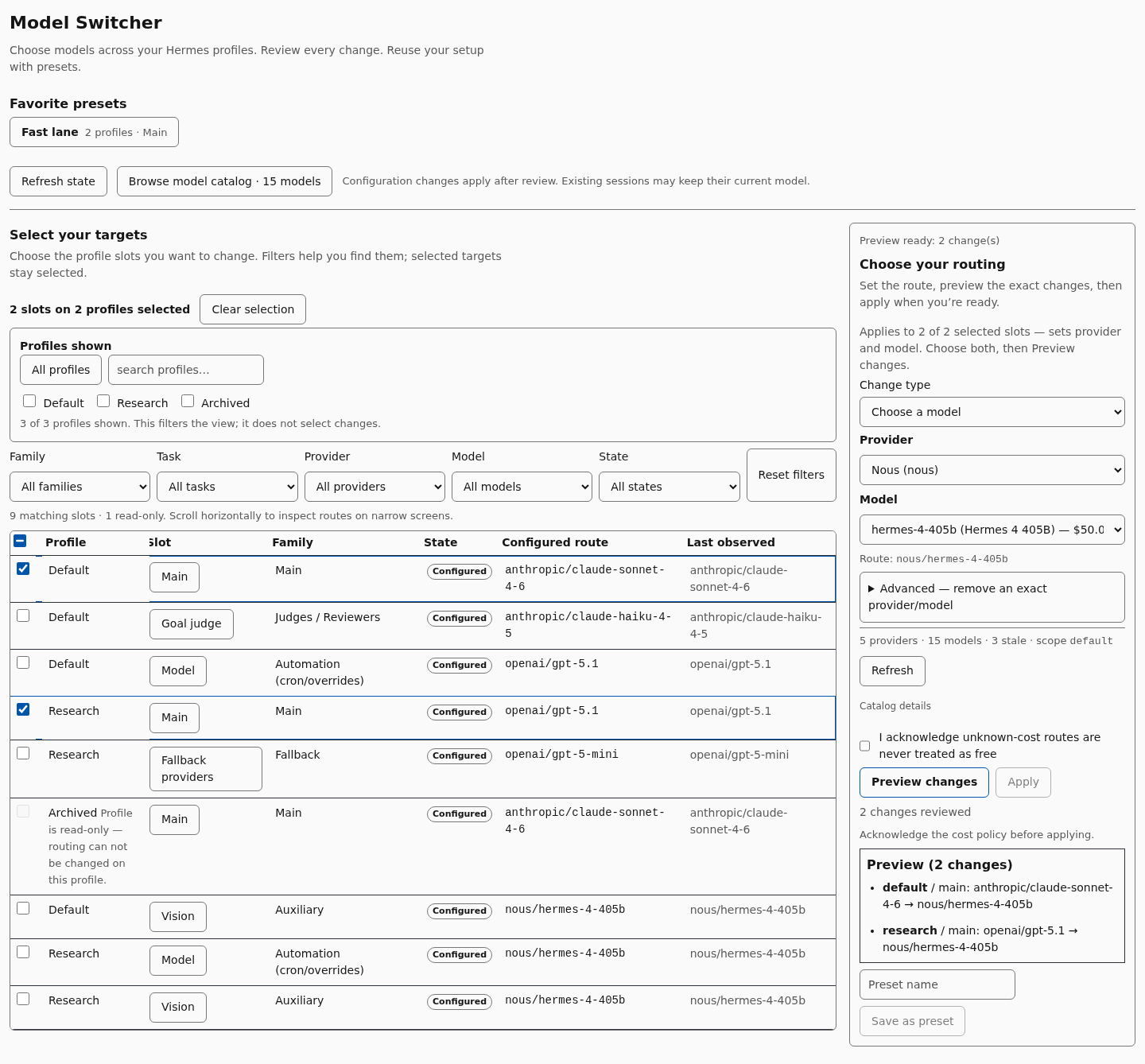
The plugin follows the host Dashboard theme; the same idle workspace under the
light host tokens.
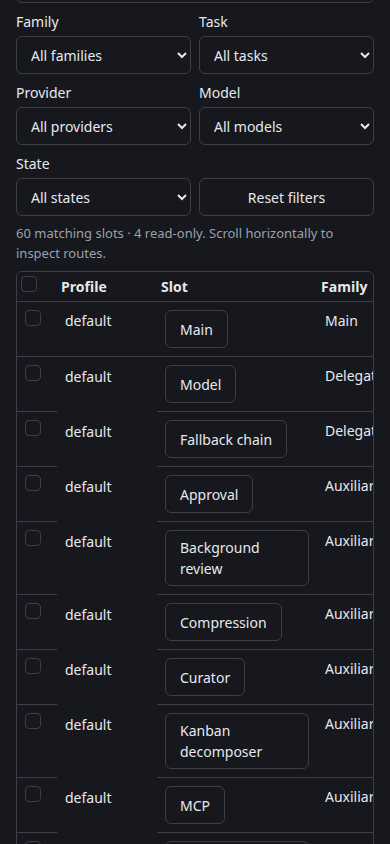
At 390x844 the editor stacks above the matrix and the matrix scrolls horizontally
inside its own region; the page itself does not overflow.
The images and their digests are recorded in
docs/images/catalog-captures.json; they are
reproducible with HMS_WRITE_CATALOG_CAPTURES=1 against the real-router harness.
These predate 0.3.0 and are kept unchanged for comparison. Their captions describe
the older interface.
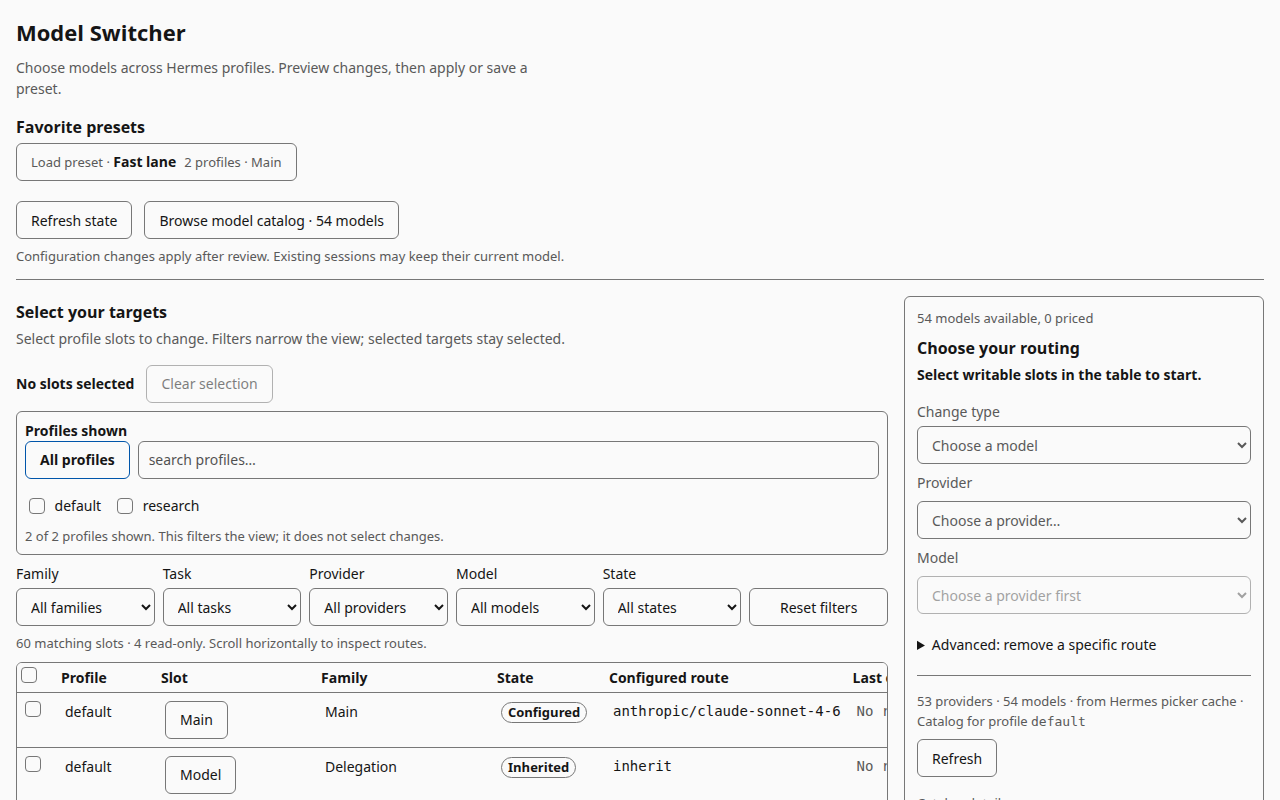
Pre-0.3.0 capture: the compiled plugin in a Dashboard SDK fixture with synthetic
lab profiles. This screenshot demonstrates the interface; it is not evidence of live
Dashboard deployment or provider inference.
Pre-0.3.0 capture: the plugin follows the host Dashboard's theme; the light theme
is shown here.
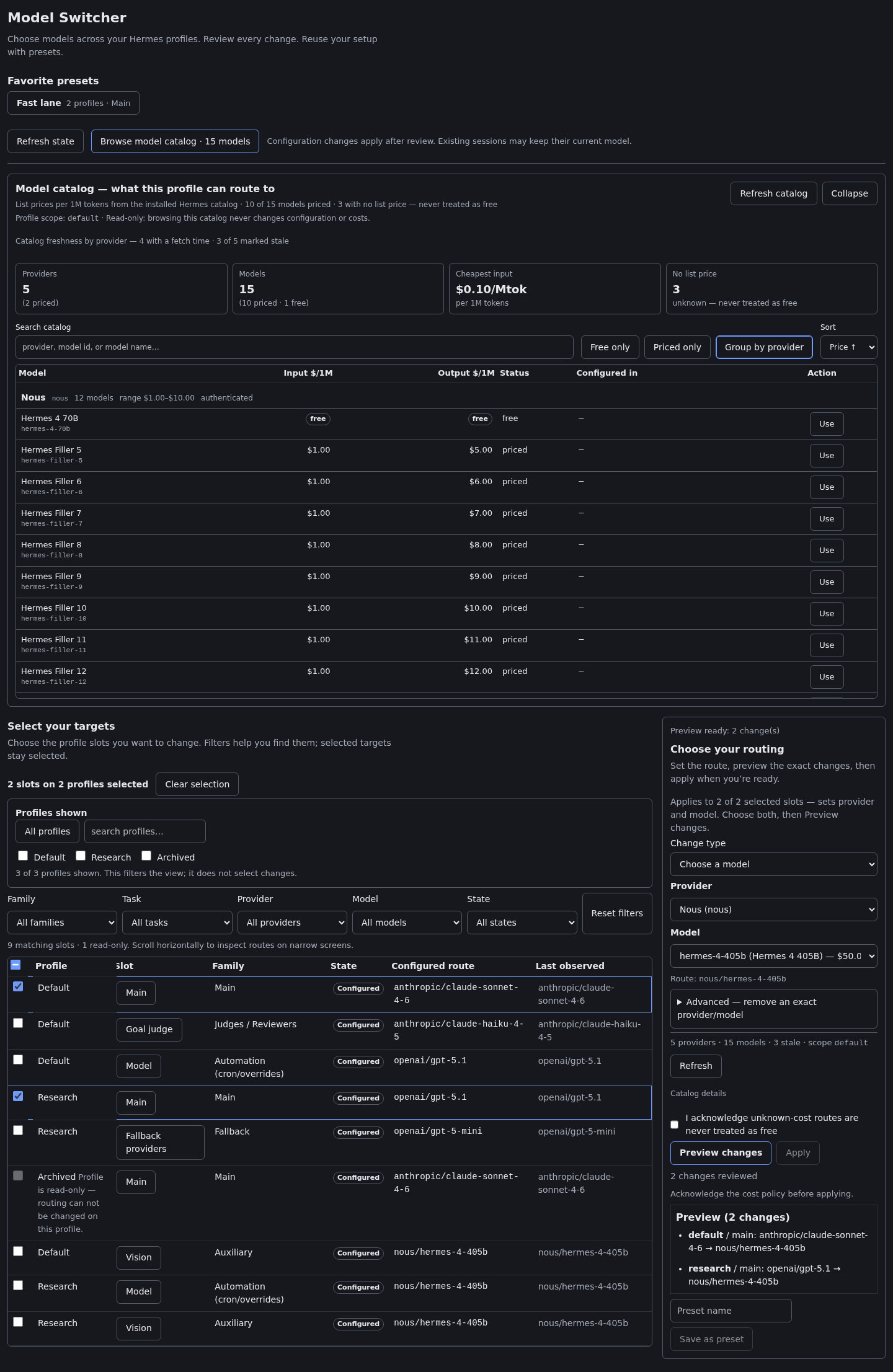
Pre-0.3.0 capture: the provider-grouped catalog in the Dashboard SDK fixture with
synthetic lab profiles. Catalog prices come from the public host options payload,
not direct plugin cache reads, inference or recorded spend.

Pre-0.3.0 capture: the same catalog on a narrow screen; a fixture render of the
compiled plugin, not a live Dashboard deployment or provider execution.

Pre-0.3.0 capture: on a narrow screen the matrix scrolls horizontally inside its
own region.
Isolated lab Dashboard captures (pre-0.3.0)
Captured at commit 02703e3 from an isolated lab Hermes Dashboard with two synthetic
profiles (default and research) and synthetic routes. They are historical evidence,
not verification of the current host-step protocol:
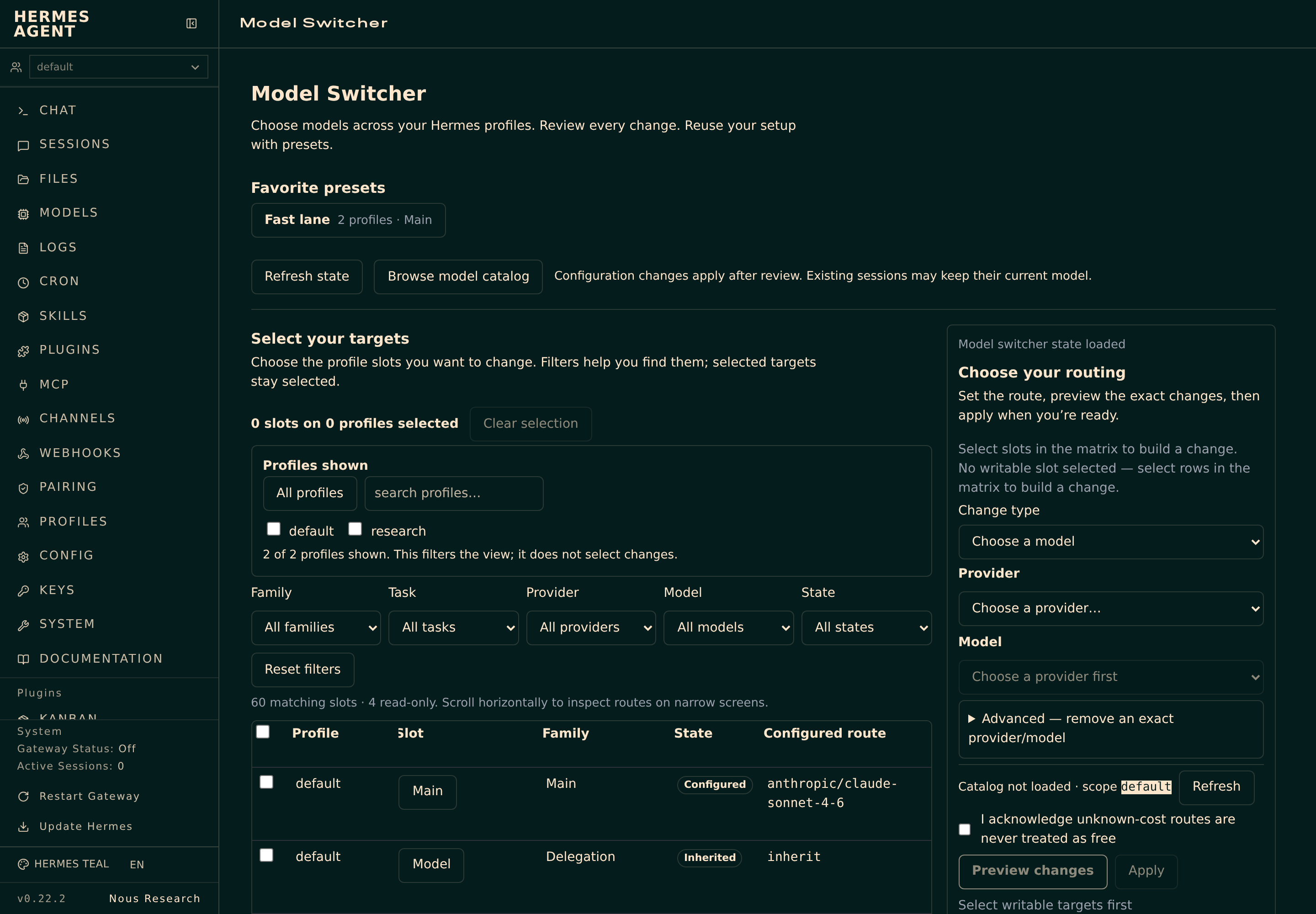
Choose the slots you want to change; filters do not select edit targets.
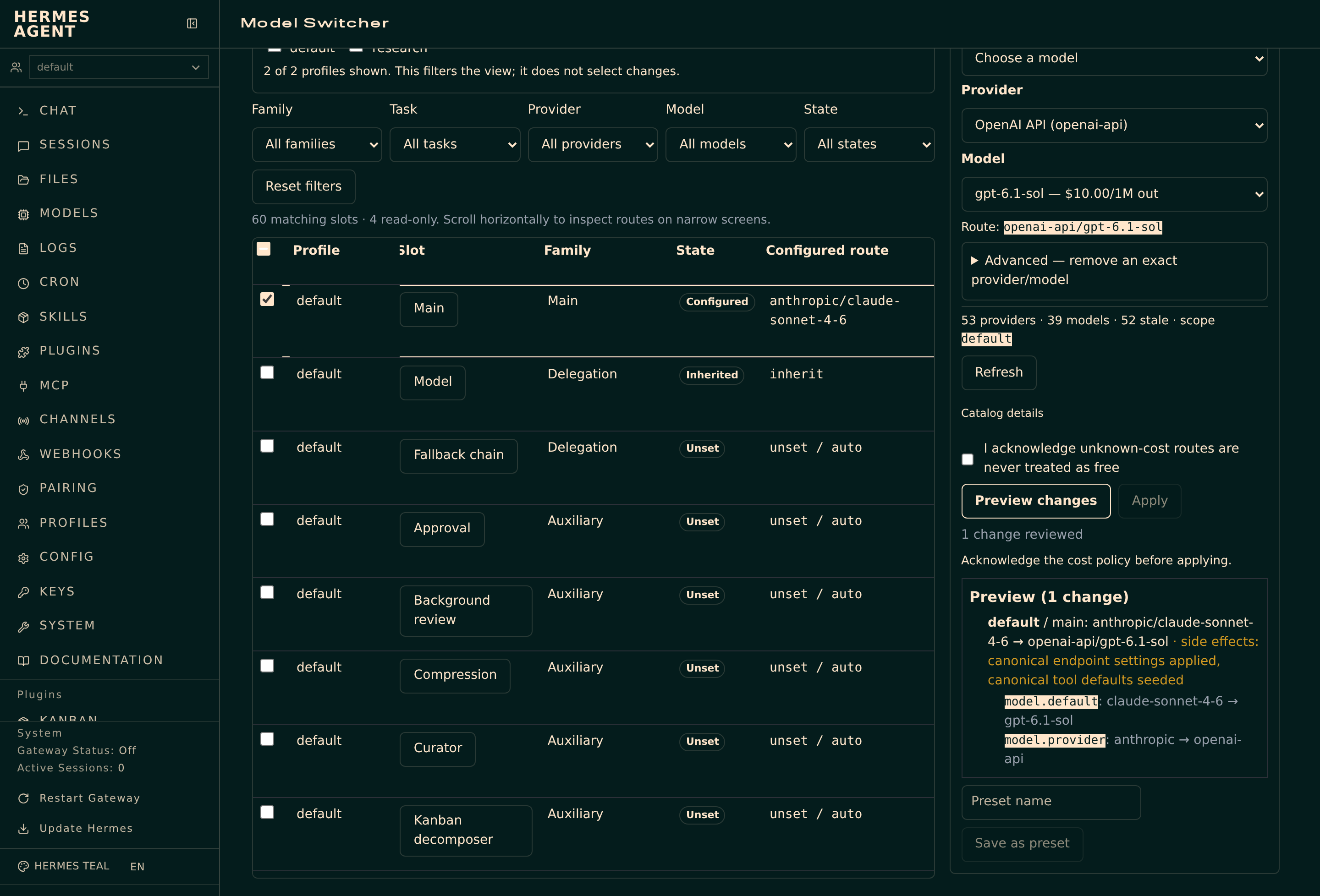
Review provider/model intent before writing. In 0.3.0, the main slot shows semantic
intent; the exact persisted config diff appears only after readback.
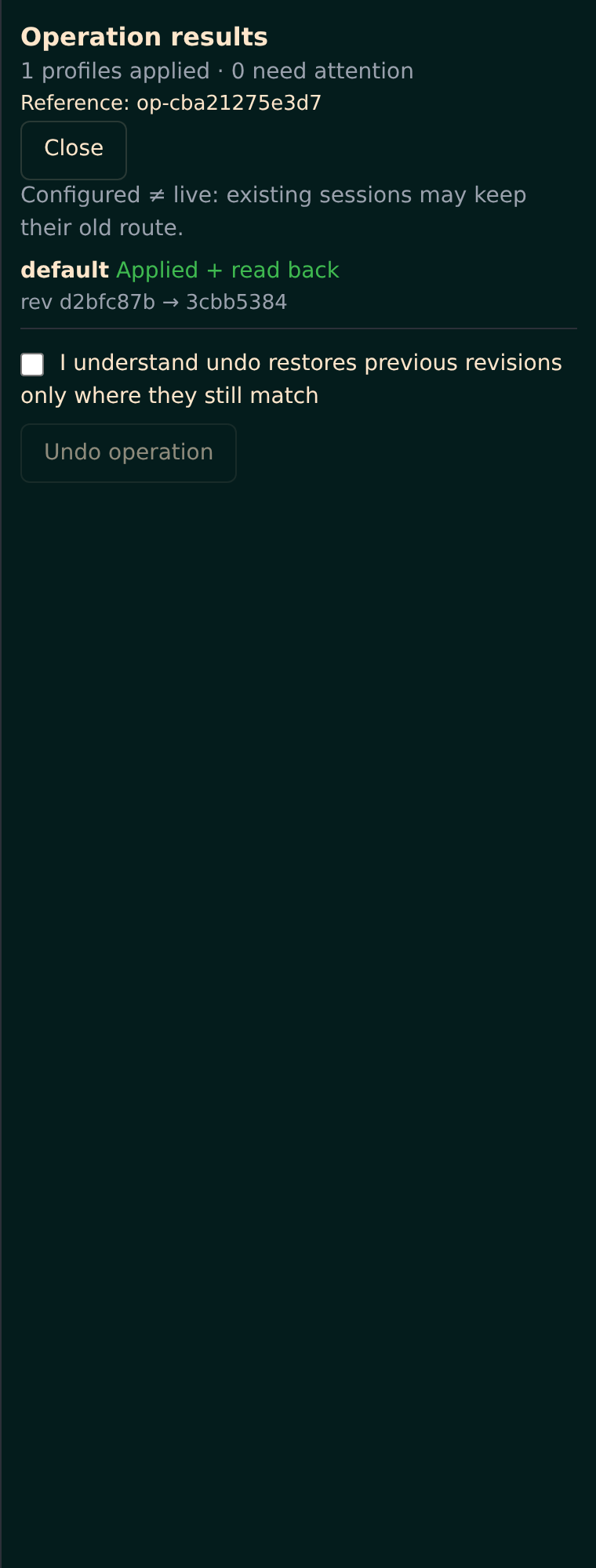
Applied and read back. The lab's subsequent Undo restored the original configuration
bytes exactly. These captures show configuration changes, not provider inference.
Setup
You need a running Hermes installation with the Web Dashboard and plugin support, and
a Python version compatible with your Hermes release. This plugin declares Python
>=3.10; the Hermes runtime it integrates with requires Python >=3.11. Linux is the
verification target; macOS and native Windows are unverified.
Version 0.3.2 needs the public Dashboard /api/model/options,
/api/model/auxiliary, /api/model/moa and /api/model/set routes. The UI uses
the authenticated Dashboard SDK; no private Hermes imports or direct pricing-cache
reads are used by plugin runtime code. Missing required capabilities or host write
routes leave affected changes read-only/unavailable. Compatibility is capability-based,
not a minimum-version comparison. The tested reference is Hermes
v0.22.3, commit 5b147ab0; see
release readiness for evidence and remaining checks.
From this repository
This plugin is not yet in the curated Hermes plugin catalog, so the bare name
hermes plugins install hermes-model-switcherdoes not resolve. Use the
owner/repoform below until a catalog entry is merged.
# Install from the repository (pin an exact commit with --ref <40-char sha> if you want)
hermes plugins install nicolasestrem/hermes-model-switcher

# Enable it when you are ready
hermes plugins enable hermes-model-switcher

# Confirm what is installed
hermes plugins list

# Pull later changes (when the installed source tracks the repository)
hermes plugins update hermes-model-switcher
Run hermes plugins install --help for the full set of options (--ref,
--enable/--no-enable, --force, dependency-consent flags). These are the official
Hermes plugin commands; the plugin does not ship a self-updater.
Pinned installs do not move with update. Hermes refuses that command rather
than silently replacing your chosen revision. To move a pin, rerun hermes plugins install with the same repository, --force, and --ref followed by the new commit's
full 40-character SHA.
The Dashboard bundle is already built and committed. If the installer reports that
build-time Node dependencies were skipped, you do not need to install them to use
these shipped assets; Node.js is needed when rebuilding the UI from source.
From the built package
python scripts/build_package.py # in the source repository; assembles dist-package/ (needs a built UI)
dist-package/ contains the backend, the prebuilt Dashboard assets, and the
documentation, and can be pointed at a Hermes plugin directory. The builder refuses
an existing destination unless you pass --replace.
Manual
Clone or copy this repository into your Hermes plugins directory as
hermes-model-switcher, keeping the root plugin.yaml and __init__.py together,
then enable hermes-model-switcher in Dashboard plugin settings and reload the
Dashboard. The repository ships the built Dashboard assets, so Node.js is needed only
when you rebuild the UI yourself.
Make your first switch
- Select your targets. Narrow the matrix with the Profiles shown selector
and the Family, Task, Provider, Model, and State filters, then
select the slots you want to change. Filtering changes the view only; checkboxes
choose edit targets. The selection summary includes selected slots hidden by filters. - Choose your routing. Pick a provider, then a model from its dropdown (each
entry shows its list price), open Browse model catalog to compare options, or
choose Other to enter an exact provider/model pair for custom routes. Model IDs belong to their provider,
so keep the pair together. - Preview changes. Review the affected profiles and proposed routing. Main-slot
preview shows provider/model intent, not an exact future config diff. Resolve blocked
entries and acknowledge unknown-cost routes when required. Changing the selection
or routing requires a fresh preview. - Apply and inspect. Main and compatible auxiliary assignments run through the
host write route. If Hermes requests expensive-model confirmation, approve or cancel
its separate dialog; plugin billing approval does not bypass it. Check each profile's
readback and exact persisted diff, then save the setup as a preset for next time.
Favorites open a preset preview before application. Refresh state reloads external
edits. Advanced controls cover inherited/default routing, ordered fallback sequences,
and exact-model removal; see advanced routing.
FAQ
- Does switching a model here start using it right away? No. Changes update saved
configuration; an already-running session keeps its previous routing until a new
session starts. Configured routing is not proof of inference or of recorded
usage. - Does it manage credentials? It does not copy credentials between profiles or
modify authentication stores. Presence checks use public profile-scoped secret helpers
and authenticated host options; it never reads another profile's environment file
directly. Missing credential evidence blocks the change. Recovery snapshots do copy
complete pre-change configs, which can include embedded credentials; keep them private. - What if the model list looks stale or a provider is missing? Model catalog
refresh can contact provider services; a catalog result is a listing, not an
inference test. Missing providers usually mean a missing credential on that profile. - Where do the catalog prices come from? List prices per 1M tokens come only from
GET /api/model/optionspricing fields. The plugin does not open pricing registries
or provider caches. Host prices can lag behind provider pages; missing or pending
prices stay unknown, never free or$0.00. They are not inference or recorded spend. - Someone edited a config while I was reviewing — what happens? Each operation
validates profiles and revisions, but the host write route has no expected-revision
check. Readback detects foreign edits and ends inrecovery_required, not silent
success or blind rollback. It cannot prove every possible race was observable. Avoid
concurrent CLI/editor edits during Apply or Undo and use Refresh state afterwards. - Can I undo anything? Undo is explicit, per-operation, and revision-guarded: it
refuses to overwrite conflicting external edits. Disabling or uninstalling the plugin
does not reverse changes already applied. - Where does recovery data live? Only under
<hermes home>/state/hermes-model-switcher/,
with a private SQLite journal (0600in a0700directory). If that location is
inside the plugin tree or a Git worktree, the plugin is read-only; no alternate
location is chosen. The journal keeps a copy of each complete pre-change config,
including any sensitive fields, not just the model selection. - What if my saved presets get corrupted? The original preset store is quarantined
(kept, not deleted) and valid entries are salvaged with a visiblepresetsCorrupt
warning, so a damaged file is not silently swallowed and is not silently overwritten. - Does it work on a remote / hosted-isolation Dashboard? Writes require an
in-process Dashboard. Hosted isolation stays read-only; the plugin does not change
that setting. - Why are some slots read-only? Unknown model-like keys and unsupported plugin
selectors remain coverage gaps and never receive write access.
Limitations
- Configured ≠ live. Applying a change writes configuration. It is not evidence
that a provider accepted it, that inference happened, or that a running session
adopted it. - Not a single global transaction. Multi-profile application uses a journal and
compensation; it is not one atomic transaction across all files. - Explicit selection only. Only supported, explicitly selected slots are writable;
unknown or unsupported slots remain coverage gaps. - Prerequisite: connected credentials. A missing connection blocks the change.
- Prices are informational. Catalog list prices can be stale or absent; they are
not spend estimates, not cost approvals, and unknown cost is never treated as free. - Scale. Large profile sets increase first-request (cold discovery) time. No
performance measurement from the pre-refactor candidate is carried forward as
0.3.2 acceptance. See
release readiness and
backlog. - Platform scope. Linux is the verification target; macOS and native Windows are
unverified. Earlier green results do not establish final 0.3.2 compatibility. - Host capabilities required. Missing public config, home or secret capabilities make
the plugin read-only; missing host payloads show notices and unknown data. Main and
compatible auxiliary writes need/api/model/set; other slots use public config
load/save under the target home. No private-core compatibility shim is used.
Privacy
The plugin does not copy credentials between profiles or rewrite authentication stores,
memories, skills, or transcripts. It uses the Dashboard's authenticated transport.
Before writing, it copies each complete pre-change config into the private undo
journal described above. Those snapshots can contain sensitive data even if only
the model was changed; never publish journals, sidecars or backups. Public operation
responses expose status, outcomes and only the current host call's allowlisted
fields/token, without raw configurations, snapshots, store paths or exception strings. Read the
privacy audit for scope and limits.
Recovery
There is no fleet-wide transaction and no always-undo promise. Applying across
several profiles is a journalled sequence, not one atomic transaction. When a step
fails, the engine compensates in reverse order only while each profile's revision still
matches; a conflict stops compensation and the operation reports recovery_required. A
compensated, partial, or recovery_required outcome is reported as ok=false with a
fixed failure category and the operation's final state — a success is never claimed for
a fleet that did not fully apply.
Main and compatible auxiliary steps pause at awaiting_host while the UI calls
POST /api/model/set through the Dashboard SDK and returns a one-time-token result.
The backend verifies the actual config before committing; an HTTP success alone is
not enough. Abandoned host steps are reconciled during recovery/restart. The host
route cannot perform an expected-revision check, so foreign changes detected at
readback require recovery rather than blind restoration.
Undo is explicit and per-operation. It refuses to overwrite conflicting external
edits. After a crash, recovery reconciles recorded intent with the actual files. Keep
recovery data until any outstanding operation is resolved; disabling or uninstalling the
plugin does not reverse changes already applied.
Develop and contribute
See
CONTRIBUTING.md
for dependency setup, the portable vs real-runtime test split, and the CI workflow. In
short:
python -m pip install -e '.[test]'
npm ci && npm run build
python -m pytest tests/
npm test
python scripts/privacy_guard.py
Read the design contract, usability notes,
technical reference,
verification scope, and
release findings. Changes should preserve preview, apply,
readback, and guarded Undo.
License
MIT. This is a community project and does not claim official Hermes
endorsement or catalog listing.
README from the reviewed commit d62530d; it updates when the author re-pins.