rrglab




Don't hire another bot. Launch a company.
Create AI-native companies for yourself and your customers. Publish services. Receive orders. Put Hermes workers to work. Retrieve the result.
Explore the product → valoresearch.org/hermes-unlimited · Discuss a provider pilot →
A REHT Research Group product. Built on NousResearch Hermes Agent.
A native Hermes Agent plugin for providers to create and operate AI-native companies and deliver services to their own customers.
Names and acronyms
| Term | Meaning |
|---|---|
| AGY | Autonomous Goal Engine — a goal-oriented engine for turning objectives into bounded work, tracking execution and evaluating results. Company operation is an application, not the expansion of AGY. |
| REHT | REHT Research Group — the organization behind Hermes Unlimited. Used here as a name, not a separately expanded technical acronym. |
| CAVO | Chief AI Value Officer — the role/function focused on the costs, value and return of AI use; not a claim of live financial outcomes in the public plugin. |
| A2UI | Agent-to-User Interface — structured information presented through user interfaces; not a claim that a full cockpit ships in this repository. |
| JustYou | Name of the identity and signed-session verification integration; not an acronym. |
| The Thread | Name of an optional external agent/conversation memory system; distinct from the public plugin's present capabilities. |
| AI | Artificial Intelligence. |
| API | Application Programming Interface. |
| CLI | Command-Line Interface. |
| MCP | Model Context Protocol. |
| UI | User Interface. |
| OS | Operating System; “Company OS” refers to company management logic. |
| ROI | Return on Investment. |
| SLA | Service Level Agreement. |
| SMTP | Simple Mail Transfer Protocol. |
| CI | Continuous Integration. |
| SHA | Secure Hash Algorithm (Git commit identifiers are SHA-derived hashes). |
| PR | Pull Request. |
These terms explain names used across the broader product and roadmap. Inclusion does not mean the corresponding capability is shipped or production-verified in this public release. See What works.
Official public release repository
This is the official REHT Research Group public release home for Hermes Unlimited. New implementation work occurs in private DEV repositories; tested and approved public releases are promoted here through pull requests. Do not automatically mirror the frozen competition source into this repository or overwrite release documentation. Release changes require relevant passing tests and security checks before merge.
The original NousResearch Hermes Agent catalog entry #153503 is already merged, but its alpha.4 pin still references nsolland/hermes-unlimited at 09cd80374b994fa38abc5ed6b8904b98ac9b3554. That legacy repository is frozen for the competition submission. Changing the catalog URL or pinned source requires a separate reviewed upstream PR. No claim of externally verified customer fulfillment or payment settlement is implied.
Versioned release contract
The canonical public manifest and VERSION must match. This source declares 0.2.0-beta.6 with seventeen native Hermes tools as an experimental prerelease; the release tag is published only after exact-commit qualification. Previous experimental alpha.6–alpha.8 snapshots do not establish a stable 1.0 release. Private development is not a public release. Do not publish a GitHub release or request a Hermes catalog SHA bump until the exact candidate commit passes local tests, Hermes plugin validation/security scanning and an actual-host compatibility check; review the declared tools and external effects. The upstream catalog pin moves only through a separate reviewed NousResearch PR. npm is not used for the Python-native plugin; a separately maintained JavaScript/TypeScript client may be npm-packaged if introduced later.
What works
- Official public
rrglabprerelease includes seventeen declared native tools with no Hermes core override. The separate NousResearch catalog still points at its older upstream pin until maintainers merge the catalog update. unlimited_specialist_factorydiscovers host-reported tool schemas and drafts unverified proposals. It does not grant tool access, classify effects, run benchmarks or execute tasks. When Hermes does not expose a public host registry (including v0.23.1), discovery is limited to this plugin’s own static declarations and markedLOCAL_PLUGIN_DECLARATION_ONLY; this is never evidence of live availability. External toolsets require a host-provided registry.- Read-only
unlimited_memory_recallretrieves existing company-scoped SQLite memory rows with JustYou-scoped access; stored verification labels and digests are not independently attested by this tool. No memory ingestion or execution is included. - Read-only
unlimited_adapter_discoverlists catalog-only community adapter descriptors; no providers are connected and no execution permissions are granted. unlimited_economic_evaluatecompares already recorded model-submitted, unverified costs to a model-submitted, unapproved scenario cap. The output is a scenario, not a budget authorization, verified cost, ROI or execution decision. Missing cost inputs return insufficient evidence.- Model-submitted, unverified oversight time and AI/recovery costs in the service currency can be recorded per scoped service request and read back. These are unverified cost inputs, not a bank statement, verified benefit or measured ROI.
- Provider/tenant-scoped company and service registry backed by SQLite.
- Priced service publishing and durable customer request intake with idempotent native Kanban submission; completed worker execution is asynchronous.
- JustYou session + signed Hermes profile binding verifier, with no token files bundled.
- Native Hermes Kanban task submission and scoped state reader, including request-to-task result association.
- Fail-closed checks for missing identity, mismatched profile, tenant boundaries and duplicate request IDs.
The native tool handles for company creation, service publishing and requests are functional with a trusted JustYou verifier supplied by the Hermes host.
Green Core — live acceptance (11 November 2026)
A bounded, synthetic end-to-end acceptance run on the Acer Hermes Unlimited runtime completed successfully. This validates the installed customer-flow integration; the public repository's smaller native plugin core is a separate implementation and is not claimed to contain every runtime component exercised below.
- Company
acceptance-1111was created from the support-desk template with three isolated Hermes profiles (triage, responder, knowledge). - Three company-scoped JustYou identities were verified; the registry, session renewer and learning timer were active.
- Native Hermes Kanban task
t_5d8dce9dwas assigned to the triage profile, executed by a real worker and completed with exit code0and a customer-support handoff summary. - The result was harvested into company-scoped memory once. A subsequent harvest recognized the duplicate without creating a second record.
- The learned entry was classified
RECORDED_UNVERIFIED: it is an agent self-report, not independently verified evidence. No external customer contact or external effect was performed.
Acceptance verdict: GREEN for synthetic company creation → identity isolation → task execution → handoff → scoped learning capture. Still open: independent output verification, externally reproducible customer onboarding and production readiness. The runtime acceptance is not a substitute for green local tests against the public repository's exact commit.
Future developments
Our direction: AI-native companies as a service.
Hermes Unlimited is evolving from a native Hermes plugin into a platform where a provider can create, operate, and scale AI-native companies for customers—with people and agents working as one organization.
| Area | What we are building toward |
|---|---|
| Captain's Bridge | One operating cockpit for companies, teams, missions, communications, customers, and results. |
| AI Crew | Coordinated agent roles—helpers, specialists, routers, coordinators, and directors—with clear ownership and handoffs. |
| Mission Control | Goals that persist across sessions, task execution, attention management, retries, completion, and measurable outcomes. |
| AI Bridge | Choice of models, providers, and routing strategies based on capability, latency, budget, and workload. |
| Company Memory | Durable context and organizational learning, with optional integration of The Thread. |
| Service Factory | Turn repeatable agent work into customer-facing services, intake, delivery, and reusable packages. |
| Business Engine | Revenue, cost, AI ROI, billing, and continuous improvement of company economics. |
| Communications | Customer and team interaction through supported phone, email, and messaging channels. |
| Integrations & add-ons | Modular tools, virtual work environments, and optional governance or evidence capabilities. |
AI crew roles
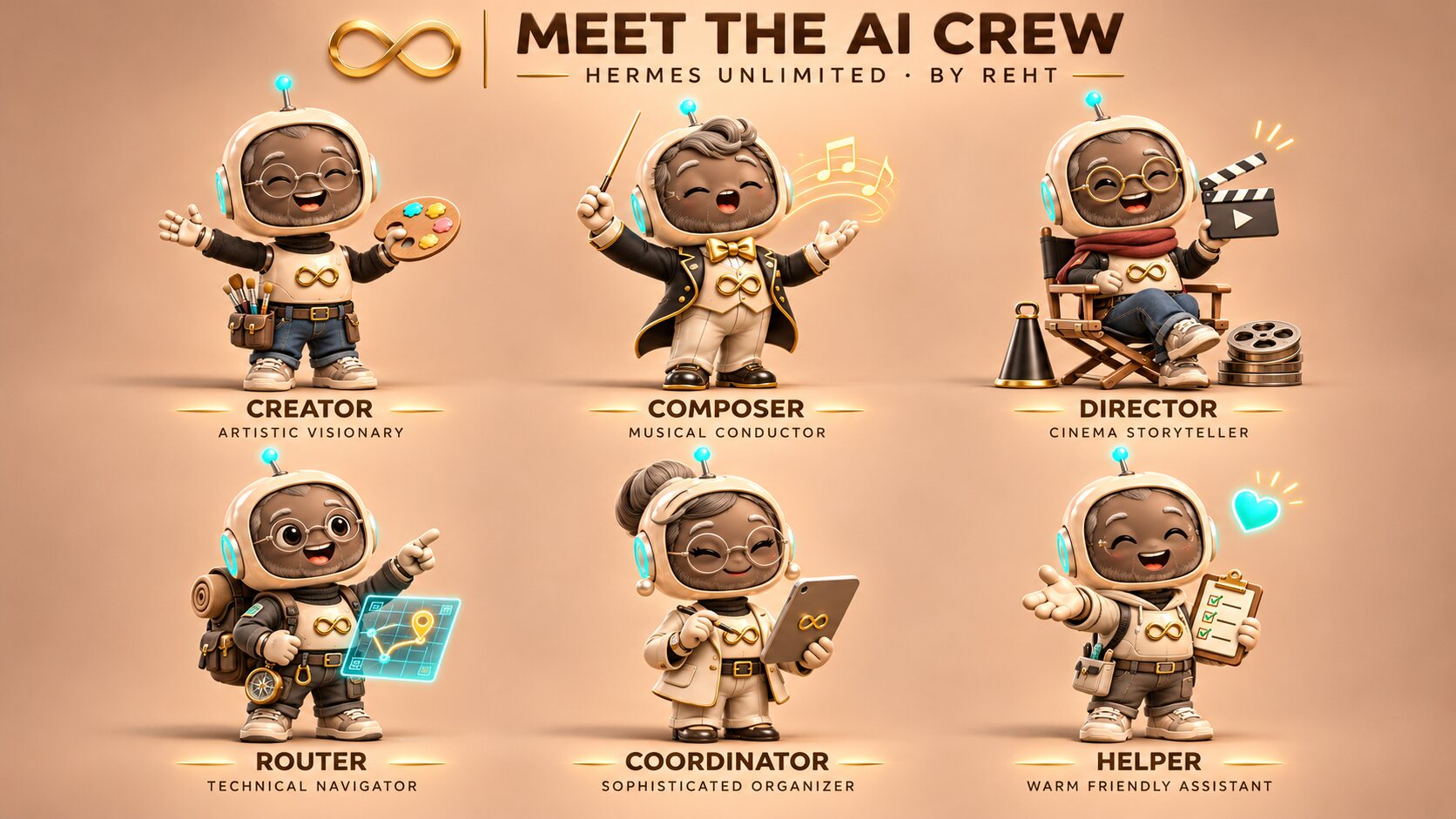
The crew is a role model for work, not a fixed set of separate models or mandatory agents. One agent may perform multiple roles, and roles can be reassigned by the coordinator.
| Role family | Roles | Responsibility |
|---|---|---|
| Direction | Director, Coordinator, Router | Set direction, break down goals, assign work, and select the right execution path. |
| Creative | Creator, Composer, Storyteller | Design ideas and produce creative content. |
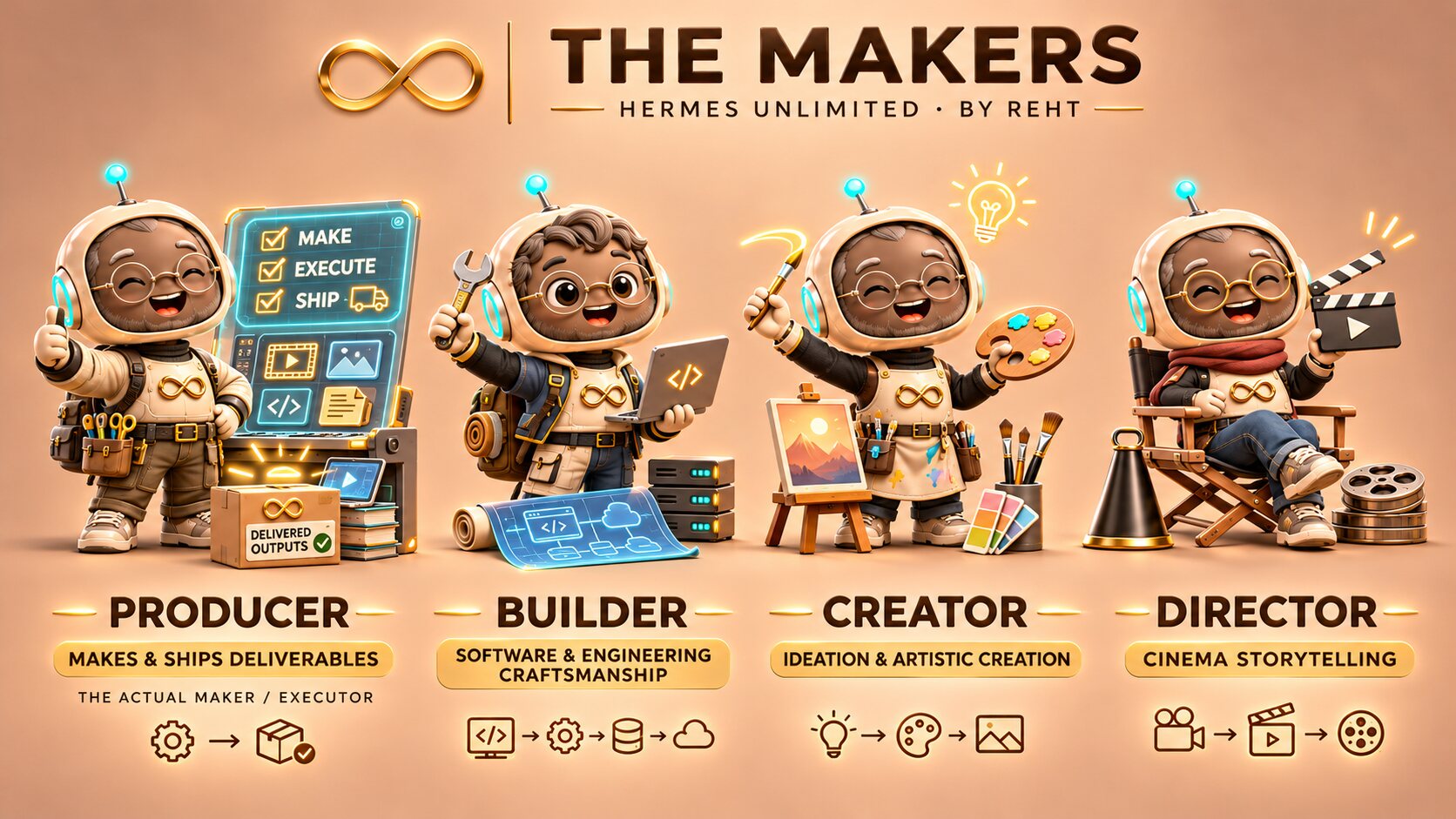
| Production | Producer, Builder, Coder | Make concrete deliverables: software, artifacts, and customer work. |
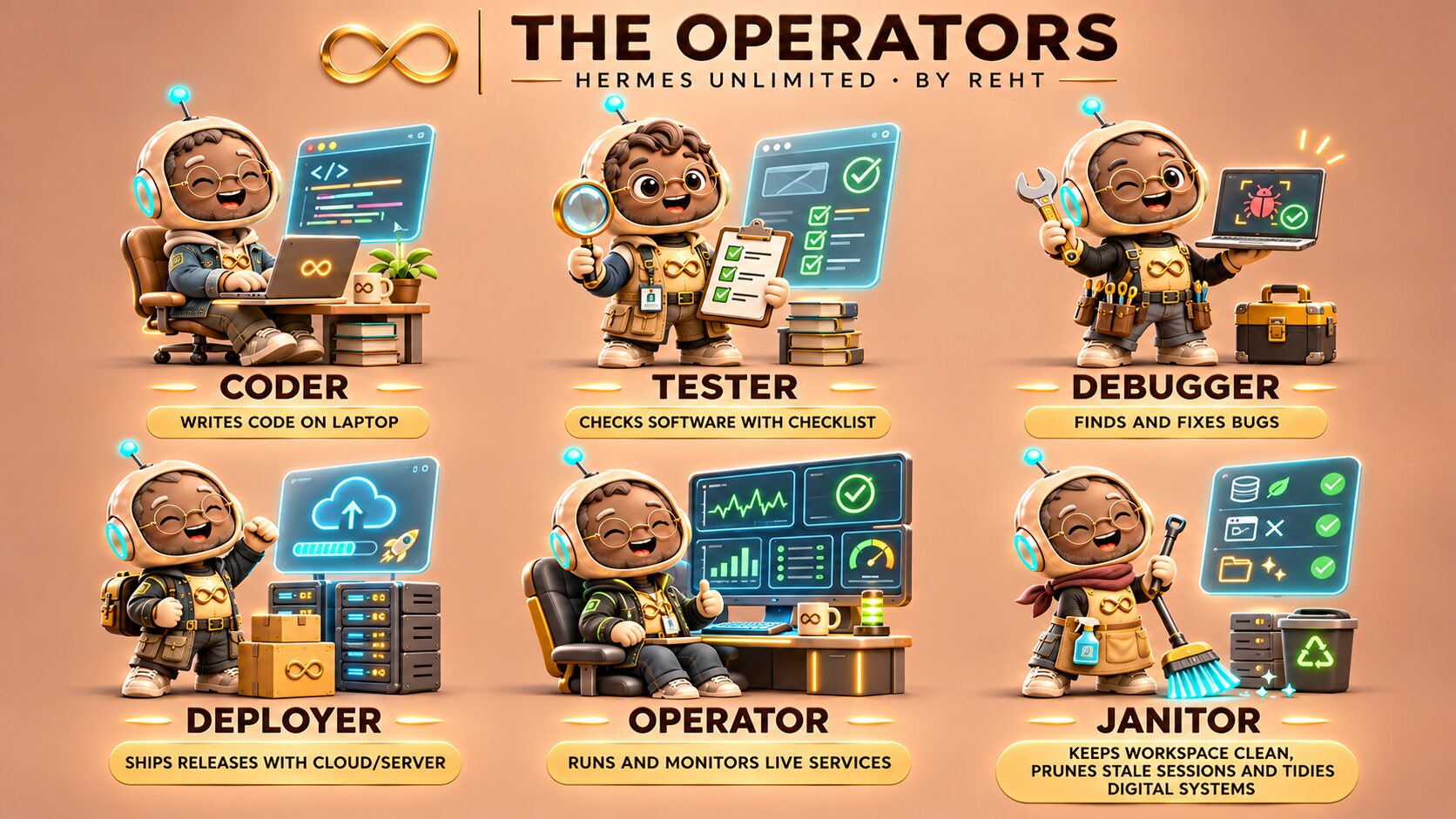
| Quality | Tester, Debugger, Reviewer | Validate results, identify failures, and repair defects. |
| Operations | Deployer, Operator, Janitor, Maintainer | Release and run services, monitor outcomes, clean up stale state, and keep systems healthy. |
| Support | Helper, Specialist | Assist execution with targeted skills and domain knowledge. |
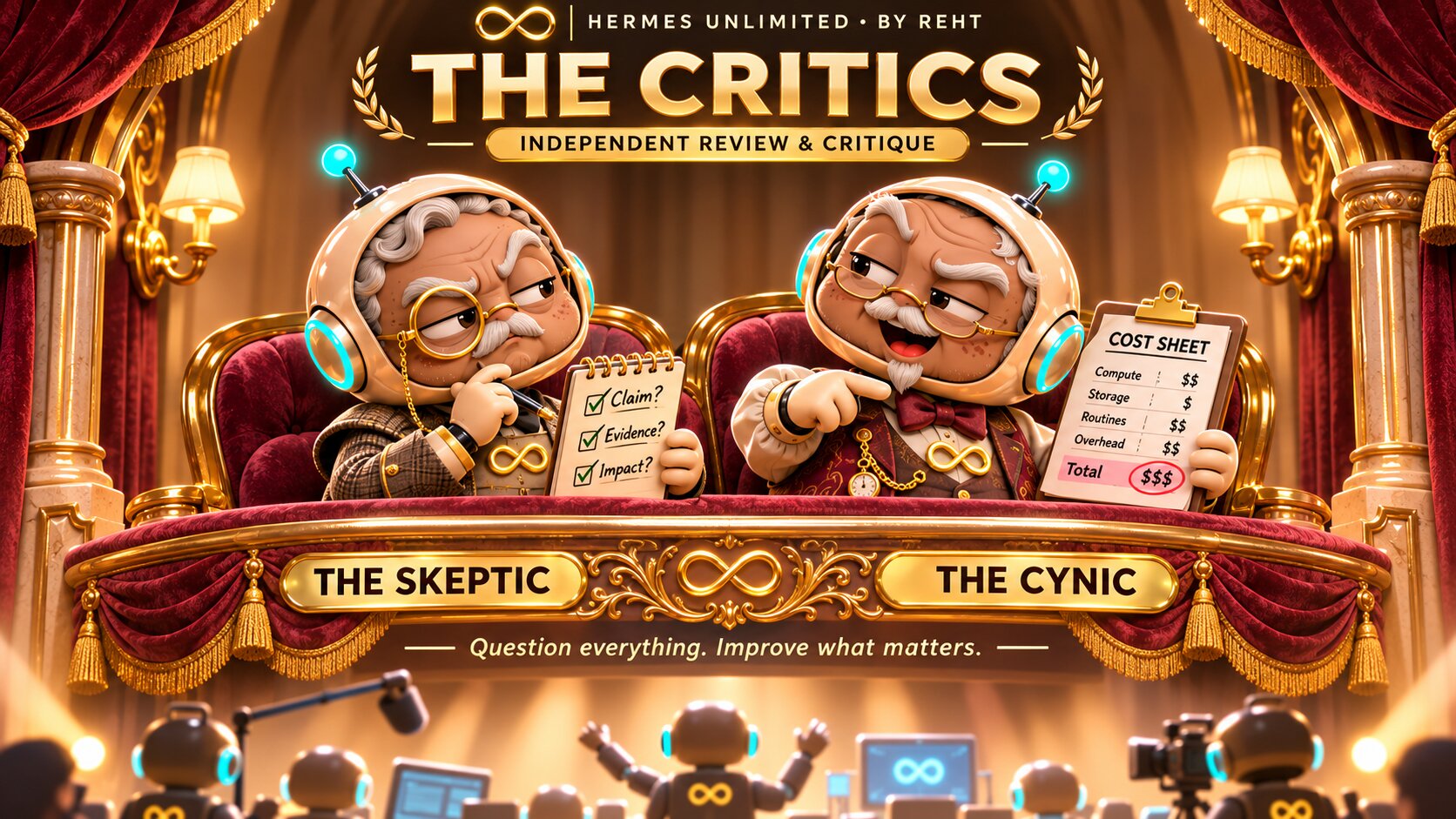
| Independent Review & Critique | The Skeptic, The Cynic | Challenge evidence, assumptions, costs, customer value, and each other's conclusions; report actionable concerns to the Coordinator. |
Roles are envisioned capabilities; the illustrations are a visual identity, not proof of live autonomous execution.
The Humor Gallery — serious AI, ridiculous personalities
The Humor Gallery is an original cast of comic AI work archetypes. Their job is to reveal real organizational failure modes through short, memorable scenes and, eventually, optional evaluation routines. Characters are original; classic comedy is inspiration for the failure mode, not a source of copied scripts, likenesses, voices, or character designs. The gallery is a creative concept, not a claim that these runtime agents are implemented.
| Original character | Comedy inspiration | Practical responsibility | Expected output |
|---|---|---|---|
| The Critics: The Skeptic & The Cynic | Theatrical balcony critics (Statler & Waldorf) | Independently question evidence, assumptions, cost and customer value. | Specific objections and recommended verification. |
| The Reality Checker | Monty Python's Dead Parrot | Compare cheerful status claims with real observations and effects. | Claim-versus-observation discrepancy with supporting evidence. |
| The Confused: The Literalist & The Interpreter | Abbott & Costello's Who's on First? and The Two Ronnies' Four Candles | Expose ambiguous names, instructions, ownership, and handoffs before work starts. | Clarification questions, unambiguous restatement, and examples. |
| The Bureaucrat | Yes Minister | Detect procedural loops, circular approvals, and administrative delay. | List of unnecessary gates and a simpler permitted path. |
| The Boundary Tester | Wesensteen's submarine captain | Challenge assumptions about borders, scope and hidden operating constraints. | Boundary cases and concrete negative tests. |
| The Normality Inspector | Leif Juster's Mot normalt | Notice deviations that teams have normalized or stopped questioning. | Anomaly report and baseline comparison. |
| The Overconfident Expert | Fleksnes | Stress-test unjustified confidence and unsupported competence claims. | Confidence calibration questions and missing-proof list. |
| The Misinterpreter | Wesensteen's Hos tannlegen and verbal misunderstandings | Catch situations where participants agree on words but mean different things. | Terminology conflicts and clarified intent. |
| The Contrarian | Monty Python's Argument Clinic | Test whether disagreement contains reasoning or is merely opposition. | Steelmanned counterargument with a falsification test. |
| The Obstruction Detector | British bureaucratic satire | Distinguish necessary controls from process that prevents delivery. | Delay cause, accountable owner, and actionable simplification. |
| The Improvisers | Swedish Macken (Roy & Roger) | Explore low-cost practical workarounds when the standard route fails. | Bounded alternative proposal with assumptions and trade-offs. |
| The Logical Satirist | Hasse & Tage | Apply a claim's logic consistently to expose contradictions. | Counterexample or contradiction. |
| The Obsolescence Inspector | Galenskaparna's Stinsen brinner | Identify workflows kept alive after their underlying purpose has vanished. | Retirement or modernization recommendation. |
| The Strategist | Blackadder | Challenge weak plans, wrong priorities and excessive complexity. | Simpler strategy with explicit trade-offs. |
| The Frustrated Operator | Fawlty Towers | Detect broken operational handoffs and poor customer experiences. | Failure timeline, owner and recovery action. |
| The Social Skeptic | Larry David's observational comedy | Challenge whether customers actually want or understand an offering. | Customer-value hypothesis and validation test. |
| The Diagnostician | House | Compare competing explanations before declaring a root cause. | Ranked hypotheses and discriminating tests. |
| The Minimalist | Parks and Recreation's Ron Swanson | Remove unnecessary agents, meetings, tools and workflow stages. | Smallest viable implementation and cost delta. |
| The Bullshit Detector | George Carlin's language criticism | Flag inflated claims, jargon and unsupported marketing statements. | Plain-language claim and proof checklist. |
| The Questioner | Socratic questioning | Surface unstated premises and test reasoning with targeted questions. | Assumptions and falsification questions. |
| The Makers | Original Hermes Unlimited production crew | Producer, Builder, Creator and Director turn goals into concrete assets. | Traceable production deliverables. |
| The Operators | Original Hermes Unlimited execution crew | Coder, Tester, Debugger, Deployer, Operator and Janitor build, validate and maintain outputs. | Working artifacts, tests, releases and maintenance records. |
These characters observe, question, test and recommend. They do not grant execution authority, silently mutate customer data, or override a company owner's decisions. The Coordinator can commission a review; a Reviewer or Tester validates findings; the owner decides consequential changes. The Critic is not the same role as a deterministic permission gate.
Character-led episode collection
The first episodes already sketched for the Hermes Unlimited Comedy Crew are:
| Episode | Working title | Failure mode |
|---|---|---|
| 01 — The Critics | Who Reviews the Reviewers? | Independent reviewers must themselves be reviewable; a third auditor challenges The Skeptic and The Cynic. |
| 02 — The Confused | Who's Running Who? | Circular delegation and ambiguous role ownership. |
| 03 — The Minimalist | Fourteen Agents and a Shell Script | Overengineering a task that requires a simpler tool. |
| 04 — The Operators | It Works on My Machine | A local success is mistaken for a tested, deployable system. |
An initial Gemini-produced visual episode for The Critics was created outside this repository; the table is a concept slate, not a claim that all four videos are published here.
Animated micro-series: The Humor Gallery — AI Gone Wrong
- The Deployment Is Just Resting — a service is unresponsive while the team insists it is “optimizing.” Reality Checker demands a live result, while The Critics comment from the balcony. Failure mode: status optimism without evidence.
- Who's Running What? — Router, Coordinator and Builder all interpret the same task name differently. The Confused map the handoffs. Failure mode: ambiguous ownership and instruction semantics.
- We Can't See the Boundary Underwater — a confident operator assumes a boundary does not apply because it cannot be seen. Boundary Tester introduces explicit negative cases. Failure mode: invisible constraints ignored.
- The Committee That Approved Nothing — every approval refers to another approval. The Bureaucrat documents the loop and Obstruction Detector proposes a lawful shorter route. Failure mode: progress confused with process.
- Everything Is Perfectly Normal — a dashboard labels repeated breakdowns “normal operations.” Normality Inspector, Overconfident Expert and The Critics test that claim. Failure mode: normalization of deviance.
Video production brief: English voice and on-screen text; original charming 3D robot characters consistent with the Hermes mascot; midnight, ivory and champagne-gold palette; correct gold infinity mark; brand lockup Hermes Unlimited — by REHT. Episodes can be cut into 8–12-second scenes for Gemini/Veo and assembled into 30–40-second stories. Preserve consistent character silhouettes and voices across episodes. Do not recreate copyrighted sketches, dialogue or performers.
Pilot acceptance: At least one scene should demonstrate an actual testable failure mode using synthetic inputs, a verifiable observation, a useful critique and an actionable correction. Measure whether users can correctly describe the failure and fix after watching. Entertainment alone does not prove an AI capability.
The intended customer journey
- Create a company — define its owner, purpose, customers, services, and operating limits.
- Assemble the crew — choose agent roles, models, tools, and communication channels.
- Launch missions — set goals, delegate work, supervise execution, and handle exceptions.
- Harvest outcomes — collect deliverables, results, costs, and feedback.
- Improve and scale — reuse what works across customers, services, and companies.
This is the product direction, not a statement that every capability above is already shipped in this public repository. The native core and its current scope are described in What works and Boundary below.
Native tools
hermes_unlimited_statusunlimited_company_createunlimited_company_listunlimited_service_dispatchunlimited_service_resultunlimited_service_publishunlimited_service_requestunlimited_company_taskunlimited_company_resultunlimited_a2ui_surface
Trusted profile setup
The plugin accepts trusted JustYou objects injected by Hermes (ctx.justyou_session_store, ctx.justyou_resolver) or connects to a JustYou service through a loopback-only session validator and Ed25519-signed profile binding cache. It fails closed if either verification is unavailable. The required secret is HERMES_UNLIMITED_JUSTYOU_SESSION_TOKEN, supplied through the host-scoped Hermes secret store. Configure the remaining non-secret values through the native Hermes plugin config:
HERMES_UNLIMITED_PROVIDER_IDHERMES_UNLIMITED_TENANT_IDHERMES_UNLIMITED_JUSTYOU_IDENTITYHERMES_UNLIMITED_REGISTRY_DB- Optional
HERMES_UNLIMITED_HERMES_CLI
Without host injection, configure these additional non-secret plugin settings:
HERMES_UNLIMITED_JUSTYOU_REGISTRY_URL(http://127.0.0.1:<port>only)JUSTYOU_BINDINGS_FILE(private, signed JustYou binding export)JUSTYOU_AUTHORITY_KEY_IDJUSTYOU_AUTHORITY_KEY_FILE(private, public verification key for Ed25519)- Optional
JUSTYOU_AUTHORITY_KIND(defaults toed25519; other values are rejected)
The Ed25519 binding verification implementation is included in unlimited/authoritative_binding.py; the plugin does not import an undeclared protocol.authoritative_binding package. cryptography>=41,<47 is declared in plugin.yaml. A bindings JSON file is a cache, not authority; every binding and version announcement is signature-verified, and every operation revalidates the active session. No private keys, signed live identities, or tokens are bundled.
The session token is read from the trusted Hermes profile secret store; a token-file fallback is not implemented. Do not put credentials, customer data or keys in the plugin repository.
Tenant-isolated Kanban boards
Hermes Unlimited pins every Kanban create/list operation to a dedicated board computed from the trusted provider and tenant. Hermes tenant filtering alone is not a hard isolation boundary; each board has its own SQLite queue and worker scope.
Provision the board before dispatch using the provider/tenant values from the trusted Hermes profile:
python3 -c 'from unlimited.hermes_kanban import board_for; print(board_for("YOUR_PROVIDER_ID", "YOUR_TENANT_ID"))'
hermes kanban boards create <printed-board-slug>
Do not set the board to default or reuse a board across customers. Missing boards must fail closed; no fallback to the active board. Board provisioning alone is not a proof of worker completion or independent customer-delivery verification.
Validate
python3 -m unittest discover -s tests -v
hermes plugins validate . --install-deps
Local green tests remain canonical. Public GitHub Actions independently run
offline unit tests on Python 3.11–3.13 and CodeQL security analysis on pull
requests. CI results are advisory and do not attest to live Hermes dispatch,
customer effects, or production readiness. Dependabot checks action updates.
Installation and execution disclosures (catalog rule 13)
- Network: The ten registered core tools do not send mandatory telemetry or invoke ComfyUI. Hermes workers can contact model providers selected and paid for by the host. Optional ComfyUI client code exists but is not registered in alpha.4.
- Local files and persistence: Provider, company, service and customer-request metadata are stored in the configured SQLite registry. The JustYou verifier may read a signed binding export and public verification-key file from explicitly configured paths, never by scanning arbitrary files.
- Shell and background work: The plugin invokes the local
hermes kanbanCLI to create and read worker tasks on an explicitly provisioned tenant board. Hermes, not the plugin, owns scheduling and workers. No additional privileged daemon, unattended shell job or self-updater is installed. - Secrets: Identity, tenant and authority are resolved from host/profile scope; no API credentials, private keys or bearer tokens ship with the repository. Secrets remain in the host's configured stores.
- Approvals: No auto-approval, disabling of Hermes guards or core override. Missing authorization fails closed. The plugin may submit work only after trusted JustYou verification.
- Limits: No live payment settlement, no independently attested worker effects and no claim of production customer fulfillment. A Hermes task marked
doneis not proof of customer acceptance.
Boundary
Hermes owns the worker, channels, scheduler and Kanban execution. JustYou supplies verified identity. Unlimited supplies provider/customer company and service semantics, task routing and result retrieval. Task state is not independent evidence. Company Memory (The Thread), Captain's Bridge, Jackets, Veritas, model routing and commercial optimization are optional integrations and are not bundled here.
See docs/ARCHITECTURE.md. The public code is Apache-2.0 licensed; private customer data and separately licensed extensions are not included.
Optional ComfyUI creative engine
unlimited.comfyui.ComfyUI provides an opt-in HTTP client for an existing
ComfyUI server. It submits an
API-format workflow to /prompt, reads /history/{prompt_id} and downloads
output descriptors from /view. No ComfyUI runtime, models, weights, workflow
templates or GPU are installed or bundled. Configure the origin explicitly:
from unlimited.comfyui import ComfyUI

creative = ComfyUI("http://127.0.0.1:8188")
ack = creative.submit(api_format_workflow)
result = creative.result(ack["prompt_id"])
if result["state"] == "completed":
    print(result["outputs"])
Use only a trusted deployment and reviewed workflows. The calling Hermes
service must enforce tenant permissions, cost ceilings, allowed nodes and
output ownership; this low-level client does not grant execution authority.
ComfyUI is separately licensed (GPL-3.0) and is not redistributed here. A
successful offline test does not establish a live GPU workflow or finished media.
Visual identity
The GitHub hero is assets/brand/github-banner.svg. The official product lockup is assets/brand/wordmark.svg. Use assets/brand/icon.svg for app icons and assets/brand/infinity.svg where the standalone infinity mark is needed.
Brand colors: midnight #0B0F17, champagne gold #C9A76A, and ivory #F8F9F5. The product name is Hermes Unlimited; the endorsement is by REHT. These assets are product branding, not a claim that optional integrations are included in this repository.
AI Workforce — optional qualification plugin (preview)
Don't just deploy agents. Qualify them, govern their work, and keep demonstrated capability separate from execution permission. AI Workforce is a proposed optional integration of EmplAI competence assessment, relAIon evidence lineage, and JACKETS live mandates into existing Hermes worker and company flows. Not included or installable in this public core release. Read the product description and release checklist.
Digital workforce integration boundaries
Hermes Unlimited is a consumer and orchestration surface, not a second system of record for professional qualification, developmental history or execution authority. EmplAI is the canonical operational owner of capability identity, verification, Shu/Ha/Ri evidence-based assessment and matching. VALO Family defines the professional vocabulary, relAIon owns developmental history, and JACKETS owns the live Work Permit mandate and admission state. Unlimited does not implement a second qualification engine. Integrations may reference a model/agent Passport (artifact provenance and evaluation evidence), a domain-specific professional qualification (Shu/Ha/Ri, Tatsujin or Steward), developmental capability evidence, and a Work Permit (a live, scoped mandate administered by an external authority system such as JACKETS). These concepts are distinct: qualifications and Passports never themselves grant runtime permissions. Existing Hermes tools and integrations should be reused before creating new components.
These are integration boundaries, not claims of shipped Passport, professional qualification, JACKETS or consequence-time authorization adapters in the public core. Provider integrations need separately verified route coverage and effect evidence.
README from the reviewed commit 183cc5f; it updates when the author re-pins.