Frazzlesprite
Imprint
Your week, in print.
Imprint compiles a week of Hermes activity into a typeset book. Chapters come
from a verified event ledger, every sentence carries a citation to the event it
came from, a one-page executive edition sits at the front, and the raw evidence
is printed at the back.
Every sentence cites the event it came from.
Disclosure - read this before installing
Imprint observes and records. What that means in practice:
| What | Detail |
|---|---|
| Network | None of its own. The only outbound calls are the model calls you already configured, made through ctx.llm during prose generation and fact-checking. No telemetry, no analytics, no update check. |
| Reads outside its own data | Only imprint_import, which opens the active profile's state.db read-only and bounded to a requested window of days. Every other component reads only the plugin's own database. |
| Writes | Only the plugin data directory (plugin_data_dir("imprint")). Never the install tree, never a config file, never another plugin's data. |
| Shell | Runs typst compile when Typst is on PATH, and typst --version to check it. Nothing else. |
| Stored content | Summaries of 280 characters or fewer, redacted at write time. Tool arguments are hashed, never stored. File contents and command arguments never reach the ledger. Message bodies are never stored either, but imprint_import keeps a redacted summary of up to 280 characters drawn from each imported message. |
| Approvals | Imprint observes approval prompts and records the decision. It never answers one, never auto-approves, and cannot veto a tool call. |
| Erase | imprint_burn is not a model tool. Erasing a week is a human action: /imprint burn, hermes imprint burn <week> --yes, or the dashboard button. It deletes that week's ledger rows, compiled artefacts and bible entries, and there is no undo. |
PDF rendering uses Typst, which you install yourself. If
Typst is absent, Imprint still writes HTML and EPUB and says so in its result
rather than failing.
What you get
- A ledger, written as Hermes runs: tool calls with outcome and duration,
provider spend and tokens, approvals and their decisions, subagent lifetimes,
session boundaries. - Quests and chapters, extracted deterministically. A quest is a project and
a stretch of work; a chapter begins at an act break - a failure streak that
turned, a check that went from red to green, an approval that unblocked a
stall, a change of approach. - Prose in one of three voices:
epic,noir,ships-log. The voice
changes; the event set never does. - A canon checker that runs before anything is printed. Deterministic rules
first, a cheap semantic pass second, and a disposition: keep, rewrite once,
or cut. - Artefacts: A5 PDF via Typst, EPUB, and a self-contained HTML file.
What it looks like
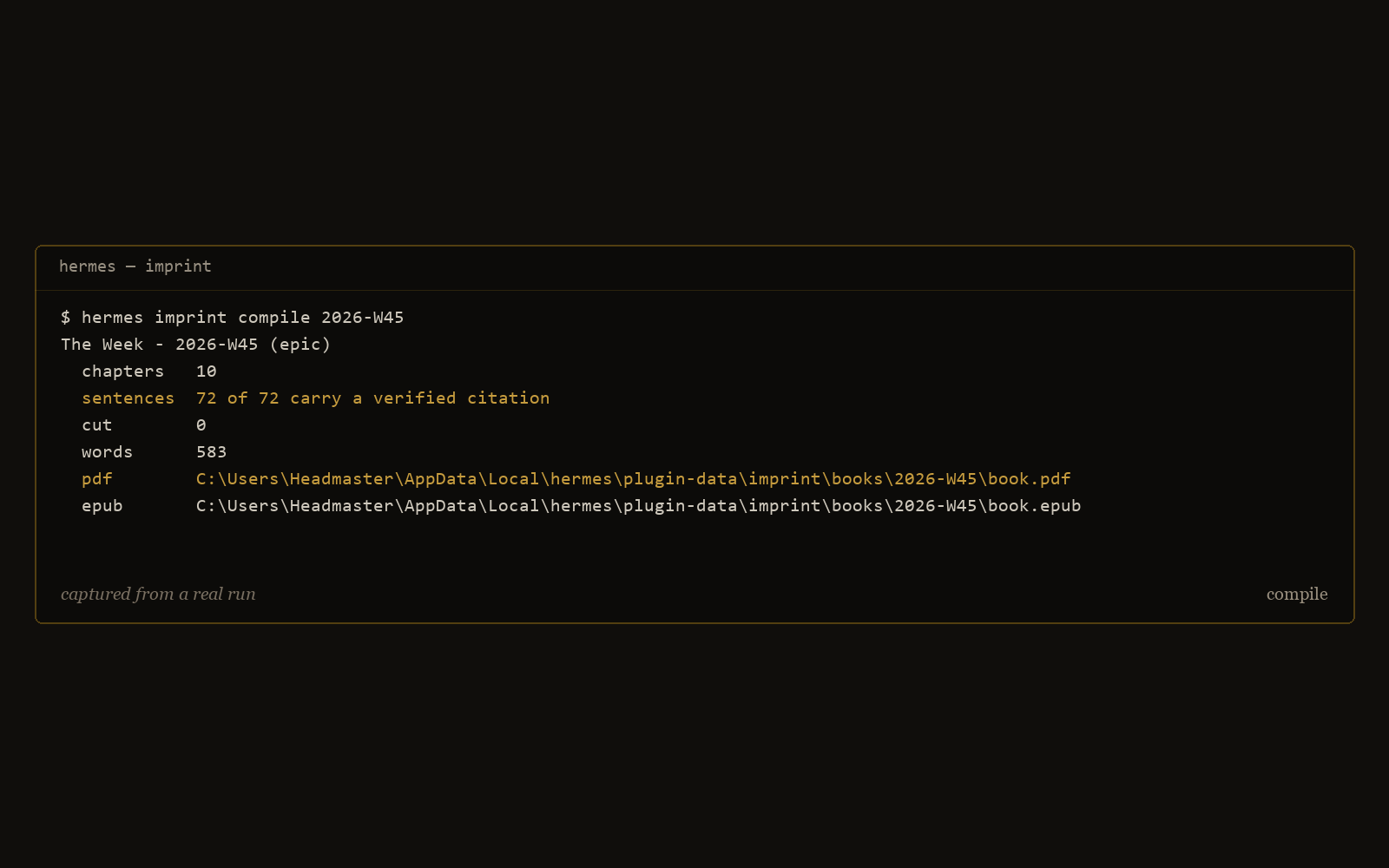
The compile gate, on a real run:
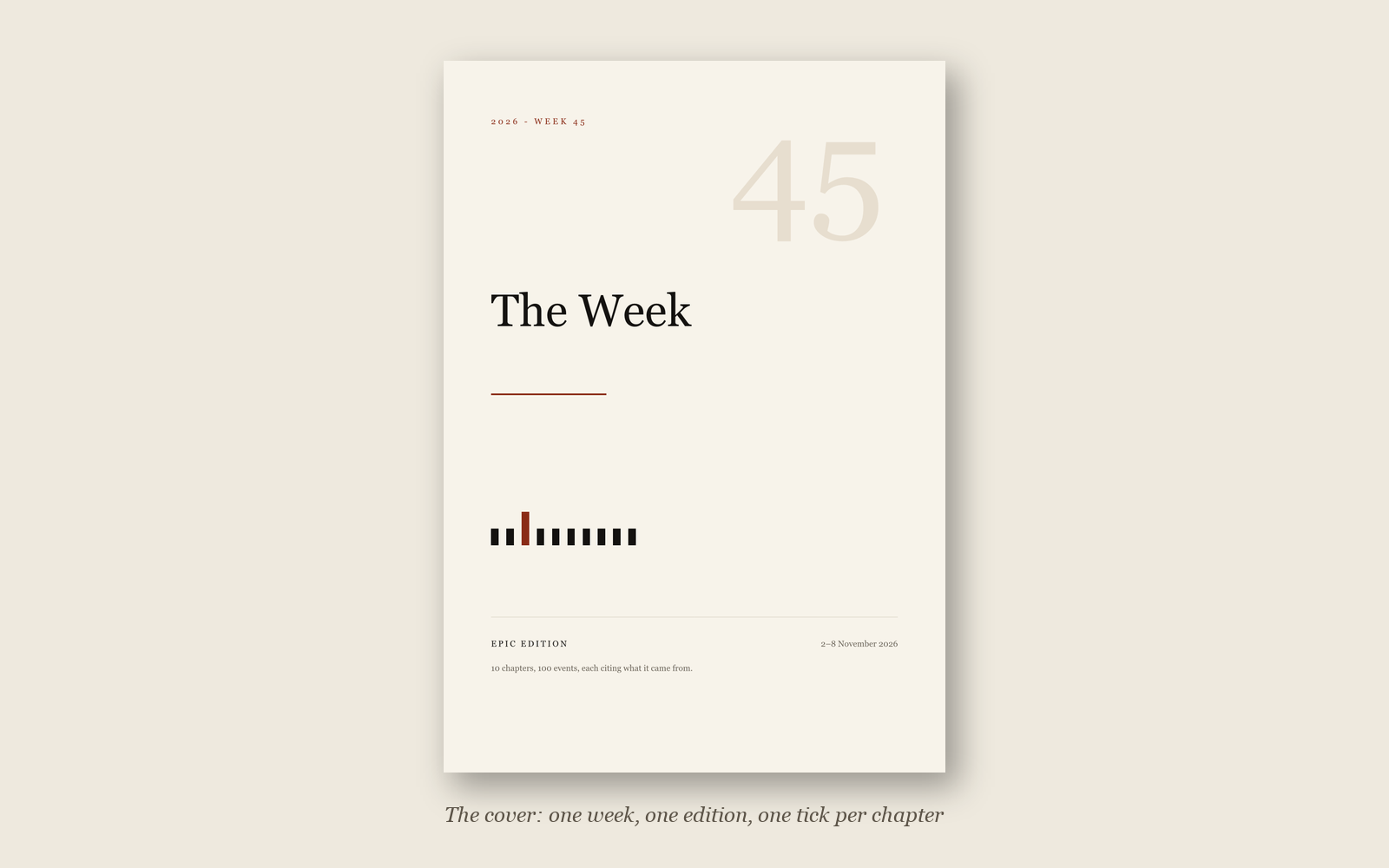
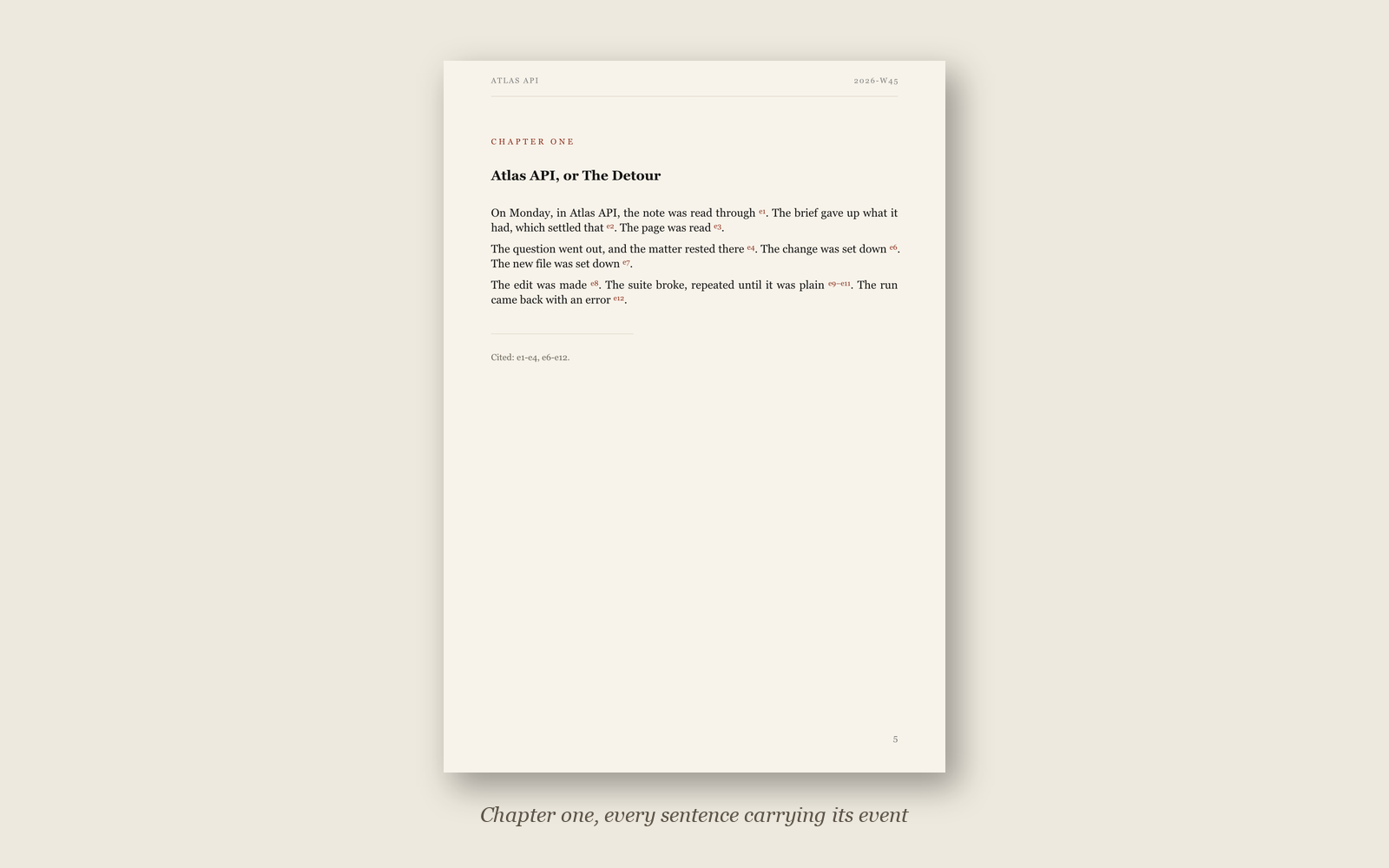
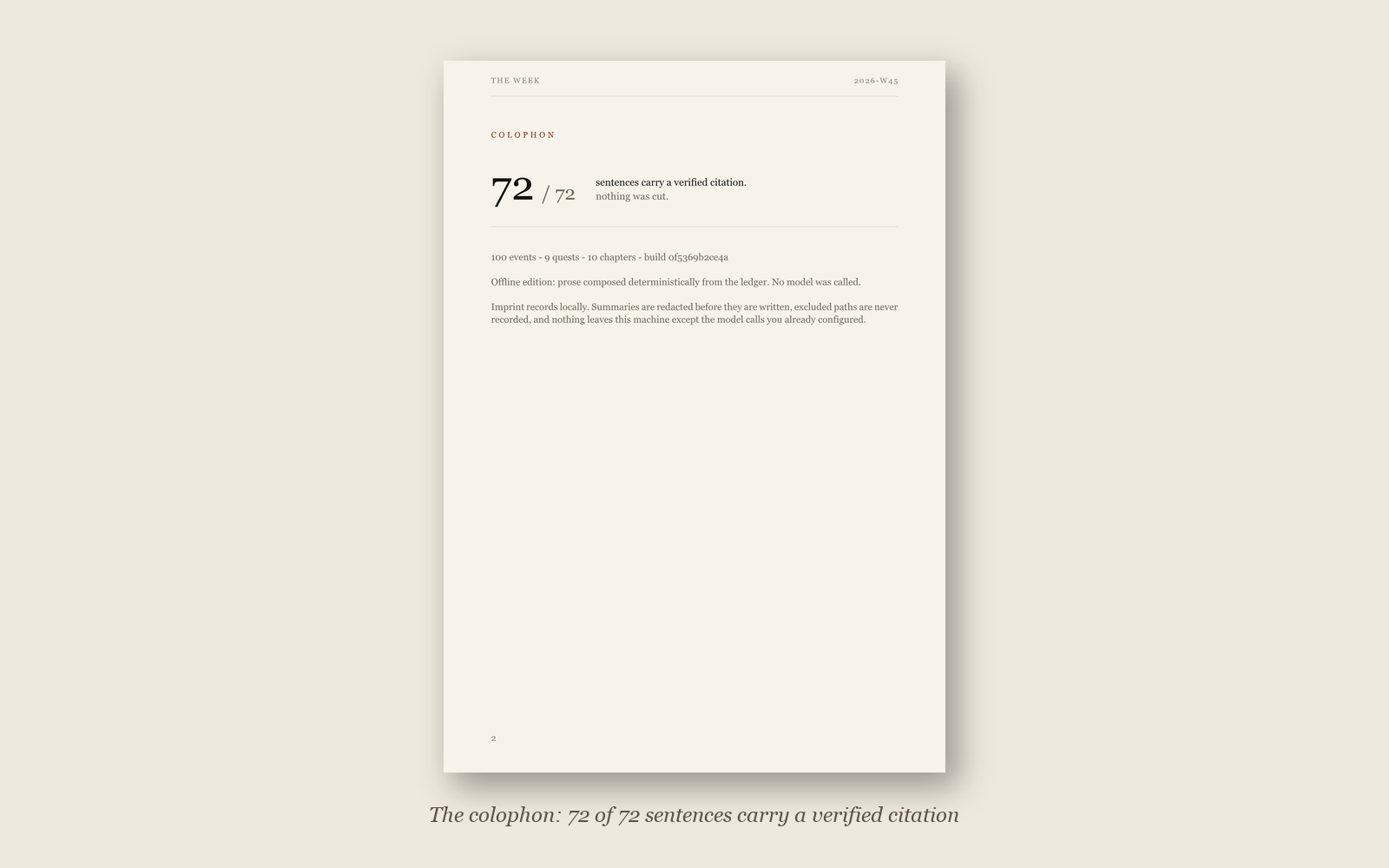
The book it writes. Cover, a chapter, and the colophon that prints the
verification ratio:
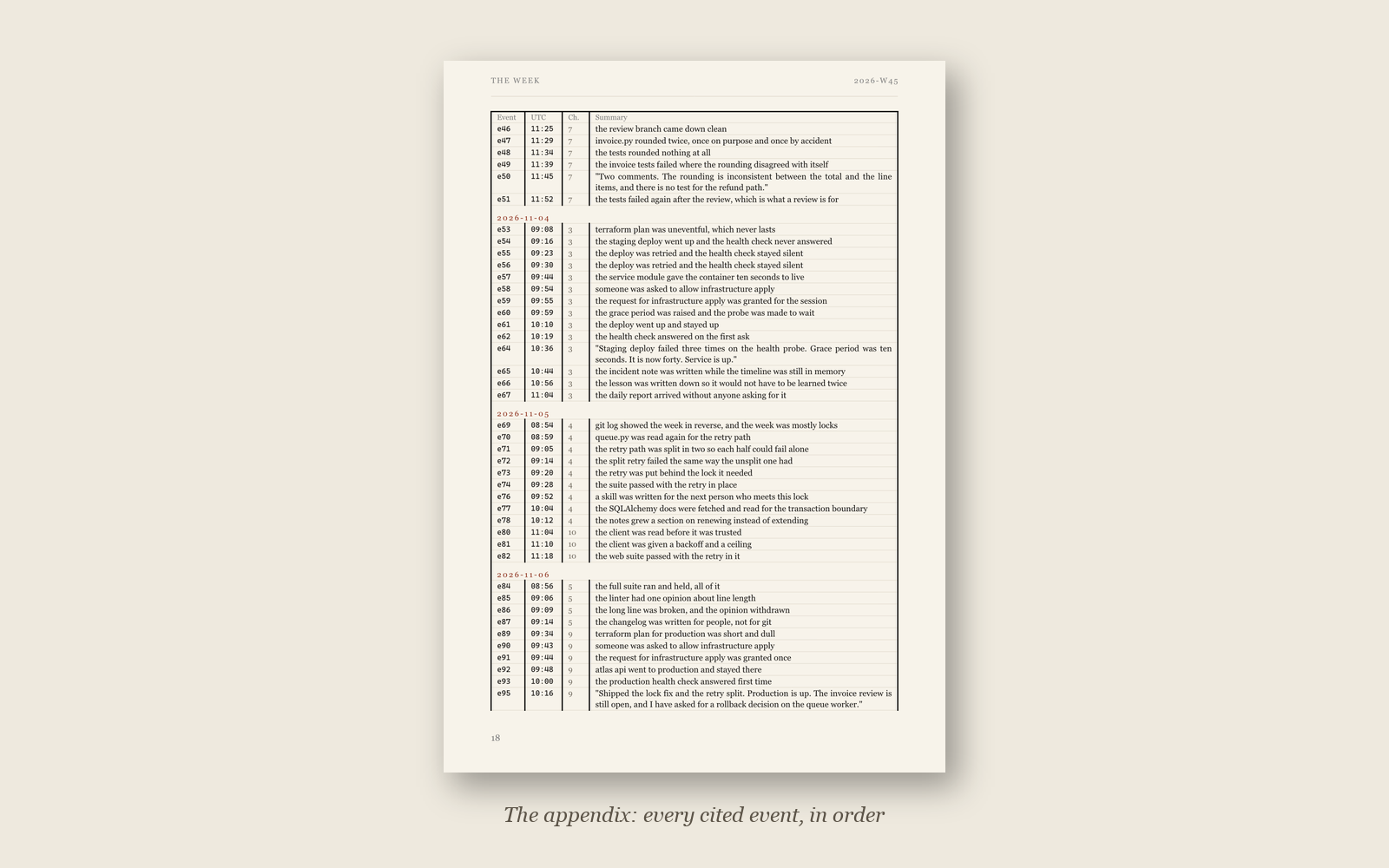
The one-page executive edition, and the appendix that lists every cited event
in order:
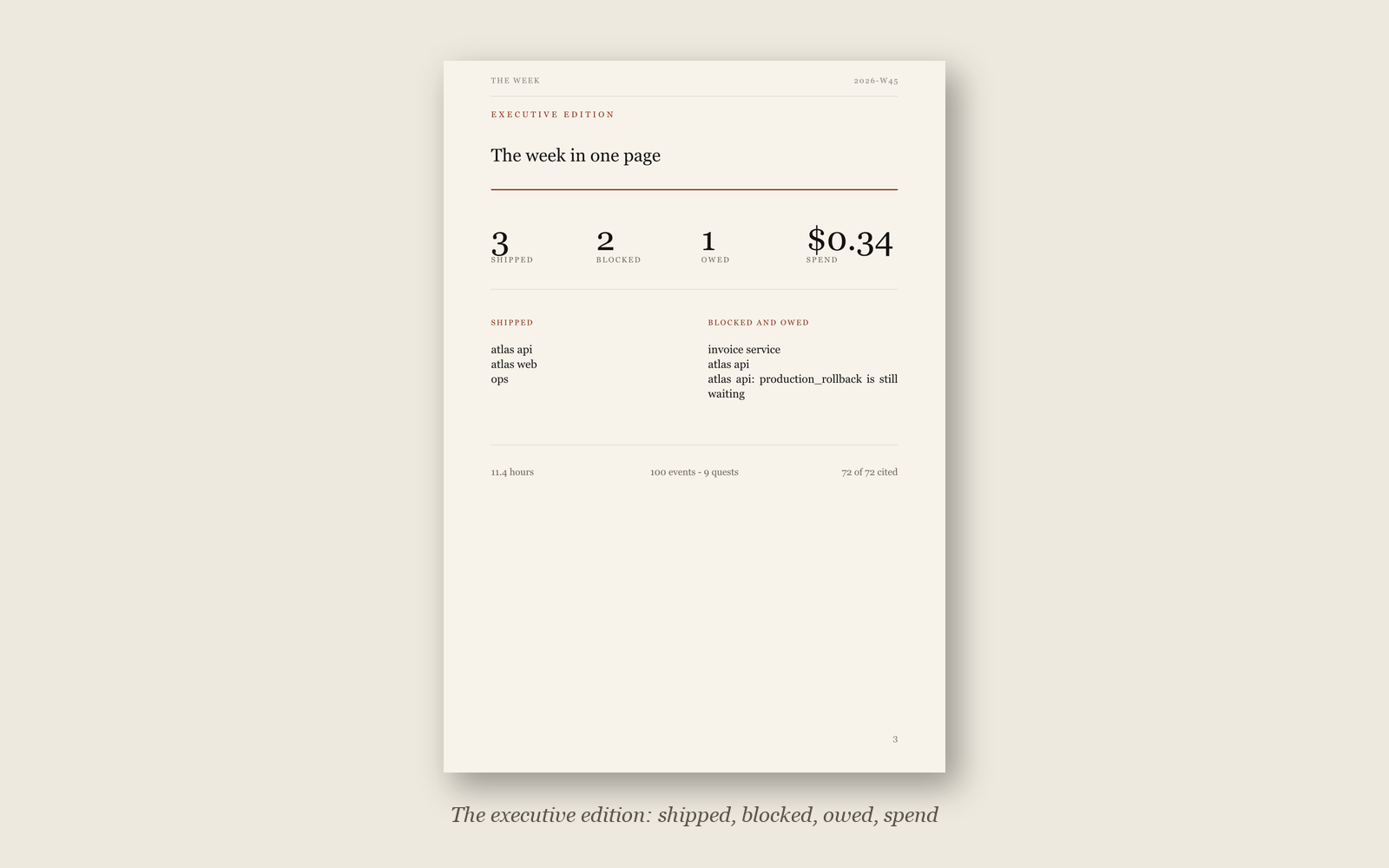
- An executive edition: shipped, blocked, owed, spend, hours. The Friday
status report that writes itself. - A Desktop library with a shelf, page-turn preview, genre switch, and a
status-bar chip. Plain ESM, SDK only.
The colophon prints the result honestly:
412 of 419 sentences carry a verified citation. 7 were cut.
Install
# from a checkout
hermes plugins install . --enable

# or from the catalog, once listed
hermes plugins install imprint
Then check it loaded:
hermes plugins doctor . --ci          # discovery, manifest, register(), registries
hermes plugins validate . --install-deps
Requires Hermes >=0.23.0. Python >=3.11.
For PDF output, install Typst and put it on PATH
(winget install Typst.Typst, brew install typst, or a pinned release from
the official GitHub releases page). Imprint does not download a binary.
Use
| Surface | Call |
|---|---|
| Tool | imprint_compile(week="2026-W45", genre="epic") |
| Tool | imprint_preview(book_id) - the executive page as text |
| Tool | imprint_status() - ledger size, weeks available, open threads |
| Tool | imprint_import(days=7) - read-only backfill from the session store |
| Slash | /imprint, /imprint 2026-W45, /imprint status, /imprint library, /imprint burn |
| CLI | hermes imprint burn 2026-W45 --yes - erase a week (deliberately not a model tool) |
| Desktop | Sidebar -> Imprint; palette -> Imprint: open the library |
Settings live under plugins.entries.imprint.settings: book_title, genre,
week_start_day, excluded_paths, retain_weeks.
excluded_paths is the privacy switch you will actually use. A path under an
excluded prefix produces no row at all - it is dropped before insert, not
hidden afterward. Matching is case-insensitive on normalised separators.
How the checking works
- Deterministic, always runs. Every cited id exists and belongs to the
chapter; every numeral in a sentence appears in a cited event; every
specific entity (path, file, repo, identifier) appears in a cited event; no
sentence without a citation. - Semantic, optional. A cheap model is asked, per sentence, whether its
evidence supports it:supports,partial,unrelated. - Disposition.
supportsis kept.partialgets one rewrite attempt and
is cut if that fails.unrelatedis cut. No sentence is quietly kept.
If the semantic pass is unavailable, the deterministic stage still runs and the
ratio printed is the lower, honest one.
Limitations
- A week needs events. A fresh install has an empty ledger. Come back after
a week, or useimprint_importto backfill from the session store. If the
store's shape is not recognised, Imprint refuses rather than guessing and the
book begins at install. - Prose is the only stochastic stage. It is gated, cached by event-set hash,
and never runs during capture. With no model configured, Imprint still
prints: the chapter is composed deterministically from the ledger, every
sentence still cites its event, and the colophon says which path produced the
book. It is plain on purpose; it is the honest floor, not the pitch. - The arc vocabulary is fixed: the breakthrough, the dead end, the rescue,
the detour, the hand-off. A chapter is never labelled with something invented
for it. - The importer is deliberately narrow. It reads a window, in read-only mode,
and refuses on an unexpected schema. - Desktop and agent halves are separate processes. The library page reads
the plugin's own backend at/api/plugins/imprint/; the Python backend is
mounted only when the plugin is inplugins.enabled. - v1 does not do audio narration, illustration beyond one procedural cover,
multi-user books, live streaming generation, or cloud sync. - Windows paths are normalised to forward slashes and compared
case-insensitively.
Development
python -m unittest discover -s tests -t .        # 56 tests, no model calls
python tools/seed_demo.py --genre noir            # compile the fixture week
The fixture week (tests/fixtures/week.json, generated by make_week.py)
contains one of each act break, so the tests assert behaviour rather than a
snapshot.
Layout:
plugin.yaml  __init__.py  schemas.py  tools.py  pipeline.py
capture.py   importer.py  arcs.py     cast.py   prose.py   canon.py
redact.py    db.py
typeset/     book.typ, render.py       # PDF via Typst, EPUB + HTML always
desktop/     plugin.js                 # the library, plain ESM
dashboard/   plugin_api.py             # shelf + executive backend
skills/imprint/SKILL.md
tests/       fixtures/week.json, test_arcs.py, test_canon.py,
             test_redact.py, test_typeset.py
Licence
MIT.
README from the reviewed commit f9b4bf9; it updates when the author re-pins.