 D0xedDevi0
hermes-neural-mesh
Long-term memory for Hermes that remembers when things were true.
A Hermes MemoryProvider backed by NEURAL_MESH —
a self-organizing memory engine with bi-temporal recall, supersession instead of overwrite,
and resonance + lexical retrieval over an auto-linking typed graph.
No API keys. No network. No compiled binary. The core is vendored as pure source, so the
plugin works offline on a fresh install and every line of it is reviewable.
mesh_asof("how often does the deploy key rotate?", as_of="2026-03-01")
→ "the deploy key rotates every 90 days"     # what we believed then

mesh_recall("how often does the deploy key rotate?")
→ "the deploy key rotates every 30 days"     # what is true now, the 90-day value superseded
That distinction is the whole point. A flat vector store overwrites the old value and then
cannot answer the first question at all.
Watch it
An 85-second walkthrough, rendered offline from real captured output —
docs/demo.mp4 (source ledger ·
proof):
- a real agent session stores a fact, then a cold process with its session history deleted
answers it from the store; - the same store returns the current value and the value that held in March 2026, correctly
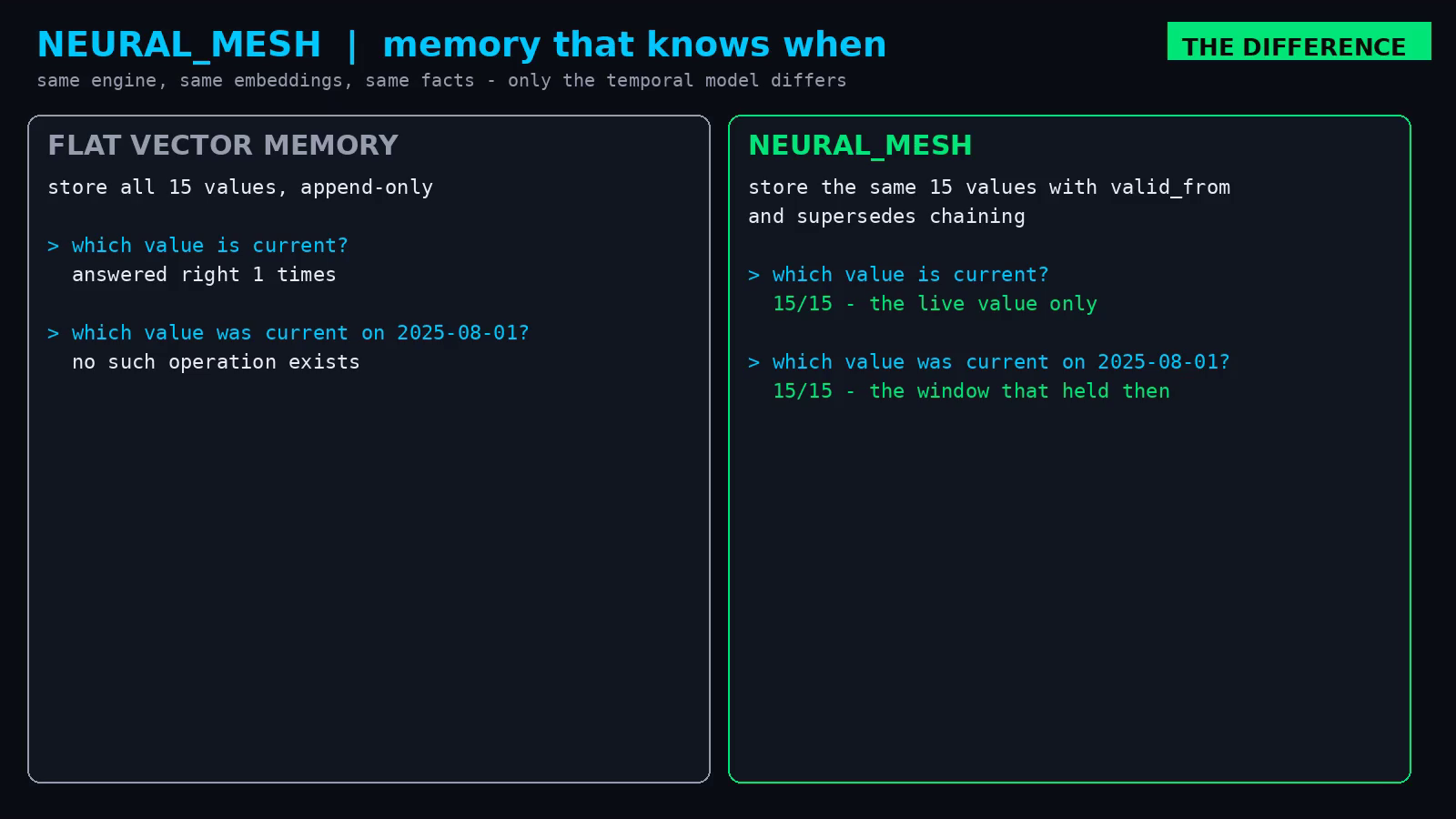
different; - the measured ablation — 15/15 against a flat store's 1/15.
Re-checked live on 2026-11-07 with the control the demo does not include: same profile and
binary, session history deleted, store present → the fact comes back; store removed → "I have no
vault code stored in memory". Commands and raw output:
docs/evidence/live-recheck-2026-11-07.txt.
Nothing in it is a screen recording: the frames are rendered from captured command output and
every line traces back to the ledger. scripts/demo_build.py capture re-runs the real
commands; render rebuilds the cut.
What it gives an agent
- Bi-temporal recall. Every memory carries
valid_from/valid_to, andmesh_asof
ranks only what was true at that moment. "What did we believe in March" is answerable. - Supersession, not deletion. A corrected fact is stored with
supersedes=<id>, so the
history survives and the correction is visible as a correction. - Hybrid retrieval. Dense + lexical fusion by default, so exact-keyword matches that
dense vectors miss are not lost. The upstream core reports hybrid beating dense,
resonance-only and lexical-only on MRR (0.260 vs 0.238 / 0.238 / 0.225) on its own
20-case LongMemEval retrieval experiment — that is the core's measurement, not ours. - Poisoning defence. Content is scanned before a node becomes retrievable; what the
validator flags is quarantined rather than recalled. - A precision floor, measured. See Measured behaviour.
Requirements
- Hermes Agent
>= 0.22.0(developed and verified against0.22.7) - Python 3.10+ (stdlib only)
- Nothing else. No API key, no network access, no build step.
Install
The plugin is a directory under your Hermes home. Clone it there and select it:
git clone https://github.com/D0xedDevi0/hermes-neural-mesh ~/.hermes/plugins/neural-mesh
hermes config set memory.provider neural-mesh
hermes memory status     # expect: Provider: neural-mesh / Plugin: installed ✓ / Status: available ✓
Long-lived sessions pick the provider up at startup, so restart the agent (or start a new
session) for the change to take effect. Your memory store is created on first use.
To go back:
hermes config set memory.provider yantrikdb # or whichever provider you used before
Tools
Four tools are registered with the agent:
| Tool | What it does |
| --- | --- |
| mesh_remember | Store a fact, with optional kind (semantic / episodic / procedural / working), valid_from, and supersedes |
| mesh_recall | Search memory for what is relevant to a query |
| mesh_asof | Point-in-time recall: what was true on a given date |
| mesh_stats | Size, lanes, retrieval backend, and the path of the store it is using |
Configuration
Settings live in <hermes_home>/neural-mesh/config.json and can be set through the host's
normal config surface:
recall_top_k(default5) — how many memories are offered as context per turn.store_turns(defaulttrue) — store substantive turns as episodic memory. Trivial
prompts (hi,thanks) and short turns are always skipped.inject_min_score(default0.25) — the precision floor for automatic injection.
The runtime passes recall_top_k through initialize() if you prefer to set it there; host
kwargs win over the saved file.
Where your memory lives
hermes -z "call mesh_stats and tell me the store path"
The store is a single SQLite file at <hermes_home>/neural-mesh/mesh.db, owned by you and
readable without the plugin. mesh_stats and backup_paths() both report it. Uninstalling
the plugin does not delete it; removing the file does.
This is a memory provider, so treat the store as sensitive. Everything the agent
decides to remember is written there in plain text, and anything in it gets recalled into
session context. It is not encrypted. If a secret should not persist, do not let it reach
memory — the scanning described above reduces accidental poisoning, it does not make the
store a secret store.
Measured behaviour
The precision floor
Automatic injection needs to be strict: a memory that is merely nearby pollutes every
turn. Measured with three memories stored and nine candidate floors
(scripts/calibrate_floor.py reproduces the table):
| query | no floor | ≥ 0.05 | 0.25 | 0.3 | 0.4 |
| --- | --- | --- | --- | --- | --- |
| relevant — deploy key rotation | 3 | 1 | 1 | 1 | 0 |
| relevant — the dog's name | 3 | 1 | 1 | 1 | 1 |
| relevant — hackathon deadline | 3 | 1 | 1 | 1 | 1 |
| unrelated — zzzz-nonexistent-topic | 3 | 0 | 0 | 0 | 0 |
| unrelated — quantum chromodynamics | 3 | 0 | 0 | 0 | 0 |
Unrelated queries returned every stored memory with no floor. A relative floor
(fraction of the top score) does not help here — it cannot trim a single candidate.
Absolute 0.25 sits inside the measured band where every relevant probe still hits and
unrelated ones return nothing, so automatic injection uses 0.25 and an explicit
mesh_recall uses 0.05.
What temporal structure buys
The ablation below runs through the shipped tools — mesh_remember, mesh_recall,
mesh_asof — over the same 15 fact families in both arms. A family is one attribute whose
value changes twice across 2025–2026, so the answer now differs from the answer in August
2025. The temporal arm stores valid_from and chains supersedes; the flat arm only
appends, which is what a flat vector memory does. Same engine, same embeddings, same facts, so
the difference is attributable to the temporal model.
| question | mesh (temporal) | flat vector |
| --- | --- | --- |
| which value is current? | 15/15 | 1/15 |
| which value was current on 2025-08-01? | 15/15 | 1/15 |
scripts/evidence_temporal.py reproduces this and writes docs/evidence/temporal-accuracy.json.
The first row is the one worth sitting with: a flat store asked "which value is current?"
answered correctly once in fifteen. All three values of a family are near-identical
sentences, so similarity has nothing to separate them with. The second row is not a fair fight
at all — a flat store has no point-in-time operation — and it is scored on its best available
move, ordinary similarity search.
Writing this section found a real bug. The core closes a superseded fact at the moment of
supersession: correct when a correction arrives in real time, wrong when history is
backfilled, because every past value then stays valid at every past date and a dated snapshot
returns all of them ranked by similarity. That measured 1/15. Handing the successor's
valid_from to the predecessor's valid_to is what moved it to 15/15, and
test_a_correction_supersedes_without_deleting_the_history locks it so it cannot regress.
Threading
Hermes calls a provider from several threads: initialize() on the startup thread, tool
calls on the executor thread, and sync_turn on a background daemon worker. A sqlite3
connection may only be used by the thread that created it, and the core owns its own
connection — so a single shared handle raises "SQLite objects created in a thread can only
be used in that same thread". In sync_turn that exception is swallowed by design, which
makes the failure look exactly like "memory silently didn't save". Each thread therefore
gets its own handle on the same file (_m()); the core commits per call, so writes are
immediately visible to the others. Regression tests cover it.
What this does not claim
- No token or cost savings are claimed. Injecting memories adds input tokens. What it
buys is recall, not thrift. - No benchmark leadership is claimed. The MRR figure above is the upstream core's own
experiment, quoted and attributed. This plugin has not been benchmarked against other
memory providers, and no comparison is asserted. - The Rust acceleration module is not shipped.
rust_mesh.sois a compiled extension and
catalog rule 17 forbids shipping binaries outside a CI build attestation. Retrieval runs on
the pure-Python path, which the core documents as the definition and the Rust functions as
the accelerated twins. The mesh reports its own backend:resonance_backend: python.
Disclosure
How it works, and what it touches:
- Runs in-process with the agent in pure Python. It reads no
.envfile, no
auth.json, no browser profile, no keychain, and no other tool's credential store — it
has no credentials at all. - Makes no network calls. There is no telemetry, no remote store, no sync.
- Spawns no child processes and no Hermes children.
- Writes only inside its own store directory under the Hermes home, plus the config file
named above. - On a completed turn it stores a redacted turn snippet, and it mirrors built-in
MEMORY.md/USER.mdwrites into the mesh. Destructive native writes (remove) are
deliberately not mirrored: without exact identity in the callback, mirroring a wrong
delete is worse than not mirroring one.
Development
python3 -m unittest discover -s tests -v     # 22 tests, offline, no credentials
python3 scripts/calibrate_floor.py           # reproduce the precision-floor table
The tests pass both against the real MemoryProvider ABC (PYTHONPATH=/opt/hermes) and on
a bare interpreter with no Hermes installed, because the plugin falls back to a local stub
of the ABC when the real one is not importable.
Provenance and licence
MIT. The vendored neural_mesh/ package is MIT, by the same author, pinned to upstream
commit fd7b35c7b5b9a61a8c7f4fbcebfdda25070a1d6e — see PROVENANCE.md for the
exact vendoring command, what was excluded, and why.
README from the reviewed commit 26abb61; it updates when the author re-pins.