
 Adolanium
hermes-plugin-openalex
OpenAlex tools for Hermes Agent. Look up works, authors, sources, and institutions. A session budget refuses a call before it is sent.
No API key required. Anonymous traffic gets $0.10/day. A free key gets $1.00/day. Identifier lookups and name resolution are $0 and still work when the daily budget is gone. The snapshot stays free. You pay OpenAlex only after the daily allowance, if you buy prepaid usage or a plan.
hermes plugins install Adolanium/hermes-plugin-openalex --enable
hermes plugins remove openalex
Install clones the plugin, optionally prompts for OPENALEX_API_KEY, writes it to ~/.hermes/.env, and enables it. Restart the gateway if one is running. Hermes registers the tools on every frontend that shares the tool registry (desktop, CLI, TUI, gateway, ACP, cron).
Demo
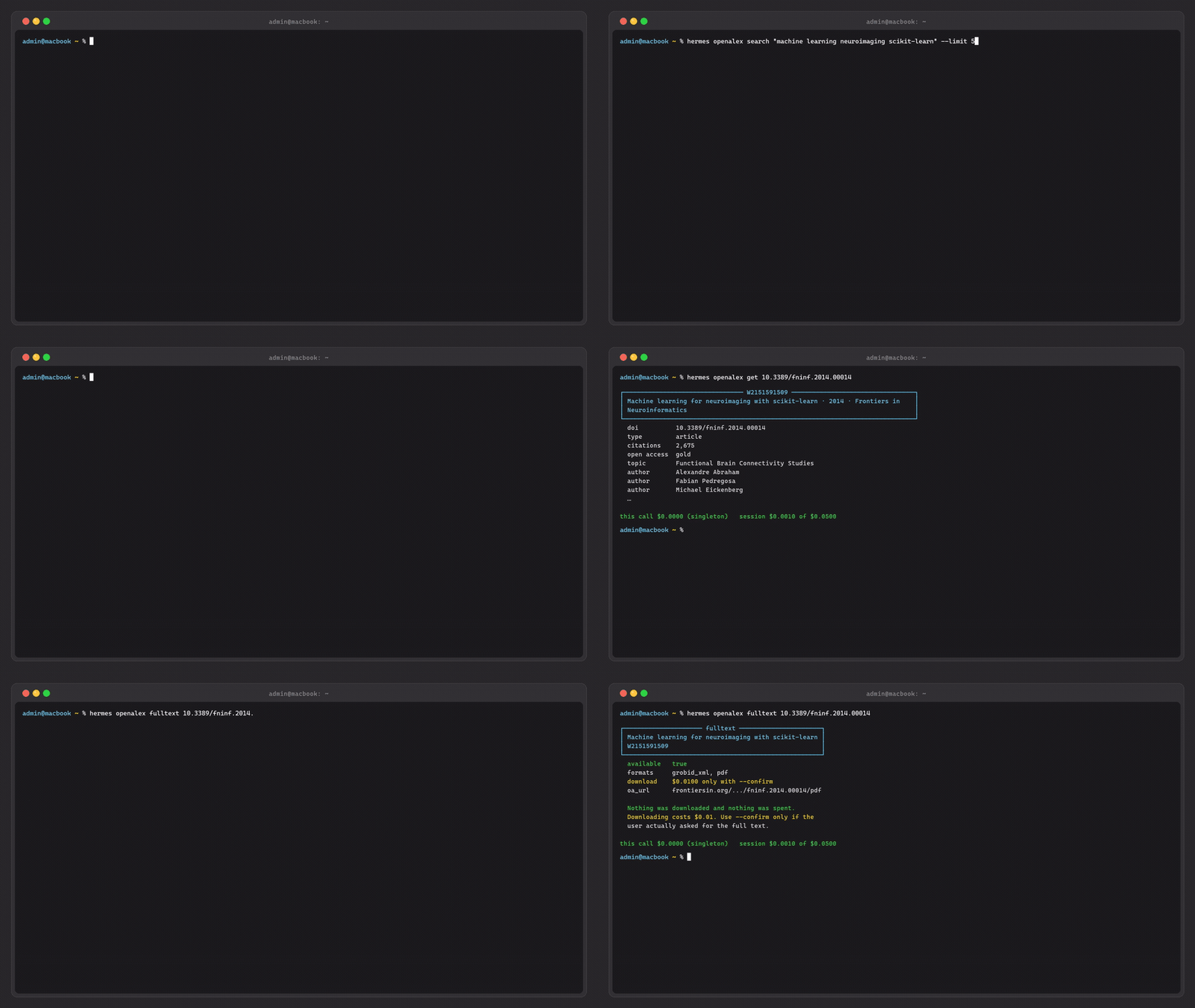
Search, get of metadata, then a fulltext probe that does not download. Hermes CLI.
Try it
Key optional. Free calls work without one.
hermes openalex search "machine learning neuroimaging scikit-learn" --limit 5
hermes openalex get 10.3389/fninf.2014.00014
hermes openalex fulltext 10.3389/fninf.2014.00014
# $0.01, downloads text:
# hermes openalex fulltext 10.3389/fninf.2014.00014 --confirm
hermes openalex doctor
Captured once. Index counts move.
| Call | What came back | Cost |
|---|---|---|
search … --limit 5 | 16 matches, 5 shown, top hit 2,675 cites | $0.001 |
get 10.3389/fninf.2014.00014 | metadata (title, year, venue, OA, authors) | $0 |
fulltext without --confirm | available true, formats grobid_xml + pdf | $0 |
fulltext --confirm | downloads text | $0.01 |
$ hermes openalex search "machine learning neuroimaging scikit-learn" --limit 5
16 matches, showing 5
  year    cites    title
  2014    2,675    Machine learning for neuroimaging with scikit-learn
  ...
this call $0.0010 (search)
$ hermes openalex fulltext 10.3389/fninf.2014.00014
┌───────────────────── fulltext ──────────────────────┐
│ Machine learning for neuroimaging with scikit-learn │
│ W2151591509                                         │
└─────────────────────────────────────────────────────┘
  available   true
  formats     grobid_xml, pdf
  download    $0.0100 only with --confirm

  Nothing was downloaded and nothing was spent.
this call $0.0000 (singleton)
get is a catalog record, not the PDF. fulltext without --confirm only asks whether OpenAlex holds the text. --confirm is the download.
Fulltext downloads accept only https://content.openalex.org and do not follow redirects. Downloads stop at 8 MiB, and gzip expansion stops at 32 MiB. Tool responses stay within max_result_chars, including truncation notices. A shortened response is incomplete; narrow the query or request fewer fields when needed.
OpenAlex prices (February 2026)
The API is usage-priced in dollars by call shape. OpenAlex announcement. Data snapshot remains free.
| Call | Price | Calls in a $0.10 anonymous day |
|---|---|---|
| Fetch by id, prefixed form | $0 | unlimited |
| Autocomplete | $0 | unlimited |
List, filter, or group_by | $0.0001 | 1,000 |
| Search | $0.001 | 100 |
| Text classification or fulltext download | $0.01 | 10 |
A query with group_by is billed as a list call even when a search term is present. That is OpenAlex's price table, not a plugin discount. count returns totals and groups. search returns records. They are different responses.
OpenAlex bills $0.0001 on a rejected 400. The plugin predicts cost from the call shape and refuses locally when the session budget would be exceeded, so that refusal is not sent and is not billed. A 400 that does go out is still billed.
Each request reserves its predicted cost before sending, so concurrent calls share the same remaining session budget. Every retry is checked separately. Response headers settle the charge; when a connection fails without a reported cost, the local ledger keeps the estimate because billing is unknown. A server charge above the estimate can still exceed the local limit.
OpenAlex returns 429 for both a short throttle and a spent daily budget. During a throttle, X-RateLimit-Remaining can be 0 while budget remains. Retry-After is the field that distinguishes them: about a second versus tens of thousands (until midnight UTC). The plugin retries the first and does not retry the second.
Captured at zero daily balance:
error_kind: budget_exhausted
http      : 429
details   : {"retry_after_seconds": 42549.0, "cost_required_usd": 0.0001}
next_step : The OpenAlex daily budget is spent and refills at midnight UTC.
            Do not retry this call. ID lookups (openalex_get) and name
            resolution (openalex_resolve) are free and still work...
In that state, openalex_get, openalex_resolve, and openalex_fields still returned data.
What get returns
openalex_get fetches metadata. Default verbosity is summary: id, title, year, venue, citation count, OA status, topic, and up to ten authors plus author_count. It does not include the abstract (detail does). It does not download the paper.
select only accepts top-level fields, so it cannot trim inside authorships. The plugin caps the author list after the response arrives. concepts is dropped (deprecated, replaced by topics). Abstracts arrive as an inverted index. The plugin reconstructs the sentence when reconstruct_abstracts is on.
Measured 2026-08-13 on doi:10.7717/peerj.4375 (W2741809807):
OpenAlex response body     31,468 characters
plugin summary record       1,855 characters
plugin detail record        (abstract + topics + keywords added)
An earlier capture of the same work was 33,475 / 1,921. The index moves.
A separate collaboration work was measured at 2.88 MB raw, 93% one author list.
Tools
One openalex toolset, free tools first.
core (default)
| Tool | Returns | Price |
|---|---|---|
openalex_resolve | Name to id, plus the filter key for the next call | $0 |
openalex_get | Metadata by OpenAlex id, DOI, ORCID, ROR, ISSN, or PMID. Up to 20 ids | $0 |
openalex_fulltext | Availability, or text if confirm is set | $0 probe / $0.01 download |
openalex_fields | Valid filter and select names, from disk | $0 |
openalex_account | Daily budget and session ledger | $0 |
openalex_count | Total, optional group_by breakdown | $0.0001 |
openalex_related | cited_by, references, or related works | $0.0001 |
openalex_search | Record list (per_page default 25, max 200) | $0.001 |
full (hermes openalex profile full)
| Tool | Returns |
|---|---|
openalex_harvest | Cursor pages up to max_records. Cost is estimated first and the call is refused if the session budget cannot cover it |
openalex_classify | Topics for arbitrary text. $0.01. Off until allow_text_classification: true |
openalex_classify is hidden by default. Ten calls spend a $0.10 anonymous day. If the work is already in OpenAlex, get already has topics.
Examples
Captured output.
Resolve
$ hermes openalex resolve "bengio" --entity authors
'bengio'  (free)
  id            name              type    works   hint
  A5086198262   Yoshua Bengio     author  1,290   Mila / Université de Montréal
  A5017529415   Samy Bengio       author  391
Filter on the id for an exact author. A name search also matches acknowledgements and reference strings.
Count
$ hermes openalex count --search "graph neural network" --group-by publication_year
887,992 works
publication_year
  value      count
  2025     134,581
  2024     134,292
  2023     129,716
  ...
this call $0.0001 (list)   session $0.0001 of $0.0500
That capture used OpenAlex's default (full-text) search. A later title_and_abstract run of the same string returned 101,610 works. count is $0.0001. search of the same string is $0.001 and returns a page of records (per_page, default 25).
get payload (summary)
{
  "ok": true,
  "record": {
    "id": "W2741809807",
    "doi": "10.7717/peerj.4375",
    "title": "The state of OA: a large-scale analysis of the prevalence and impact of Open Access articles",
    "year": 2018,
    "type": "article",
    "cited_by_count": 1241,
    "authors": [
      {"name": "Heather Piwowar", "id": "A5048491430", "institutions": ["Impactstory"]}
    ],
    "author_count": 9,
    "venue": "PeerJ",
    "open_access": "gold",
    "topic": "Scholarly Communication"
  },
  "cost": {"this_call_usd": 0.0, "price_class": "singleton", "spent_usd": 0.0}
}
The snippet above is shortened for the README. Live summary size for this work is in the table earlier.
Spent daily budget
{
  "ok": false,
  "error": "Insufficient budget. This request costs $0.0001 but you only have $0.0000 remaining.",
  "error_kind": "budget_exhausted",
  "http_status": 429,
  "details": {"retry_after_seconds": 42549.0, "cost_required_usd": 0.0001},
  "next_step": "The OpenAlex daily budget is spent and refills at midnight UTC. Do not retry this call. ID lookups (openalex_get) and name resolution (openalex_resolve) are free and still work at zero budget, so use those. A free API key raises the daily budget from $0.10 to $1.00."
}
Configuration
Under plugins.entries.openalex. Defaults work.
plugins:
  enabled: [openalex]
  entries:
    openalex:
      profile: core            # core | full
      verbosity: summary       # summary | detail | raw
      max_result_chars: 24000
      rate_limit_per_second: 8 # API ceiling is 10/s
      timeout_seconds: 30
      retries: 2
      reconstruct_abstracts: true

      cache:
        enabled: true
        ttl_seconds: 3600
        max_entries: 512

      budget:
        usd_per_session: 0.05          # 500 list/count calls, or 50 searches
        allow_text_classification: false

      tools:
        enabled: []
        disabled: []
OPENALEX_API_KEY is sent as a Bearer header. The documented query-parameter form is the fallback.
Terminal
hermes openalex doctor
hermes openalex prices
hermes openalex budget
hermes openalex resolve "eth zurich" --entity institutions
hermes openalex get 10.7717/peerj.4375
hermes openalex fulltext 10.3389/fninf.2014.00014
hermes openalex fulltext 10.3389/fninf.2014.00014 --confirm
hermes openalex count --filter 'is_oa:true,publication_year:2024' --group-by 'open_access.oa_status'
hermes openalex search "protein folding" --limit 10
hermes openalex profile full
hermes openalex cache stats
doctor checks the plugin is enabled, makes one free request so a missing key and a dead network stay distinguishable, prints the live budget and reset time, and refreshes prices from the account headers.
In conversation
/openalex W2741809807         fetch a work by id           $0
/openalex 10.7717/peerj.4375  fetch by DOI                 $0
/openalex bengio              resolve a name to an id      $0
/openalex budget              session spend and balance    $0
Slash only runs those free paths. Count and search go through the agent tools.
Skills
openalex:query-syntax— filters, grouping cap, identifier forms, prices. A rejected filter is still billed.openalex:lit-review— order of calls (anchor, size, shape, traverse, retrieve), plus citation-age bias, author merge errors, and coverage gaps.
Development
git clone https://github.com/Adolanium/hermes-plugin-openalex
cd hermes-plugin-openalex
pytest tests
104 tests. None call the API. Use pytest tests, not bare pytest: Hermes needs __init__.py at the plugin root, so pytest would otherwise import that file as a package. tests/pytest.ini pins rootdir.
tests/conftest.py loads the plugin the way hermes_cli/plugins.py does (hermes_plugins.openalex with a synthetic parent).
No extra pip dependencies. httpx, rich, and pyyaml already ship with Hermes.
The HTTP client is a thin httpx layer so X-RateLimit-* headers stay available. pyalex drops the response object after parse, and retries every 429, including a spent daily budget.
Known limits
Semantic search currently returns HTTP 500, so it is not exposed. The n-grams endpoint was removed and now returns the plain work object with no error. Above a few hundred thousand records the free snapshot at s3://openalex is cheaper and faster than paging the API.
License
MIT. See LICENSE.
README from the reviewed commit d38a1ee; it updates when the author re-pins.