 ilPez00
hermes-physis
https://github.com/ilPez00/hermes-physis · install · benchmark
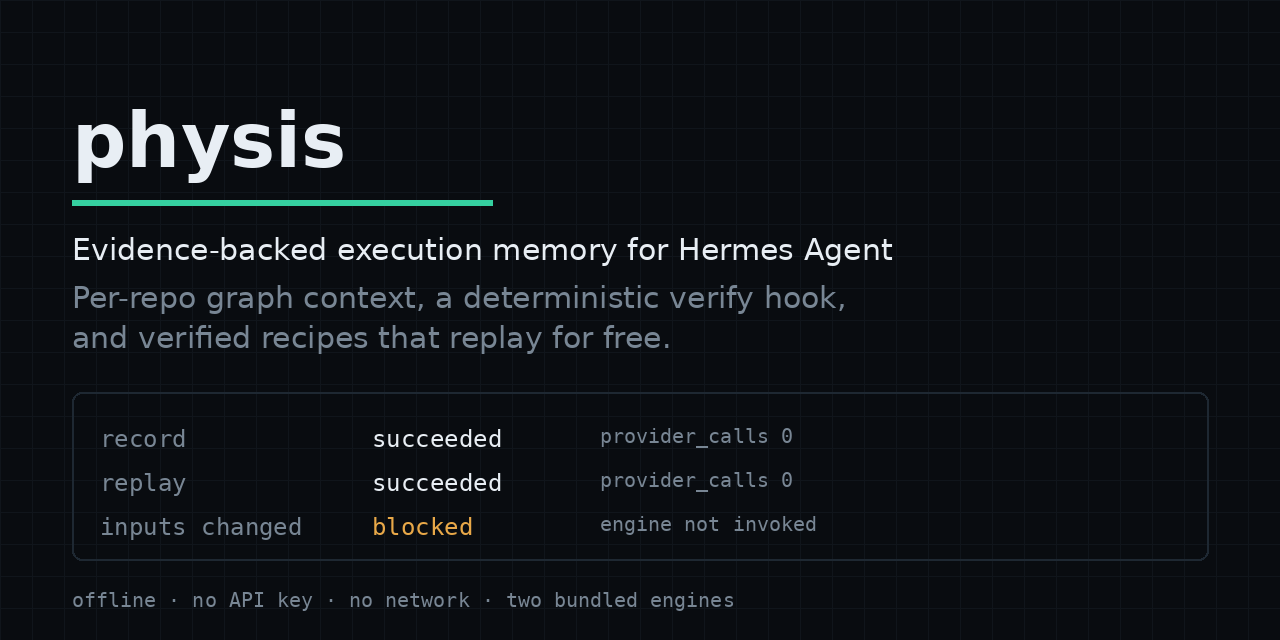
Evidence-backed execution memory for Hermes Agent, with both engines bundled.
No API key. Python stdlib is required when running Python entry points.
Physis answers four questions a model normally guesses at, and then remembers
the answer as a verified procedure:
- What is in this repo? -
physis_observeindexes it into a coherence graph. - What is relevant to this task? -
physis_contextpacks the best nodes
into a fixed token budget. - Where is it? -
physis_queryreturns scored file/snippet matches. - Did the change move the way it was asked to? -
physis_diffruns the
engine'sdirectioncheck: before/after plus the null of doing nothing.
Plus replant: record a verified tool recipe once, then re-execute the real
actions and checks on later identical requests. The model is not called again;
cached successes are never returned. Changes to captured edited files block
replay, but untracked dependencies are not checked. replant_demo exercises a
separate counter fixture; /physis replay <prompt> repeats an approved recipe
without a model turn.
physis_chain runs the engine's whole pass - structure, gaps, drift and the
label-permuted control - when a task needs an overview rather than one query.
What is bundled
| Engine | Version | License | Role |
|---|---:|---|---|
| bin/physis-core | 0.2.0 | Apache-2.0 | scan, search, node-search, context, classify, grid, snapshot |
| bin/replant | 0.3.0 | Apache-2.0 | verified tool-recipe replay |
| vendor/physis-core | 0.2.0 | Apache-2.0 | full source snapshot used to build the binary |
| vendor/physis-replant | 0.3.0 | Apache-2.0 | full source snapshot used to build the binary |
The binaries are Linux x86_64 and are used by default. PHYSIS_BIN or the
engine_bin setting overrides discovery; a comma-separated list is accepted.
models/bge-small/ ships the MIT bge-small-en-v1.5 uint8 ONNX export, so
semantic embeddings are on without a model download.
Install
hermes plugins install /path/to/hermes-physis
hermes plugins enable physis
Verify:
hermes plugins list | grep physis
In a session, ask for physis_engine_status; it should list two engines and
the graph node count.
60-second demo: one task, evidence and a repeat
Task: add token rotation to auth. Baseline without the plugin: grep, open three
files, paste ~1200 tokens into context, then guess whether the change helped.
# Index once.
physis_observe(path="/path/to/repo")          # 62 files -> coherence graph

# Ask, with a budget. Returns the relevant functions plus the evidence trail.
physis_context(task="add token rotation", budget=300, mode="code")
# -> 3 nodes, 176 tokens (4.5x compression vs. ~800 tokens of raw hits)
#    evidence: physis_why("rotate_token") lists the nodes and coherence score

# Make the change, then check direction against the do-nothing baseline.
physis_diff(before="auth.py@before", after="auth.py@after", ask="shorter, safer")
# -> moved: true, retention 0.7

# Repeat the verified deploy with no model call.
replant_demo()   # record once, replay twice, provider_calls = 0

# Operator replays an approved candidate, with no provider call:
# /physis replay deploy api
# After a fingerprinted input changes, the same command refuses replay.
The plugin is not a collection of tools: it is the path from "what is in this
repo" to "did the change move as asked" to "run that again for free" to "do not
run that again, the world changed".
Tools
physis-core
| Tool | Engine command | Use it for |
|---|---|---|
| physis_engine_status | - | versions, capabilities, store path, node count |
| physis_observe | scan <dir> | index a repo (run first) |
| physis_snapshot | snapshot | graph health: nodes, coherence index, high/mid/low |
| physis_context | context (docs) / node-search (code) | fixed-token packet + compression stats |
| physis_query | search | similarity search over indexed nodes |
| physis_why | node-search | evidence/coherence around a named object |
| physis_classify | classify | adaptive-grid cells for text or a file |
| physis_grid | grid | axes, shape, populated cells, active embedder |
| physis_ingest | watch | append observations; fs/git by default, terminal/agent/process/browser opt-in |
| physis_observed | observed | read the observation log with sources and timestamps; disabled sensitive buckets are filtered out |
| physis_diff | direction | did the change move as asked, versus the null |
| physis_chain | chain | one pass: structure, gaps, drift, control |
replant
| Tool | Engine command | Use it for |
|---|---|---|
| /physis replay <prompt> | run | operator-triggered replay of an exact request, or return blocked |
| replant_stats | stats | records, replays, misses, blocks, replay share |
| replant_show | show | inspect a learned record |
| replant_demo | record + run + stats | zero-config proof, bundled counter fixture |
| physis_candidates | - | workflows learned from verified sessions, awaiting approval |
Learned workflows (opt-in)
With auto_learn: true and verify_cmd set, a session that passes its check is
turned into a candidate: the request it answered (pre_llm_call), the exact
foreground terminal commands, the files it edited, and the check that passed.
Candidates are stored in the plugin's own profile directory
(~/.hermes/plugin-data/physis/replant/candidates/, or
$PHYSIS_REPLANT_STORE/candidates when the operator relocates it) and nothing
replays until an operator approves one by id.
Approval executes the steps and the check through replant (provider_calls: 0),
which is what makes them replayable later.
/physis candidates                # full content-bound id, request, steps, files, check
/physis approve <full-candidate-id> # re-run checks and record it
/physis replay say hi             # operation: replay, provider_calls: 0
The generated registry names only stepN / verify and runs a fixed Python
wrapper. verify_cmd and approved commands still
run with the configured user's filesystem and network access; this is not a
sandbox or deterministic execution environment.
Command
/physis status (engines + graph), /physis recipes (receipt stats),
/physis candidates (learned, unapproved work), /physis replay <prompt>
(repeat a recorded recipe with no model call), /physis approve <id> (record a
candidate).
Replant state is never taken from a repository path or a model argument. The
registry is the operator's replant_tools setting, or
~/.hermes/plugin-data/physis/replant/learned/tools.json after /physis approve. approve is not
a registered tool. Both approval and replay require the operator's slash
command; neither is model-callable. The model may have write access as the same
OS user; that user can modify the registry and approval manifest together, so
an on-disk checksum is not authentication. Private file permissions alone do
not establish an approval boundary.
This is not a sandbox against a compromised local user or tampered plugin files.
Only recorded edited files are fingerprinted; other dependencies must be
independently reviewed. Missing or invalid freshness evidence blocks replay.
Hooks
post_tool_call- withauto_observe: true, re-indexes the edited folder;
withauto_learn: true, records replayable steps (errors are skipped).pre_verify- withverify_cmdset, runs that command after code edits; a
non-zero exit keeps the turn going with the real failure tail, so a
deterministic check decides whether the work is done. A passing run is what
creates a candidate.pre_llm_call- withauto_learn: true, remembers the user request so a
candidate knows which prompt it answers.
Configuration
plugins.entries.physis.settings:
| Key | Default | Meaning |
|---|---|---|
| engine_bin | "" | override engine path(s); empty = bundled |
| model_dir | "" | ONNX embedding model directory; empty = bundled BGE-small |
| semantic | true | use the semantic embedder; false = deterministic hashing (reproducible, not semantic) |
| auto_observe | false | after write/patch, re-index (scan) the edited folder |
| verify_cmd | "" | command run by the pre_verify hook after edits; non-zero keeps the turn going |
| auto_learn | false | after verify_cmd passes, save the session as an approvable workflow candidate |
| ingest_sources | ["fs", "git"] | observation sources physis_ingest may read; terminal (shell history), agent (~/.claude/projects transcripts), process (/proc/<pid>/cmdline) and browser (history database) are sensitive and refused unless listed |
| replant_tools | "" | operator-owned tools registry for replay/record; empty = ~/.hermes/plugin-data/physis/replant/learned/tools.json after /physis approve |
| budget | 800 | default physis_context token budget (100-4000) |
| timeout | 20 | per-subprocess timeout (seconds) |
Sensitive ingestion sources
physis_ingest can read four sources that carry data the user did not
explicitly hand to the tool:
| Source | What it reads |
|---|---|
| terminal | the user's shell history (~/.zsh_history or ~/.bash_history) |
| agent | another coding agent's session transcripts under ~/.claude/projects |
| process | every process's command line from /proc/<pid>/cmdline |
| browser | the browser history database (Chromium/Chrome History, Firefox places.sqlite) |
They are disabled by default. physis_ingest refuses them — before any
engine runs — unless the operator lists them in
plugins.entries.physis.settings.ingest_sources:
plugins:
  entries:
    physis:
      settings:
        ingest_sources: [fs, git, terminal]
physis_observed refuses a disabled source by name and filters disabled
buckets out of an unfiltered read, so a sensitive observation recorded before
the gate cannot be read back through it either.
Environment variables
All settings above can also be driven (or overridden) through environment
variables. These are read by the engine directly and work without Hermes config.
| Variable | Default | Effect |
|---|---|---|
| PHYSIS_BIN | (bundled) | override engine path(s); comma-separated list accepted |
| PHYSIS_MODEL_DIR | (bundled BGE-small) | ONNX embedding model directory |
| PHYSIS_MODEL_DIM | 384 | embedding dimension; must match PHYSIS_MODEL_DIR |
| PHYSIS_SEMANTIC | 1 | 0/false/no/off disables the semantic embedder (deterministic hashing instead) |
| PHYSIS_CACHE_DIR | (bundled cache) | ontology-embedding cache directory (~3.5 MB, ~0.2 s first call) |
| PHYSIS_CORE_DIR | per-repo hash | graph store location; set explicitly for one shared store |
| PHYSIS_AUTO_EXPAND | 1 | 0 disables learning a new ontology entry on uncertain classifications |
| PHYSIS_ONTOLOGY_DIR / PHYSIS_ONTOLOGY_FILES | (bundled) | add axes or entries at runtime |
| PHYSIS_REPLANT_STORE | ~/.hermes/plugin-data/physis/replant | operator relocation of replant state (recipes, candidates, registries); never settable through a tool argument |
| PHYSIS_NO_... | - | see --no-expand flag on physis_classify |
Turning semantics off
Set semantic: false in plugins.entries.physis.settings, or PHYSIS_SEMANTIC=0 in
the environment. The engine falls back to deterministic hashing: reproducible and
offline, but not semantic. Useful for reproducible CI or to drop the embedder
dependency entirely.
Swapping the embedder
- Place an ONNX embedding model (
model.onnx+tokenizer.json) in a directory. - Set
model_dirto that directory (orPHYSIS_MODEL_DIR). - Set
PHYSIS_MODEL_DIMto the model's output dimension (e.g.768for BGE-base). - Restart the session.
physis_gridreports the active embedder.
The model must use the same loader as the bundled BGE-small (CLS pooling, uint8
or float). Heavier models trade bundle size and first-call latency for accuracy;
the default keeps the bundled model available without a download.
Measured
Classification on two fixtures, reproducible with the bundled binary:
PHYSIS_CORE_DIR=/tmp/physis-bench ./bin/physis-core \
  bench-semiotic benchmarks/semiotic_cases.json
| Fixture | Cases | top-1 cell | top-3 cell | domain | mode |
|---|---|---|---|---|---|
| calibration | 55 | 60.0% | 76.4% | 67.3% | 72.7% |
| validation (authored after tuning) | 30 | 26.7% | 56.7% | 63.3% | 46.7% |
With 160 cells the random baselines are 0.6% (top-1), 1.9% (top-3),
12.5% (domain) and 5.0% (mode). The gap between the two fixtures is the
honest limit: the grid is a coarse lens, not an oracle. On unfamiliar phrasing
prefer the top-3 cells plus the best_domain / best_mode axes, and let
auto-expansion record what the ontology missed.
Context and replay are measured separately: 62 Rust files compress to 176
tokens at a 300-token budget; a recorded replant recipe replays with
provider_calls=0.
Verified loop, measured on the bundled fixtures (real binaries, temp store):
| Step | Command | Result |
|---|---|---|
| approve learned candidate with fingerprinted input | /physis approve <id> | status: succeeded, provider_calls: 0 |
| replay unchanged inputs | /physis replay <prompt> | operation: replay, provider_calls: 0 |
| replay after editing input.txt | /physis replay <prompt> | blocked: true, changed: ["input.txt"], engine never invoked |
| per-repo isolation | physis_observe on A, then physis_snapshot on B | A nodes: 1, B nodes: 0 |
| learn a verified session | pre_verify passing with auto_learn: true | 1 candidate, 0 replays |
| approve it | /physis approve <id> | status: succeeded, provider_calls: 0 |
| replay it | /physis replay <prompt> | operation: replay, provider_calls: 0 |
Honest limits
- The bundled embedder is semantic (BGE-small uint8, 384d, CLS pooling) and on by default.
The ontology-embedding cache ships warm (models/cache, ~3.5 MB), so the
first call is ~0.2 s instead of ~6 s;PHYSIS_CACHE_DIRoverrides it. - The grid is adaptive: it is whatever the loaded ontologies define. The
bundle ships 8 domains x 20 modes, all 160 cells populated (896 entries),
including agentic (GOVERN, DELEGATE, REFLECT, VERIFY, INFER) and
agent/world packs derived from physis-next's entity kinds. - Auto-expansion: when a classification is a tie (margin < 0.02), the
engine adds one learned entry to the top domain's INFER cell and persists it
tocustom_ontology.json; the entry count grows on the next call.
--no-expandorPHYSIS_AUTO_EXPAND=0disables it. Near duplicates
(Jaccard >= 0.6) are refused, the store is capped at 500 learned entries,
and texts under 20 chars are ignored. - Add axes or entries at runtime with
PHYSIS_ONTOLOGY_DIR/
PHYSIS_ONTOLOGY_FILES; the grid, cache config and classifier pick them up. physis_contextdefaults tomode=code(the scanned graph).mode=docs
runs the compiler, which now ingests any text file (source included),
skips binaries and build dirs, and chunks documents so a file larger than
the budget can still contribute.- The index is per repository: the graph store is derived from the resolved
path, so scanning two repos keeps their nodes apart.PHYSIS_CORE_DIRstill
overrides it with one explicit store (the pre-1.5 behaviour). Queries can no
longer surface nodes from an unrelated project. - Auto-indexing is bounded:
physis_contextrefuses to scan a corpus over
~1500 files and the docs compiler refuses over ~5000; pass a narrower path. - Replay freshness covers only captured edited files up to 1 MiB each. The
capture can be empty, and it is not a check of all inputs or a whole tree.
A changed or missing captured file blocks replay; this does not replace
replant's own fingerprint of the tool implementation. pre_verifyruns one command, once per turn (attempt> 0 is a no-op), with
the working directory of the first changed file.- Learning is opt-in and advisory: only foreground
terminalcommands
(≤2000 chars) and the edited files are kept, up to 12 steps and 16 files per
session, 32 sessions in memory. A candidate is written only when both an
intent (pre_llm_call) and a passing check exist. Nothing learned replays
until an operator approves it by id; approval re-runs the steps and the check
against the current tree, so a stale candidate fails at approval, not later. physis_whyis evidence retrieval, not a causal-chain generator. If the
label is absent, that is missing evidence, not a verdict.- replant is deliberately narrow: exact request match, registered tools only.
A miss is the correct answer when the request differs.
Development
python3.13 -m pytest          # requires pytest and PyYAML
scripts/build-engines.sh      # rebuild both binaries from vendor/ (needs Rust 1.89+)
On 2026-11-10, 84 plugin tests passed locally. The local plugin validator
reported dependency preparation failed because local Hermes 0.22.7 is below
the required 0.23.0, although its static probe passed.
The integration tests are the regression net for the original packaging bug:
unit tests with fake engines passed while the shipped binary advertised a
different command vocabulary. tests/test_integration.py runs the real
binaries in an isolated PHYSIS_CORE_DIR.
Layout
__init__.py          register(ctx): tools, hook, skill
tools.py             handlers + register_tools(ctx) + post_tool_call hook
schemas.py           tool schemas (descriptions are operating instructions)
engine.py            discovery, capability probing, subprocess execution
bin/                 bundled binaries + SHA256SUMS
vendor/              source snapshots for both engines
examples/            zero-config replant fixture
skills/physis/       the skill Hermes loads with the plugin
tests/               unit + integration
Troubleshooting
- Installer flags the bundle. Hermes scans third-party plugins. The two
Linux binaries are the only opaque files. Review the bundle, then re-run with
--forceif your installer asks. No recalled nodes. The index is empty for that store; run
physis_observefirst, or checkPHYSIS_CORE_DIR.physis_contextsays "no corpus documents". It compiles markdown/text
documents; pointpathat a directory that contains them.- Everything looks lexical. The bundled embedder is BGE-small-en-v1.5 (ONNX,
384d, CLS pooling). If you overridemodel_dir, point it at a directory
containingmodel.onnxandtokenizer.json; an empty or wrong directory
falls back to deterministic hashing, which is reproducible but not semantic.
Publishing
The plugin is published at https://github.com/ilPez00/hermes-physis
(release v1.6.0). The bundled engines are built by GitHub Actions and carry
SLSA build provenance attestations. Catalog submission is in progress; the
pinned commit must be one whose binaries verify with gh attestation verify.
To ship a new version:
scripts/publish.sh # bumps nothing by itself; review, tag, push
Then open a SHA-bump PR against NousResearch/hermes-agent updating
plugin-catalog/physis.yaml. Review the tree first: git status,
bin/SHA256SUMS, THIRD_PARTY_NOTICES.md.
License
Plugin: MIT. Bundled engines: Apache-2.0 (their LICENSE/NOTICE files are
preserved in vendor/). See THIRD_PARTY_NOTICES.md.
README from the reviewed commit 330e795; it updates when the author re-pins.