LangerSword
Pilot
A real TTY for Hermes.
Hermes's terminal tool runs one command through a pipe. Programs that ask a question, draw a full screen,
or wait for a keystroke die there: ssh logins, vim, htop, fzf, less, installers, gh auth login,
REPLs. The usual workarounds are -y flags, yes |, expect, script -qec, or giving up.
Pilot gives the agent a real terminal: a private tmux server, one session per task. It opens a program,
reads the screen as text, types literal text and named keys, waits for a pattern, and keeps the session
alive across tool calls. You can attach to the same pane and take over at any time.
demo: video ·
site: langersword.github.io/hermes-portal ·
catalog: PR #153787
If this is useful, a star helps the next person find it.
| the plugin, recorded | the page, hosted |
|---|---|
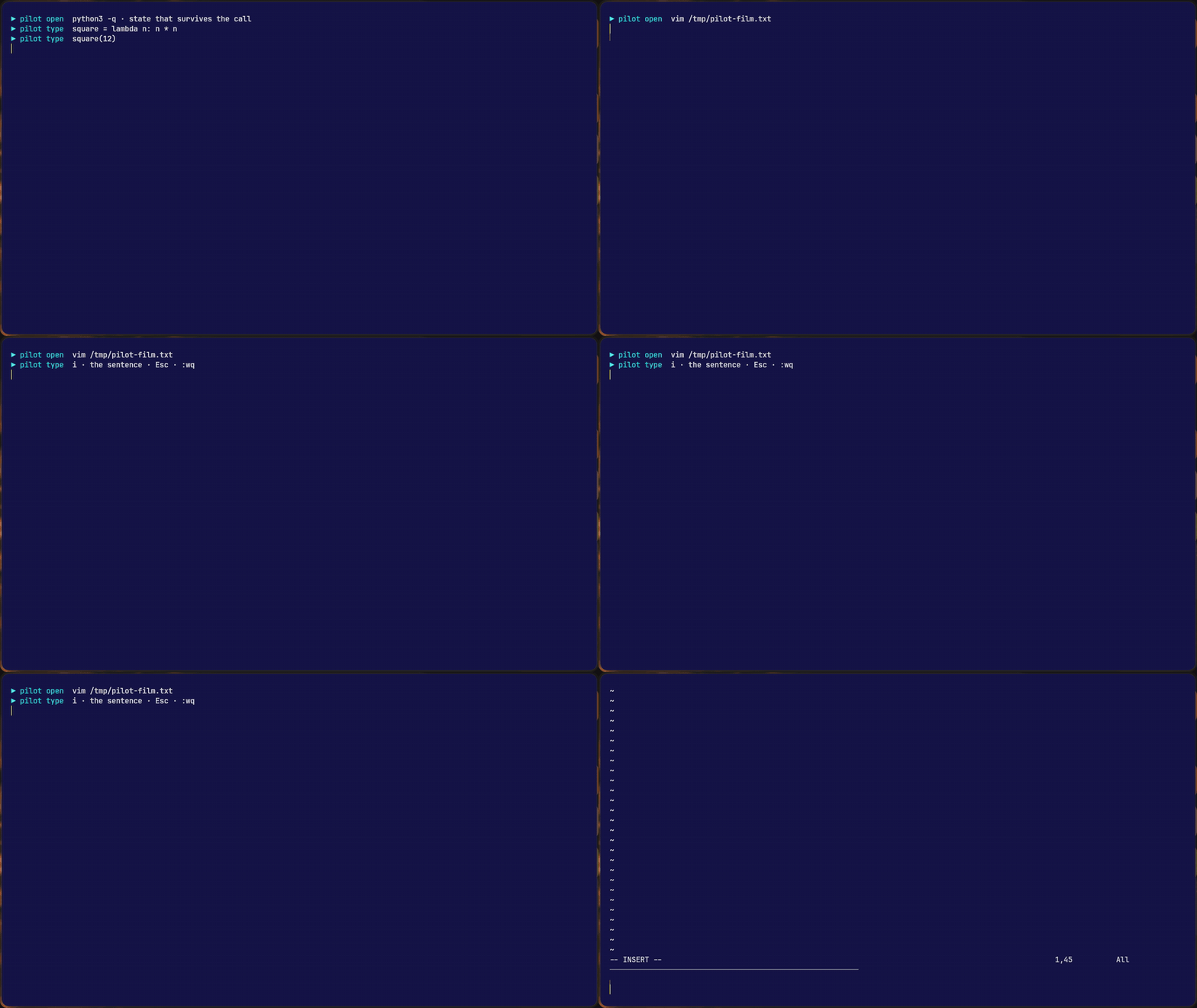 | 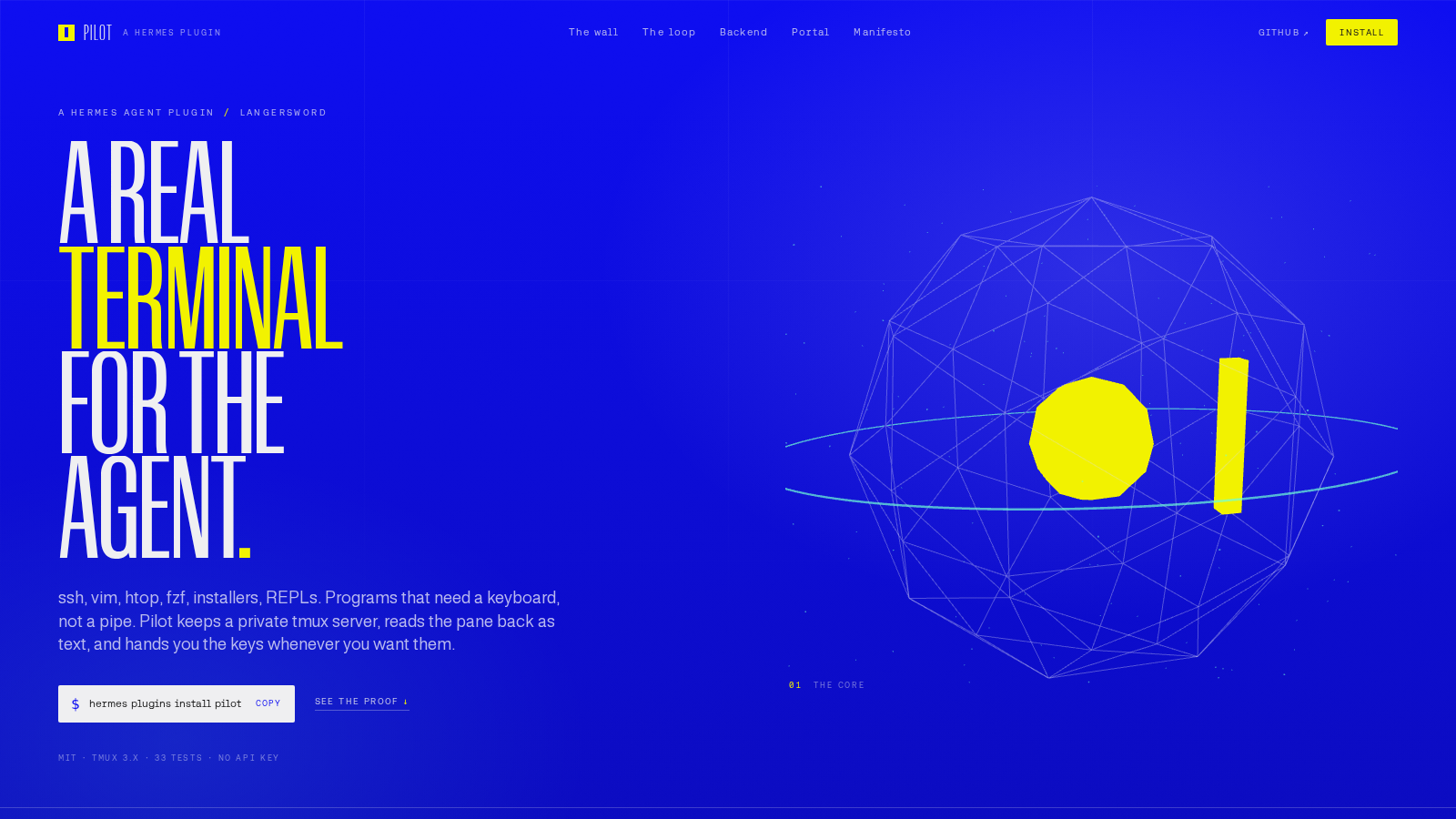 |
| recorded: real keystrokes, 900×506 | hosted: GitHub Pages, 1600×900 |
How it works
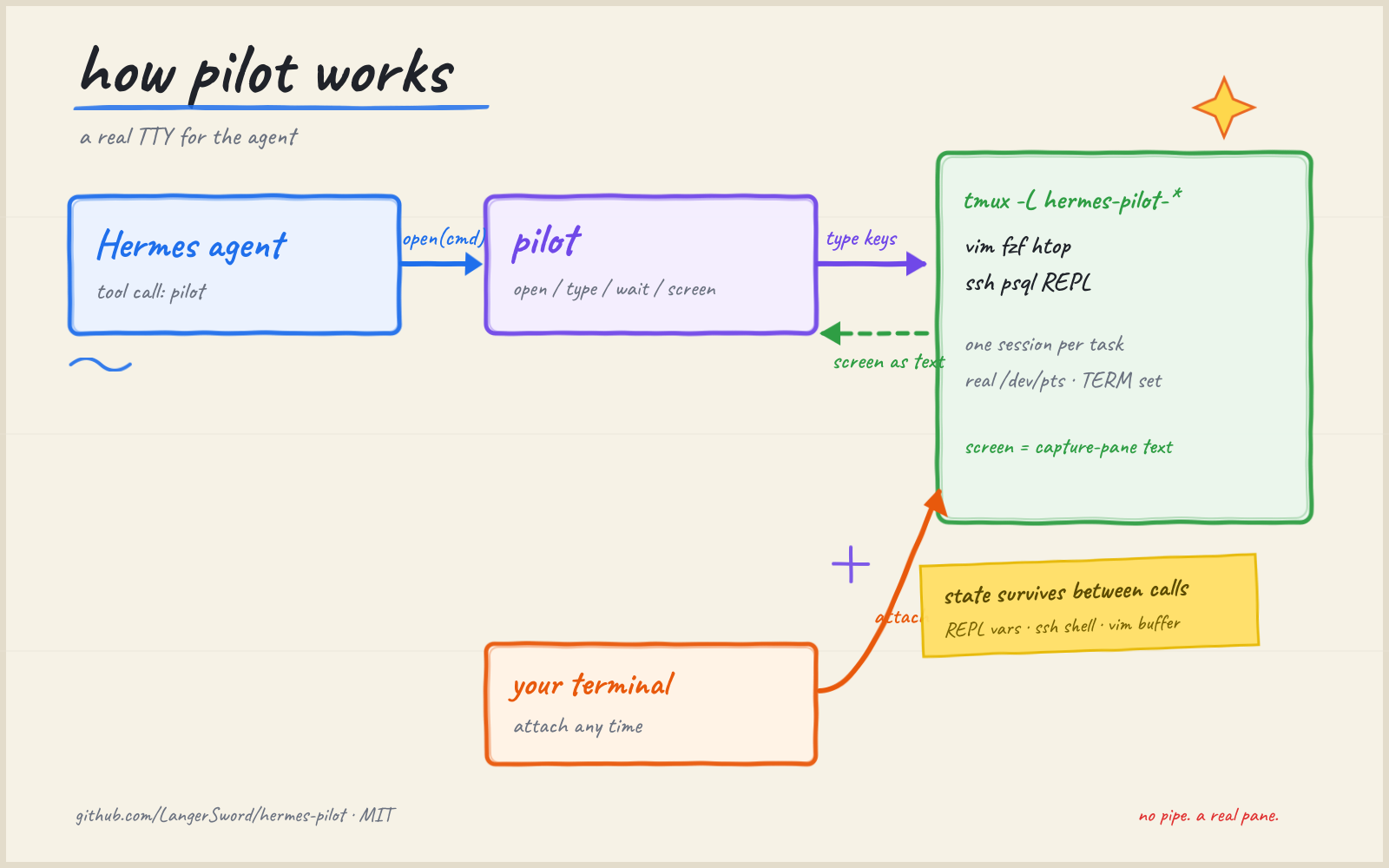
Agent calls pilot, pilot drives a private tmux pane, the screen comes back as text, and you can attach
to the same pane at any time.
Five decisions carry it:
- Profile-scoped tmux server (
-L hermes-pilot-<id>): your own tmux sessions are never listed or touched,
and another Hermes profile gets a different socket. remain-on-exitbefore the pane is created: a command that exits instantly still leaves its final
screen and#{pane_dead_status}to read.- Text, not ANSI:
capture-pane -p -Jreturns the screen a human sees, with no escape parser. waitbefore reading: full-screen apps redraw asynchronously, so poll for a pattern or a quiet pane
instead of sleeping.- argv, not interpolation: commands go through
sh -cas argv, named keys are allow-listed, and session
names match[A-Za-z0-9_-]{1,32}.
Tools
The suite registers 24 tools. pilot keeps the full open/screen/type/wait loop; the focused tools are
cheaper to call and add operations the single tool never had.
| tool | what it does |
|---|---|
pilot | the full loop: open, screen, type, wait, list, status, attach, close |
pilot_open | open a program in a new persistent pane |
pilot_screen | read the visible screen plus scrollback |
pilot_type | type literal text and named keys |
pilot_wait | wait for a regex, or for the pane to settle |
pilot_list | list sessions with pid, command, size, dead state, exit status |
pilot_status | status for one session |
pilot_attach | print the human attach command |
pilot_close | close one session |
pilot_killall | close every session |
pilot_run | one-shot command in a fresh TTY; output, exit status, duration |
pilot_expect | scripted wait/type/keys/sleep sequence with a step trace |
pilot_search | regex search the screen and scrollback with context |
pilot_diff | snapshot a pane, then diff the current screen |
pilot_log | record a pane to a log file, stop, or read the tail |
pilot_signal | send Ctrl-C, Ctrl-\ or Ctrl-Z |
pilot_resize | resize the pane |
pilot_rename | rename a session |
pilot_health | tmux, socket, session counts and limits |
pilot_upload | write a local file into a shell session over base64 |
pilot_download | read a remote file out through base64 |
pilot_send | type text/keys and optionally wait in one call |
pilot_snapshot | save the current screen to a text file |
pilot_cleanup | reap finished sessions past a TTL |
State survives between calls: a REPL keeps its variables, ssh keeps its shell, vim keeps its buffer.
Terminal backend
hermes pilot backend on sets terminal.backend: pilot. Every terminal call then runs in a persistent
tmux shell instead of a pipe:
cd, exports and aliases survive across calls and turns;TERM=tmux-256colorand a real/dev/pts, so pagers and curses work;- a timed-out command returns
exit 124and is left running;pilot screenandpilot typecan inspect it; - the next call refuses to type into a running program (
exit 126,pilot_busy: true), so a REPL never
receives your next echo — and once that program finishes, the following call recovers on its own; - output is bounded to the last 20K characters of the pane: a long build never dumps stale scrollback
into the model, and the completion marker at the tail always survives the trim; - if the session is lost before the command is delivered, the shell is recreated once and the
command retried; loss after delivery is reported as indeterminate (pilot_indeterminate,
exit -1) and never auto-retried, so non-idempotent commands (rm,mv, deploys) are not duplicated.
Long-running servers belong in pilot_open sessions: they outlive terminal calls, while jobs started
inside the terminal shell end when that session is cleaned up.
Restart once from outside the agent with hermes gateway restart. Turn it off with hermes pilot backend off.
Run it
git clone https://github.com/LangerSword/hermes-pilot ~/.hermes/plugins/pilot
hermes plugins enable pilot
hermes pilot list            # sessions, pids, attach commands
hermes pilot attach live1    # Ctrl-b d to detach
hermes pilot killall         # closes tool sessions; live terminal-backend shells survive
hermes pilot killall --include-terminal   # explicit full reset
Needs tmux 3.x on PATH. No Python dependencies. The pilot tool appears in the next session.
Backend switching needs a restart and plugins.isolation: in_process (the default).
Limits
- Text, not pixels: it reads the terminal grid, so GUI apps are out.
- Full-screen programs redraw.
waitfor a pattern before treating the screen as final. - An unclosed session keeps running;
hermes pilot killallcleans up tool sessions. Terminal-backend
shells (term-*) belong to live tasks and survive killall unless--include-terminalis passed. - It adds a TTY, not privilege: the agent could already run commands as you.
Safety
- Mutating tool calls (
pilot,pilot_open,pilot_run,pilot_type,pilot_send,pilot_expect,
pilot_upload,pilot_download) go through Hermes'spre_tool_callapproval gate. Read-only
screen,wait,list,statusandattachcalls do not. The rule key ispilot:<tool>;
unattended runs fail closed. - Panes inherit a minimal environment:
PATH,HOME,USER,LANG/LC_*,TERM,SHELL,TZ,
TMPDIRandXDG_RUNTIME_DIR. Provider keys and adapter tokens are not passed. Explicit per-pane
envvalues are added when a caller asks for them. pilot_snapshotandpilot_downloadresolve writes underplugin-data/pilotand refuse paths that
escape it.pilot_uploadrefuses sources under the Hermes home,~/.ssh,~/.aws,~/.gnupg,
key stores and.env/key files. Logs live in the same plugin data directory.- The plugin has no credential store of its own. Terminal snapshots, pane logs and downloaded files
can contain sensitive output and persist underplugin-data/pilotwhen those tools are used.
Evidence
| check | command | result |
|---|---|---|
| unit tests | python3 -m unittest discover -s tests | 84 tests, OK, against real tmux |
| admission | hermes plugins validate . | validation passed |
| runtime | hermes plugins doctor . | 24 tools, 1 hook registered |
The suite covers stdin, REPL, vim keystrokes, fzf, exit status, dead-pane reaping, large-output
completion, timeout recovery, session-loss recovery safety (no re-execution after delivery),
shared busy state, killall scoping and the send Enter contract. Every test module rides a private
tmux socket (HERMES_HOME isolation), so the suite never touches live sessions. scripts/demo.py
runs the same flow on camera.
Stack
| component | role |
|---|---|
| Python 3 standard library | plugin, tmux wrapper, CLI |
| tmux 3.x | panes, screen capture, keys, exit status |
| Hermes >= 0.22 | plugin host, tool and terminal backend registration |
Layout
plugin.yaml        manifest (24 tools)
__init__.py        register(ctx): tools, terminal backend, /pilot, hermes pilot
pilot_tmux.py      tmux layer: open, screen, type, wait, status, close, attach
pilot_env.py       terminal backend: persistent shell, markers, busy guard, timeout handoff
pilot_tools.py     legacy pilot tool schema and JSON handlers
pilot_toolset.py   the 24-tool suite: schemas, wrappers, dispatch
pilot_features.py  run_once, expect, search, log, transfer, safe paths, health
pilot_hooks.py     pre_tool_call approval policy for mutating tools
pilot_cli.py       hermes pilot and /pilot
tests/             55 stdlib unittest cases (skip cleanly without tmux)
scripts/demo.py    recorded demo: stdin, REPL, vim, fzf, htop
art/media/         README media: demo gif, site shot, whiteboard
MIT, Lakshaya Sharma (@LangerSword) · v0.3.2.
README from the reviewed commit 3724e8f; it updates when the author re-pins.