t4lus-sec
pwn-board
Pwn boards for Hermes Agent: for engagements and problems where you know the origin, can test
the goal, and don't know the path — plus a workflow that takes finished work through your review
and an independent verification before it counts as done.
A penetration test is the canonical case. The origin is known (a subnet, a set of credentials, a
URL), the goal is a condition a command can check (a shell on a host, a readable file, a flag),
and the path is whatever the target turns out to be. The same shape fits an intermittent test
failure, a regression hiding among a thousand commits, or a latency number that has to drop below
a threshold.
What makes these hard for an agent isn't reasoning but bookkeeping:
- what has been tried, and what it ruled out;
- what it opened up;
- which open direction is worth taking next.
Without that, a long run re-treads explored ground, loses the frontier after a compaction, and
eventually decides it has succeeded because nothing stops it from saying so.
A board keeps that structure, and it keeps the agent honest in two ways:
- A finding must cite real tool output. While a board is open, every tool result the agent
receives is recorded and tagged with an evidence id (e12). A finding has to cite ids that
exist, so it can't be something the model simply said. - The model never scores its own search. The goal test is fixed when the board opens.
pwn_board_testruns it through Hermes's own terminal tool, under your normal approval rules,
and the plugin writes the verdict. Nothing in the tool surface can mark a board solved. Where
no mechanical test exists, the most the agent can reach isproposed_solved, and you decide.
The board carries no offensive tooling of its own and makes no network calls. The agent brings its
own terminal and file tools; the board decides what counts as progress.
Where this comes from
The model behind a board is Cairn's. oritera/Cairn is a
general-purpose AI state-space search engine, validated first on autonomous penetration testing,
built on a blackboard architecture with an explicit fact–intent graph: facts the agent writes
to the board, intents it declares as directions worth exploring, and hints the operator
injects at any time. The graph grows from a known origin toward a testable goal, every fact a
stepping stone and every intent a step into the unknown. That structure is Cairn's idea, and this
plugin is built on it — down to the origin sitting at the root of the tree, which every seed
intent grows from.
pwn-board is an independent implementation of that model for Hermes Agent, and it shares no code
with Cairn. Cairn is a FastAPI server with a dispatcher, scheduler and worker pool; this is a
Hermes plugin with a SQLite store, lifecycle hooks, a slash command and a Desktop pane. Cairn is
licensed AGPL-3.0 and offers a separate commercial license; this plugin is MIT and contains
none of Cairn's source. If you want the engine rather than the bookkeeping, use Cairn.
What this adds on top of that model: a priority-ordered frontier; ruling an intent out as a
distinct move that needs a negative finding to justify it; an evidence ledger that forces a
finding to cite real tool output; a goal test fixed at open time that the model cannot score
itself; step budgets and claim expiry; and a review → verification → complete workflow with an
independent verifier that starts with none of the agent's conversation.
What the agent gets
| Tool | What it does |
|---|---|
| pwn_board_open | Opens a board: name, origin, goal, goal test (command, observation or judgment) and step budget. |
| pwn_board_list | Lists boards that are live or waiting for you. |
| pwn_board_read | Shows your notes first, then the frontier (open intents by priority), then recent findings (paged). |
| pwn_board_leads | Declares directions worth trying, each with a rationale naming the findings behind it. |
| pwn_board_claim | Claims an intent before exploring it. Claims go stale after 30 minutes. |
| pwn_board_finding | Records one finding per exploration (supports or rules_out), citing evidence ids. Spends a step. |
| pwn_board_rule_out | Rules an intent out. Requires a rules_out finding. |
| pwn_board_test | Has the plugin run the goal test and record the verdict. Spends a step. |
| pwn_board_close | Closes as proposed_solved, proposed_exhausted (only with an empty frontier) or abandoned. |
| pwn_board_report | Writes up a finished board, with the files that make up the work (kept as delivered). |
| pwn_board_answer | Answers one of your review notes. Every note needs an answer before the next write-up. |
| pwn_board_review | Reads the write-up and the files as delivered. |
| pwn_board_verify | Files the agent's own check of a board in verification. |
| pwn_board_verification | Reconciles its own check with the independent verifier's into the report you accept or send back. |
It also gets:
- A bundled skill,
pwn-board:pwn-board, with the search loop. - A short block on every turn, with one line per board, so a search stays visible after a
compaction. The block is injected into that turn only, never persisted, and absent when there
are no boards.
Subagents can work a board the main agent opened. A subagent can't open or close boards, holds
one claim at a time, must name the intent its finding explores, and can't rule out an intent
someone else is exploring. Its reads leave your notes marked new for the main agent.
When the step budget runs out, the board suspends. The graph stays intact and you decide whether
to extend it.
The workflow: from finished to complete
working ──agent: report──▶ review ──you: back──▶ working (a new round)
                             │ └──you: verify──▶ verification ──you: accept──▶ complete
                             │                        └──you: back / toreview──▶ …
                             └──you: exhaust (a proposed_exhausted board)──▶ complete
any stage ──you: discard──▶ discarded
- Write-up. A board that passed its goal test, or that the agent closed
proposed_solvedor
proposed_exhausted, owes a write-up: what was done, how it was checked, and what is left. The
agent names the files that make up the work. The plugin reads them through Hermes'sread_file,
so it works with any terminal backend, and keeps them as they were at that moment. You review
what was delivered, not what is on disk now. - Review. You read the write-up and the files and leave review notes (Review note 1, 2…).
- Send it back, and the board opens again in a new round. The agent must answer every note
before it can write the board up again. - Send it to verification when you're satisfied.
- Send it back, and the board opens again in a new round. The agent must answer every note
- Verification. Two checks run independently:
- The independent verifier is a Hermes subagent, launched through Hermes's subagent
lifecycle (ctx.subagent_lifecycle) as a leaf child of the main agent. It starts with none of
the agent's conversation: only the board, the write-up, the delivered files, your notes with
the answers, and every finding with the tool output it cites. It's told not to trust the
write-up and to check each claim on the machine: it gets the terminal and file tools (within
what the parent session has), runs the goal test, and reads and builds the delivered files.
It can read the board but not change it. Hermes only starts subagents during an agent turn, so
the verifier starts at the agent's next turn (at once, if you've allowed the plugin to start
turns; see below). Its report comes back through thesubagent_stophook. - The agent's own check can use tools: it re-runs the test and reads the delivered files.
- The verifier's report is held from the agent until it has filed its own check. Then the
agent reconciles the two into one report, with a verdict.
- The independent verifier is a Hermes subagent, launched through Hermes's subagent
- Complete. You accept the reconciled report, and the board is closed solved,
"verified (passed); accepted by the operator". Or you send it back to work, or back to review.
From complete you can reopen it or have it verified again.
Discarding works from any stage. "Exhausted" stays your word.
Waking the agent. Some of your moves need the agent: sending a board back, sending it to
verification, and the verifier's report once the agent may see it. If you allow it, the plugin
starts a turn in the session that last worked on the board:
# ~/.hermes/config.yaml
plugins:
  entries:
    pwn-board:
      allow_gateway_injection: true
Without that, the agent hears with your next message, in that session or any other, and a verifier
you sent a board to starts then.
What you get
/pwnboard works in every surface (CLI, TUI, Desktop, Telegram, Discord…):
/pwnboard                      boards that are live or waiting for you
/pwnboard show <name> [all]    the board as a tree
/pwnboard detail <name> <ref>  the origin, or one intent, finding or note in full, e.g. "Finding 2" (with its evidence)
/pwnboard note <name> [Intent 3:] <text>   leave a note, optionally about an intent or finding
/pwnboard unnote <name> <Note 2>      take a note off
/pwnboard confirm|exhaust <name>      accept a proposal
/pwnboard reject <name> [why]  send a proposal back; your reason becomes a note
/pwnboard extend <name> <steps>       give a suspended board more steps
/pwnboard abandon <name> [why] stop a search

/pwnboard review <name>        the write-up, the files as delivered, your review notes and the answers
/pwnboard file <name> <path>   one delivered file, as delivered
/pwnboard comment <name> <text>      leave a review note
/pwnboard uncomment <name> <Review note 2>   take back a note the agent hasn't answered
/pwnboard back <name> [why]    send it back to work (a new round)
/pwnboard verify <name>        send it to verification
/pwnboard verification <name>  both checks and the reconciled report
/pwnboard reverify <name>      run a failed verifier again
/pwnboard accept <name>        accept it as complete
/pwnboard toreview <name> [why]      back to review, from verification or complete
/pwnboard discard <name> [why] throw it away, wherever it is
The board reads as the tree it was searched as: the origin → intents → what each found → the
intents that opened.
[*] dmz-foothold — Shell on the internal app host from the VPN
│  open · steps 7/60 · frontier 2 · 5 findings · opened 41 min ago
│  goal: a shell as any user on 10.10.4.17
│  test (command): ssh -o BatchMode=yes -o ConnectTimeout=5 svc@10.10.4.17 id
└─ [o] Origin — 10.10.4.0/24 reachable over the VPN, no credentials
   ├─ [?] Intent 5 · p7 — Try the script console with the token from the backup
   ├─ [+] Intent 2 · p8 · explored — Enumerate the Tomcat manager on :8080
   │  └─ [+] Finding 2 · supports — Manager reachable, default creds rejected, /backup listable (e4)
   │     └─ [*] Intent 4 · p7 · exploring (the main agent, 6 min ago) — Pull /backup for credentials
   │        └─ [!] Note 1 · new — that tarball is from the staging host, creds may differ
   ├─ [+] Intent 1 · p6 · explored — Port scan the /24
   │  └─ [-] Finding 1 · rules out — Only 22, 80, 8080 open on .17; no SMB surface (e1)
   └─ [-] Finding 4 · goal test · failed — Goal test failed (exit 255): `ssh … svc@10.10.4.17 id`. (e9)
The markers mean:
[o]the origin: where the search started, the root every seed intent grows from;[+]done, or supports;[*]under way;[-]ruled out or failed;[?]open;[!]wants you (a proposal, a suspended board, or a note the agent hasn't read).
The Desktop pane ("pwn boards") shows the same tree live, rooted at the origin, with folding,
color-coded by kind (cyan origin, blue intents, green and red findings, yellow notes) and a
stepper across the top: Search → Write-up → Review → Verify → Complete. Its four tabs, Board,
Review, Verification and Complete, are there from the start; a tab that waits on you gets a dot.
Write-ups, both checks, the reconciled report, review notes and answers, and finding and note text
render as Markdown, with the chat's own renderer, in preview mode, so nothing in them loads an
image or runs anything. A delivered .md file renders too, with a "Show source" switch. All text
in the pane can be selected and copied, and the cards, the detail strip, cited tool output and
delivered files each have a Copy button for the text as written (Markdown source included).
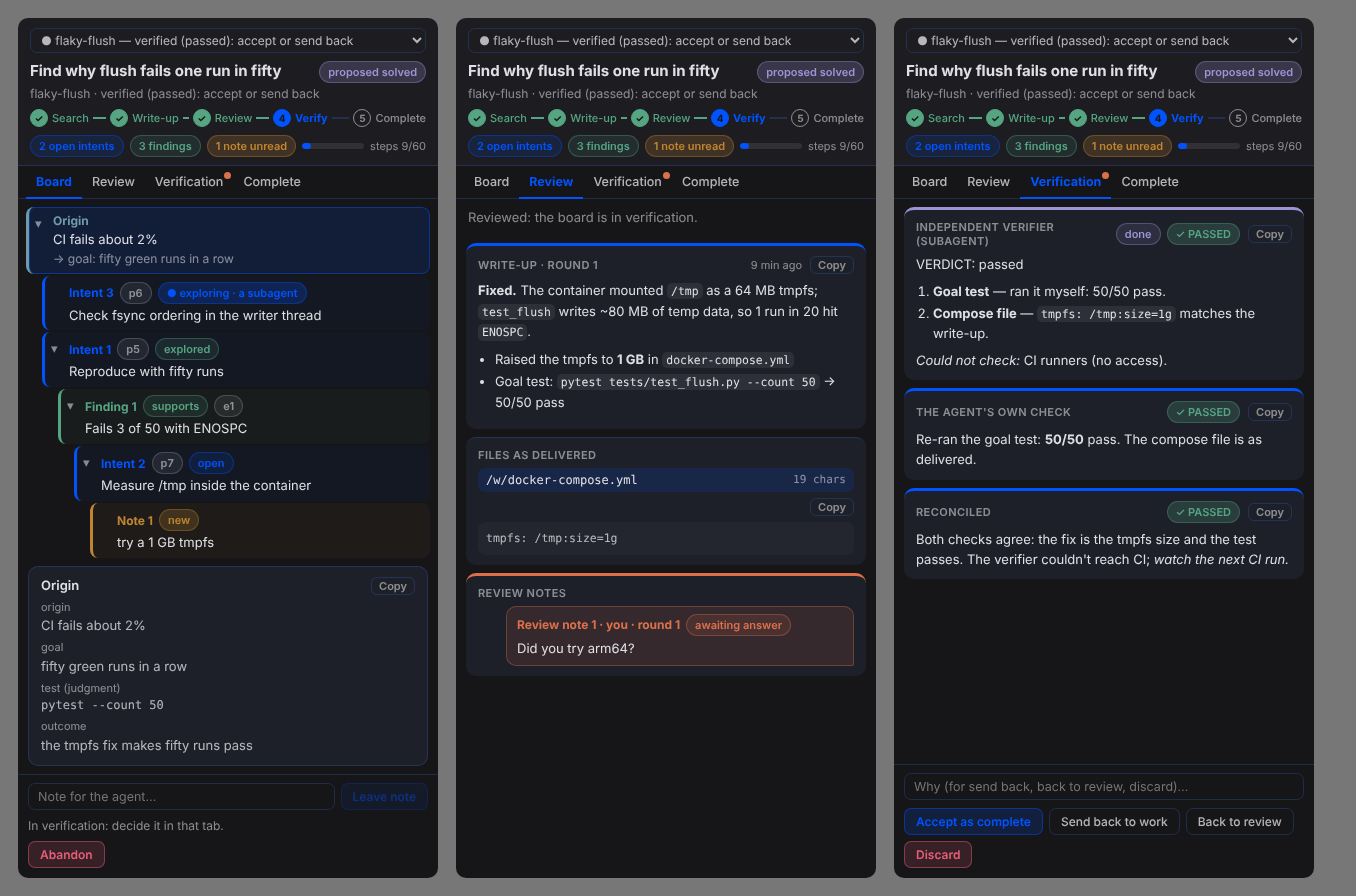
The workflow tabs show the write-up, the files as delivered, your notes with the agent's answers,
both checks and the reconciled report, with every workflow move as a button. Click a row for its
full text; a finding also shows the tool output it cites. Below that you can leave a note about
the selected intent or finding, take a note off, confirm or send back a proposal, extend a
suspended board, or abandon one. Confirming and abandoning take a second click.
The agent hears about your decisions with its next turn.
Install
hermes plugins install pwn-board --enable              # once listed in the catalog
hermes plugins install t4lus-sec/pwn-board --enable        # straight from GitHub
Then, in Desktop: Capabilities → Plugins → pwn-board, and enable the desktop half to get the
pane.
Updating. Hermes keeps the plugin's Python loaded until it restarts, and Desktop keeps the
pane it loaded. After an update, run hermes gateway restart (or quit and reopen Hermes), then
switch the desktop half off and on. The pane checks which build each side runs and shows a
"Restart needed" banner, saying what to restart, while any side is behind. A verifier that an
older build left unfinished shows as failed, with "Run the verifier again".
Authorization
A board is bookkeeping; the commands are yours. Use this only against systems you have explicit
authorization to test. The plugin runs exactly one command of its own — the goal test the agent
declared when it opened the board — through Hermes's terminal tool, under your normal approval
rules. It has no scanner, no payloads, no target list and no network access of its own.
Disclosures
- Tool results are recorded while a board is open. While at least one board is open, the
plugin records an excerpt of every tool result the agent receives: the first and last 2,000
characters, the first 1,000 characters of its arguments, its length and its SHA-256. These go to
<hermes home>/plugin-data/pwn-board/boards.db, and the plugin tags the result with an evidence
id. With no board open, nothing is recorded or changed. Treat that database as engagement data:
it will contain command output, and therefore whatever your tools saw. - Retention. Evidence that no finding cites is deleted after 14 days. Results of the plugin's
own tools are never recorded. - Tagging changes tool results. For JSON object results the tag is an added
"_evidence"key;
for anything else it's a final[evidence eN]line. - Goal tests run through Hermes's terminal tool.
pwn_board_testruns the board's goal-test
command throughterminal, in the same backend and under the same approval rules as any command
the agent runs. The command is the one the agent declared when it opened the board. A refused or
blocked command records nothing. - Delivered files.
pwn_board_reportreads the files the agent names through Hermes's
read_filetool (at most 30 files and 2 million characters) and keeps them in the plugin's
database. - The verifier is a subagent. Each verification launches one Hermes subagent through
ctx.subagent_lifecycle, with roleleafand theterminalandfiletoolsets (narrowed to
what the parent session allows). It runs commands and reads files under Hermes's own rules for
child agents: the same backend, approvals and limits as any subagent. Its goal and context carry
the board, the write-up, the delivered files, your review notes and the tool output the findings
cite (at most 30,000 characters of context). It uses your configured model and credentials; the
plugin never sees a token. Like any delegation, it's reported to an external memory provider if
you use one. If the board moves on (sent back, discarded), the verifier is cancelled at the next
turn. - Starting turns. If you grant
allow_gateway_injection, your workflow moves start a turn in
the board's session throughctx.inject_message. Without it, nothing is injected. - A background thread. On first use, a daemon thread starts. Every 3 seconds it reads the
plugin's own database to deliver those turns and to notice a verifier that a restart cut off. It
never launches anything itself. It stops when the plugin unloads. - Context injection. The
pre_llm_callhook adds a few lines (one per board, plus your recent
decisions) to the main agent's current turn. Nothing is persisted. - What the plugin doesn't do. No network calls of its own (the verifier's model calls go
through Hermes), no telemetry, no credentials, no background processes beyond the thread above,
no shell commands of its own beyond the declared goal test, and no self-updater. - The Desktop pane's backend. It talks only to this plugin's own routes
(/api/plugins/pwn-board/…). Those routes read boards, evidence and the workflow, and accept
only your actions: notes, extend, confirm, exhaust, reject, abandon, and the workflow's moves.
Nothing there writes an intent, a finding, a write-up or a check. - Build stamp. The plugin records its version (
build.agent) in its own database on first
use, and at load only if that database already exists, so loading it creates no files. The
pane's/buildroute reads it, to tell you when Hermes still runs an older build. - Provenance. The fact–intent–hint board model originates in
oritera/Cairn (AGPL-3.0). This is an independent
implementation for Hermes and contains no Cairn source. See Where this comes from.
Development
pytest                                   # store, tools, hooks, commands, routes (needs fastapi for the routes)
cd tests/desktop && npm install && \
  PWN_BOARD_PANE_FIXTURE=$PWD/fixture.json pytest ../.. -k fixture && npm test   # the pane, in jsdom
hermes plugins validate . --install-deps
The Python tests run without Hermes against a fake context. The pane test renders
desktop/plugin.js with React in jsdom against a snapshot the real backend routes produced.
License
MIT — see LICENSE. The board model it implements comes from
Cairn, which is AGPL-3.0; no Cairn code is included here.
README from the reviewed commit 7896f5e; it updates when the author re-pins.