klautimus
Rule Injector
Rules that arrive when they're needed, instead of sitting in a system prompt getting ignored.
A Hermes Agent plugin that moves hard behavioural rules out of SOUL.md / the system prompt and injects them at the exact moment they apply — on the tool call, the tool result, or the completion gate where the failure would actually happen.
The problem
Every serious agent setup accumulates rules. "Never ship a placeholder." "Verify before claiming." "Read the config, don't guess it." They get pasted into the system prompt, and then one of two things happens: the prompt grows until the rules are diluted noise, or the rules are condensed until they're too vague to change behaviour.
The research finding this plugin is built on is blunt: rules in tool results worked. The same words in tool descriptions did nothing. Injected messages at the point of need beat standing rules in the system prompt. Context position is not a detail — it's most of the effect.
Rule Injector treats a rule as a small program with a trigger, not a paragraph of prose.
What it does
A rule is {trigger, inject}. Triggers are matched against the live turn, and only the rules that match get injected, only where they land.
Three hooks, three different jobs:
| Hook | Position | Good for |
|---|---|---|
pre_llm_call | Before the model runs | Behavioural guards: "think before acting", "no placeholders", "read the source" |
transform_tool_result | Appended to a tool result | Corrective nudges where the model is already reading: repeated errors, empty results |
pre_verify | Completion gate | Hard stops: "you have no evidence for that claim", "that's a limitations list, not a delivery" |
Trigger types include always, keyword, regex, tool_name, tool_error, path, session_scope and boolean compound (and/or/not over any of the above), so a rule can be as narrow as "only when the user's message mentions a threshold AND the last tool was a file read."
Install
# from a checkout
hermes plugins install /path/to/rule-injector

# or from the catalog (once listed)
hermes plugins install rule-injector
Then enable it and restart the gateway:
hermes plugins enable rule-injector
Verify it loaded and is firing:
hermes plugins list
tail -f ~/.hermes/logs/rule-injector-trace.jsonl
Write a rule
rules.json next to the plugin is a plain list — no code, no restart:
{
  "id": "no-placeholders",
  "name": "No Placeholders",
  "enabled": true,
  "hook": "pre_llm_call",
  "priority": 1,
  "trigger": {
    "type": "compound",
    "operator": "or",
    "conditions": [
      { "type": "keyword", "scope": "latest_user_message",
        "keywords": ["implement", "build", "code", "stub"] },
      { "type": "tool_name", "tool_names": ["write_file", "patch"] }
    ]
  },
  "inject": {
    "context": "Never ship a stub or a TODO body. Build the real data path."
  }
}
The file is re-read on modification (mtime-checked), the loader is fault-isolated per rule, and a malformed rule is skipped rather than taking the whole set down.
This repo ships six starter rules in rules.json to show the shape. Replace them with yours — the point of the plugin is that your rules are yours.
How matching stays cheap
- Compiled keyword sets, not a regex sweep over every rule per turn.
- Per-turn injection budget — a per-turn character cap applied while rules are collected by priority, so a large rule library can't flood the context. High-priority always-on rules are exempt and cannot be dropped; low-priority noise is.
- Scope guards — rules can be scoped to the latest user message, the whole conversation, or the tool result, so a keyword in an old turn doesn't re-fire forever.
The adjudicator (optional, off by default)
Keyword matching is precise and dumb: it misses paraphrases and it fires on incidental mentions. The optional adjudicator adds a second, semantic pass for the ambiguous cases — a cheap auxiliary model reviews the candidate rule against the turn and decides fire / don't fire, with the decisions trace-logged so you can audit why a rule did or didn't apply.
It is disabled by default and costs one model call per ambiguous turn when enabled. Enable it in ~/.hermes/config.yaml:
auxiliary:
  adjudicator:
    enabled: true
The call goes through ctx.llm.complete — Hermes' host-owned LLM facade — so it runs on whatever model the session is actually using, with Hermes' own credentials and budget. The plugin holds no key and never imports an internal client module. Overriding the provider or model per plugin is deliberately not done by default: that is gated behind the host's per-plugin trust flags (plugins.entries.rule-injector.llm.allow_provider_override / allow_model_override), and a plugin that hardcodes its own provider is a plugin that ignores the user's configuration.
Auto-drafting rules from corrections
propose.py turns a correction ("no, that's wrong because…") into a draft rule with a trigger and an inject block, which you review before it lands. The useful part isn't generation, it's the review step: seeing a rule as {trigger, inject} makes vague rules obviously vague.
CLI
python cli.py list                     # every rule, hook, priority, enabled
python cli.py trace --tail 50          # what fired this session and why
Web dashboard
A local web view of the rule set and the live activation trace. It reads
rules.json and the trace log from disk, so it works as a standalone viewer
whether or not a gateway is running.
pip install fastapi uvicorn      # the only optional dependency in the project
python3 dashboard.py --port 9123
# → http://127.0.0.1:9123
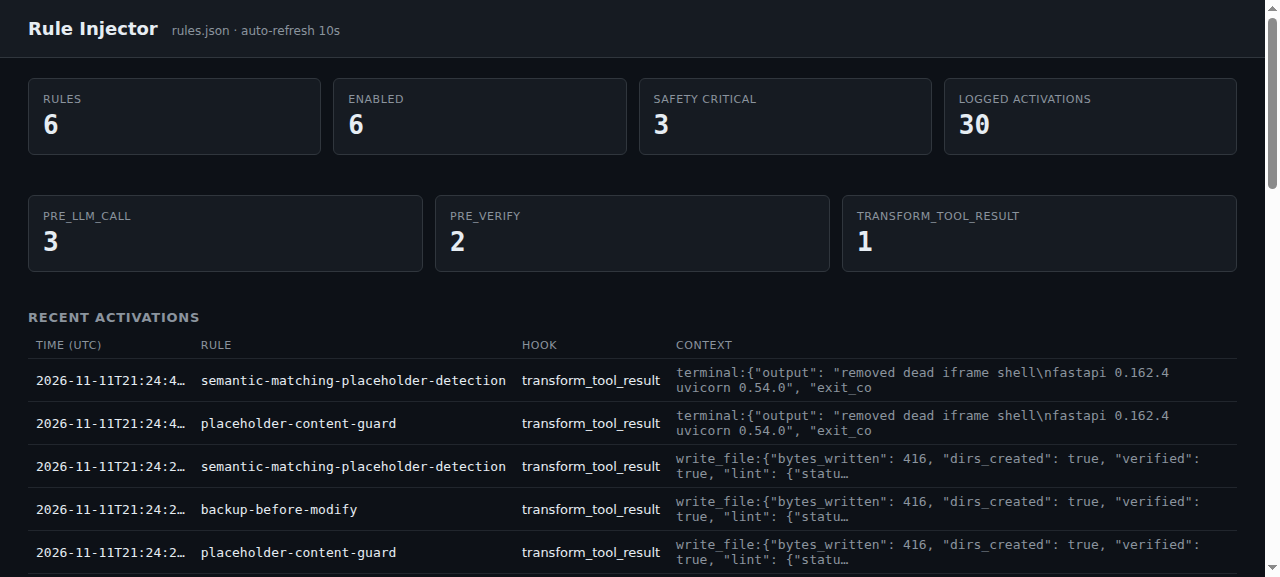
Server-rendered, no JS build step. Endpoints: /api/status, /api/rules,
/api/trace?limit=N. It is read-only by design — an outside process cannot
mutate the adjudicator's in-memory state, so the dashboard shows it rather
than pretending to toggle it.
Limitations — read these before installing
- Keyword triggers are literal. A rule written for the word "deploy" does not fire on "ship it". That is the trade for being free. Use the adjudicator or compound triggers when a rule must be robust to paraphrase.
- Injections cost tokens. Every fired rule adds text to the turn. The budget keeps it bounded, but a rule set of 150+ rules with loose triggers will visibly raise input tokens.
- It changes model behaviour, not model capability. A bad rule produces confident wrong behaviour more reliably.
- Rules are global to the profile. Per-project rule sets need a separate profile or a path-scoped trigger; there is no first-class project scoping yet.
- The adjudicator is a second model reading your turn. If you enable it, the current turn is sent to whatever model the session is running on. Leave it off if that matters.
- Semantic triggers download a model. Rules whose trigger type is
semanticusesentence-transformers, which fetches its embedding model (~80 MB) from Hugging Face into the usual cache on first use. Without that package, or without network access at that moment, semantic rules fall back to no-match rather than failing the turn. - No rule versioning/rollback UI.
rules.jsonis a file; use git. - The dashboard is read-only over HTTP. It reads
rules.jsonand the trace log from disk, so it cannot change adjudicator state that lives inside a running gateway process. Editing rules from the browser is not implemented. - The dashboard adds
fastapi+uvicorn. Only if you run it; the plugin itself imports neither, and loads without them. - Tested on Hermes 0.21.x, Linux/WSL. Not tested on macOS or the Desktop app.
Disclosure
- Reads:
rules.jsonin the plugin directory, and the plugin's own trace log. - Writes:
~/.hermes/logs/rule-injector-trace.jsonl(one line per activation), andrules.jsonwhen a rule is created or edited through the CLI/propose path. - Network: none by default. Two opt-ins reach the network: the adjudicator (one completion per ambiguous turn, through
ctx.llm.complete, on the session's own model) andsemantictriggers (a one-time sentence-transformers model download from Hugging Face, then local inference). The plugin stores no keys and reads no.env,auth.jsonor other credential store. - Logging: no handler of its own. Records go to the host's log routing; set
RULE_INJECTOR_DEBUG=1to get a stderr handler for debugging. - Shell: none. The plugin never spawns commands.
- Telemetry: none. Nothing leaves the machine except the adjudicator call you opt into.
Feedback that would help
- Rule sets where keyword triggers produced obvious false positives or false negatives — the trigger shapes that survive real use are the interesting part.
- Whether a 150-rule set stays under your acceptable token overhead with the budget as shipped.
pre_verifygate ideas that catch a failure before it reaches the user, especially around "done" claims without evidence.- Anyone running it on macOS or the Desktop app.
License
MIT.
README from the reviewed commit 7da7aa3; it updates when the author re-pins.