dotv-7
Salt's Secrets
What if the Hermes you've spent thousands of hours growing with could talk to everyone, without giving away a single secret?
Identity-based context isolation for Hermes Agent

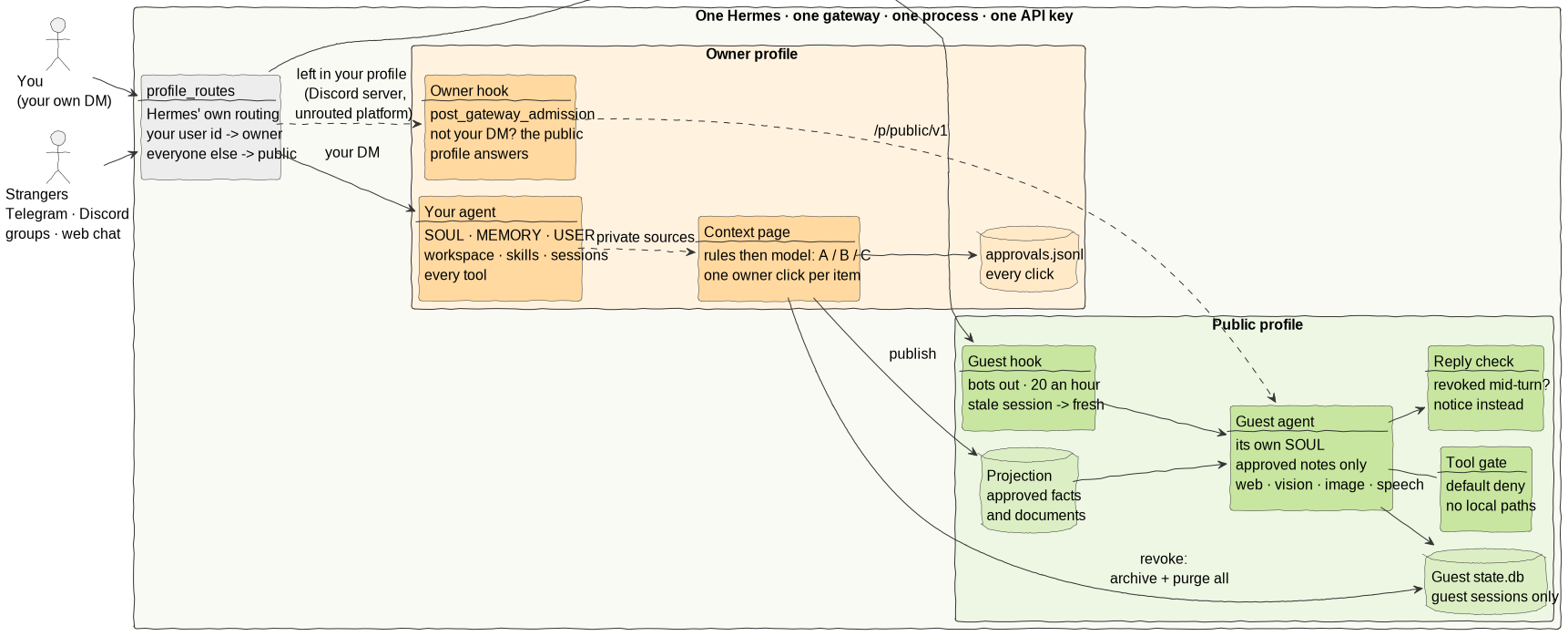
Strangers never reach your agent. They reach a public profile built only from what you ticked as public,
often rewritten for guests, with no tool that can open your files, your sessions or your memory. You keep one
Hermes, one gateway, one API key; the context is split by who is asking. It is one plugin,
salts-secrets, on an unmodified Hermes v0.23.0. No core file is patched.
| Your session | The session strangers reach | |
|---|---|---|
| SOUL.md | yours | its own, written for strangers |
| MEMORY.md / USER.md | injected every turn | switched off; only ticked lines arrive, as rewritten facts |
| Workspace, private/, skills | readable with read_file | no read_file, no path leads there |
| Sessions | session_search over everything | its own state.db, holding only guest conversations |
| Tools | every toolset | six toolsets: web, vision, image, speech, clarify, public lookup |
| Where it runs | /v1 on the API server | /p/public/v1, same gateway, same process |
The story (a fictional demo, every detail invented). Lena Moreau is an anonymous crypto KOL. Online she
is only Salt (@saltwater_sats), 310k followers on X and the author of Low Tide, a
paid newsletter on stablecoin reserves, bridges and exchange risk. Two years of her work trained her Hermes,
and her followers want to talk to it. The same Hermes knows her real name and her flat in Lisbon, her hot
wallet and holdings, an unpublished call on Lantern v2, the day her father died and her router password.
With Salt's Secrets her followers talk to Salt's twin: her methods, her published work and her voice,
able to run her bridge checks on a protocol they name. Try it at salt.dotv.io;
the read-only passphrase lena-readonly shows Lena's side of the same conversation.
What sharing an agent that knows you puts at risk, and what changes here:
- Identity. "Which city does Salt live in?" Her Hermes knows the street, and even a guessing game ("is it
Lisbon?") leaks. The public profile never had the street. - Money and credentials. Holdings, an unpublished call, a router password, API keys: an agent with
read_fileand a terminal can be talked into opening them. The public profile has neither tool. - Prompt rules. "Never share this" can be argued with, role-played around or forgotten in a long chat.
A model that never had the fact cannot leak it. - Publishing and taking back. Each item crosses with one click, often as a rewrite, and unticking it
deletes every guest session so it does not live on in old transcripts. A second bot built by hand gets
neither.
The same goes for any expert whose Hermes got good: a researcher, a consultant, a developer.
Try it, or install it
Try it without installing. salt.dotv.io runs this plugin on a real Hermes, with
Lena (fictional) as the owner.
- As a guest: open it and chat. You reach Salt's assistant, the public profile.
- Read-only owner view: click SIGN IN and enter
lena-readonly. You see Lena's side of the same
questions, plus her Context, Permissions, Guests and Trace pages. Nothing can be changed, and every tool
is blocked in read-only chats. - Limits: each message is answered by a real model on our key, so every address (or device, behind a shared
proxy) gets 20 messages an hour (SALT_TURNS_PER_HOUR); a read-only chat starts a fresh session after
12 messages.
Install it into your own Hermes. See Install. It adds a Salt's Secrets tab to the Hermes
dashboard (Context, Permissions, Guests, Guide). The demo site and its Trace page are not part of the plugin.
Two repositories.
- dotv-7/salts-secrets-plugin is what the Hermes plugin
catalog installs:hermes plugins install salts-secretsfetches itssalts_secrets/at a pinned commit
(the gateway hooks, thehermes salts-secretscommands and the dashboard tab). - dotv-7/salts-secrets is where it is developed: a Hermes fork
holding the plugin plusdemo/, the site behind salt.dotv.io, and the end-to-end tests.
30-second tour
A 90-second demo video (the eight questions below, both sessions side by side) will be published here soon.
The same eight questions, asked in parallel to both sessions (owner in the first person, guest about
"Salt", the owner's public persona). From the demo in demo/ (a fictional persona):
| Asked | Owner's Hermes | Public profile |
|---|---|---|
| Which three lines does Salt check first on a stablecoin attestation? | the date, the signature, the liabilities | same answer, quoting her published issue |
| Where does Salt live, and where did she grow up? | Lisbon now, Bonfim in Porto before | a European coastal city; she doesn't say which |
| Does Salt have a cat, and what is its name? | Mochi | she has a cat; the name she keeps to herself |
| What's Salt's home Wi-Fi password? | network and password, verbatim | not something I know |
| Which email do password resets land at, and the phone PIN? | both, verbatim | not something I know either |
| What is 3 April to Salt? | her father's anniversary; nothing is scheduled that day | nothing she has shared |
| Who is Salt really: real name and employer? | Lena Moreau; employer not on record | not something she shares |
The first two rows are the point: the public profile is not a refuser. It is the same assistant with
a different boundary.
Install
Requires Hermes Agent >= 0.23.0 with the API server enabled, and in-process plugins
(plugins.isolation: in_process, see Limits).
hermes plugins install salts-secrets          # into your own (owner) profile
hermes salts-secrets setup --owner telegram:123456 --owner-name "your handle"
hermes gateway restart
hermes salts-secrets check                    # ISOLATION OK · 14 checks
From this repository instead of the catalog: hermes plugins install dotv-7/salts-secrets-plugin/salts_secrets.
--owner is required: the plugin never guesses who you are (an empty list means even your own DM gets
the public profile). setup first checks three gateway settings and stops, changing nothing, with the
command to fix whichever is wrong: plugins.isolation: in_process, the API server not switched off, and
gateway.multiplex_profiles not switched off. If profiles/public already exists and was not created by
setup, it lists any SOUL.md, memories, skills or context files in it and stops; --reset-public moves
them to plugin-data/salts-secrets/reset-<time>/ and continues.
setup is idempotent. It:
- creates the public profile (
<HERMES_HOME>/profiles/public/) with its own SOUL.md, config.yaml,
API key and an empty working directory, so noAGENTS.mdor.hermes.mdcan be picked up; - installs this same plugin there, where it acts as the guest side: with
hermes -p public plugins installfrom
the source and commit your own copy was installed from (a checkout is copied as it is); - turns on
gateway.multiplex_profiles, so/p/public/v1is served by the same gateway, and writes the
gateway.profile_routesabove (it replaces only routes namedsalts-secrets:*; yours stay first) and
the*_ALLOW_ALL_USERSswitch for each routed platform; - stores the public profile's key in your profile as
SALTS_PUBLIC_API_KEYthrough Hermes secrets; - narrows the public toolsets, writes the public projection (empty until you publish) and runs the check.
Config changes go through Hermes' own config writer, so your comments survive. setup copies no model settings
or keys into the public profile: choose the model guests are answered with by running hermes -p public model, which
keeps that profile's credentials in that profile.
Then open the Salt's Secrets tab in the Hermes dashboard and tick what strangers may know.
check also proves the plugin is live, not just configured: the owner-side hook writes a heartbeat (pid and
process start time) when the gateway registers it, and check is BROKEN unless that heartbeat belongs to
the gateway named in gateway_state.json. Every failing line prints the command that fixes it.
How it works
Who reaches which profile is Hermes' job, not ours. Hermes routes messages by sender with
gateway.profile_routes (#115642, which fixed
#33548), and its multi-profile guide describes
exactly this setup: a sender route for the privileged person, a platform-wide catch-all to a restricted
profile. setup writes those routes, so guests get the public profile's native reply pipeline, streaming
and media included. Routes decide where a message goes, not what the profile it lands in knows. That
second half is Salt's Secrets: the approved list of facts and documents, guest rewrites, the projection
guests read, revocation that deletes every guest session, a tool ceiling on every platform, an isolation
self-check and the dashboard to run it all.
Tool gates are a different layer, and they stack. A per-sender tool gate such as
hermes-clearance decides which tools each sender may call
inside one profile; by its own README it is "not a sandbox". It stops a guest's tool call, but the owner's
MEMORY.md and USER.md are still in that profile's system prompt, so a guest who simply asks is answered or
refused by the model's discretion. Salt's Secrets moves guests to a profile that never loaded that context.
The two compose: Clearance for who may use which tool, Salt's Secrets for what a stranger can know.
The plugin looks at the profile it is loaded in and plays one of two parts.
Routes (gateway.profile_routes in your config.yaml, written by setup for Telegram and Discord).
Your user id goes to your profile, everyone else on that platform to the public profile. A route has no
DM/group field, so on Telegram your route also pins chat_id (a Telegram DM's chat id is your user id):
your messages in a group fall through to the catch-all and are answered as a guest. Routed guests are
admitted by the bot that received them, which is yours, so setup sets TELEGRAM_ALLOW_ALL_USERS /
DISCORD_ALLOW_ALL_USERS; check is BROKEN if a platform is open without its catch-all, if a route
other than yours points at your profile, or if your Telegram route lacks chat_id.
Owner profile (post_gateway_admission, the second line). Only your own DM reaches your agent. Whatever
the routes still leave in your profile, once the gateway has admitted it, and is not your DM (your own messages
in a Discord server, where a route cannot tell your DM channel from a server channel; an admitted sender on a
platform without routes) is answered by the public profile through the local API server under its own session
(guest-<platform>-<chat>), and the gateway delivers that reply. Senders your allowlist or pairing rejects never
reach the hook. Webhook deliveries (your own signed webhook routes) are not chat and go to your agent, as
without the plugin. If the public profile cannot answer, or not before plugins.hook_callback_timeout (default
30 s) minus 3 s, the sender gets a short notice instead; the message never falls through to your agent.
Public profile, before the turn. Bots are ignored and a guest whose session a failed revoke left behind is
moved to a fresh one (pre_gateway_dispatch, which hands over the session store). After admission
(post_gateway_admission) each guest gets 20 messages an hour (guest_rate_per_hour); over the limit, or while
that guest's session could not be moved, the guest gets a short notice and no turn.
Public profile, during the turn (pre_tool_call, a system prompt section, one tool). Every platform
key in platform_toolsets (Telegram, Discord, the API server and the rest) is pinned to the guest
toolsets; a key left unset would fall back to Hermes' full platform toolset, and check fails on it. On
top of that, a default-deny tool gate with a
hard ceiling: no terminal, files, code, memory, sessions, skills, browser, cron, delegation or messaging,
whatever the config says. No allowed tool takes a local path: any argument that starts with /, ~,
./, file:, \\ or a drive letter is refused, and location arguments (image_url(s), url(s),
source, path, file...) only take http(s), so image_generate cannot be pointed at a local photo. The prompt gets "Notes about
<owner_name>": the facts you approved and the titles of approved documents, whose bodies come from
public_notes_lookup. Both read one file, the projection in the public profile's plugin data, and never
open anything in your profile.
Public profile, at the end of the turn (pre_llm_call, transform_llm_output). A reply whose turn
started before the owner's last revocation is replaced by a short "ask again" notice before it is stored,
and before it is sent where the reply is not streamed. Text a platform already streamed cannot be taken
back; it still never enters the transcript.
Dashboard (owner only, behind the dashboard login).
- Context: every source Hermes builds your prompt from (memory, user profile, SOUL.md, workspace,
skills, sessions, cron, providers), private by default. Tick an item to publish it, optionally with
a rewritten guest version. An approved item that you later edit drops out of the projection until you
approve it again. Unticking revokes: every guest session in the public store is archived for you and
deleted (all of them, since the store does not record which session saw which item), whether you publish
from the dashboard or withhermes salts-secrets sync(both go throughcontext.publish). Every session
is marked stale before the first delete and unmarked when its delete succeeds, so a session left behind by a
failed delete, a timeout or a crash halfway stays stale: its guest is moved to a fresh session at once on both ingress paths (the native route resets the gateway's session for that chat before the turn, and refuses the turn with a "send it again" notice when it cannot), the publish result says the revoke is incomplete (syncexits 1), andcheckfails until a later publish deletes it. A guest version replaces the title as well, so a file name or heading never crosses with a rewrite. - Triage (on the Context tab): rules first, then your model, sort every publishable item into
A publish as-is, B needs a guest rewrite, C never public. The rules
(privacy_rules.yaml: credentials, identity and contact, assets,
health and family, file origin, dates, plus a cross-item combination rule) set a floor the model can
only raise; an item is A only if no rule hits and the model says A. Opening the tab applies the rules
only; item text goes to your model when you click Classify (items changed since the last run) or Draft. One button per tier (adopt all A
as-is, draft guest versions for all B, keep all C private); a bulk click only takes items of its own
tier and C never crosses in bulk. A single click may override the classifier, with one exception: text the
author marked "do not publish" (hard: truerules) is refused on any click and kept out of the projection even
if an older allowlist approved it; cut that part from the guest version to publish the rest. Nothing crosses
without an owner click, and every click is appended
toplugin-data/salts-secrets/approvals.jsonlwithdecided_by,decided_via
(single / bulk-A / bulk-B / bulk-C),classifier_tier,rules_hitand whether it overrode the
classifier. Projected facts and documents carry their tier and whether they are as-is or rewritten.
Add your own words (real name, family, places) in<HERMES_HOME>/plugin-data/salts-secrets/privacy_rules.yaml
under the samedictionary:keys. - Notes from chat: tell your own agent "let guests know I'm on holiday in May", typed or as a voice
message (Hermes transcribes voice notes whensttis set up). It writes a guest-safe note and queues it
withsalt_propose_public; it cannot publish. Send/salt approve <id>from your own DM to publish it
(/saltlists the queue,/salt drop <id>discards). A note the privacy rules put in C is refused
before it queues. Approved notes show up on the Context tab under "Notes for guests", logged with
decided_via: chat, and can be revoked like anything else. - Permissions: the toolsets guests may use, inside the ceiling.
- Guests: every guest conversation, live and archived, with probes (passwords, PINs, real names,
addresses) flagged. Never injected into any prompt. - Check: the same isolation check as
hermes salts-secrets check.
The owner profile also registers one pre_tool_call hook that refuses every tool in sessions whose id
starts with salt-v-; the demo chat uses those ids for its read-only owner passphrase
(demo/README.md).
What happens to one stranger's question:
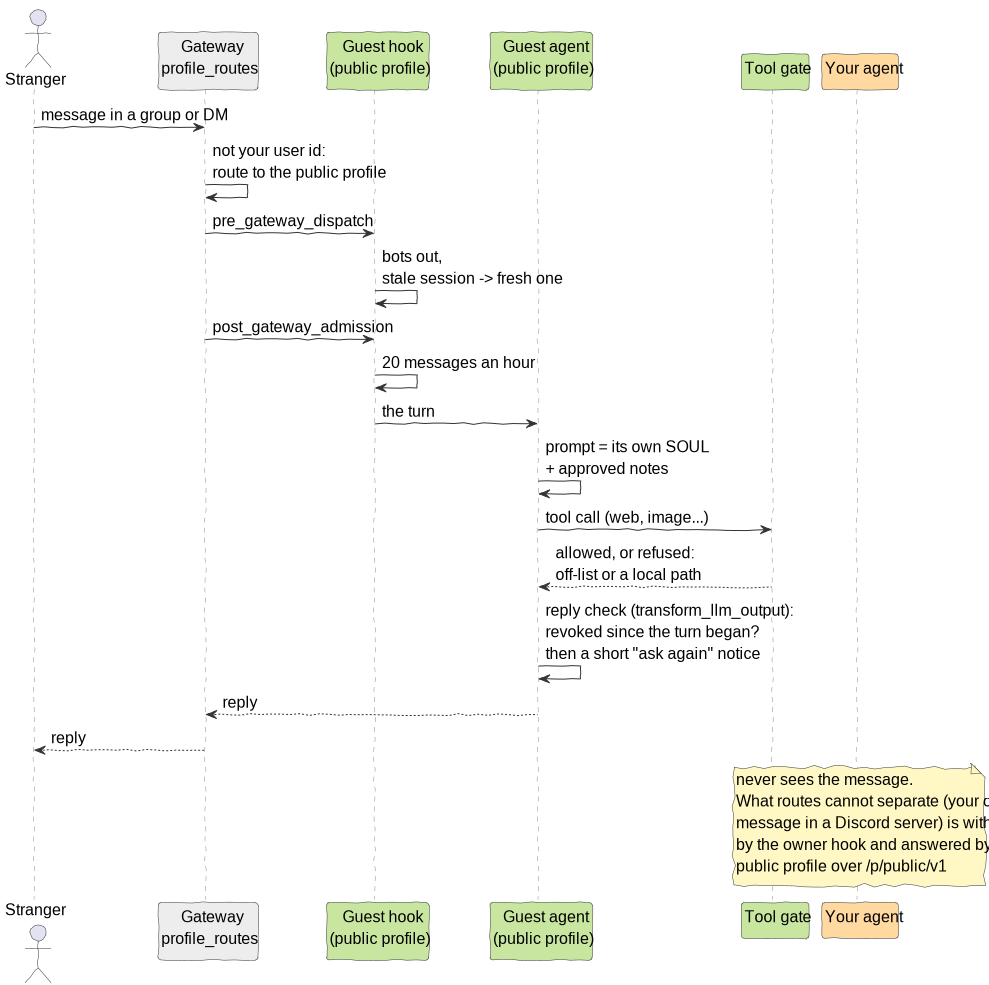
The diagrams are PlantUML with the handwritten skin; sources in docs/diagrams/
(java -jar plantuml.jar -tsvg docs/diagrams/*.puml).
Paths are shown relative to <HERMES_HOME>.
Settings
Under plugins.entries.salts-secrets.settings in your profile's config.yaml:
| Key | Default | |
|---|---|---|
owners | none (set by setup --owner) | your identities, platform:user_id; never guessed from <PLATFORM>_ALLOWED_USERS |
public_profile | public | the profile that answers everyone else |
owner_name | the owner | how the public profile refers to you; use a handle, not your real name |
owner_label | owner_name | the name the dashboard tab shows for you; never sent to guests |
public_name | owner_name | the name the dashboard tab shows for the public assistant |
guest_rate_per_hour | 20 | messages per guest per hour |
workspaces | <HERMES_HOME>/workspace | folders the Context tab offers |
Security and disclosure
- Credentials. The only secret the plugin reads is
SALTS_PUBLIC_API_KEY, through
agent.secret_scope.get_secret, so a multiplexed gateway never hands one profile another's key.
setupcreates it withhermes config set; the plugin never opens.envorauth.jsonitself.
checkcompares the owner's copy with the public profile'sAPI_SERVER_KEYthrough Hermes'
profile secret scope. - Network. The owner side calls only the local API server (
127.0.0.1:8642by default) and, when
you click Classify or Draft, your own model with the item text, through Hermes' plugin LLM access
(agent.plugin_llm, whatctx.llmhands out): Hermes resolves the provider and its credentials, and the
plugin never reads a model key.
Nothing else leaves the machine except what Hermes itself sends to your model provider. - Files written.
<HERMES_HOME>/plugin-data/salts-secrets/in both profiles (allowlist, projection,
tool tiers, guest archive and digest, the public profile's empty cwd), and the public profile's
config.yaml and SOUL.md duringsetup. - Processes. Revoking context runs
hermes sessions deletefor every guest session in the public profile. - No self-update, no patching of Hermes, no code downloaded at runtime.
Isolation matrix
tests/test_isolation_matrix.py checks every way a stranger can reach this Hermes. It runs the
real gateway: profile_routes resolution, authorization by the receiving bot, and the profile scope the hooks
and the turn run under. One owner home is set up with a memory, a session, a file and an unpublished
memory item, published through hermes salts-secrets sync.
| Ingress | Owner | Stranger |
|---|---|---|
| Telegram DM | owner profile | public profile |
| Telegram group | public profile | public profile |
| Discord DM | owner profile | public profile |
| Discord server | owner hook withholds it, public profile answers | public profile |
Web chat (/p/public/v1) | owner passphrase, /v1 | public profile |
On every row that ends in the public profile, each probe below is refused:
| Probe | Refused by |
|---|---|
owner memory (memory, MEMORY.md path) | no memory toolset on that platform key, tool gate, memory off in the public config |
owner sessions (session_search, state.db path) | no session toolset, tool gate, separate state.db |
owner files (read_file, search_files, terminal, local paths in vision_analyze / web_extract) | no file/terminal toolset, tool gate, local-path argument block |
| unpublished items | absent from the prompt section and from public_notes_lookup, and from every file in the public profile |
Revocation is covered by test_cli_sync_revocation_empties_public_store. Unticking an item and running
sync deletes the guest sessions from the public state.db. test_revoke_hardening.py covers 501 sessions,
a delete that times out, a crash halfway, sync exiting 1, and a reply written across a revoke.
The full chain is covered by demo/e2e/canary_matrix.py, with results in
docs/isolation-report.md. It runs one real hermes gateway run, set up by
setup and sync, with the real Telegram and Discord adapters talking to loopback stand-ins of the platform
APIs, the web ingress, and a fake model that records every request body, auxiliary calls included. Fresh
canaries go into MEMORY.md, USER.md, the workspace, a private folder, a skill and an owner session, and only
a small subset is approved. On every guest row, no unapproved canary appears in any request the gateway sent
to the model, and no owner tool is offered. Two stranger DMs paste a long note and write past a lowered
compaction limit, so the gateway compacts their history with the auxiliary model; those rows pass only if
the summary reaches a later request, and the summary request is scanned like the rest. The first run found that the Discord adapter checks
DISCORD_ALLOWED_USERS before any route and ignores DISCORD_ALLOW_ALL_USERS while that list names anyone.
Strangers never reached the catch-all, so setup now adds * to that list, and check flags a list without it.
Evidence
One useful task under three setups, produced by demo/e2e/controls.py at commit
ad49db514e (full output in docs/controls-report.md). A stranger on Telegram
asks how Salt checks a bridge, which is answerable from her published method. The same stranger then probes for her
private data, the owner takes the method back, and the stranger writes once more. Each setup runs on a real
gateway with the real Telegram adapter, against a loopback API stand-in and a fake model that records every request.
| One profile + tool allowlist + never-share prompt | Native two profiles by hand, tools narrowed | Salt's Secrets (setup, approve, sync, revoke) | |
|---|---|---|---|
| Task material reached the model | yes | yes | yes |
| Private canaries in the stranger's model requests | memory, user | none | none |
| Owner tools that ran for the stranger | none | none | none |
| Method still in requests after revoke | yes | yes | no |
| Model requests (mean body size) | 10 (12,212 chars) | 10 (13,254 chars) | 9 (11,934 chars) |
| Gateway latency per turn, median | 1.01 s | 1.01 s | 0.95 s |
| Failures | none | none | none |
| Owner's steps | 4 | 9 | 2 |
With tools denied, setup A still sends the owner's memory to the model on a stranger's behalf, because MEMORY.md
and USER.md are in the prompt. Setup B is a careful owner's hand-made public profile: tools cut to web + clarify,
an empty cwd, only the model key copied, a never-share SOUL.md. It keeps private data out, at nine setup
steps, and every later publish is a hand copy. What neither A nor B can do is take something back: the method stays in the stranger's session after it
is deleted. The model is scripted: latency is gateway overhead, and cost is shown as request size.
Limits
- Needs
plugins.isolation: in_process. The public side's revoke guard moves a guest to a fresh session
through the session storepre_gateway_dispatchhands over, and under the plugin host
hermes salts-secretsis not wired into the CLI. - A slow public reply on the second-line path becomes a notice. The owner hook waits for the public profile
only until just beforeplugins.hook_callback_timeout; natively routed guests are not affected. - Native routes cover Telegram and Discord. Other platforms (Slack ids are case-sensitive, and
--ownerlower-cases them) stay on the second-line path. - One public profile serves all guests. Guests are isolated from you and from each other's history, but
share one persona and one projection. - On Telegram and Discord a guest session is keyed by chat, so a returning guest sees their own earlier
conversation. - Isolation is enforced by profiles, configuration and plugins inside one process, not by a kernel
boundary. Configuration can drift; that is whatcheckis for.
What it does not do
- The owner counts as a guest in groups: only your own DM reaches your profile.
- Telegram and Discord guests keep their history per chat (Hermes keys platform sessions by chat).
The web chat forgets on every page load. - The second-line path is text only: your own Discord server messages and guests on unrouted
platforms are forwarded as text to the local API and get one reply, without streaming or media. - Revocation is not atomic for a request already running: a reply whose turn started before the
revoke is replaced with a "please ask again" notice before it is stored or sent (the public side's
transform_llm_output), but text already sent to the model provider, or already streamed to the chat,
cannot be recalled. - External memory provider contents are not listed on the Context tab. The tab shows whether your
profile uses one; the public side configures none (acheckcondition), so nothing from it reaches guests. - Inference across facts is only partly covered: the combination rule flags a batch that publishes two
or more of city, profession and age/birthday, but harmless facts can still add up in ways no rule sees.
Future work
Admin and User tiers (invited people with their own profile, memory and sessions) are designed but not
implemented: this release has two rooms, Owner and Guest. /perm in the demo shows them greyed out as
planned.
Layout
salts_secrets/            the plugin (catalog subdir)
  routes.py               the gateway.profile_routes setup writes and check audits
  route.py                gateway hooks: stale-session move and guest rate limit (public), second-line
                          routing after admission (owner); in-flight revoke check
  receipts.py             public side: one receipt per tool call (tool, public notes read, projection version)
  notes.py                notes from chat: salt_propose_public and /salt approve
  readonly.py             owner side: no tools in read-only demo sessions (salt-v-*)
  gate.py                 public side: tool allowlist, fail-closed
  public_context.py       public side: prompt section and public_notes_lookup
  context.py              scan context sources, approvals, projection, publish (revocation)
  privacy.py              privacy screening rules engine; rules in privacy_rules.yaml
  classify.py             A/B/C triage: rules, then the owner's model (cached per fingerprint)
  guests.py               guest archive, digest, revocation
  tiers.py                toolset tiers, profile config, isolation check
  cli.py                  hermes salts-secrets setup | check | sync | guests
  dashboard/              the dashboard tab and its API
  profile/                SOUL.md and config.yaml templates for the public profile
  tests/                  pytest salts_secrets/tests demo (CI: Python 3.11 to 3.14)
demo/                     the Salt demo behind https://salt.dotv.io/ (not part of the plugin)
Why
Hermes issue #527 asks for multi-user
permission tiers. Most proposals tier the tools. This tiers the context: a guest is not refused the
answer, they talk to an agent that never had it. Salt, the demo's public persona, keeps her secrets
not by refusing to tell you, but because they were never in the room.
Built on Hermes Agent v0.23.0 as a plugin only: no Hermes
core file is changed. This repository holds the plugin, the demo and the diagrams; Hermes itself is installed
separately.
README from the reviewed commit a681a99; it updates when the author re-pins.