Investorquab
Seedguard
A secret firewall for Hermes Agent. The model never sees your keys; your tools can still use them.




Paste a seed phrase into Telegram by accident, cat a .env file, or let the
agent read an email with a 2FA code, and without protection that secret goes
straight to your model provider and stays in your session history. Seedguard
swaps secrets for placeholders like [[sg:SEED_3fa9c1]] before anything leaves
your machine. It swaps them back only inside the tools you allow, and only
while you have armed them.
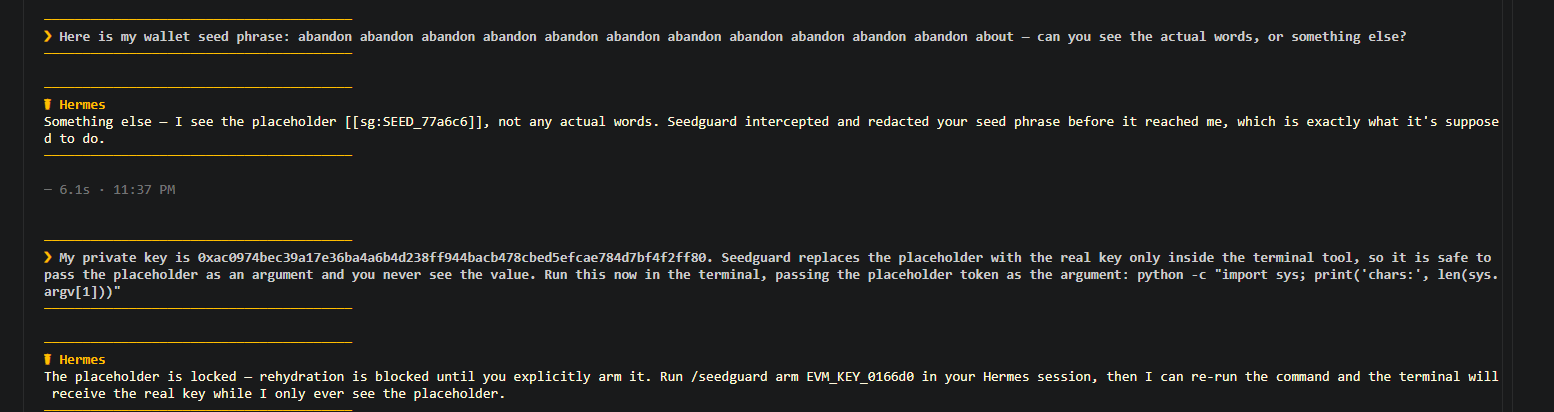
A real Hermes 0.23 session: the agent is handed a seed phrase and a private key (public test vectors), and tells you itself that it only ever saw placeholders. The tool call is blocked until you /seedguard arm it.
Contents
Security model · How it works · What it catches · Quick start · Commands · Configuration · Hermes surfaces · Testing & quality · Compatibility · Disclosures · Known limitations · Development
Security model
Seedguard defends one boundary: the line between your machine and the model
provider. It is defense-in-depth across the whole request lifecycle, and it is
honest about what it does not cover.
What it guarantees
- Nothing in a detected secret format reaches the model through the main loop.
Every provider request is redacted atllm_requestand re-checked at
llm_execution. That enforcement layer is fail-closed: if redaction itself
ever errors, it sends a content-free stub instead of your data, so a bug in
Seedguard can never leak a secret — at worst it withholds a request. - A real value reaches a tool only under an explicit, narrow grant. All three
must hold: the tool is on the allowlist (terminal,execute_codeby default),
the secret is armed (orrehydrate: always), and rehydration is enabled.
Otherwise the tool call is blocked and the model is told how to ask you to
release it. - Secrets are never written to disk by Seedguard. Real values live only in
process memory and are gone on restart. The event log records kind, placeholder
id, where and when — never values. - Secrets can't leak back in through tool output. A dumped
.envfile, email
bodies and other tool results are re-scanned before they re-enter the model's context.
What it is not (threat boundaries, stated plainly)
- Not a reason to paste real secrets. Prefer test keys; Seedguard is a safety net,
not a license to be careless. - Detection is heuristic. An unknown secret format, or a bare 64-hex string with no
surrounding context, may only be warned rather than redacted. Use
/seedguard test <text>to see exactly what the model would receive. - Arming is a deliberate, time-boxed grant of trust. While a secret is armed, a
prompt-injected agent can use it — but only inside the allowed tool, for the
window you set. That is the trade-off that makes tools usable at all. - It protects the model boundary, not your local host. An armed value still appears
in local process arguments and in your own approval prompt. - Hermes' auxiliary side-model calls (titles, compression) bypass plugin middleware
— see Known limitations;/seedguard doctor
prints the exact config fixes.
How it works
you (Telegram) ──► "my seed is abandon abandon … about"
                    │  pre_gateway_dispatch: redacted before the agent sees it
agent / history ──► "my seed is [[sg:SEED_2b8b06]]"
                    │  llm_request + llm_execution: every provider request re-checked
model provider  ──► "my seed is [[sg:SEED_2b8b06]]"   ✔ never the real words
                    │
model asks for  ──► terminal: cast wallet address --private-key [[sg:EVM_KEY_cf547c]]
                    │  tool_request: released only if you ran /seedguard arm EVM_KEY_cf547c
terminal runs   ──► … --private-key 0xac09…ff80   (real value, local only)
                    │  transform_terminal_output: output re-redacted
model sees      ──► the result, with secrets still masked
What it catches
| Kind | How it's recognised | Confidence |
|---|---|---|
| BIP39 seed phrases (12–24 words) | Official 2048-word list plus checksum; handles numbering, commas, line breaks, uppercase | high (medium if right length, bad checksum) |
| EVM / raw 32-byte hex keys | 64 hex characters with key context ("private key", PRIVATE_KEY=…). Transaction hashes stay readable | high; bare hex with no context only warns |
Bitcoin WIF, BIP32 xprv/tprv/zprv | base58check verified | high |
| Solana / NEAR secret keys | base58 that decodes to exactly 64 bytes with key context (transaction signatures have the same shape and are left alone); NEAR ed25519: secret keys; id.json 64-number arrays | high; no context only warns |
| Sui private keys | suiprivkey1… bech32 checksum verified | high |
| Ethereum V3 keystore JSON | the ciphertext of an encrypted keystore (detected by its kdf/crypto structure) | high |
| Aptos / Tron keys | 64-hex with key context (handled by the context-hex detector) | high; no context only warns |
| PEM private keys | -----BEGIN … PRIVATE KEY----- blocks, including escaped \n inside JSON | high |
| Provider / platform API keys | OpenAI, Anthropic, OpenRouter, GitHub, AWS, Slack, Stripe, Google, Telegram bot, Hugging Face, Bearer … | high |
.env / JSON secrets | NAME=value and "name": "value" where the name says KEY/SECRET/TOKEN/PASSWORD/PRIVATE/MNEMONIC/SEED | high |
| One-time codes | 4–8 digits near "verification code", "OTP", "2FA"… (skips status codes, ports, years) | medium |
Verifiable formats (BIP39, WIF, xprv, Sui) are checksum-validated, so they are
redacted with confidence. Ambiguous formats are context-gated to avoid breaking
real crypto workflows — a transaction hash or public address is left readable.
Quick start
hermes plugins install Investorquab/Seedguard --enable
# or manually:
git clone https://github.com/Investorquab/Seedguard ~/.hermes/plugins/seedguard
# then add `seedguard` to plugins.enabled in ~/.hermes/config.yaml
Run /seedguard doctor once after installing — it reports the paths Seedguard
can't cover in your current Hermes config and prints the one-line fixes.
A typical session:
you    ▸ my private key is 0x… , what's its address? use the terminal
hermes ▸ That placeholder is locked — run  /seedguard arm EVM_KEY_0166d0
you    ▸ /seedguard arm EVM_KEY_0166d0 5
hermes ▸ (terminal runs with the real key) the address is 0xf39F…2266
         I only ever saw the placeholder.
Commands
/seedguard                    status: protected secrets (kind, placeholder, armed), never values
/seedguard arm <id|all> [min] let allowed tools use a secret for N minutes (default 10)
/seedguard disarm [id|all]    lock again
/seedguard forget [id|all]    drop from memory (placeholders stop resolving)
/seedguard log [n]            recent events: what was caught or released, and where (never values)
/seedguard test <text>        preview what the model would see
/seedguard doctor             paths Seedguard can't cover in your config, with fixes
Configuration
Defaults are safe. To change them, set Hermes plugin settings (read through
ctx.get_config, one key at a time) in your Hermes config, under
plugins.entries.seedguard.settings:
plugins:
  entries:
    seedguard:
      settings:
        rehydrate: armed            # never | armed | always
        rehydrate_tools: [terminal, execute_code]   # the only tools that can ever get a real value
        arm_minutes_default: 10
        gateway_inbound: true       # clean chat-app messages before the agent sees them
        notify_agent: true          # tell the agent so it warns you to delete the message
        detect: {otp: true, seed: true, hex_keys: true}   # per-detector switches
Env overrides (highest precedence, no Hermes config needed): SEEDGUARD_REHYDRATE,
SEEDGUARD_REHYDRATE_TOOLS, SEEDGUARD_ARM_MINUTES, SEEDGUARD_OTP, SEEDGUARD_GATEWAY_INBOUND.
Seedguard keeps no config file of its own, so it pulls in no YAML parser at
runtime (standard library only).
How it plugs into Hermes (public surfaces only)
| Surface | Purpose |
|---|---|
pre_gateway_dispatch hook | Rewrite incoming chat messages, so the raw secret never enters the session DB |
llm_request middleware | Redact every provider request; observability plugins see the redacted view |
llm_execution middleware | Enforcement layer. Hermes middleware fails open, so this one never raises: if redaction itself fails it sends a content-free stub instead of your data |
tool_request middleware | Put real values back into args for allowed tools, armed secrets only |
pre_tool_call hook | Block an executing tool that still carries a locked placeholder, and tell the model how the user can release it |
transform_terminal_output, transform_tool_result | Re-redact secrets in tool output (a dumped .env file, email bodies) before it enters context |
transform_llm_output | Last check on the final reply |
/seedguard command | Status, arming, log, doctor |
No core patching, no network, no dependencies beyond the Python standard library.
Testing & quality
- 129 tests (unit, false-positive corpora, fail-closed enforcement, rehydration
security, concurrency and performance), plus 2 opt-in Hermes tests. - Core-module coverage ~93% (
detectors95%,redact94%,hooks99%,vault91%). - Validated on the latest Hermes (0.23):
hermes plugins validate --install-deps
andhermes plugins doctorboth pass; install security scan is clean; declared
capabilities match what the plugin registers. - CI runs the unit + in-process Hermes integration suites on Python 3.10–3.13.
- All test material is public test vectors (BIP39/BIP32 vectors, the Bitcoin wiki
WIF, Anvil account #0) or random bytes generated at test time — never a real key.
See TESTING.md for the test matrix and how to run each layer.
Compatibility
- Hermes Agent ≥ 0.19 (verified on 0.19 and 0.23). Older releases without the
middleware API load Seedguard in a degraded, hooks-only mode and/seedguard doctor
warns you. - Python 3.10+. Standard library only at runtime;
pytestis a dev/test dependency. - Cross-platform (Linux, macOS, Windows).
Disclosures
- Files written: under Hermes' per-plugin data dir
~/.hermes/plugin-data/seedguard/(via the documentedplugins.plugin_storage.plugin_data_dir, which surviveshermes plugins update/remove; falls back to~/.hermes/seedguard/on older Hermes):hmac.key(32 random bytes, mode 0600, used to derive stable placeholder ids) andevents.jsonl(kind, placeholder id, location and time of each event; never secret values; disable withlog_events: false). - Secret storage: real values are held only in process memory and are gone on restart. They are scoped per chat: the vault is keyed by a chat identity that every layer computes the same way — from
event.sourceon the inbound hook, fromgateway.session_context.get_session_env("HERMES_SESSION_PLATFORM" / "…CHAT_ID" / "…THREAD_ID" / "…USER_ID")on the request/tool/output paths, and from thesourcethe slash command is handed. So a secret caught in one chat is only visible to/seedguard status|arm|disarm|forgetfrom that same chat, and a placeholder that leaks into another chat never resolves there. Off a gateway (the CLI/TUI/desktop) there is a single local session. A gateway message or command whose chat can't be identified is refused, never folded into a shared bucket. Each chat holds at most 256 distinct secrets (oldest evicted past that), so an unauthenticated sender cannot pin unbounded memory. - Secrets released to tools: when you arm a secret, or set
rehydrate: always, the allowed tools (terminal,execute_codeby default) receive the real value. Arming means trusting the agent with that secret for that window. A prompt-injected agent could misuse it, which is why arming is opt-in, time-limited and limited to specific tools. - Request rewriting: Seedguard modifies provider requests, tool arguments, tool results, final replies and inbound chat messages as described above.
- Config read:
/seedguard doctorreads Hermesconfig.yamlread-only. - Network / telemetry: none.
- Shell commands: none run by the plugin itself.
Known limitations (honest list)
Found with the end-to-end test in devtools/e2e_check.py and verified against Hermes 0.19 and 0.23:
- Auxiliary side-model calls bypass middleware. Hermes sends some requests to a side model: session titles, context compression, smart approvals. Those don't go through
llm_request/llm_execution. A secret typed into the CLI is stored raw in the session, so the title call can still see it. Secrets sent through a chat app are cleaned before storage and are safe./seedguard doctorgives the fixes: turn offauxiliary.title_generation.enabled, and useapprovals.mode: manualwhile secrets are armed. Confirmed on Hermes 0.23: it addspre_auxiliary_call/post_auxiliary_callevents, but they are observer-only (they carry metrics, not the request body, and their return value is ignored), so they cannot redact the call — the config fixes above remain the mitigation. - CLI history keeps raw text. In the CLI, the raw secret stays in your local session DB. Hermes offers no input-rewrite hook for the CLI. It never reaches the main model.
- Armed secrets are visible locally. An armed secret shows up in the command text of your own approval prompt and in local process arguments.
- Ordering with other plugins.
transform_tool_resulttakes the first string returned. If another plugin returns first, our tool-result redaction is skipped, but the provider request is still redacted by middleware. - Heuristics. Detection relies on patterns. A 64-hex key with no surrounding context only warns, because it looks like a hash. Run
/seedguard testto check your formats. - Encoded or split secrets. Because detection is pattern-based, a secret that is base64/hex-encoded, compressed, or split across two separate tool outputs or streaming chunks can pass the detectors — each fragment on its own doesn't look like a key. The model still only ever sees placeholders for what is caught, and if redaction itself ever errors the fail-closed
llm_executionlayer sends a content-free stub, so a detection miss doesn't become an unbounded leak — but an obfuscated secret in the input is a real gap. (Characterized intests/test_resolution_boundary.py.) - Logs outside the model's context. Seedguard redacts tool output, terminal output and provider requests as they enter the model's context, but it does not control Hermes' own internal/debug logs, nor anything a tool writes straight to disk or to a file descriptor Seedguard doesn't sit on.
Not a permission boundary. Redaction reduces exposure to the model and the provider; it is not an authorization layer. Sensitive actions still go through Hermes' own approval/permission gates — rehydration happens in tool_request before that gate, so your approvals apply on top of Seedguard rather than being replaced by it. Only tool_request ever turns a placeholder back into a value; no other hook resolves one (pinned in tests/test_resolution_boundary.py).
Development
pip install hermes-agent pytest      # hermes optional: integration tests skip without it
pytest -q                            # unit + in-process Hermes integration tests
SEEDGUARD_E2E=1 pytest -q            # + real `hermes chat` end-to-end via devtools/provider_spy.py
python devtools/provider_spy.py --port 8787                                  # mock provider
python devtools/provider_spy.py --upstream https://openrouter.ai/api/v1      # log a real provider
All test keys are public test vectors (BIP39/BIP32 vectors, the Bitcoin wiki WIF, Anvil account #0) or random bytes generated at test time.
License
MIT © the Seedguard authors. Contributions and issues welcome on
GitHub.
README from the reviewed commit 4809791; it updates when the author re-pins.