vykhovanets
hermes-plugin-stack-memory
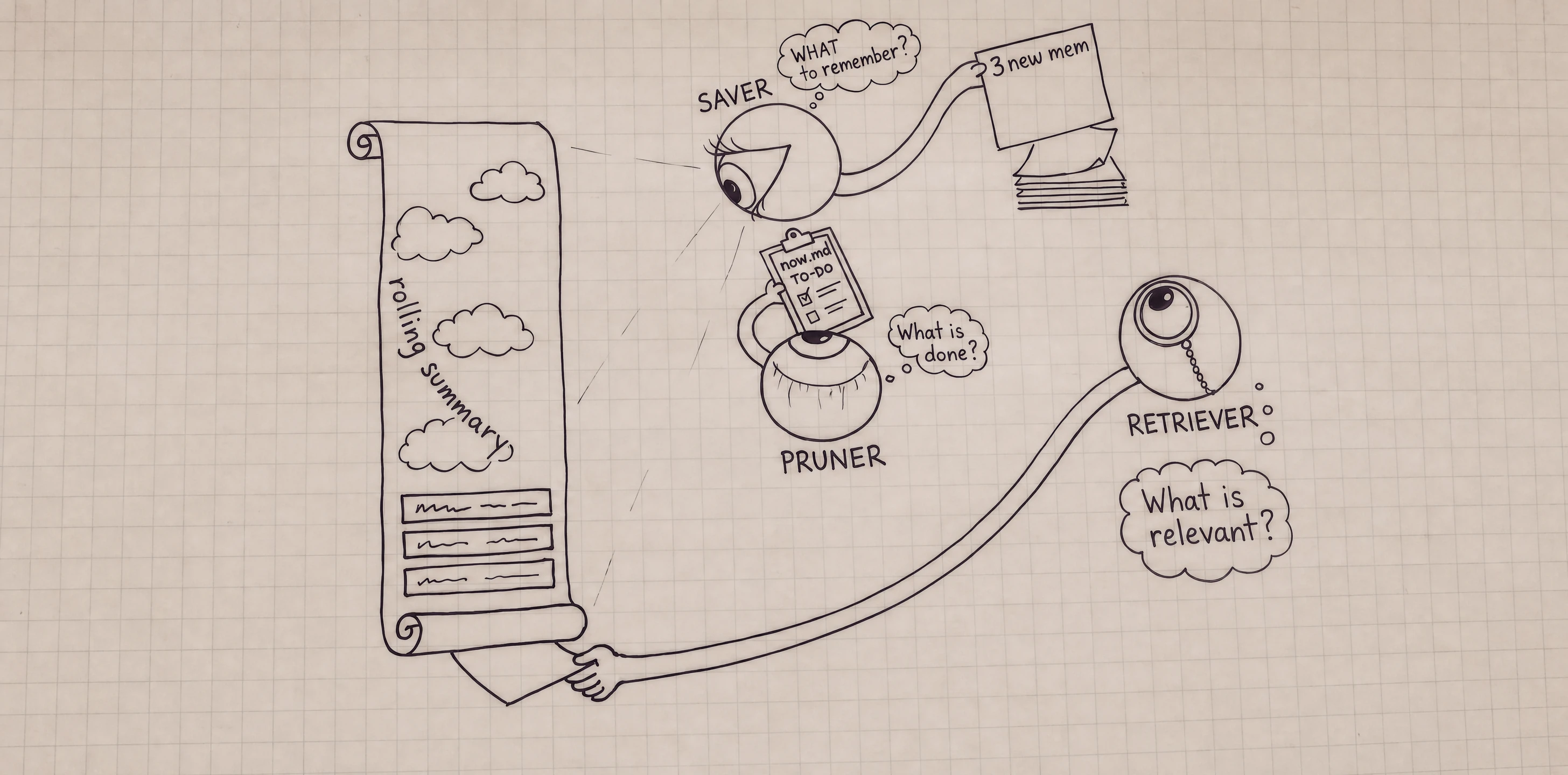
A Hermes memory-provider plugin for a git-backed
markdown memory store that an agent maintains and reads. The plugin is program (engine, schema,
saver); the store is data only. Memorizing and remembering run in the background.
Setup
hermes plugins install Karb-Interactive/hermes-plugin-stack-memory --enable
hermes config set memory.provider stack
hermes memory setup
hermes config set auxiliary.<component>.{provider,model}
hermes gateway restart

hermes -p <profile> plugins install <repo>     # install into a named profile
Models are set separately from hermes memory setup because they are not part of the provider's own
config schema. On first run the plugin creates and commits its own store at $HERMES_HOME/memories/stack
(normally ~/.hermes/memories/stack). Needs uv and git on PATH and a configured Git name/email.
Each profile installs the plugin itself and gets its own store. hermes memory setup is where you set
cadence, max_iterations, now_max_chars, the store, and the dataset option.
Models
Stack makes three model calls. By default each inherits your main model; each can be routed to its
own. The retriever and summarizer are quick, no-tool calls — favor speed. The saver is a
judgment-heavy tool loop that edits the store — favor capability.
hermes memory setup                       # interactive; sets all three

# or set them directly — the example config used by @vykhovanets:
hermes config set auxiliary.retriever.provider ollama-cloud
hermes config set auxiliary.retriever.model nemotron-3-super     # fast; no tools
hermes config set auxiliary.summarizer.provider ollama-cloud
hermes config set auxiliary.summarizer.model nemotron-3-super    # fast; no tools
hermes config set auxiliary.saver.provider ollama-cloud
hermes config set auxiliary.saver.model glm-5.3-flash             # agentic; edits the store
hermes config set warns that the auxiliary.* paths are unrecognized keys — expected, they are
read by the plugin, not core. The saver ignores any timeout set under auxiliary.*.
How it works
Four beats, all in the background:
- Session start — injects the store's context (
now.md,user.md, the index) once, as a stable
system-prompt block served from the prompt cache. - Every turn — the retriever picks ≤3 relevant pages and injects their current bodies.
- Every few turns — the saver decides what is durable, searches existing memory before writing,
edits what it finds, commits, then reconcilesnow.md. Pending turns are also flushed at session
end and before compression. A run may legitimately save nothing. - Curation — the main agent is given no stack tools (
get_tool_schemas()returns[]); store
writes go through the background saver.
| Component | Slot | Job | Shape |
|---|---|---|---|
| Retriever | auxiliary.retriever | ≤3 relevant pages per message | one call, no tools |
| Summarizer | auxiliary.summarizer | compresses the rolling context the saver reads | one call, no tools |
| Saver | auxiliary.saver | writes durable facts; reconciles now.md | agent: search · read · patch · terminal |
Stores
A store is data only — wiki/ + config.json + git history. To share one across profiles, point
them at the same absolute repo_path. It is an ordinary git repository: back it up by pushing it,
and a local-only store is legal. engine.py doctor warns when the branch has no upstream. On first
run the plugin commits the new store; the saver also pulls, commits, and pushes it.
Share a store with a team via submodules. Any wiki/<org>/ folder can be a git submodule (a
checkout under wiki/, backed by its own repo), so teammates pull the same shared knowledge while
the rest of the store stays private:
git -C <store> submodule add <org-wiki-repo> wiki/<org>   # e.g. git@github.com:acme/wiki-acme.git
git -C <store> commit -am "add shared wiki/<org>"
Submodules are pulled at session start; the saver pulls, commits, and pushes them with your
credentials. engine.py doctor reports a submodule that is uninitialized, behind, or ahead.
Configuration
| Key | Default | Where | Effect |
|---|---|---|---|
memory.provider | "" | config.yaml | Must be stack; with "" the plugin never loads. |
memory.stack.cadence | 4 | config.yaml | Completed exchanges between saver runs. Lower = more frequent, more tokens. |
memory.stack.max_iterations | 18 | config.yaml | Tool-call budget for one saver run. A fact-dense session can exhaust a smaller budget mid-write (empty pages, no commit). |
memory.stack.now_max_chars | 6000 | config.yaml | Size limit for now.md in characters, frontmatter included. After the prune turn the saver gets up to two more turns to shorten it. |
memory.stack.retrieval | shortlist | config.yaml | shortlist: BM25 over page bodies ranks the pages first, and the retriever chooses only from the top 10. catalog: the retriever chooses from every page. |
memory.stack.dataset_enabled | false | config.yaml | Writes a local debug/dataset file of raw turns and tool traces. Off by default. |
repo_path | profile-local | $HERMES_HOME/stack.json | Store this profile reads/writes; an absolute path shares one store between profiles. Absent ⇒ $HERMES_HOME/memories/stack. |
auxiliary.{retriever,summarizer,saver}.{provider,model,api_key,base_url} | main model | config.yaml | Route each component to its own model (see Models). |
Project-folder mapping — the store's config.json (at the store root, git-ignored, absent by
default). To have Stack pick project context from the current directory and resolve source anchors,
copy config.example.json to config.json and map its org/project keys to local folders (~ and
$HOME are supported, e.g. "path": "$HOME/Code/acme"):
{"orgs": {"acme": {"is_container": true,
  "projects": {"widget": {"path": "$HOME/Code/acme/widget", "aliases": ["widget"]}}}}}
Recreate those paths when moving between machines; the wiki pages themselves are portable. This is
separate from stack.json, which selects the store.
Data and permissions
- Model calls leave the machine with a remote provider: the retriever sends the message + page
catalog, the saver the buffered excerpts + rolling summary + store paths + catalog, the summarizer
the excerpts + previous summary; selected pages also reach the main model. - Local access: the saver is a background tool-using agent under the Hermes process's
permissions (search, read, patch, terminal). Not a sandbox; memory writes have no human gate. It
does not pass YOLO/skip-approval or bypass Hermes approval guards. Thestore_jailguard is armed
only on the saver's thread, so the main agent's own file and terminal tools are not confined to the
store. - Containment: a thread-scoped
pre_tool_callguard blocks a destructive command (rm,mv,
cp,chmod,>/>>,sed -i, …) naming an absolute path outside the store. It is
shape-independent and fails open on relative paths,cdstate, and in-process mutations; reads and
executions stay open. A guard, not a sandbox — the store is the boundary and git is the undo. - Git: the saver pulls, commits, and pushes the store with your credentials; a remote is
optional, anddoctorwarns if the branch has none. Configure a remote for the intended audience
— the plugin does not make one private. The opt-indataset_enabledfile (raw turns, no rotation)
lives under$HERMES_HOME/memories/.stack-provider/; no outbound telemetry.
Engine
engine.py (at ~/.hermes/plugins/stack/engine.py) is the single runtime and is harness-neutral —
no Hermes imports; any harness can call it, and it need not be copied into a store. check and
doctor are the maintenance commands (run against a real store, e.g. --repo ~/System/stack):
uv run --no-project engine.py --repo <store> load    [cwd]   # context + page catalog
uv run --no-project engine.py --repo <store> resolve [cwd]   # cwd -> (org, project) + page set
uv run --no-project engine.py --repo <store> verify  <page>  # anchors -> verified|drifted|unknown
uv run --no-project engine.py --repo <store> sync    <page>  # set synced_at to today after a re-check
uv run --no-project engine.py --repo <store> check   [cwd]   # health: verify-all, dangling links, orphans
uv run --no-project engine.py --repo <store> create  ...     # write a page (stages; does not commit)
uv run --no-project engine.py --repo <store> doctor          # config, git state, submodules
uv run --no-project engine.py --repo <store> init            # create a minimal store at an absent path
Develop
STACK_PROVIDER_DEBUG=1 hermes            # logs seams to $HERMES_HOME/logs/stack-provider.log
PYTHONPATH=$HOME/.hermes/hermes-agent:$HOME/.hermes/plugins \
  uv run --project $HOME/.hermes/hermes-agent --no-sync \
  python -m unittest discover -s tests -p 'test_*.py'
tests/test_vocab.py runs standalone; tests/check_profile_store.py exercises profile/store
resolution against temp HERMES_HOMEs. Behaviour is defined by the code and tests; the old v1 spec
was deleted and lives in Git history.
Principles
Own the data; the harness is a replaceable surface. Autonomy is additive-only. Raw sources stay
where they are — only extracted knowledge and anchors live in the store.
README from the reviewed commit a1763ec; it updates when the author re-pins.