
 whiskybeer
ToolRecall Light (toolrecall-light)
Your agent pays for the same tool output on every turn after the first. This plugin stops that — and keeps the bytes recallable.
A plugin for Hermes Agent. When a tool result repeats
— the same pytest run, the same search_files scan, the same MCP call — the model receives a
one-line stub instead of the full payload. The original is kept in a local SQLite file and comes back
byte-for-byte through recall_result(result_id) whenever the model actually needs it.
Why it matters: a 40 KB traceback emitted on turn 3 is still in the transcript on turn 9, and is
re-sent with it. Long sessions pay for the same output ten, twenty times.
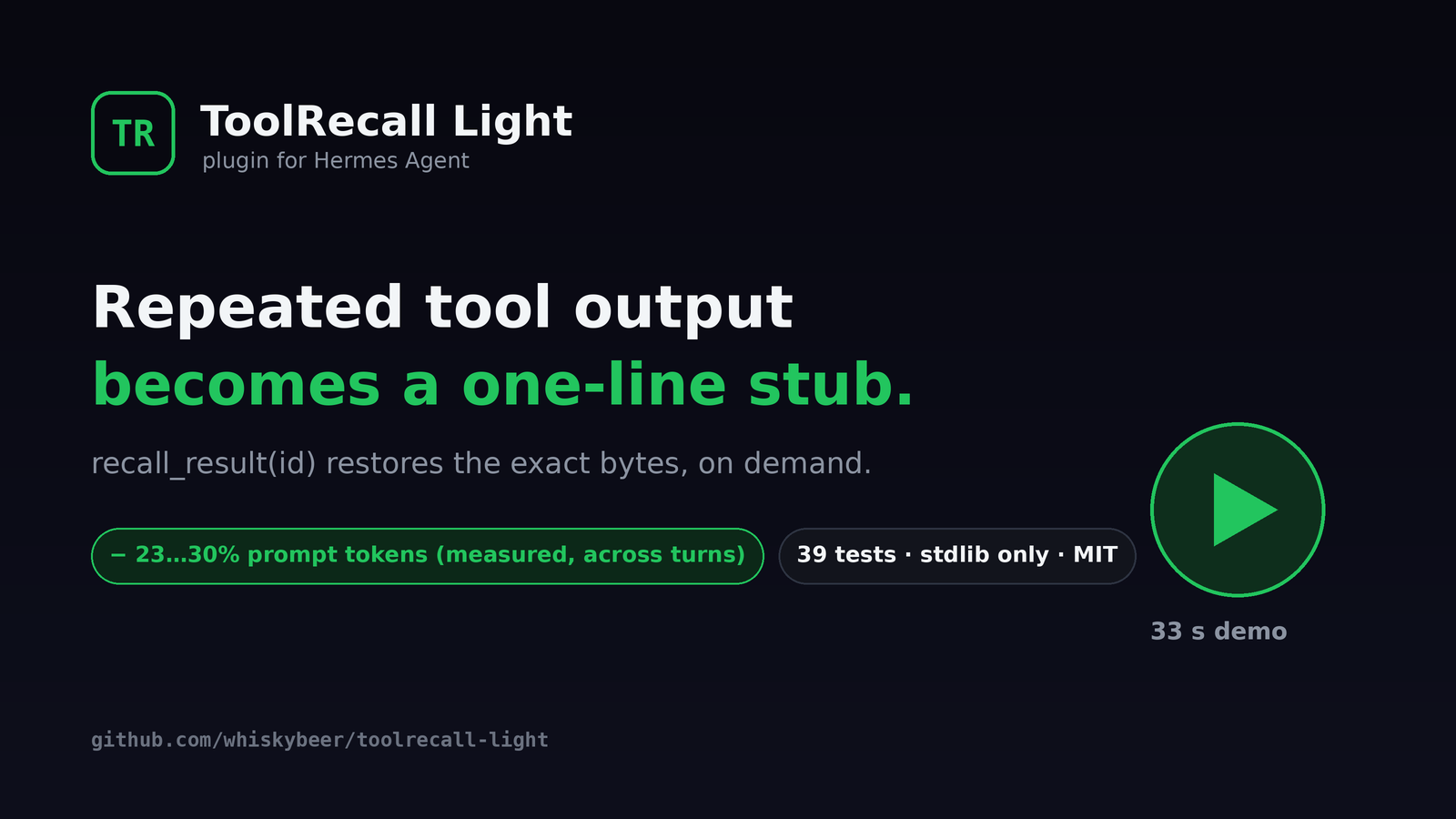
33-second overview. The longer technical walkthrough (100 s, narrated, shows the store and recall_result): assets/demo.mp4.
[toolrecall-light] identical to earlier terminal result 50f59afa067a (2317 bytes) in this session.
Call recall_result(result_id="50f59afa067a") if you need the full content.
Measured across turns — 4-turn session, 40 KB result repeated each turn, real billed ledger:
−23.2 % / −29.6 % total prompt tokens, −24 % / −30 % cost. It is not a within-turn win:
core already dedups repeats inside a turn and does it more cheaply. The breakdown, including where
this plugin loses, is in Evidence, by provenance.
hermes plugins install https://github.com/whiskybeer/toolrecall-light
Zero dependencies, stdlib only, fail-open. Looking for host-wide multi-agent pooling, MCP multiplexing,
or forward proxy stream replay? See ToolRecall Core.
Why ToolRecall Light?
Since Hermes v0.23.x, core already deduplicates byte-identical tool results within a single turn:
agent/tool_guardrails.py replaces a repeat from the 2nd occurrence (IDENTICAL_RESULT_STUB_MIN_CHARS = 512)
and calls reset_for_turn() at every turn boundary. Measured on v0.23.1, 6 identical 40 KB terminal
calls in one turn: with the plugin 306 k prompt tokens, without it 255 k — core alone is better, because
its stub is cheaper and the plugin occasionally provokes an extra call.
What core does not do is carry that across turns. That is the gap this plugin fills:
- a 40 KB result emitted on turn 1 is re-sent in full on turns 2, 3, 4 … because the per-turn state was reset;
- this plugin keys on
(tool, args)per session, so later turns receive the stub.
Measured, 4-turn session, the same 40 KB command once per turn (2 seeds):
| Arm | turn 1 | turn 2 | turn 3 | turn 4 | total prompt | cost |
|---|---|---|---|---|---|---|
| plugin on | 33,943 | 116,198 | 199,058 | 282,752 | 631,951 | $0.002367 |
| plugin off | 54,889 | 145,098 | 269,478 | 428,439 | 897,904 | $0.003080 |
| plugin on (seed 2) | 45,218 | 127,485 | 210,343 | 294,027 | 677,073 | $0.002337 |
| plugin off (seed 2) | 55,747 | 137,969 | 263,779 | 423,882 | 881,377 | $0.003671 |
- 23.2 % and 29.6 % fewer total prompt tokens; −30.6 % / −34.0 % on the final turn, where
compounding is largest; cost −24 % / −30 % (provider ledger,--usage-file). - Turn-1 baselines differ between arms by 10–21 k tokens for a reason we could not attribute (same prompt,
one call each). The per-turn comparison from turn 2 onward is the stable part: −23.5 % / −29.1 %.
toolrecall-light intercepts these repeats before they enter context, saves them to local SQLite, and serves a 1-line stub. If the model ever needs the exact original lines back, it uses the tool to recall tools: recall_result.
Evidence, by provenance
Numbers in this project are labelled by how they were produced. Do not read across categories.
1. Measured — duplicate rate in real Hermes sessions (state.db)
Query over the local Hermes state.db (snapshot: 659 sessions with tool calls, 135,038 tool
results; re-computed 2026-11, reproduces within ~3 % of the 668-session figures first published):
- 58.4 % of tool results ≥ 2,000 characters are exact intra-session duplicates
(16,859 duplicate rows of 28,866 candidates; 60.1 % on the earlier snapshot). - Those duplicates account for 74.6 MB of redundant payload (71.1 MB on that snapshot).
terminalalone contributes 2,067 large duplicate results (> 10 MB raw).
This measures duplication in transcripts. It is not a token-saving percentage.
2. Derived — streak-guard capture efficiency (95.35 %)
Computed by replaying the observed duplicate corpus through the streak algorithm. It says how many
duplicates the guard still catches at streak = 5; it is not a context or cost reduction.
3. Modelled — 20-turn A/B simulation (bench/run_benchmark.py)
Deterministic and reproducible, but not a session measurement: the transcript is a hand-written
20-turn SWE scenario, tokens are estimated as chars / 4, and cost assumes $3.00/M prompt tokens.
- -54.04 % cumulative prompt tokens on that synthetic workload (73,348 tokens).
- Valid only for the regime it models: a small fixed context (~1 k tokens/turn) with duplicates
that dominate it. It does not transfer to sessions with a ~12 k-token system prompt.
4. Measured — live sessions, real billed ledger (--usage-file)
4a. Within one turn (where core already dedups). 6 identical terminal calls, 7,014-char
results (3 runs/arm) and 40,363-char results (2 runs/arm), deepseek-v4.1-flash-1017:
- 7 KB: total prompt 101,313 (plugin) vs 101,845–101,968 (none) — ~0.5 %, inside noise.
- 40 KB: 306,130 (plugin, 8 calls) vs 254,662 (none, 7 calls) — the plugin is ~20 % worse.
Core's own stub (512-char floor, replaces from the 2nd repeat) already covers this case more cheaply,
and the plugin occasionally provokes an extra call.
4b. Across turns (where core resets). 4-turn session, the same 40 KB command once per turn:
631,951 vs 897,904 and 677,073 vs 881,377 prompt tokens (−29.6 % / −23.2 %), cost
$0.0024 vs $0.0031–0.0037. See the table above; turn-1 baseline drift is called out there.
Net: the plugin's measured value is cross-turn duplicate suppression, not intra-turn.
5. Microbenchmark — recall latency
0.28 ms average recall_result round-trip against local SQLite (in-process, this machine).
Real for that operation; not a network or end-to-end number.
Model-Facing Stub & Recall
When an identical result is detected, the model context receives a compact stub:
[toolrecall-light] identical to earlier terminal result 50f59afa067a (2317 bytes) in this session.
Call recall_result(result_id="50f59afa067a") if you need the full content.
If the agent needs the full traceback or compiler lines, it invokes recall_result:
{
  "name": "recall_result",
  "arguments": {"result_id": "50f59afa067a"}
}
recall_result returns the exact byte-for-byte original content in sub-millisecond time.
Run one, not both (co-installation with ToolRecall core)
ToolRecall core (daemon + forward proxy + MCP bridge) and this plugin both rewrite tool results
before the model sees them, at different layers. They do not crash each other, but they overlap:
- core sends full content for a bridge/shim file read;
- this plugin replaces that content with its own stub;
- core then records a full send the model never received, so its
mcp_dedupcounters overstate
what actually reached the model.
Install one. If core is running, you do not need this plugin — core already dedups file reads
and its proxy is the only layer that reduces billed tokens for the current turn. Keep core:
hermes plugins disable toolrecall-light. Keep this plugin: toolrecall stop and remove its
proxy/MCP wiring.
Detection is built in on both sides:
- this plugin checks at
register()and logs one warning naming what it found (proxy:8569,
MCP bridge, active shim, importable package); the same result is available as
status()["core_conflict"]; - core reports an enabled/installed plugin in
toolrecall healthcheck.
Hardened Safety & Non-Goals
- Loop Breaker (Streak Guard): Forces full content pass-through after 5 consecutive stubs for the same key (configurable via
HERMES_TOOLRECALL_LIGHT_MAX_STUB_STREAK) to prevent stuck model evaluation loops while preserving 95.4% deduplication efficiency. - Compaction Aware (
post_compaction): When history is compacted (/compress), the generation advances; the first repeat post-compaction re-serves full content once before re-stubbing. - 100% Fail-Open: Any database error or exception cleanly returns
None(passes through raw result untouched). - Zero Runtime Dependencies: Python stdlib only (
sqlite3,hashlib,json). - No Core Overrides: Built on official Hermes v2 hooks (
transform_tool_result,post_compaction) andctx.register_tool(Catalog Rule 9 compliant). - Defense-in-Depth Security: Parameterized SQL queries, 2 MB payload cap (
MAX_CHARS), cryptographic SHA-256 verification, and zero network egress. SeeSECURITY.mdfor the full threat model and trust boundary documentation.
Installation
Via Hermes Plugins CLI (Recommended)
hermes plugins install https://github.com/whiskybeer/toolrecall-light
Via Git Clone
git clone https://github.com/whiskybeer/toolrecall-light.git ~/.hermes/plugins/toolrecall-light
hermes plugins enable toolrecall-light
Local Development Symlink
mkdir -p ~/.hermes/plugins
ln -s /path/to/hermes-tool-recall ~/.hermes/plugins/toolrecall-light
hermes plugins enable toolrecall-light
Is it firing? (activation is observable)
"Installed" is not "active". A plugin can be on disk, listed in
plugins.enabled, and still never run — a mismatched manifest key, a hook the
host does not invoke, or every result under the size floor all look identical
from the outside. This plugin therefore persists its own counters and exposes
status():
| Signal | Meaning |
|---|---|
| loads == 0 | never registered with the host — check the manifest key (toolrecall-light), not the directory name, in plugins.enabled |
| hook_calls == 0 | registered, but transform_tool_result is never invoked |
| stubs == 0, hook_calls > 0 | invoked; nothing qualified (min_chars floor, or every tool on the ignore list) |
| stubs > 0 | working — last_stub_at is the last stub time, passes the full sends |
Enable it by the manifest key, never by path:
hermes plugins enable toolrecall-light     # key from plugin.yaml "name:"
hermes plugins list | grep toolrecall      # must read "enabled"
Counters live in the plugin's own SQLite store (stats table) and survive log
rotation; loads/first stub also emit one INFO line each so the host log
answers "did it load?" without a shell.
Store hygiene: results carry the bytes behind every stub, so a sweep runs at
most every 6 h on the stub path (gc_ttl_hours = 24), pruning expired results
and dead per-session rows.
Validation & Testing
# Run test suite (29/29 unit & integration tests)
pytest tests/ -v

# Run official Hermes plugin admission check
hermes plugins validate .
Configuration
| Environment Variable | Default | Description |
|---|---|---|
| HERMES_TOOLRECALL_LIGHT | 1 | Global kill-switch (0 or off to disable). Also respects legacy HERMES_TOOL_RECALL. |
| HERMES_TOOLRECALL_LIGHT_MIN_CHARS | 2000 | Minimum character length before deduplication is considered. |
| HERMES_TOOLRECALL_LIGHT_MAX_CHARS | 2000000 | Maximum character length (2 MB; 0 = unlimited). |
| HERMES_TOOLRECALL_LIGHT_MAX_STUB_STREAK | 5 | Consecutive stubs before forcing full pass-through once. |
| ttl_hours | 24 | TTL duration for database garbage collection. |
Benchmark Receipt (20-turn SWE Trajectory)
Modelled, not measured: this is the synthetic 20-turn scenario from bench/run_benchmark.py — small
fixed context (~1 k tokens/turn), tokens estimated as chars / 4, $3.00/M assumed. It describes that
workload only; the measured numbers are the cross-turn A/B in Evidence.
| Metric | Baseline (Vanilla) | Treatment (With toolrecall-light) | Impact |
|---|---|---|---|
| Stubs Emitted | 0 | 11 stubs | - |
| Deduplicated Bytes | 0 B | 33,639 B | - |
| Cumulative Prompt Tokens | 135,937 tokens | 62,477 tokens | -73,460 tokens (-54.04%) |
| Billed Cost ($3/M tokens)| $0.4078 | $0.1874 | $0.2204 saved (54.04%) |
| Recall Latency | N/A | 0.23 ms | Sub-millisecond |
See full report: bench/results/BENCHMARK_REPORT.md
License
MIT © 2026 Robin Schultka robin@toolrecall.dev
Project page: toolrecall.dev
README from the reviewed commit 96c2cfd; it updates when the author re-pins.


