
 mochiNJ
Waypoint — session status for Hermes Desktop
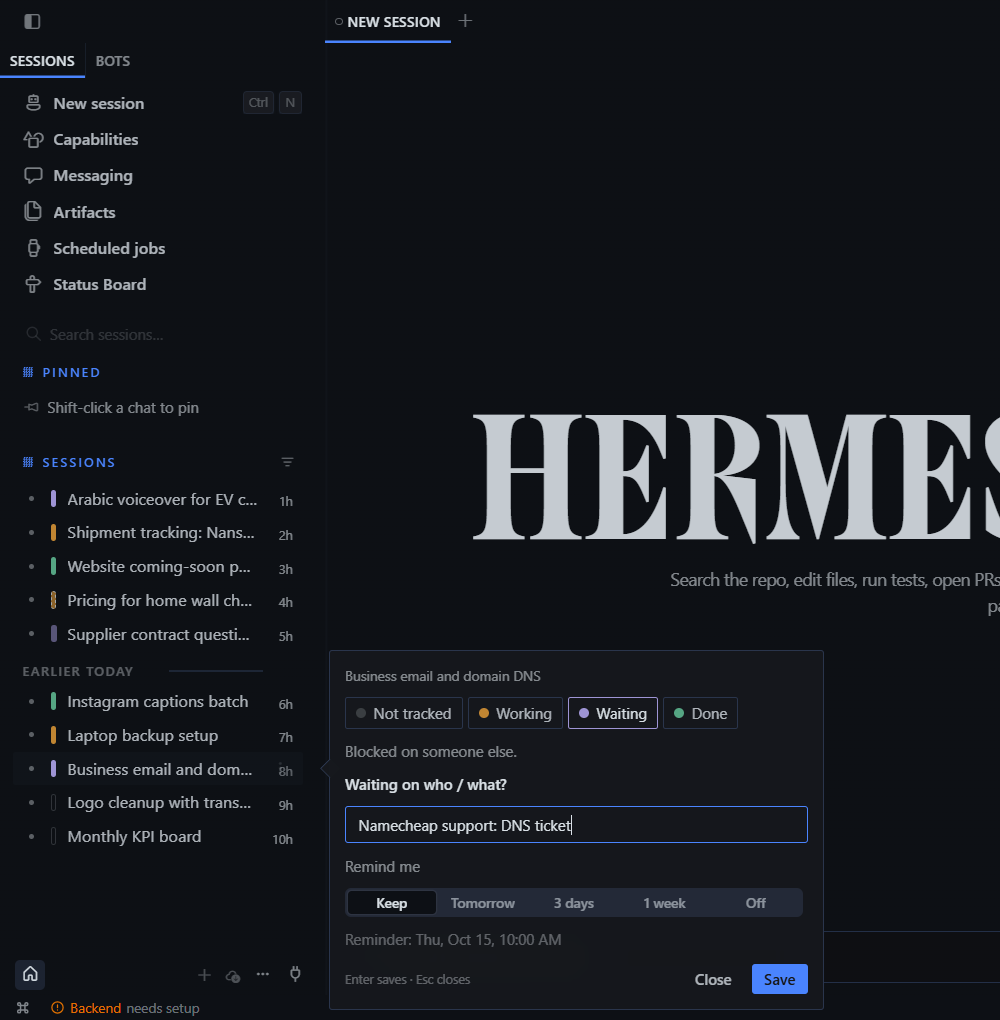
Never lose your place again. Waypoint puts a thin status bar next to every
session in the Hermes sidebar, so you can see at a glance which conversations are
still open, which are stuck on someone else, and which are finished.
Why
If you work with an AI agent all day, you start ten things, switch projects, and
come back three days later to a sidebar of forty sessions. Which one did you
finish? Which one was waiting on a supplier's documents? Where did you stop?
Waypoint answers those questions with four states, on purpose. More colours
means more thinking, so it stays at four:
| Bar | State | What it remembers |
|---|---|---|
| ▯ grey | Not tracked | nothing |
| 🟨 yellow | Working | your next step: where you stopped |
| 🟪 purple | Waiting | who/what you're waiting on, plus a follow-up reminder |
| 🟩 green | Done | the outcome, and a one-click fresh start |
New in 2.1: suggested next steps
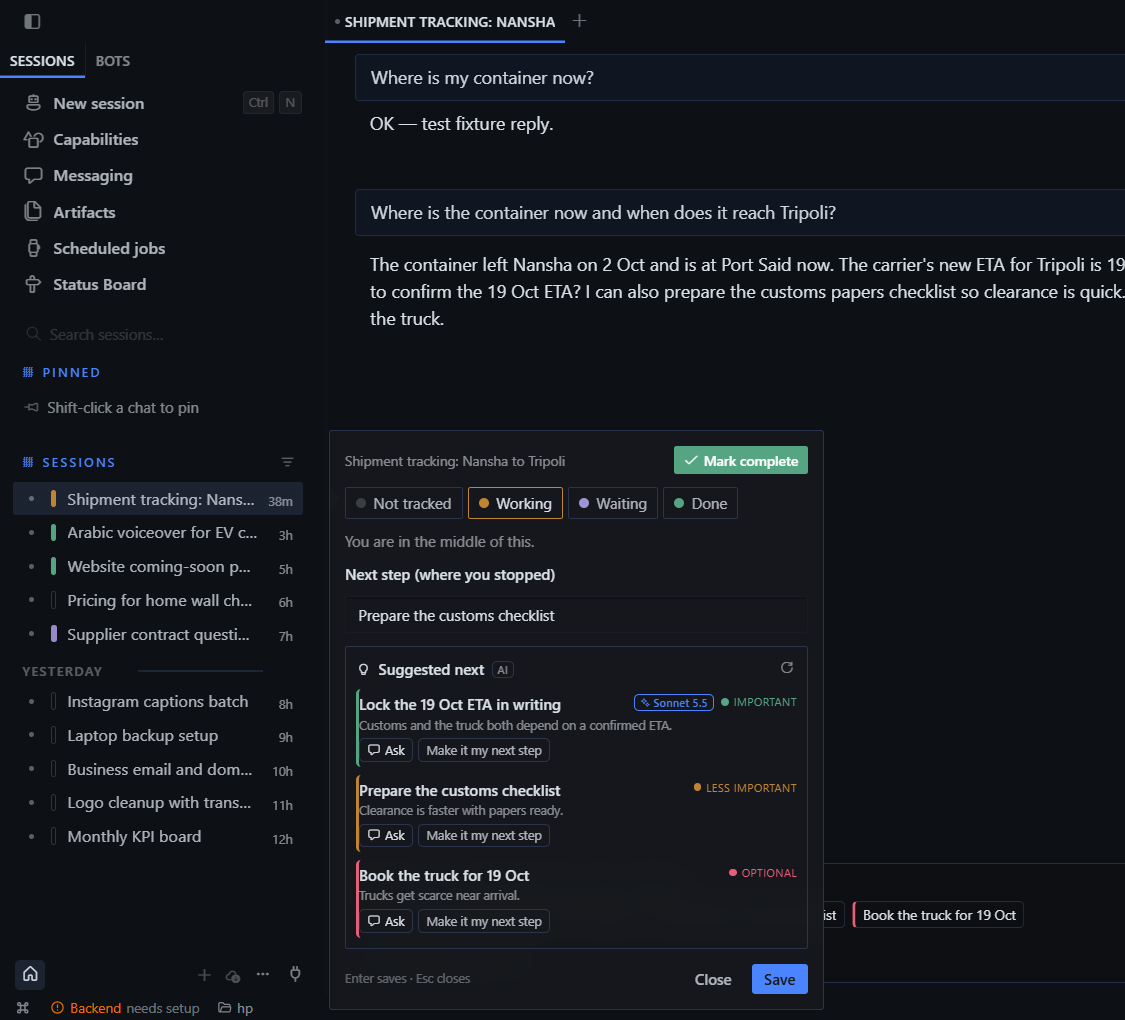
Every session gets 3 ideas for what to do next: in the status card, and as one-click chips
above the message box (Next: Confirm the 19 Oct ETA · Prepare the customs checklist · …).
- Quick ideas are instant, free and never leave your computer. They come from offers the
assistant just made ("Want me to…", "I can also…"), plus sensible defaults for the
session's status: a follow-up draft when you're Waiting, a handoff summary when you're Done. - AI ideas (opt-in) are written by your auxiliary model, the same cheap model Hermes uses
to name your sessions, from the last messages of the open session. Each idea comes with a
reason and a ready-to-send message. They refresh automatically after a reply, at most once
every 90 seconds and only when there are new messages. - Ask puts the idea's message in the chat box, and you press send. Make it my next step
saves it as the Working note, so it shows up in the resume banner and on the board.
Turn AI ideas on from the card (Turn on AI suggestions) or in Board → Settings
(Off / Tracked sessions / All sessions).
⚡ Power up: strong-model ideas on demand
Feeling stuck? Press ⚡ Power up in the status card or on the Next: row. Waypoint sends a
longer slice of the chat to your strong model and gets back 3 sharper ways to continue,
each with a reason, a priority and a ready-to-send message. It runs only when you press it,
so your strong-model usage stays under your control. The ideas stay on screen until the chat
moves on.
Choose the model with one click: the arrow next to the button opens a menu with Strong
model 1, Strong model 2 and My chat model (the open session's own model). Picking one
runs Power up right away and remembers it as the default.
Strong models 1 and 2 are Hermes auxiliary tasks. With the Python half enabled they appear as
Waypoint power up (model 1/2) in the auxiliary picker, or set them directly:
hermes config set auxiliary.waypoint_ideas.provider anthropic
hermes config set auxiliary.waypoint_ideas.model claude-opus-5-5
hermes config set auxiliary.waypoint_ideas.reasoning_effort high
hermes config set auxiliary.waypoint_ideas_2.provider anthropic
hermes config set auxiliary.waypoint_ideas_2.model claude-sonnet-5-5
Then name them in Board → Settings (e.g. Opus 5.5 and Sonnet 5.5). If you leave them unset,
they fall back to your cheap auxiliary model.
There is also an optional switch that adds one strong-model "big idea" automatically in the
background, refreshed at most every 10 minutes; it is off by default.
Power up log: each Power up call on strong model 1 or 2 writes one line to the Hermes log
(logs/agent.log) with the model, reasoning effort, response time and token counts:
Waypoint power-up call: task=waypoint_ideas model=claude-opus-5-5 effort=high (configured=high) time=11.70s tokens in=3648 out=991 (incl. thinking) total=4639 finish=stop status=ok
It also adds a record to plugin-data/waypoint/power-calls.jsonl in your Hermes folder (capped at
about 1 MB). Your messages and the ideas are never logged. If your Hermes version doesn't pass
token counts to plugins for your provider (today: the Anthropic route of auxiliary tasks), the line
says tokens unknown and one warning explains why, rather than showing a misleading 0. This needs
the Python half enabled.
Priority colours: 🟢 important · 🟡 less important · 🔴 optional. Ideas are sorted by priority.
Mark complete: the green button at the top of the status card turns the bar green and
stops suggestions for that session. Choose Working to bring them back.

Features
- One-click status. Click the bar to cycle grey → yellow → purple → green.
Right-click (or Shift+click) opens the status card. Keys 1–4 pick a state,
Enter saves and Esc closes. - Waiting on someone. Turning a bar purple asks "Waiting on who / what?"
and "Remind me: Tomorrow / 3 days / 1 week". When the reminder is due you get
an in-app toast (Open session / Remind tomorrow) and a native OS
notification if you're away. The bar also pulses until you deal with it. - Resume banner. Open a Working session and the composer shows "Where you
stopped: render the Arabic version", with Insert to drop it into the
message box. - Fresh start with a handoff. From a Done session, Start fresh session
opens a new chat already holding a@session:link back to the old one, plus
your outcome and next step. The agent can pull that context without you
re-explaining anything, and the new session stays short and fast. - Status Board (sidebar → Status Board). Shows Working / Waiting / Done
columns, a Follow-ups due strip at the top, stale detection (untouched for
9d), and Archive N done in one click. Archived sessions are moved out of
the sidebar, not deleted. - 30-second triage. The board lists recent sessions that have no status yet,
each with one-click Working / Waiting / Done / Skip buttons. - Status bar counter.
● 3 ● 2!shows Working, then Waiting (!means
follow-ups are due). Click it to open the board. - Morning summary. Once a day: "2 working (1 stale) · 3 waiting (1 due)".
- ⌘K commands: mark the current session Working / Waiting / Done, clear its
status, start fresh, or open the board. - Your words. You can rename the states (e.g. Doing / Blocked / Shipped),
choose the reminder hour, hide grey bars until hover, and set the stale
threshold. - English + Arabic with full RTL. The card always opens beside the sidebar,
whichever side the sidebar is on. - Backup / restore your statuses as JSON.
Privacy
- Everything is stored locally in the desktop app's plugin storage, keyed by
the durable session id, so statuses survive context compression. - AI suggestions are off by default. When you turn them on, Waypoint sends the
last ~12 messages (trimmed, up to ~7,000 characters) of the session you have open,
plus its title and your notes, through Hermes's ownllm.oneshotcall: to your
cheap auxiliary model (title_generation), and to thewaypoint_ideasmodel for
the one big idea, or to the session's own model if you pick My chat model. It
never talks to any other service. Quick suggestions never leave your computer.
Marking a session complete stops all suggestion calls for it. - Power up log (Python half): one line per Power up call in your own Hermes log plus a local
record file (plugin-data/waypoint/power-calls.jsonl, about 1 MB max): model, effort, time, token
counts and status only, never your messages or the ideas. It stays on your computer. Delete
the file any time. - Nothing is sent to the agent. Drafts (Ask, Insert, Start fresh session) are
only placed in the chat box. You choose whether to send them. - No network calls of its own and no telemetry. The plugin uses only the official
Desktop plugin SDK: session-row slots, a route, sidebar nav, status bar, composer
banner, palette, notifications, and thesession.list,session.archive,
session.historyand (opt-in)llm.oneshotgateway calls. The Python half
registers two auxiliary tasks and two observe-only hooks (pre_auxiliary_call,
post_auxiliary_call) for the log above.
Install
From the Hermes plugin catalog (once listed):
hermes plugins install waypoint
Then turn it on in Settings → Plugins → Waypoint. The desktop half of a catalog
plugin is opt-in, so it stays off until you flip that switch.
Plugin folder (any Hermes Desktop ≥ 0.21.5):
- Unzip
waypoint-<version>-standalone.zipinto
<HERMES_HOME>/desktop-plugins/(usually~/.hermes/desktop-plugins/; on
Windows,%LOCALAPPDATA%\hermes\desktop-plugins\). You should end up with
desktop-plugins/waypoint/plugin.js. - Hermes Desktop picks it up within a few seconds. If it doesn't appear, run
⌘K → Reload desktop plugins.
Unified package: copy the waypoint/ folder into <HERMES_HOME>/plugins/,
then turn it on in Settings → Plugins.
Requirements
Hermes Desktop with the session-row decoration SDK (SESSION_ROW_AREAS),
Hermes ≥ 0.21.5.
Support
Questions or ideas: open an issue on this repository, or email support@dbtechglobal.com.
License
MIT © 2026 DB TECH. See LICENSE.
README from the reviewed commit 971bab6; it updates when the author re-pins.


