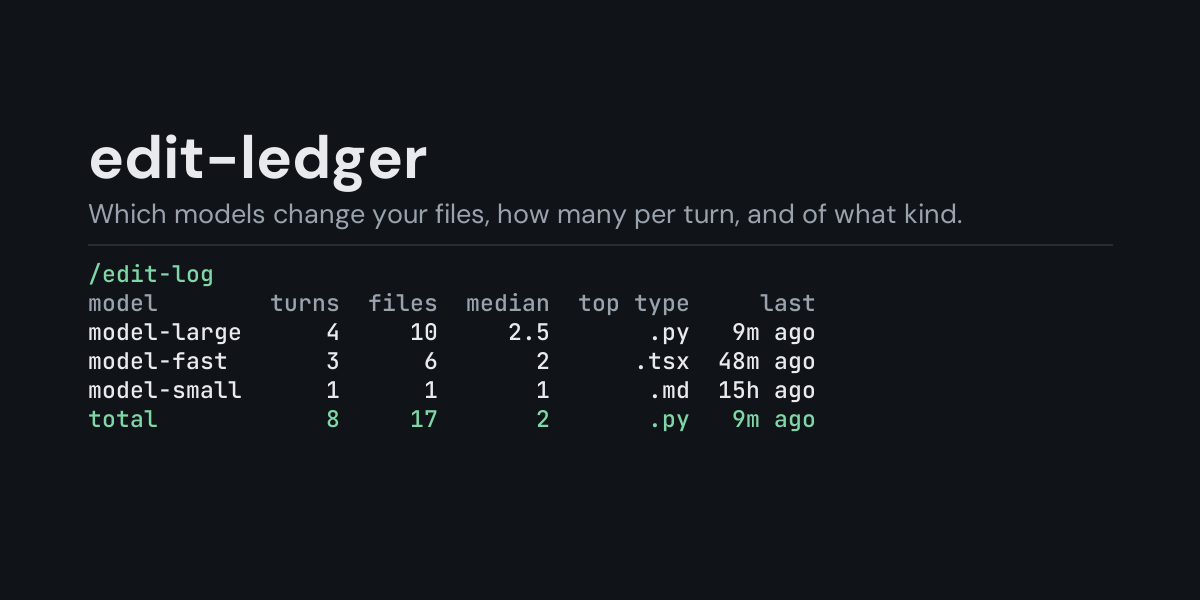
edit-ledger

❖ Communityv1.0.0★ 0

Local ledger of the turns in which the agent changed files with write_file or patch: /edit-log shows how many turns changed files, how many files in all, the median per turn, the most changed file type and how long ago the last one was, per model, platform or day, a table of file types (extensions), or the newest turns, for the last 24 hours, any number of hours or days, the latest session or everything recorded; /edit-log recent lists the newest turns (ten, or up to 100 with /edit-log recent 50). A turn another plugin keeps going is counted once.

Open in Hermes Desktop
hermes plugins install edit-ledger

What it adds

Hooks 1

pre_verify

README

From the reviewed commit c0a93cb ↗; it updates when the author re-pins.

edit-ledger

A local ledger of the turns in which Hermes's agent changed files, and an /edit-log command that shows which models change files, how many per turn and of which file types.

When a turn in which the agent changed files is about to finish, Hermes fires pre_verify with the list of files that turn changed. edit-ledger subscribes to it and keeps one row per turn: the model, the platform, how many files and their types (.py, .md, .tsx, ...). You can see afterwards that one model touches four files a turn and another one, that most of this week's changes were Markdown, or how many turns changed code in a session.

The plugin only watches. pre_verify is also how a plugin can keep the agent going (to run a check first); edit-ledger always returns nothing, which lets the turn finish exactly as it would without it, and does not change what any other pre_verify plugin decides.

Install

hermes plugins install edit-ledger --enable

Requires Hermes 0.21.5 or newer. No API key, no configuration, no dependencies.

Use

/edit-log             last 24 hours, by model
/edit-log session     the most recent session
/edit-log all         everything in the ledger
/edit-log 7d          the last 7 days (any number of hours or days: 6h, 30d)
/edit-log types       add to any of the above to list file types (or platforms, days)
/edit-log recent      add to any of the above to list the newest 10 turns instead
/edit-log recent 25   the newest 25 instead (1 to 100)
/edit-log clear       delete the ledger

Example (/edit-log all, from the end-to-end test: two hermes chat turns, the first writing a .py and a .md file, the second writing two .py files):

Turns that changed files, all recorded:

model       turns  files  median  top type    last
fake-model      2      4       2       .py  3s ago

Counts files changed with write_file and patch, not by terminal commands.
  • turns counts turns that changed at least one file, and files the files they changed.
  • median is the middle number of files per turn.
  • top type is the file type changed most often, and last how long ago the newest turn was. The model with the most turns comes first.

/edit-log types lists file types instead. From the same run:

Turns that changed files, all recorded, by file type:

type  files  turns     last
.py       3      2   3s ago
.md       1      1  11s ago

/edit-log recent lists the newest ten turns of the chosen window, newest first (/edit-log recent 25 lists 25, up to 100), with the three most changed types of each:

Turns that changed files, all recorded, newest 2 of 2:

when          model  platform  files         types
3s ago   fake-model       cli      2         .py 2
11s ago  fake-model       cli      2  .md 1, .py 1

A file type is the file's extension in lower case; (none) is a file without one (Makefile, .env) and (other) an extension that is not a short plain one.

/edit-log days puts one day on each line, newest day first; days are your computer's local calendar days. A time window counts back from now (/edit-log 6h, /edit-log 7d types). session and all take precedence over a time window. The ledger keeps its newest 5,000 rows, so a long window on a busy install reaches back only as far as those rows do.

What it sees and what it does not

  • Hermes lists the files changed with its write_file and patch tools. A file changed by a terminal command (sed -i, a formatter, git checkout) is not on that list.
  • A turn is counted when it is about to finish with an answer. A turn that is stopped or fails before that is not counted.
  • If another plugin keeps the agent going (a pre_verify "continue"), Hermes fires the hook again in the same turn with the full list so far; edit-ledger updates that turn instead of counting a second one.

What is recorded

One JSON line per hook call in <HERMES_HOME>/plugin-data/edit-ledger/edits.jsonl (per profile):

ts, session, platform, model, attempt, files, types.

types maps each file type to how many files of it the turn changed. No path, file name or anything the agent wrote is stored. session is the first 12 hex digits of a SHA-256 of Hermes's session id, enough to tell sessions apart; attempt is Hermes's count of times the turn was kept going.

The file is bounded: once it passes 2 MB it is rewritten to its newest 5,000 rows.

Security and footprint

  • register() only registers one hook (pre_verify) and one command (/edit-log).
  • Observer only: the hook always returns nothing, so it never keeps the agent going or changes a turn. Each hook call appends one line to the ledger, and nothing else.
  • No network access, no subprocesses, no downloads, no credentials read. It never opens the changed files.
  • Writes only edits.jsonl under its own plugin data directory. /edit-log clear deletes it.
  • The hook never raises: if the ledger cannot be written, the failure is logged at debug level.
  • Standard library only.

Development

python -m pytest tests                                            # unit tests, no Hermes needed
PYTHONPATH=<hermes checkout> python tests/e2e/edit_ledger_e2e.py   # real hermes chat turns
hermes plugins validate edit-ledger

Changes

  • 1.0.0: first release.

MIT licensed.

approval-ledger❖ Community★ 0

Local ledger of Hermes's approval prompts (dangerous commands, protected writes, MCP consent, smart-mode verdicts): /approval-log shows how often each rule asked, how many prompts were approved, denied or left unanswered, and how long a person took to answer, per rule, per surface or per day, for the last 24 hours, any number of hours or days, the latest session or everything recorded; /approval-log recent lists the newest decisions (ten, or up to 100 with /approval-log recent 50). Disclosure — writes decision metadata (session id, surface, rule label, answer, timings; no command, description or session key) to plugin-data/approval-ledger/approvals.jsonl, trimmed to 5,000 rows past 2 MB; observer only, cannot answer or change an approval; no network

Tools
aux-ledger❖ Community★ 0

Local ledger of Hermes's auxiliary LLM calls (titling, compression, vision, approval): /aux shows tokens, time and failures per task, model, provider or day, or lists the newest calls (ten, or up to 100 with /aux recent 50), for the last 24 hours, any number of hours or days, the latest session or everything recorded. Disclosure — writes auxiliary-call metadata (ids, models, timings, token counts, no prompt or response text) to plugin-data/aux-ledger/calls.jsonl, trimmed to 5,000 rows past 2 MB; no network

Tools
command-ledger❖ Community★ 0

Local ledger of the slash commands you run in Hermes (built-in commands in the CLI, built-in and plugin commands on messaging platforms): /command-log shows how often each command was used, its share, in how many sessions and when last, per command, platform, surface or day, for the last 24 hours, any number of hours or days, the latest session or everything recorded; /command-log recent lists the newest commands (ten, or up to 100 with /command-log recent 50) with the alias typed. Disclosure — writes command metadata (command name, alias typed, surface, platform, a 12-digit hash of the session key; no arguments, session key or user id) to plugin-data/command-ledger/commands.jsonl, trimmed to 5,000 rows past 2 MB; observer only, cannot block or change a command; no network

Tools
error-ledger❖ Community★ 0

Local ledger of failed provider calls (rate limits, overloads, timeouts, context overflows): /errors shows how many attempts failed per model, provider or cause, how many Hermes could retry, and the most common HTTP status, for the last 24 hours, any number of hours or days, the latest session or everything recorded; /errors days puts one day on each line, newest first; /errors recent lists the newest failures (ten, or up to 100 with /errors recent 50) and how long ago each happened. Disclosure — writes failed-attempt metadata (ids, provider, model, HTTP status, Hermes's failure class, exception class name, timings; no error message, request or prompt text) to plugin-data/error-ledger/errors.jsonl, trimmed to 5,000 rows past 2 MB; no network

Tools
interim-ledger❖ Community★ 0

Local ledger of the messages models write in the middle of a turn, before their final answer (the text that comes with a tool call, which on chat platforms can arrive as messages of their own): /interim-log shows how many each model wrote, in how many turns, how many per such turn, their median length and how long ago the last one was, per model, provider, surface or day, for the last 24 hours, any number of hours or days, the latest session or everything recorded; /interim-log recent lists the newest messages (ten, or up to 100 with /interim-log recent 50). Counted even where display.interim_assistant_messages hides them. Disclosure — writes message metadata (model, provider, surface, step of the turn, length in characters, 12-digit hashes of the session and turn ids; never the message text) to plugin-data/interim-ledger/interim.jsonl, trimmed to 5,000 rows past 2 MB; observer only, cannot delay, change or hide a message; no network

Tools
stop-ledger❖ Community★ 0

Local ledger of the turns you stopped while Hermes was still working (/stop, or /new and /reset during a running turn, on messaging platforms, the TUI and the desktop app): /stop-log shows how many running turns were stopped, how many by /stop and by /new, in how many sessions and how long ago the last one was, per platform or per day, for the last 24 hours, any number of hours or days, the latest session or everything recorded; /stop-log recent lists the newest stops (ten, or up to 100 with /stop-log recent 50). Disclosure — writes stop metadata (platform, /stop or /new, Hermes's label for the stop, a 12-digit hash of the session key; no session key or chat content) to plugin-data/stop-ledger/stops.jsonl, trimmed to 5,000 rows past 2 MB; observer only, cannot delay or undo a stop; no network

Tools

← Back to the catalog · catalog built Oct 18, 2026