
hermes-rich-ui
Publish rich, read-only answer cards from Hermes agents. One rich_present
tool call turns an agent's real, gathered data — table rows, chart series,
metrics, a dated sequence, cited sources — into an A2UI v1.0 createSurface
record against the read-only hermes-rich-ui/1 catalog (18 component types).
The agent's reply carries a ::richui{id="<card_id>"} directive that the Hermes
desktop transcript expands into an inline card, rendered by the zod-stubbed
Renderer from @json-render/react 0.21.0 with uPlot 1.6.32 charts. Nothing
renders until a stdlib-only admission engine has validated the record against
the frozen docs/CONTRACTS.md budgets — a rejected card is rejected before a
byte is written to the card store.
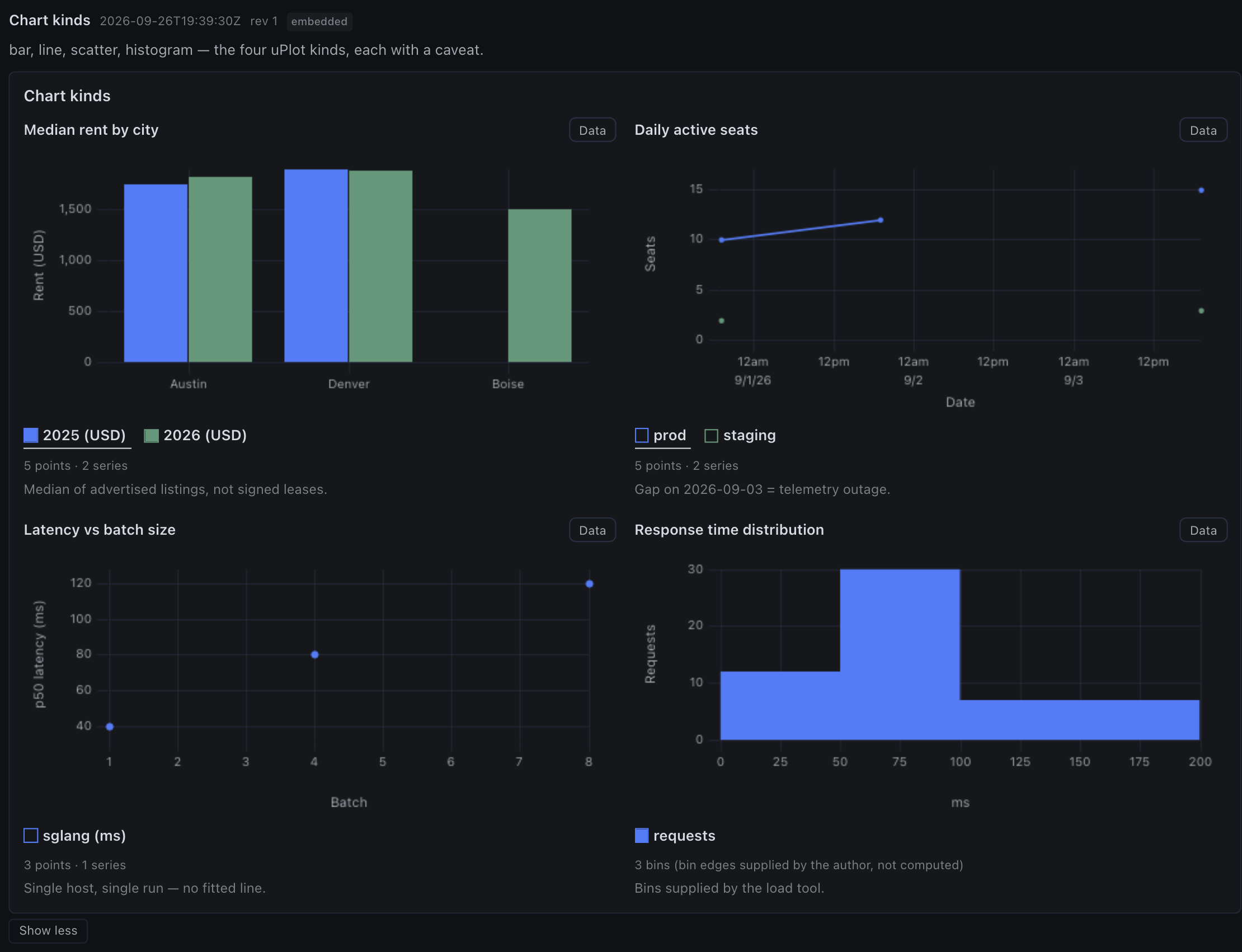
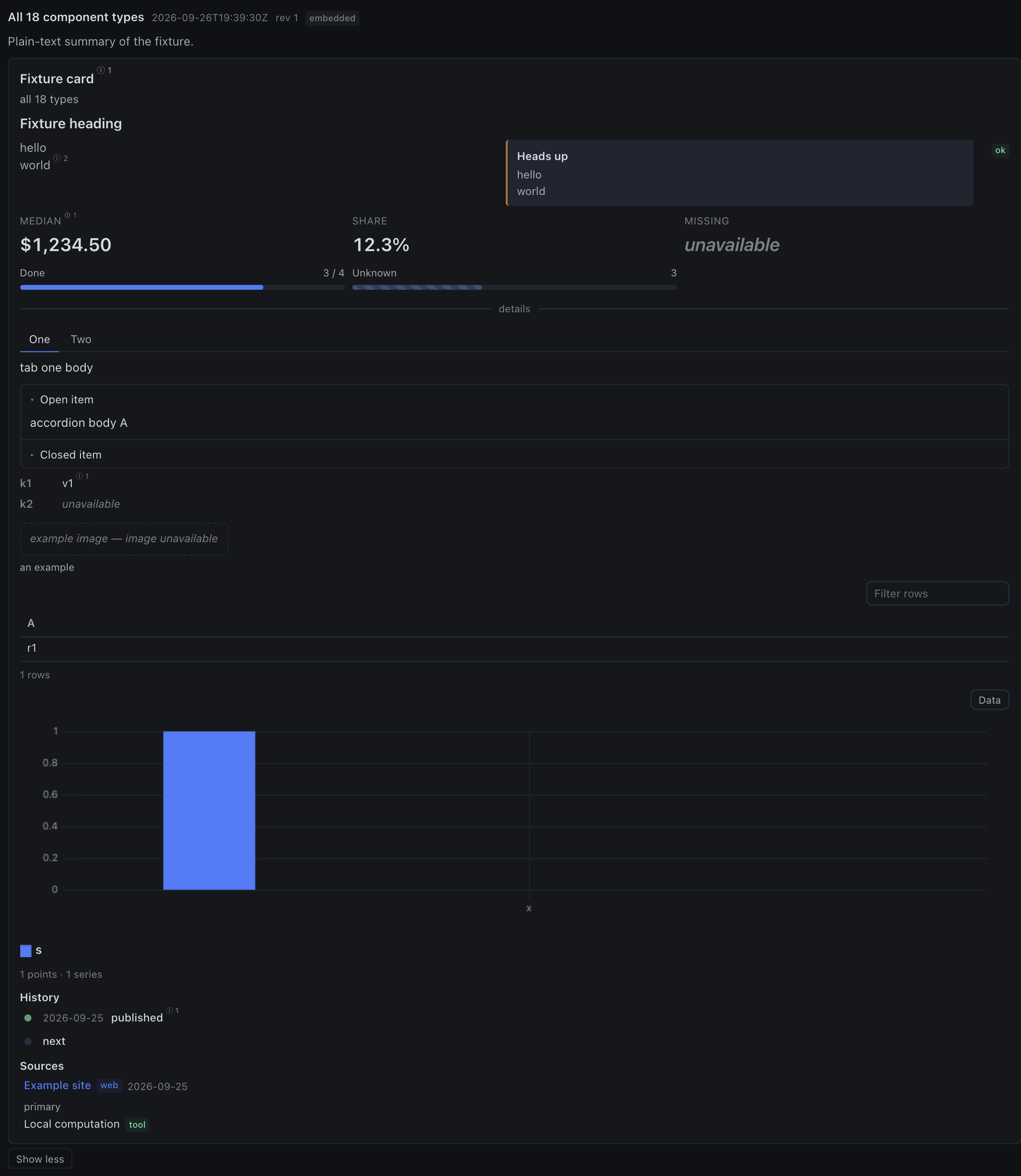
All three images are pixel-real captures of the renderer (no mockups): a
metrics card showing every value format — including null rendering as
unavailable, never as 0 — a four-kind chart card, and an all-components
fixture card (timeline, tabs, accordion, table, chart, sources).
The two halves
| Half | Runs on | Installs to |
|---|---|---|
| Gateway (tools, admission, card store, REST) | the machine running hermes serve |
~/.hermes/plugins/hermes-rich-ui/ |
| Desktop (transcript renderer) | the APP machine | ~/.hermes/desktop-plugins/hermes-rich-ui/plugin.js |
No patched core required. This is a pure Hermes plugin: the gateway half registers its tools through the public plugin API, and the desktop half is one bundled ESM file loaded through the public desktop-plugin mechanism. Nothing here forks, patches, or reaches into Hermes internals.
Quickstart
Both halves must be installed for cards to render; each is harmless alone
(INSTALL.md has the negative-control walkthrough for one-half-installed
cases).
Half 1 — gateway (on the hermes serve machine):
cp -r dashboard/ engine/ catalog/ skill/ ~/.hermes/plugins/hermes-rich-ui/
Enable it in ~/.hermes/config.yaml, then restart:
plugins:
  enabled:
    - hermes-rich-ui
hermes serve
The serve log must print
Mounted plugin API routes: /api/plugins/hermes-rich-ui/, and
curl -s http://<gateway>/api/plugins/hermes-rich-ui/health must return
{ok:true, ...}.
Half 2 — desktop (on the machine running the Hermes desktop app):
mkdir -p ~/.hermes/desktop-plugins/hermes-rich-ui
cp desktop/plugin.js ~/.hermes/desktop-plugins/hermes-rich-ui/plugin.js
sha256sum -c desktop/plugin.js.sha256    # Linux  (macOS: shasum -a 256 -c)
Then open Settings → Plugins (Capabilities) in the app, flip hermes-rich-ui
on, and reload. From then on, agents can call rich_present and paste the
returned directive line into their reply.
Philosophy: read-only, evidence-first
- 18 read-only component types. No forms, no actions, no scripts, no network calls from the card. Local interaction (sort/filter/page, chart hover, tabs, expand) is built into the renderer, never authored in the spec.
- The agent authors only content; the gateway mints identities, admits the
record against
docs/CONTRACTS.mdbudgets (rejects, never truncates), stores it under$HERMES_HOME/rich-ui/cards/, and returns the directive. - Every bound value is a data binding (
{"path": "/data/..."}/{"path": "/meta/..."}). Unknown values arenulland render as "unavailable", never as 0. - External claims carry
sourcesand per-elementsourceIds; computed values carryderivationswith method and input paths. Fabricating series, prices, or history to fill a card is forbidden by the authoring contract (skill/SKILL.md). - Chart engine is one library: uPlot 1.6.32 (bar / line / histogram / scatter).
Security posture
- Read-only catalog. No actions, no data-model writeback, no event handlers, no catalogId overrides. Cards cannot ask for refresh or push data anywhere; interactive refresh belongs to trusted chrome, never to spec fields.
- SDK-only renderer. The desktop bundle imports only
react,react/jsx-runtime, and@hermes/plugin-sdk. Every attempt to bypass the sandbox is caught at build time by a banned-surface scan that rejectswindow.hermesDesktop,localStorage,document.querySelector,innerHTML,eval,new Function, dynamicimport(), and baredocument/window(one content-allowlisted uPlot environment guard is the sole exception) — any hit fails the build. - Admission before persistence. The stdlib-only Python engine (no
third-party imports anywhere in the gateway half) validates structure,
budgets, binding paths, and URL schemes (
https://only) and rejects the whole card on any violation; nothing is written to the card store until admission passes. - No self-updater. Nothing downloads or swaps code at runtime. The committed bundle is the artifact, and CI rebuilds it and fails on any diff.
The 18 types (catalog hermes-rich-ui/1)
| # | component | purpose |
|---|---|---|
| 1 | Card | the card itself: title, subtitle, children |
| 2 | Stack | vertical/horizontal arrangement |
| 3 | Grid | 1–4 column layout |
| 4 | Divider | section separation, optional label |
| 5 | Tabs | switch between 1–8 child views |
| 6 | Accordion | 1–12 expandable sections |
| 7 | Heading | level 1–3 heading |
| 8 | Text | plain explanatory text, tone/variant |
| 9 | Callout | takeaway, limit, or uncertainty |
| 10 | Badge | compact categorical label |
| 11 | Metric | one salient scalar (null ⇒ unavailable) |
| 12 | Progress | completed/total, or indeterminate |
| 13 | KeyValueList | compact label/value facts |
| 14 | Image | https-only image with required alt |
| 15 | DataTable | typed, sortable, pageable rows |
| 16 | Chart | bar / line / histogram / scatter (uPlot) |
| 17 | Timeline | dated or labeled sequence |
| 18 | SourceList | evidence and provenance |
Props are frozen in docs/CONTRACTS.md §2; authoring guidance lives in
skill/SKILL.md with complete recipe examples in
skill/references/recipes.md.
Where to go next
- Authoring agents: start at
skill/SKILL.md, then the five recipes inskill/references/recipes.md. - Installing:
INSTALL.md(both halves + negative control). - Contributing / hacking on the repo: read
AGENTS.md(laws, build & test), thenCONTRIBUTING.md, thendocs/CONTRACTS.md— the contracts are frozen for a reason.
Contributions keep the tree publish-clean: python3 scripts/make_public.py /tmp/public-tree (also run by tests/test_public_strings.py in CI) audits
every shipped file for machine-specific strings and refuses to export if any
un-allow-listed hit remains.
MIT licensed — see LICENSE (Jacob Hausler).