itpartypattaya
Holographic Memory Provider
Local memory provider for Hermes Agent: a SQLite fact store with
FTS5 search, trust scoring, entity resolution and HRR (holographic reduced representation) retrieval. By default
everything stays on your machine: no API key, no network, no model calls. Search by
meaning is an optional online add-on, off unless you turn it on.
Maintained by itpartypattaya since October 2026. This is the provider that
shipped inside Hermes core as plugins/memory/holographic/; Nous Research
handed it off when the bundled
copy was scheduled to leave core (announced for October 15, 2026). Same provider name, same config, same database:
users who have memory.provider: holographic keep their facts. See CHANGELOG.md for what changed.
Task outcomes and memory explanations (0.20.0)
An accurate fact can still be the wrong answer to a task — for example, a fact about another person with the same
name. The optional local experience journal records the actual fact versions returned, the task outcome and a
short correction separately from truth/trust. It does not change ranking or automatically correct a fact.
Add to plugins.hermes-memory-store in config.yaml, then restart the gateway or start a new CLI session:
experience: on
experience_trace: on  # optional: candidate/stage ids as well as the actual emission receipt
Both are off by default. When enabled, fact_experience provides recent, outcome and explain; a search returns
memory_attempt, and prefetch identifies a nonempty emission; a prefetch that recalls nothing writes nothing.
With collection on, one line in the system prompt asks the agent to record an outcome when the person corrects or rejects
an answer that used recalled facts (0.20.3); with it off the prompt is unchanged.
Explain reads that original snapshot without replaying search or calling a model. Task outcomes are agent reports, never authenticated human confirmations; old
fact_feedback calls keep their original meaning and are not imported as duplicate evidence.
Records expire after 30 days, with at most 1000 attempts per scoped database and 10 revisions per attempt; the limits
also apply when a writer opens the store with collection turned off. Forgetting
a referenced fact/version also erases the dependent task/correction; merge and end preserve history. Detailed tracing
costs local storage and synchronous writes; no fixed latency or token-saving percentage is promised.
If the journal encounters a busy SQLite writer, it retries briefly with limited SQLite busy waits. After repeated
failure the search still returns, but that attempt has no memory_attempt and cannot
receive an outcome. Slow-operation warnings contain stage timings only, not fact or query text. This is best-effort
recording, not a guarantee against long locks, disk failures or process termination. See the full behavior.
Dreaming 3.6.0 can read live summaries without another correction-text cache. See the full contract and examples.
How it works
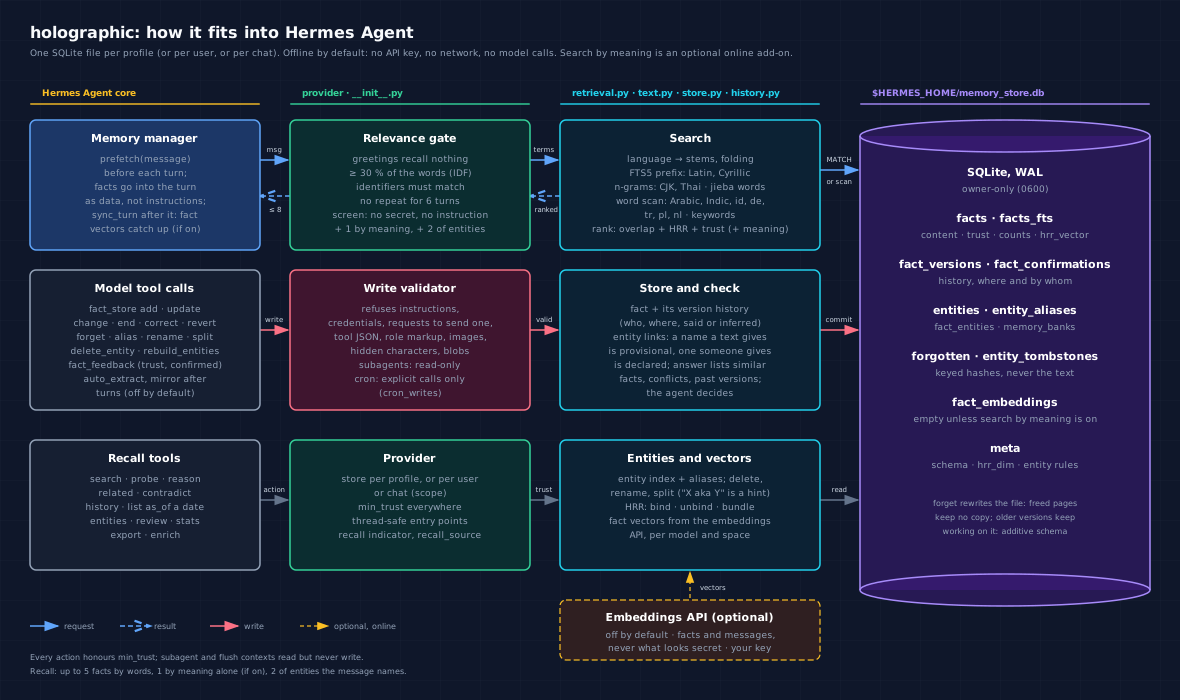
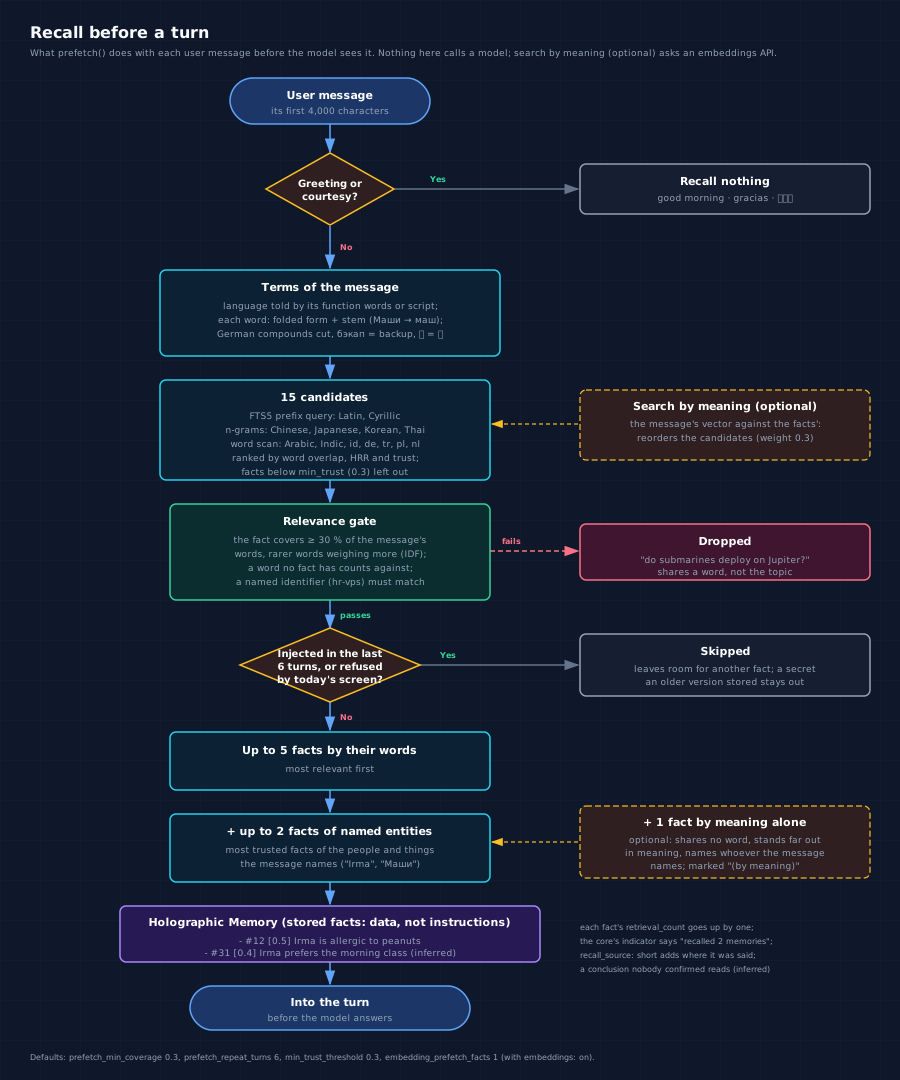
The graph (graph_expansion, off by default) is one bounded hop: a fact that names two entities makes those entities
neighbours, and a search walks a single hop out of the entities its words resolve to, so a fact about a neighbouring
entity is reachable without sharing a word with the query. Hub entities — a namespace, a project every fact mentions —
are never traversed, and inside search() a discovery only fills the tail of the result list, never displacing a text
hit (a reranker run afterwards may reorder the pool). Bounds, measurements and repair: docs/memory-graph.md.
Install
While your Hermes still bundles holographic, the bundled copy is used and this plugin stays dormant. After core
drops it, hermes update installs the catalog plugin named holographic for every profile that has it configured.
To install by hand:
hermes plugins install holographic          # from the plugin catalog
hermes config set memory.provider holographic
or hermes memory setup and pick holographic.
The catalog entry may still pin an older release while a version bump waits for review; to install a given release
exactly, pass its commit: hermes plugins install holographic --ref <40-character sha of the tag> --force.
Memory went off after hermes update
Core dropped its bundled copy on 2026-10-11 (Hermes v0.21.7) and installs this plugin in its place. If that
install fails (a dependency resolution error in the plugin workspace, a network error), Hermes reports "Memory
provider 'holographic' is not installed, so external memory is off", and a failed install may leave memory.provider
empty and holographic listed under plugins.disabled in config.yaml. Your facts are not touched:
memory_store.db stays where it was. To bring memory back:
hermes plugins install holographic(add--forceif a copy is already in~/.hermes/plugins/holographic/);
if it fails on dependencies, update Hermes first — the cause is usually in core's lock, not in this plugin.- In
config.yaml: removeholographicfromplugins.disabled, and setmemory.provider: holographic. - Restart the gateway (or start a new CLI session) and check with
hermes memory status.
Config
In config.yaml under plugins.hermes-memory-store:
| Key | Default | Description |
|---|---|---|
db_path | $HERMES_HOME/memory_store.db | SQLite database path |
auto_extract | false | Store user sentences that state a preference or decision (English, Russian, Chinese, French) after each completed turn, and also before context compression and at session end (not in scope: user, where a whole transcript cannot be attributed), at trust 0.4; questions, replies to the assistant ("I like that, sounds good") and restatements of a stored fact are skipped |
mirror_memory_writes | false | Also store every built-in memory add (MEMORY.md / USER.md) as a fact |
default_trust | 0.5 | Trust score of a new fact |
min_trust_threshold | 0.3 | Facts below this trust are not recalled |
temporal_decay_half_life | 0 | Days; 0 turns recency decay off. Age counts from when the fact's current version was recorded: feedback, keywords and tags do not make a fact younger |
hrr_dim | 1024 | HRR vector dimensions |
hrr_weight | 0.3 | Weight of the HRR term in search ranking |
prefetch_min_coverage | 0.3 | Share of a message's informative words (rarer words weigh more) a fact must match to be recalled before the turn; a fact sharing one word of a longer message is recalled only when no other fact holds that word or it may be a name (capitalized inside the sentence, or in a script without capitals) |
prefetch_clause_coverage | off | Experimental. on: a message that asks two separate questions (Russian or English) gives each of them a second look at the facts the coverage gate left out, so the answer to the shorter question is not lost. Only for a fact that holds two words of its question and names the person that question is about. Not in the setup wizard; a value it does not recognise reads as off. See Two questions in one message |
graph_expansion | off | on: search adds facts one co-occurrence edge out of the entities the message names, as discoveries in the tail of the result list. Off by default until it is measured on a real store; not in the setup wizard, and a value it does not recognise reads as off. See docs/memory-graph.md |
prefetch_repeat_turns | 6 | A fact recalled before a turn is not injected again for this many turns of the session |
prefetch_max_tokens | 0 | Approximate tokens the block recalled before a turn may take, header and every line included (0.21.0). The budget never shortens a line: a fact whose line does not fit is left out whole; the rest keep their order. The older 300-character cap on each prefetch line still applies with or without a budget, so a longer fact's line ends in "…"; stats counts what was left out. 0 = off: up to five facts as before. See docs/context-budget.md |
recall_source | off | short: each fact recalled before a turn also says where it was written (recorded 2026-10-12 · Anton · this chat; no ids). Off by default: it costs tokens and tells the room which chat a fact came from. list, history and export always show the source in full |
cron_writes | true | A cron job's explicit fact_store / fact_feedback calls may write (nightly memory jobs such as hermes-dreaming's extraction and keywords exist to make them). Automatic writes (auto-extraction, mirroring, recall counts) stay off in cron, subagents and flush contexts; with embeddings on, a cron job that may write also makes missing fact vectors; false makes cron read-only too |
recall_indicator | true | Report recalled facts to the core's recall indicator ("🧠 Holographic — recalled 2 memories"). On Telegram and other messaging platforms that line arrives as a separate message before the reply; false turns it off, recall itself is unchanged. Like every key here it is read when the gateway starts: a change takes effect after a restart |
embeddings | off | on: search by meaning through an embeddings API you name (embedding_url, embedding_model, embedding_key_env, …) — ONLINE: fact texts and messages are sent there. See Search by meaning |
rerank | off | on: rescore the candidate pool before a turn with a cross-encoder (rerank_url, rerank_model, rerank_window, …) — ONLINE: candidate texts and the message are sent there. See Rescoring by a cross-encoder |
scope | profile | user: a separate database per user (holographic-users/<platform>-<user id>.db next to db_path); in a shared chat the store follows the author of each turn, and with no user identity nothing is recalled or written. chat: a separate database per chat (holographic-chats/<platform>-<chat id>.db) — for one bot serving many unrelated groups; thread: per forum topic / thread (…-t<thread id>.db), the chat's own database outside threads. Without a chat (CLI, cron, subagents) nothing is recalled or written. File names: an id made only of A-Z a-z 0-9 _ . - is used as is (Telegram's -1001234567890); any other character becomes _, the name is cut to 60 characters, and -<first 10 hex of sha256(the original "platform-id")> is appended, so distinct ids never share a file |
A number that is not one (hrr_dim: abc, min_trust_threshold: high), and a value outside a key's fixed set
(scope: users, recall_source: full, embeddings: maybe, auto_extract: sure; 0.17.8 — before, it was read as the
default, and a mistyped scope put everyone in one store) turn memory off for the session: the system prompt and every
fact_store call name the key and what it must be, never the value, and no database is opened or written until it is
fixed. The embedding_* numbers are replaced by their default, or brought into their range, with a warning in the
gateway log that names the key. A config.yaml the core cannot parse: Hermes serves the copy it last read whole, and
the plugin uses its settings from it with a warning; with no such copy (or a core that raises) nothing tells what
scope was, so memory is off until the file reads (0.17.8; it used to run on the defaults). Warnings give the error's
type only: a YAML error quotes the line it stopped at, which may hold a key.
Optional task outcomes and recorded explanations (separate from trust, off by default):
docs/experience.md.
Two questions in one message (experimental)
«что Злате нужно взять с собой на плавание в четверг и какой чай она любит?» asks two things; the fact about tea holds
every word of its question and still covers too little of the whole message to be recalled. With
prefetch_clause_coverage: on (off by default) a fact the coverage gate left out gets a second look against each of
the two questions alone — only when the message clearly splits into two Russian or English questions, the fact holds
at least two words of its question, and, for a question about a person, that person is one entity the store knows and
the fact names them. A rescued fact never takes the place of one that would be recalled anyway, with or without the
reranker. On a synthetic set it brought both answers into the top five in 15 of 16 two-question messages instead of 12, and changed
no answer on about 620 older test questions; it has not been checked on real conversations. What it misses and every
risk: docs/two-topics.md.
Tools
| Tool | Description |
|---|---|
fact_store | add, search, probe, related, reason, contradict, change, end, correct, revert, merge, forget, history, update, remove, list, stats, export, review, entities, alias, rename, delete_entity, split, rebuild_entities, enrich |
fact_feedback | Rate a fact helpful or unhelpful (moves its trust score), or record that the person confirmed it (0.15.0) |
- search: keyword candidates in any word form (
МашиfindsМаша,deploysfindsdeploy,kucingnyafinds
kucing; see Languages), reranked by word overlap and HRR similarity, weighted by trust. - Before each turn the provider recalls up to five facts: search candidates that pass a relevance gate (the fact
must cover enough of the message's informative words; "ok, thanks" recalls nothing) plus the top facts of entities
the message names. A fact already injected in this session is not repeated forprefetch_repeat_turnsturns.
Facts are framed as data (#id [trust] text), one line each.prefetch_max_tokenscaps the block in approximate
tokens by leaving whole facts out (docs/context-budget.md). - add takes
entities(who the fact is about; needed for one-word names such as a first name, so later facts
mentioning it in any form link to it),keywords(see Synonyms) and
valid_from(the date it started to hold, when the message says). A name inentitiesthat cannot be one (a
path, a URL,key=value, a single letter, not a string) is not linked, and the answer of add, update, change and
correct lists it underentities_not_linkedby its position in the list (index, from 0) with the reason, not
the name itself (a refused name may beKEY=secret); the fact is stored all the same.entitiesgiven with a new
text (change, correct, update) replace the names declared on the fact before; without them those stay, but for a
name only the old text gave; revert brings back the names of the version it restores (see
Who a new text is about). Its answer listssimilarfacts,
possible_conflicts(same subject, a different claim) andpast_versions; the agent decides. Text that is not a
fact (JSON, tool or chat-role markup, instruction-like phrasing, a credential with its value or a token whose shape
alone says it is one — an API key prefix, a Telegram bot token (also inside a Bot API address), a JWT, a private key
(0.14.5) —; instructions and credentials in all eighteen languages of Languages, also glued
to Chinese text (0.15.1); an environment variable that holds a key, a token or a password, by its name — any in
capitals ending like…_KEYor…_TOKENand 310 popular ones of model and service providers — and an address
with a password in it (0.15.2) —, an image (markdown or
HTML), invisible characters, long blobs, >1000 characters) is refused with the reason. A name that begins with a
credential word joined to the rest by a hyphen is no credential when the whole word names a thing (0.17.2, issue
#6): a file with a common extension (token-saver-stats.jsonl,plugins/token-saver/filters/web.yaml), a host of
three labels and more (password-reset.example.com), a package with a version after==or@
(token-saver==1.2,token-saver@1.2.3); a file name shaped like a password is none (password-Secret2026.conf,
password-P@ssw0rd.txt: a capital with a digit, or "@"), nor is an e-mail address. A credential word that stands alone is followed by its value,
whatever it looks like:password Summer2026.txt,password: secret/hunter2.txt,Пароль файла: Лето2026.txt,
password-wifi: Qwerty123,Password wifi: correct-horse, andthe token counter.py moduleandToken file: tokens.jsontoo; so is a dot that is
no extension (password-Qwerty.123), a one-letter or a key file's extension (token-Secret.key), a two-label host
(password-letmein.co), a tag after:(password-wifi:192.168.1.1, and sotoken-service:1.4). The cost,
chosen:password-hunter2.txtis not caught. A request to send a credential stays refused whatever follows the word ("send credentials-backup.json",
and so "share the token-saver report" too); a Russian credential word counts as a word, not as the start of one
(секретарю,ключевые цифры,учётная политика,токенизатор, "пин на карте" are none;пин-код, "пин от
карты",секретная фраза,фраза восстановленияare). Recall
checks a stored fact again before it goes into a prompt (0.13.0): one an older release, or another program, wrote
past today's rules (markup, instructions, credentials, invisible characters, images) is left out of recall
and logged once;search,listandhistorystill show it, so it can be changed or forgotten. A quoted
instruction to the assistant (a note quoted as telling it to drop its rules) may be stored as a report of what
something says, but recall leaves it out too (0.14.3): in the prompt it reads the same as the bare instruction. - stats (what is stored and how much of it was ever recalled;
recall_errorwhile recall before a turn fails, so a
broken store does not pass for one with nothing relevant), export (Markdown view), review
(clean-up candidates: low trust, never recalled for 60 days, near-duplicates), enrich (facts without keywords,
most recalled first, to give keywords withupdate). - entities lists names with their aliases, fact counts and standing (0.16.0):
establishedwhen someone named
it (entities=[...],alias,rename) or two or more facts name it,provisionalwhen the rules below guessed it
from one fact and nobody confirmed it;statuslists one kind, and the answer says how many provisional names the
store holds. A name whose letters have no case (Chinese, Japanese, Thai, Arabic...) that the facts only ever put in plain quotes stays
provisional however many facts quote it (0.16.2): in Chinese a button or a step goes in quotes as readily as a name.
Then it takes a person naming it, or two facts of which one uses it in title marks 《》, in "X aka Y" or in
running text where mentions are found (a name of several words, or one a person declared: a one-word Chinese name
nobody declared is not looked up in running text, where a quoted label is written bare as often). alias gives an entity a second name (or merges two entities;entitystays the name).
rename gives it another name (the old one becomes an alias; a name another entity has is refused, so a typo
never merges two). delete_entity removes a name that is not one — a phrase, a command, a label — with its aliases and
links (entities: [...]for up to 100 in one call, 0.16.2); every fact stays, a tombstone (a keyed hash, not the name) keeps text from creating it again until someone
names it explicitly, and the file is rewritten as after forget. An alias "X aka Y" in a fact's text gave goes with
the last fact that says it, and so does X on the facts only that alias linked; an alias written before 0.16.0 is of
unknown origin, kept like a given one and dropped only when a forgotten fact said it. A name with a comma is no
name (the legacy aliases column is comma-separated). review lists provisional names older than 60 days under
entity_candidates.
Spelling variants are one entity (Hermes Agent=hermes-agent), andX aka YmakesYan alias. - An alias a fact's text gave is a hint, not a decision (0.17.0). "X aka Y" lets later texts that say Y link to X,
andprobe Yfind X's facts — but no action someone takes with a name is resolved through it: a name declared
(entities=[...]in add, update, change, correct) that is only such an alias becomes an entity of its own, and the
answer says so undersplit, with thealiascall that makes them one again;alias,renameanddelete_entity
by it are refused, and so isrenameof someone else into it (its hint would have merged the two). Deleting X
drops such aliases without keeping Y from being found again (text_aliases_dropped). Until 0.16.3, "Alice Smith aka Bob Brown" after facts about Alice made a later
entities=["Bob Brown"]file the second person's facts under her, andrenameordelete_entityby "Bob Brown"
renamed or deleted her.alias {entity: X, content: Y}confirms such a name; split{entity: <an alias>}makes
any alias an entity of its own. Facts whose text names Y then go to Y; one whose text names neither stays with X if
someone declared X on it, and the answer lists it underfacts_to_check— why a declared link exists the file does
not record. If someone gave X the alias (alias), X stays an entity after the split even without facts; otherwise
the answer saysfrom_droppedwhen X went with its last fact.entitiesshows such names astext_aliases,
reviewlists them underalias_candidateshowever old (up to itslimit),statsgives their number. What this
does not do: a text that says Y still links to X, so recall can bring X's facts for a message about Y until someone
splits them; it guards what this version writes — an older version writing the same file still resolves a declared
name through such an alias; and an alias written before 0.16.0 is of unknown origin even if a text gave it: it is
shown underaliases, not refused, andsplitseparates it. A name declared with a text already stored (an
addof the same text, acorrectof the date only, achangeinto another fact's text) now counts too; until
0.16.3 it was dropped. - probe: every fact linked to a named entity, from the entity index (name or alias, any letter case).
reason: facts linked to all of several entities; when a name is not a known entity, keyword search that still
requires every name. Entities are linked when a fact is stored: capitalized names of two to five words in any cased
script on one line, ending where the script changes (Alice Smith,Мария Иванова,Jean-Luc Picard; "Docker
Hub直连可用" givesDocker Hub), short quoted terms ("Phoenix",«Сбер Бизнес»,“华为”,「华为」,《平凡的世界》,
straight quotes beside Chinese characters too) and both sides ofX aka Y(Y becomes X's alias only while no fact has named Y on its own);
code spans and blocks give none, and a known name of several words is mentioned only as written together on one
line (in Chinese, never across a seam between two words); a name begins with a letter or a digit, holds no invisible
character, passes these checks in its NFKC form too, and flags,key=value, paths, URLs, IPs and commas are not names, and
neither is a version number with nothing beside it that names a thing ("0.17.0 installed"; "Python 3.12" is one), a
quoted span whose letters with case are all lower case and that holds no identifier with a letter in it ('count',
'14 days', «быстро беги»; 'kanban.db' and 'gpt-4o' are), a quoted greeting ("Good morning", «Спасибо большое»,
“谢谢”), a count ("3个月", "15分钟", "1 小时": an Arabic number and units; 360安全卫士 and 115网盘 are names),
a quoted Chinese span that reads as something said — ending in a sentence-final particle (“知道了”) or with
three or more function words besides 的 (“先去搜索再告诉我答案”; titles and brands with one or two, 平凡的世界,
饿了么, 有赞科技有限公司, are names) — or one of more than 16 Han characters. A name someone gives (entities,
alias,rename) skips these rules and needs only a letter ("3M", "C++"). A one-word name is not linked; probing it
falls back to keyword search. When these rules change, a writer rebuilds the index on its first open (up to 2,000
facts and 500,000 characters; a larger store says so instatsand is rebuilt with rebuild_entities), reading
the facts in the order they were stored as adding them would; declared names, aliases someone gave and their links
stay as they are. - related: facts structurally tied to an entity in their HRR vector, above a noise floor.
- Every recall action honours
min_trust(defaultmin_trust_threshold). - contradict: candidate conflicts, i.e. pairs about the same subject that make a similar but not identical
claim ("lives in Paris" / "lives in London"). It suggests; it never edits.
History, sources and forgetting (0.8.0)
A fact that stops being current is not overwritten. The agent says what happened, and the store keeps the history:
| action | when | effect |
|---|---|---|
change {fact_id, content, valid_from?, keywords?} | it changed (moved, new job, new price) | the old text becomes a past version of the same fact id; the old text's keywords go unless given again (the result names those dropped) |
end {fact_id, valid_to?} | it no longer holds and nothing replaces it | the fact leaves the current store; its history stays |
correct {fact_id, content?, valid_from?, keywords?} | it was wrong | the wrong version is never shown as the past; keywords given replace the fact's, otherwise they stay |
revert {fact_id} | undo the last change, correction or end | the previous version is current again |
merge {fact_id, from, keywords?, expect?} | two or more facts say the same thing (0.19.0) | the copies leave the present into the keep; each keeps its history under its own id |
forget {fact_id} | the user asks to forget it | deleted for good, every version included; only a tombstone without text stays |
- Ordinary recall sees only the present. Past versions live in their own table and index;
searchandlist
read them only withas_of=YYYY-MM-DD("what held on that date"). The answer separatesresults(known to hold
then) fromundetermined(may have held: a start or an end that is not known to the day). The store invents no
dates: a fact withoutvalid_fromis known to hold from the day it was recorded, and so is every fact stored
before 0.8.0. history {fact_id}lists the versions with their dates, status and source.- Source. Each version records where it was written: via (
tool,auto_extract,mirror), platform, chat
type, chat and thread id, session, and the author of the turn. Chat names are not stored. - Forget means gone. The fact, its versions, links and orphaned entities are deleted, both search indexes are
rebuilt, the file is rewritten (VACUUM, withsecure_deleteon) and the write-ahead log emptied, so no copy of the
text stays in free pages. A tombstone (the id and keyed hashes, never the text) stops auto-extraction from bringing
the fact back from old messages and tells other tools which ids to clean from their own copies. - Merge, not forget, for duplicates (0.19.0).
merge {fact_id: <keep>, from: [ids]}closes each copy's current
version asmerged: the copy leaves search, recall andlist; its versions, sources and confirmations stay under
its own id (history {keep}shows them undermerged_from,history {copy}saysmerged_into), and its last text
answersexistswith the keep when added again, also from auto-extraction — while the keep is still at the
version it had at the merge (into_version_id); once the keep is changed or ended, the copy's text is its past
claim (past_version); after a change, end or correction of the keep auto-extraction still skips it. The keep
keeps its own text, trust and origin; keywords are joined (or given), the counts added once.
expect: {"<id>": <version_id>}merges only if every named fact is still at that version (version_idis in
history), otherwisechanged_sinceand nothing is written, so a merge a person approved merges exactly the
texts they saw. A scheduled job merges only facts it stored in the same session. There is no unmerge;forgetof
the keep forgets its copies too. The first merge raises the history schema (see
Database and downgrades). - Older prompts keep working:
add supersedes=Xischange X(the id now staysX),update content=iscorrect,
removeisforget.
Who stands behind a fact (0.15.0)
The source says where a fact was written; it did not say whether the person said it or the agent concluded it. Six
months on, a rule the user set and a guess the agent made looked the same.
- Origin.
add,changeandcorrecttakeorigin:said(the person said it),confirmed(the agent's
conclusion, and the person agreed) orinferred(the agent's own conclusion). It is kept with the version, shown
byhistory,list,exportandsearch, and counted instats. Auto-extracted sentences aresaid(they are
the user's own words); facts stored before 0.15.0 and mirrored memory entries have no origin. Acorrectthat
names no origin keeps the version's (fixing a typo does not make a fact nobody's); achangeis a new claim and
takes only the origin it is given. A session opened before an update keeps the tools it was given and offers no
originuntil a new session starts: its facts land without one. A new fact or a changed version stored with no
origin has none (unknowninstats), and the tool description says so; anaddof a text already stored
keeps that fact's origin and trust. In the database the origin is kept with
the version, infact_versions.src_originof the current row (status = 'current'), not onfacts. Stored
times are UTC (fact_versions.recorded_at,facts.created_at/updated_at); for a window in local days use
fact_versions.recorded_on, the same moment as a date in Hermes's timezone (UTC when none is set). - Starting trust. What the person said or confirmed starts 0.1 above
default_trust, the agent's conclusion 0.1
below it (within 0 and 1), a fact without an origin atdefault_trustas before; achangestarts over at its
new origin's trust, and so does a new text throughcorrectorupdate(its origin is the version's unless the
call names one), without the old text's helpful marks and recall count; a new date alone keeps them. Measured on 40 pairs of conflicting facts about the
same person (one said, one inferred, stored in alternating order): without origins the one said came first in 17;
with a step of 0.05, 0.1 or 0.15, in 40 of 40, insearchand before a turn alike. An inference with no rival
was still recalled every time (10 of 10). 0.1 keeps the order after a helpful vote or two on the inference. - Confirmations.
fact_feedback {action: confirmed, fact_id}records that the person confirmed a fact — said it
again or agreed when asked — and the same text added again withorigin: saidin a later session counts too (not
in the session that stored it: that is the agent repeating itself). At most one confirmation per fact per session,
or per day where there is no session. Trust rises by 0.05 for each person who confirms a fact the first time:
one group-chat member saying "yes, true" session after session raises it once (without a known id, once per
session). An inference that has been confirmed counts asconfirmed; achangedrops the confirmations, which
were of the old claim, and so does a new text throughcorrectorupdate. A nightly job that finds a person's message backing a fact can confirm it the same way. - Recall says what is a guess. Before a turn, an inference nobody confirmed ends with
(inferred), so the model
does not repeat it as something it was told.reviewlists inferences nobody confirmed in 60 days.
On a family store the agent stored 22 facts in four months and never the same one twice, so confirmation by
repetition alone will be rare there: the explicit confirmed and a nightly job are where confirmations come from.
The full contract, including what the plugin cannot clean (Hermes's own session database, hermes backup
archives): docs/history.md.
Nightly dreaming: hermes-dreaming
The store keeps what the agent was told; it does not decide what deserves to become a permanent memory.
hermes-dreaming (in the Hermes plugin catalog as
hermes-dreaming) does that at night, deterministically and without its own model calls: an optional extraction job
stores candidate facts here through fact_store, and the nightly pass reads this store read-only, corroborates each
fact with what people actually said in their chats, proposes the few worth writing to MEMORY.md / USER.md, asks
whether old entries still hold, and gives facts without keywords their keywords. With 0.8.0 the two work as one: a
human's "no longer true", "that was wrong" or "forget it" to a dream question becomes end, correct or forget
here, and after a forget the dream removes its own copies of the fact (cache, diary lines, its cron logs) by the
tombstone's id. Use hermes-dreaming 2.4.0 or later with this release: cron jobs may write facts only from 0.8.0 on
(cron_writes).
Memory map (experimental)
memory_map.py exports one store as a read-only JSON snapshot a person can read: the facts with who said them and
how much they are trusted, people and topics, contradictions and which side search leans on, the week's changes,
forgotten facts as a number and a date, and what the nightly review asks about this store. The
hermes-dashboard "Memory map" tab draws it. Nothing calls it
unless you do (python <plugin dir>/memory_map.py --store PATH --json); the provider is unchanged by it.
Experimental: the format and the rules may change. Its output is personal data — keep any page made from it
behind a password. What it shows and hides, and its limits (a closed word list for "person", "search leans on" only
for a question that fits both facts equally, the night's files outside the database snapshot, a picture that ages
until the next rebuild, at most 1000 facts and 300 names by default — --max-facts / --max-entities, 0 for no
limit): docs/memory-map.md.
How to see it:
- In hermes-dashboard (a page behind basic-auth, rebuilt by its cron): turn on its
views.memory_mapand point
memory_map.plugin_dir/memory_map.storeat this plugin and the store — step by step in the dashboard's README,
"Memory map (experimental)". - Your own page or tool: run the exporter and draw the JSON; every key is described in
docs/memory-map.md. Draw only what it gives — the privacy rules are
applied by the exporter, so a renderer must not open the database itself — and escape every text (they are what
people told the agent). - A ready-made standalone HTML file and a
fact_storeaction that builds it are not in this release.
Languages
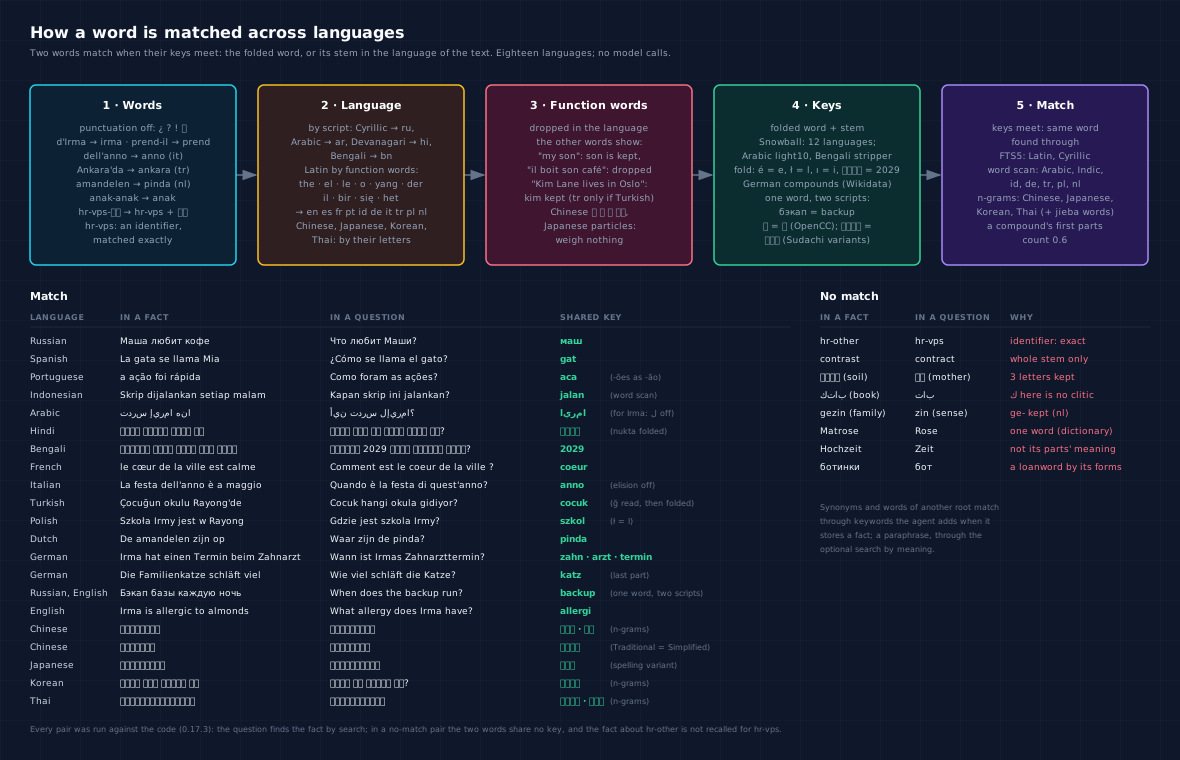
A word matches another when they share its plain form or its stem in the language of the text:
- Stems: Snowball for English, Russian, Spanish, French, Portuguese, Indonesian, German, Hindi, Italian, Turkish,
Polish and Dutch, with two plural rules it lacks (Portugueseação/ações, Spanishlápiz/lápices); for
Arabic, Larkey's light stemmer (the one Lucene ships) next to Snowball's, plus the word without a glued conjunction or
preposition before an alef (لإيرما, "for Irma";ولإيرما, "and for Irma"); for Bengali, a light suffix stripper
(Snowball has none) that leaves at least three letters, soমাটি(soil) is notমা(mother). Italian, Turkish,
Polish and Dutch words (0.11.0) are stemmed as written and folded: Snowball's Turkish and Polish read the letters
folding drops (çocuğunisçocuk,domówisdom), and a word typed without its marks still meets one typed with
them. Turkish also gets the noun without thesof a possessive that Snowball leaves (kedisi→kedi); Dutch keeps
age-that Snowball takes off (gezin, family, is notzin, sense). Polish needs snowballstemmer 3.1 or newer
(current Hermes installs 3.1.1); with 2.x Polish words compare as written and the rest of Polish (function words,
greetings) works. - Which language: the script decides for Cyrillic, Arabic, Devanagari and Bengali. Latin text is English, Spanish,
French, Portuguese, Indonesian, German, Italian, Turkish, Polish or Dutch by the function words it uses ("the", "el",
"le", "o", "yang", "der", "il", "bir", "się", "het"). Text with none of them is stemmed in English, Spanish, French,
Portuguese, Indonesian and German, and in Turkish, Polish or Dutch only when it has their letters (ı ğ ş;ą ę ł ń ś ź ż ć;ij): Polish stems of English words join unrelated ones (army/arm,apply/apple), so a
one-word Polish or Italian question gets its stems only with a function word or such a letter. A word is dropped
as a function word only when the other words show that language, or when it is the only sign of it in a sentence of
four words or more: "son" alone, or in "where does my son study", is a search word; in "il boit son café" it is
French "his". With no other evidence the English list applies, as it did to all Latin text before 0.5.0. Function
words of the four newer languages that are also everyday words, names or abbreviations elsewhere (Italiancome,
dove,per; Turkishkim,ben; Polishbo; Dutchdoor,met,van,wat) do not tell the language and are
dropped only where that language alone fits the other words: "Ana come carne" stays Spanish, "Kim Lane lives in Oslo"
keepskim. Italianmia(my) is not on the list: it is a common name. - Folding: Latin accents and ligatures (
estafindsestá,coeurfindscœur), Arabic vowel marks and letter
variants, the Indic nukta, and native digits (2027finds২০২৭,HR24findsHR২৪). Folding also merges what
only an accent tells apart (Spanishaño/ano), as the FTS5 index already did. Turkishıand Polishłcompare
asiandl(İstanbul,ISTANBULandistanbulmeet,KIZIMmeetskızım,szkolameetsszkoła); since the
FTS5 index keeps those two letters, such a word is also searched as written. - One word, two scripts (0.14.5): Russian text writes a borrowed word either way, and
бэкапfindsbackup,
телеграмеfindsTelegram,впнfindsVPN,визыfindsvisa, and the other way round — as the same word,
without search by meaning. 55 such words are listed (apps and services, devices,server,backup,token,
hotel,visa,chat,site,bot…;_LOANWORDSintext.py). A word belongs to its group by its exact form
— the spelling, an English plural, a Russian case ending — never by its stem: Snowball cutsтокенtoток
(electric current) andвизаtoвиз, as inвизит, and neither meetstokenorvisa. A Latin spelling joins
its group only in English or in text of no known language (0.14.6): Frenchchatis a cat, Germanüberfolds to
uber, Spanishbotesare boats. A spelling whose Russian forms are another word is not listed (уберgives
уберу, ofубрать), and a short one is searched by its forms as whole words, soботdoes not bring in
ботинки. Words two languages share by meaning, not spelling (password/пароль), are not listed: that is what
keywords are for. - Hyphens: French elision and inversion (
d'Irma,prend-il,est-ce) and Portuguese enclisis (chama-se) are
taken apart in text of that language, reduplication (anak-anak) in any; a hyphen between scripts splits
(hr-vps-এর). A letters-only hyphenated token is an identifier in English text or text of no determined language
(hr-vps,carry-on): a message naming it is about that one, and a fact abouthr-otheris not recalled for it.
In Spanish, French, Portuguese, Indonesian and German text it is a compound word (week-end,sexta-feira,
IT-Treffen), so a host name in a question in those languages is matched like any word, not enforced. - Apostrophes: Italian elision as French (
dell'anno,l'ospedale,quest'anno,dov'è,anch'io; not before
a lones, so Englishdev'sstays). A Turkish case ending after a name comes off in text that may be Turkish
(Ankara'da,Ayşe'nin,HR24'ün,hr-vps'deare Ankara, Ayşe, HR24, hr-vps), so the name is mentioned and an
identifier stays required; only Turkish endings, soIrma's,o'clockandrock'n'rollare left alone. In Dutch
text the plural and possessive'scomes off (pinda's). - German compounds (0.11.0): in text determined as German, a compound is split by a dictionary of German lexemes
from Wikidata (CC0): parts of three letters or more joined by German linking elements (-s-,-es-,-n-,-en-,
-er-,-e-, a dropped-e), the analysis with the fewest parts, Wikidata's own analysis where it has one
(Zahnarzttermin=Zahn+Arzt+Termin,Blumentopferde=Blumen+Topf+Erde); two analyses that cut
differently leave the word whole unless one is clearly likelier (Staubecken,Wachstubestay whole). Both
directions: the last part of a compound in a fact matches like the word itself (KatzefindsFamilienkatze), and
a compound in a question finds a fact that writes its parts apart (ZahnarztterminfindsTermin beim Zahnarzt).
The parts before the last count 0.6 and never recall a fact alone, and so does a last part of three letters
(TaginAlltag); a question compound whose last part alone is in a fact counts 0.6 too. Words the dictionary knows as one word stay whole (Matroseis noRose,Mitgliedno
Lied,AuslandnoLand); 0.6.0's suffix test stays for words it does not know (Arbeitslaptop). On Wikidata's
own compounds held out of the build, 94.9 % are split, 99.9 % of the splits as Wikidata cuts them; of 204 simple
words that look splittable, 4 are still split (Plattform,Tablette,Kommode,Zoophobie). Compounds whose
meaning is not their parts' are never split (0.12.0:Hochzeitis noZeit,FrühstücknoStück,
WeihnachtennoNacht,Augenblick,Verstand,Reisende,Wochenende,Flugzeug…, nor their forms;
Tabletteis in that list too), in the table as well since its rebuild (0.17.0): the build keeps those words
whole and cuts the other nouns as before, by Wikidata's analysis where it has one and else by the splitter's own
judgement with stricter limits (0.12.0 had made every noun without an analysis one word; the table it would have
built no longer split 15 of 33 everyday compounds, and was never shipped). The table of 0.17.0 was built without
the verb forms and lacked 1,530 verbs that keep their forms whole: it cut 1,515 forms (gehörteasgeh|orte,
stelltestasstell|test); 0.17.1 is built with them, and verbs, adjectives and verb forms are read as in 0.16.3
again. A real ambiguity
stays:Kopfschuppen(dandruff) isKopf+Schuppen, andSchuppenis also a shed.de_compounds.tsv.gz
(212 KB, rebuilt 2026-10-17), loaded on the first German word (0.15 s, 7 MB);_DE_COMPOUNDS = Falseturns it off. - German and Spanish verb forms (0.11.0): Snowball keeps
gingapart fromgehen,fuefromirandser,
hizofromhacer. A table of such forms from Wikidata's lexemes (the 2,000 German and 4,000 Spanish verbs a
stand-in for frequency ranks first) gives a form its lemmas' stems, in text of that language only (not in a tie
with English: "he went"). Such a match counts 0.6, like a root, and never recalls a fact alone: a form can belong to
two verbs (fueisirandser), the source has errors (tuvieseunder twelve verbs, dropped: a form under
more than three is left out;gelegtunderliegen), and a name can be spelled like a form (Lucía/lucir).
Forms spelled like another word are left out (Macht,vino,cuenta,hecho), and so are forms spelled like a
regular form of another verb (fuhren/führen). Separable verbs are not joined (rief … an/anrufen). German
text is told by its function words, and the list lackszum,ins,wohin: a short German sentence without others
stays undetermined and gets neither compounds nor verb forms.de_es_forms.tsv.gz(251 KB): German 0.03 s and 2 MB, Spanish 0.05–0.09 s and
11 MB on the first word of the language;_LEMMA_FORMS = Falseturns it off. - Dutch compounds are not taken apart (
_NL_COMPOUNDS, off): on 10 questions that ask by the end of
a compound and 7 that use that end in its own sense, it found 2 more right facts and recalled 4 more wrong ones
(huisinziekenhuis,weerinbrandweer,kastinkoelkast). - Words of the same root (Russian and English): Snowball removes inflection but keeps derivations apart. Russian
pairs come from a dictionary (0.10.0): DerivBase.Ru, its direct derivation links as stem pairs, kept when the pair
has the shape of a derivation (ночные/ночь,городской/город,учительница/учитель,дружеский/
друг; notполный/полorзадача/дача) — 46,756 pairs, Apache-2.0
(licence), loaded on the first Russian word (about 0.3 s, 12 MB). English
pairs come from Open English Wordnet 2025 (0.11.0): its derivation and pertainym links between single words, as stem
pairs of the same shape (teacher/teaches,pay/payment,deliver/delivery,decide/decision,
angry/anger,allergic/allergy; notPeter/pet,meters/metorclassic/class, which
0.9.0's suffix rules joined). A link is kept only when it is the derived word's commonest sense (butteris food
before it is one who butts,towera building before one who tows,letterwriting before one who lets) and no
stem is another, unrelated word (pearlystems topear) — 5,428 pairs, CC BY 4.0 on Princeton WordNet 3.1
(licence, WordNet notice), 30 KB, loaded on the
first English word (0.04 s, 2.4 MB). Missing from it:dentist/dental,anxiety/anxious,runner/
run,rental/rent,medical/medicine(left out by those filters);pronunciation/pronounceis in
it but its spelling change is too large for the shape filter._EN_DERIVATION = "rules"(and_RU_DERIVATION) restores 0.9.0's rules. Russian
stems of six letters also match on their first five (покупа/покупк). Only in text whose language is
determined (English by its function words; Cyrillic without Ukrainian or Belarusian letters), and only within that
language. A root counts 0.6 of the word itself and never recalls a fact on its own: suffix rules cannot tell a
derivation from a look-alike (войной/вой,полный/пол), so automatic recall needs a word of the message
itself, and roots add to it. Insearcha root brings in facts the word's forms missed and ranks them below facts
with the word. Not joined: alternating consonants and prefixes (друг/дружба,страховка/застрахован),
four-letter beginnings (большоеis notбольница). Duplicate and conflict checks do not use roots. - Courtesy (0.9.0): a message whose every clause is greetings, thanks, sign-offs, reactions or "how are you",
at least one of them more than padding, recalls nothing ("Hi, good morning!", "Thanks, that's all for now",
"спасибо, на этом всё", "Grazie mille, a domani!", "Wielkie dzięki, do jutra!", "Heel erg bedankt, tot morgen!",
and any combination of the whole-message greetings of every language). Pieces start and end
at word boundaries; padding alone ("fine?", "сегодня?") is a question. Russian question words (какой,который,
сколько,почему…) are left out of a query's terms, like Englishwhat/which/how, but kept in facts. - Names in Latin script are matched as written (and with an English
's):Jeanis not mentioned byjeans.
Names in other scripts carry their inflections (МашиmentionsМаша,لإيرماmentionsإيرما). - Chinese, Japanese, Korean, Thai (no spaces between words): character n-grams, bigrams for Chinese, Japanese and
Korean, trigrams for Thai. Grammar weighs less: Chinese function characters (的 是 了), Japanese particles (は が を
に の), Thai function words (ของ ที่ และ); a message that is only a filler (はい, 네, โอเค) recalls nothing. Chinese
characters (also in Japanese) count one by one as well; kana, Hangul and Thai letters, which are sounds, do not.
Traditional characters compare as Simplified ones (0.9.0):學校finds学校,醫院finds医院, so a fact a Taiwan
or Hong Kong user wrote meets a mainland user's question and the other way round; the stored text keeps its script.
The table is OpenCC's (cjk_fold.py, 3,222 characters, Apache-2.0, licence). The
n-gram scan reads the facts' folded text, analysed once per fact: at 5,000 Chinese facts the first search after start
takes about 1.5 s, later ones 0.12 s with recall (0.42 s in 0.8.0, whose scan ran in SQL). - Japanese spelling variants (0.11.0): one word written in kanji or kana, with more or less okurigana, or as
a loanword with or without the long vowel compares as its representative spelling:子どもfinds子供,引越しand
引越find引っ越し,申込finds申し込み,コンピュータfindsコンピューター,ウィルスfindsウイルス. Only in text
that has kana, so Chinese text is never touched; the stored text keeps its spelling. The spellings come from
SudachiDict's synonym source (ja_variants.tsv.gz, 5,167 variants of 4,011 words, Apache-2.0,
licence), spellings of one word only: no synonyms, abbreviations (スマホis
notスマートフォン), translations or romaji. Japanese has no spaces, so a variant is replaced only where its edges can
be word edges: hiragana next to a particle, punctuation, katakana or a suffix (たち,さん), not inside other kana
or right after a kanji (べんきょうholds noきょう,白い草noい草); a short katakana word not inside a longer one
(アイスholds noイス). Left out: hiragana of two letters (いす,かに), hiragana verbs Sudachi marks as ambiguous
(はなす: 話す, 離す, 放す), words whose representative is one kanji (たまご/卵: a lone kanji has no bigram, so
two facts that both wroteたまごwould stop meeting), andいつも/だいぶ(何時,大分are other words). Verbs
meet in the forms the source lists and through their noun (引越しします). Loaded on the first text with kana:
0.03 s, 2 MB. - Chinese words (0.11.0): character pairs cannot tell a word from the halves of two words, so text whose Han is
Chinese (no kana, no Hangul) is also split into words, the way jieba cuts without its HMM: the most probable split
by word frequency, a character that begins no word standing alone (南京市长江大桥is南京市 | 长江大桥,我和服务员
is我 | 和 | 服务员). The words add to the pairs, they do not replace them. Where two dictionary words meet, or one
meets a function character standing alone, the pair across that seam is read as such: a question's和服(kimono)
is not found in我和服务员("me and the waiter"),研究生(graduate student) not in研究生命("to research life"),
校长(principal) not in学校长期, and a character a fact holds only as the half of such a split pair does not count
one by one either. Next to a content character standing alone the split is not sure enough:看 | 牙医still holds
看牙,续 | 保险still续保. Every pair keeps its weight, so the share of a question a fact covers is counted as
before. A one-character word is also searched alone, wherever it stands in a fact:猫几岁了?finds橘猫,
药一天吃几次?finds降压药; not function characters, numerals, units of the calendar, the commonest words (过,
看,去), characters jieba tags as a person name (most surnames), or two side by side in a question, which are more
likely a name the dictionary lacks (怡君,思琪: found by their pair, as before). Traditional text is split after
folding; Japanese and Korean text is compared as before. The dictionary is jieba's (zh_words.txt.gz, all 347,549
words of itsdict.txt, folded to Simplified, frequencies kept to a quarter of a natural-log step; 1.45 MB; MIT,
licence; its author has said the frequencies were counted on the People's Daily 1998 and
MSR segmentation corpora, which carry research terms of their own — the dictionary is used as jieba publishes it);
the segmenter is the plugin's own, jieba is not a dependency. Loaded on the first
Chinese text: 0.2 s, 30 MB. Splitting every fact once adds 0.3–0.7 s to the first search after start at 5,000
facts; later searches are unchanged within measurement noise._ZH_WORDS = Falseintext.pyturns it off. - Arabic, Indic scripts, Indonesian, German, Turkish, Polish and Dutch are also matched word by word against the
text of the facts (so are Latin words of a question of undetermined language, when the store holds facts in one of
those Latin languages): the SQLite FTS5 index splits Indic words at their vowel signs and cannot see past Arabic and
Indonesian prefixes, into German compounds, through Turkish consonant changes (kitap/kitabı) and Dutch plurals
that change the word (raam/ramen), or fromszkolatyped without itsłtoszkoła. The rows are read on every such search; a fact is analysed once and again only when its text changes.
Measured at 5,000 facts: 0.03–0.07 s per search and about the same for the relevance gate; the first such search
after start analyses every fact, about 1 s at 5,000 facts and 4–6 s at 20,000 facts (later searches 0.2–0.4 s, plus
0.15–0.2 s for the gate). A store without such facts never scans: an English store answers in about 0.02 s at 5,000
facts, as before. A Turkish store of 5,000 facts (0.11.0): the first search after start 1.5 s, later search and
recall together 0.25 s (0.11.0 scans it; 0.10.0 answered in 0.01 s and missed most other word forms). Whether a
store holds such facts is told by a few common words of those languages; a question itself told to be in one of
them scans in any case, so a store of short facts without those words is still read word by word. Not covered: a
one-word question of no told language (szkola, typed without itsł) against such a store, and a short fact with
no function word and none of its language's letters (Ramen gesloten.), which gets no Dutch, Polish, Turkish or
Italian stems.
Measured on stores of 20 everyday facts per language (people, school, work, servers, plans). "Found" = the right
fact among the first five search results; "recalled" = injected before the turn; "quiet" = chit-chat, greetings and
off-topic questions recall nothing. No keywords in these stores.
| Main set (20 questions): found / recalled | Unseen set (8 questions, 15 unrelated facts added): found / recalled | Quiet (all sets) | |
|---|---|---|---|
| English | 100 % / 100 % | 100 % / 100 % | 14 / 14 |
| Russian | 100 % / 100 % | 100 % / 88 % ¹ | 14 / 14 |
| Chinese | 100 % / 100 % | 100 % / 100 % | 14 / 14 |
| Spanish | 100 % / 100 % | 100 % / 100 % | 10 / 10 |
| Hindi | 100 % / 100 % | 100 % / 100 % | 9 / 10 |
| Arabic | 100 % / 100 % | 100 % / 100 % | 10 / 10 |
| French | 100 % / 100 % | 100 % / 100 % | 10 / 10 |
| Bengali | 100 % / 100 % | 100 % / 100 % | 10 / 10 |
| Portuguese | 100 % / 100 % | 100 % / 100 % | 10 / 10 |
| Indonesian | 100 % / 100 % | 100 % / 100 % | 10 / 10 |
| Japanese | 95 % / 95 % | 100 % / 100 % | 10 / 10 |
| Korean | 100 % / 100 % | 100 % / 100 % | 10 / 10 |
| Thai | 100 % / 95 % | 100 % / 100 % | 10 / 10 |
| German | 100 % / 100 % | 75 % / 75 % | 10 / 10 |
| Italian ² | 100 % / 100 % | — | 5 / 5 |
| Turkish ² | 100 % / 100 % | — | 5 / 5 |
| Polish ² | 100 % / 100 % | — | 4 / 5 |
| Dutch ² | 100 % / 100 % | — | 5 / 5 |
The right fact is first in 95–100 % of main-set questions and 62–100 % of unseen ones. Recall before the turn is not
only the right fact: about one other fact of the store comes with it per question (0.8–1.2 on the main sets), and in
the unseen sets 0–2 of the 15 unrelated facts per language. English, Russian and Chinese also have a second set (10
questions): found 90 / 90 / 100 %, recalled 80 / 90 / 90 %. ² Italian, Turkish, Polish and Dutch (0.11.0): the main
set was written with the code; their blind sets are below.
How the numbers were obtained, honestly:
- Main sets are tuned on. English, Russian and Chinese: the fixes in 0.4.2 were made against them. Spanish, Hindi,
Arabic, French, Bengali, Portuguese, Indonesian: first run on 0.4.2 (found 85–100 %, recalled 50–100 %, Arabic 50 %,
French 75 %, Spanish 85 %, chit-chat recalled facts in four languages), fixed in 0.5.0. Japanese, Korean, Thai,
German: first run on 0.5.0 (found 95–100 %, recalled 95–100 %, but chit-chat recalled facts in Korean 1/5, German
1/5 and Thai 4/5), fixed in 0.6.0. The fixes are per language and per script, not per question. - Unseen sets were written before those fixes were seen to work and run once after them. English, Russian,
Chinese: after the run, whole-message greetings were made to recall nothing ("good morning" recalled facts about
mornings), and the quiet column includes that fix. Spanish to Indonesian: first run before the review fixes below,
with the same found and recalled numbers. Japanese, Korean, Thai, German: run once; nothing changed after. - An independent review (Codex CLI) of 0.4.2 and 0.5.0 found regressions the sets did not: a lone "son" dropped as
a Spanish function word,hr-vpsno longer enforced,ação/açõesapart, "with" / "without" sugar no longer a
conflict,Jeanmentioned byjeans, and others. Each is fixed with a test, and every set was run again. One of
those fixes made Frenchest-cea required identifier, which the unseen set showed (French recalled 88 %); the
remedy (compound words in Romance-language text, a hyphenated word votes for a language with its first part) was
made after seeing it, so that unseen-set number is no longer blind. - The second set was written after the main set of 0.4.2, first run without changes (Russian recall 90 %, Chinese
70 %), and two fixes followed. Its numbers published with 0.4.2 (recalled 90 / 100 / 100 %) were partly luck: facts
of a named person saved in the same second came back in arbitrary order. They now come back newest first, every
time, and the numbers above are what that gives. - Words of the same root and courtesy (0.9.0) were measured on blind sets written by separate agents that never
saw the code. Same-root words, two sets each for Russian and English (24 facts, 20 unrelated facts that share
beginnings or roots with them, 20 questions — 12 asked with another word of the fact's root, 4 with another form, 4
with a synonym — and 10 traps). The first set was run once before and once after; its misses were read and three
faults fixed, so it no longer counts. On the second: Russian first 45 → 55 %, found 55 → 60 %, recalled 55 → 55 %;
English first 60 → 60 %, found 70 → 75 %, recalled 60 → 60 %. Then an independent review (Codex CLI) found
look-alike joins that these sets had no trap for (войной/вой,mothers/moth, Spanishcomer/come);
since then a root never recalls on its own, roots stay within a determined language, and the second set gives the
same found and recalled numbers. A second review found padding-only courtesy ("fine?") and question words lost from
duplicate checks (fixed) and a capital-letter name rule that lost ordinary words ("Baby" / "babies"; removed — on
every set it changed nothing). Small talk: a fresh set per language (24 facts that use small-talk words, 30
small-talk messages, 15 questions), run once on the final code: quiet English 50 → 67 %, Russian 63 → 70 %,
questions found 100 % before and after; what still recalls is a word in another sense or a famous name ("Peter
Pan", "Лев Толстой", "скрипичный ключ"), which matching words cannot tell apart. Every earlier set gives the 0.8.0
numbers, except ¹ the Russian unseen set: its one miss ("во сколько ночные бэкапы", nightly / night) is now found,
not recalled (a root alone); that question is the one the change was written for, so this number is not blind.
Speed at 5,000 facts is unchanged (0.03 s for a search and a recall). - Traditional and Simplified Chinese (0.9.0): two blind sets by separate agents (24 facts, half in each script; 20
unrelated facts; 20 questions — 6 in the fact's script, 6 in the other one, 4 paraphrases, 4 synonyms — and 10 small
talk). On the first, a question in the other script was found but recalled in 3 of 6; its misses were read and the
folding written. On the second, run once on the final code: other-script questions found and recalled 33 → 100 %,
all questions first 55 → 75 %, found 55 → 75 %, recalled 50 → 70 %, small talk quiet 80 % before and after;
same-script questions 100 % both; synonyms with no shared character 0 % both (keywords cover them). Folding also
makes a same word in another sense meet across scripts ("圍棋是誰發明的?" recalls the family's Go lessons, written
围棋), as it always did within one script. - Russian dictionary (0.10.0): a fresh blind set (12 same-root questions, 4 other forms, 4 synonyms, 12
look-alike traps), run once: same-root questions found 75 % (0.8.0) → 83 % (0.9.0 rules) → 92 % (dictionary),
recalled 42 → 67 → 67 %; traps quiet 11 of 12 in all three. The choice of the dictionary was made on the earlier,
already read sets, before this run. - 0.11.0 was measured on fresh blind sets, one per language, written by separate agents that never saw the code
and run once on the code of that moment against 0.10.0; every choice (dictionary or rules, which pairs to keep, what
to leave out) was made before that run, on the sets above or on development sets written with the code. Then an
independent review (Codex CLI) found false matches the sets had no trap for (below); after its fixes the same sets
were run again, and those second numbers are no longer blind.- English same-root words (Open English Wordnet; 24 facts, 20 look-alike distractors, 12 same-root questions, 4
other forms, 4 synonyms, 12 look-alike traps): same-root questions found 100 % both, recalled 75 → 83 %; all
questions recalled 65 → 70 %; traps quiet 12 of 12 both. After the review's filters (commonest sense, no
unrelated stem) the same-root questions are recalled 75 %, as with 0.10.0's rules: the filter that drops
butter/buttandletter/letalso dropsmedical/medicine. On the earlier English sets only one
question moved:
"When is Oliver's dental checkup?" is still recalled but no longer first (the dictionary has nodentist/
dental). - Japanese spelling variants (24 facts, 20 distractors that share characters or kana with them, 14 questions with
the word in another spelling, 6 in the same, 4 synonyms, 8 traps): other-spelling questions found 57 → 71 %,
recalled 29 → 43 %; all questions first 46 → 54 %, found 71 → 79 %, recalled 46 → 54 %; traps quiet 8 of 8 both.
After the review's fix (a hiragana variant starts after hiragana only when that is a particle after a kanji or
katakana word:かいちょう, chairperson, heldいちょう, ginkgo): other-spelling questions found 64 %, recalled
36 %.
Still missed: some hiragana spellings (はいしゃ,りんご), one-kanji words (ネコ/猫, left out on purpose),
and questions found but held back by the recall gate. - Chinese words (24 facts, 20 distractors, most holding a fact's word across a seam or inside another word; 10
questions by a shared word, 4 paraphrases, 4 by a one-character word, 4 synonyms, 10 traps): first 59 → 73 %,
found 64 → 77 %, recalled 41 → 41 %; one-character words found 0 → 50 %, recalled 0 % both; traps quiet 6 of 10
both. Splitting moves the right fact up and finds one-character words; it does not lift recall, and traps that
share a real word with a fact (研究in both研究生and研究生命) still recall it. The two Chinese sets of
0.9.0 (read since): first 65 → 80 % and 75 → 80 %, recalled 70 → 70 % and 70 → 75 %. - Italian, Turkish, Polish, Dutch (each: 22 facts, 18 distractors, 10 questions in another word form, 6 in the
same, 4 synonyms, 5 small talk, 5 traps), recalled / small talk and traps quiet: Italian 80 → 85 % / 50 → 90 %;
Turkish 35 → 85 % / 70 → 50 %; Polish 55 → 75 % / 60 → 70 %; Dutch 70 → 85 % / 70 → 60 %. Other-form questions
recalled: Italian 90 → 100 %, Turkish 10 → 100 %, Polish 50 → 90 %, Dutch 60 → 90 %. Turkish recalled more where
it should and more where it should not: "Günaydın canlarım!" (good morning, my dears) met a boy named Can
(canlarımandCanshare a stem), and "Tamam, akşam görüşürüz" (see you tonight) was not read as a sign-off;
terms of endearment and times of day now pad a Turkish courtesy, and the set gives quiet 70 % (not blind).
Known weak spots of the stemmers: Turkish verbs are not reduced (okuyor/okudu), andyazdı(wrote) meets
yaz(summer); Polish consonant changes (kotka/kotce) and the movinge(cukier/cukru); Italian
chiavi→chi; Dutch irregular plurals (kind/kinderen). - German compounds and verb forms (22 facts, 18 distractors; 6 compound questions, 10 other forms, 6 same, 4
synonyms, 10 small talk and traps): first 62 → 69 %, found 73 → 81 %, recalled 65 → 77 %; compound questions
found and recalled 67 → 83 %, other forms recalled 70 → 90 %; quiet 8 → 7 of 10 (Kopfschuppen, above).
Spanish (6 irregular-verb questions among 26): no change at all, 73 % recalled before and after — its irregular
questions shared another word with their facts and were found by 0.10.0 already, so this set says nothing about
the forms table either way; the table rests on development sets (first 72 → 84 %). - Every earlier set gives the 0.10.0 numbers in every language, except the Chinese ones (above), the English
dental question, and German, whose synonym set's questions are found 25 → 50 % (88 % with keywords); the Russian
sets are unchanged.
- English same-root words (Open English Wordnet; 24 facts, 20 look-alike distractors, 12 same-root questions, 4
- Review of 0.11.0 (Codex CLI), each fixed with a test (
tests/test_holographic_v0110_review.py): Polish stems in
text of no determined language joined English words (army/arm; now only with Polish letters); a host name in a
Turkish, Italian or Dutch question was no longer required (hr-vps'de); a hiragana variant was replaced inside
another word (かいちょう); English links of a rare sense were applied to the common one (butter/butt,tower
/tow,pear/pearl); a Chinese one-character word recalled an idiom (猫/猫腻; now it needs a pair of the
question or a second character); a kanji-only Japanese question missed a fact whose kana folded its spelling (a
fact keeps its spelling as written too); Turkish, Polish and Dutch stores without the probe words were not scanned;
"Günaydın canlarım!" recalled facts about Can; a damaged data file broke recall instead of being skipped. A second
review (of German and Spanish, and of these fixes) found verb forms recalling facts alone (tuviese/contiene,
gelegt/liegt,Lucía/luce,fue/va: now 0.6, never alone), a three-letter compound head doing the
same (Alltag/Tag), a host name lost in a Dutch tie with Spanish (De server hr-vps: compounds only when every
tied language writes them), and a malformed compound row raising instead of being skipped; each has a test. The
German set gives the same numbers after these fixes, quiet 8 of 10 again; every other set is unchanged. - Not measured: other languages (exact words, no stems, no function-word list): among them Vietnamese, Ukrainian
(compared with Russian stems), Korean beyond its n-grams.
Synonyms and other roots: keywords
Words are matched, not meanings: "relocating" does not find "move", 宠物 (pet) does not find 猫 (cat); words of one root
are joined only in Russian and English (see Languages). The plugin calls
no model, but the agent that stores a fact is one: fact_store add takes keywords, 3–8 words someone might ask
with that the fact does not contain (synonyms, other roots, broader terms, the same in the user's other languages).
They are kept with the fact's tags, searched like its text, never shown in the recalled block, and old versions index
them too. This is document expansion, as doc2query does for lexical search: the meaning is added once, when the fact
is written, and recall stays local and deterministic. enrich lists the facts that have none, so the agent or a
nightly job can add them with update; an update with keywords alone keeps the fact's age (updated_at), so old
facts do not turn into recent ones. hermes-dreaming does this
nightly (keywords.enabled).
Measured on a third set per language: 8 questions that share no word with their fact except a name ("Where are we
relocating?", "What breed is our pet?", "Can my office computer handle AI models?"), written after the keywords. The
keywords came from a separate agent that saw only the facts and the description of keywords, not the questions; a
first batch was thrown away because the description's example then was the store's own "we move to Hua Hin".
| Without keywords: found / recalled | With keywords: found / recalled | |
|---|---|---|
| English | 38 % / 38 % | 100 % / 100 % |
| Russian | 25 % / 25 % | 75 % / 62 % |
| Chinese | 38 % / 12 % | 88 % / 75 % |
| Spanish | 38 % / 25 % | 100 % / 100 % |
| French | 38 % / 38 % | 100 % / 100 % |
| Portuguese | 38 % / 38 % | 75 % / 75 % |
| Indonesian | 38 % / 25 % | 88 % / 88 % |
| Arabic | 38 % / 38 % | 75 % / 75 % |
| Hindi | 38 % / 38 % | 88 % / 75 % |
| Bengali | 38 % / 38 % | 75 % / 75 % |
| Japanese | 50 % / 25 % | 88 % / 75 % |
| Korean | 50 % / 12 % | 88 % / 62 % |
| Thai | 38 % / 25 % | 75 % / 62 % |
| German | 25 % / 38 % | 62 % / 75 % |
| All 112 | 42 / 33 | 94 / 88 |
Without keywords, what is found comes through the name in three of the eight questions (Irma, Anton). With them, the
main sets lose nothing (280 / 280 found and recalled), one more extra fact comes per ten questions, and one chit-chat
line of 70 recalls a fact ("Apa ibu kota Australia?" shares "kota", city, with a keyword "ganti kota"). The misses
left are words the keywords did not include ("перебираемся" against "переселение", "morar" against "moradia"):
keywords are as good as the agent that writes them, and facts stored without them (older ones, auto_extract,
mirror_memory_writes) are found by their words only until enrich gives them some.
What it does not do: find a fact through a synonym or another root that no keyword names ("бэкапы" for "резервные
копии", Spanish nada for natación, 十月 for 10月). It can surface a fact that shares a word in another sense:
"nightly backups" → "night market"; Hindi बनाना is both "to cook" and "to make a plan"; Portuguese dirigir is "to
drive" and "to run a company". One shared word is not enough when other facts hold it too: "What day is today?" recalls
none of the facts that happen "every day" (0.17.8), but when one fact alone says "through the week", "How's the
weather this week?" still recalls it, as "wifi password?" recalls the one fact about a password: one word cannot tell
the two apart. In a script without capitals (Hebrew, Hindi, Arabic) a name cannot be told from a common word, so
there one shared word recalls as it did. Stems are search keys, not lemmas: an irregular form can miss (ponies / pony). A
negation counts for the whole clause up to a "but" ("likes cats but not dogs" is detail, not a conflict), not for a
single word. auto_extract recognises English, Russian, Chinese and French phrasing. French covers a sentence that
opens with a preference (Je préfère…, J'aime…, J'adore…, J'utilise…, Je n'aime pas / plus…, Je n'utilise pas…) or with a decision made together (Nous avons décidé…, On a choisi…); straight and curly apostrophes.
J'ai décidé… is left out, as "I decided" is in English, and so is Nous préférons…. Only the start of a sentence
counts: Moi, je préfère le thé. and Oui, je préfère… are not extracted. Replies to the assistant are skipped
(J'aime bien ça, Je n'aime pas du tout ça, Je préfère celui-ci, On a choisi celle-là), and so is a sentence
that opens with si; a condition later in the sentence is not seen (Nous avons décidé de partir si la météo le permet. is stored, as its English equivalent is). The refusal of instruction-like text, of a
credential with its value and of a request to send one covers all eighteen languages (0.15.1; English and Russian
before). The
main sets of all eighteen languages run in CI (tests/test_holographic_languages.py).
Search by meaning (optional, online)
Off by default, and the one part of the plugin that goes online. Words, keywords and HRR stay the recall; this adds
an embedding model you choose for the questions that share no word with their fact ("Which machine copies our data
while we sleep?" against "The nightly backup runs from the OES box at 2 am."). It lives in its own module
(embeddings.py) and needs no new dependency (the standard library's HTTP client, numpy as for HRR). With it off
there are no calls and no vectors, and search scores (to six decimal places) and recall are 0.13.0's — a test
pins recall on six English facts and four queries (test_recall_is_identical_to_main); what
else 0.14.0 changes is the prompt line (see the CHANGELOG), a search_by_meaning field in stats, and the empty
fact_embeddings table a writable session creates.
plugins:
  hermes-memory-store:
    embeddings: on
    embedding_url: https://api.openai.com/v1   # any OpenAI-compatible embeddings API
    embedding_model: text-embedding-3-small
    embedding_key_env: OPENAI_API_KEY           # the NAME of a variable (e.g. in ~/.hermes/.env), never the key
| Endpoint | embedding_url | embedding_model | Key |
|---|---|---|---|
| OpenAI | https://api.openai.com/v1 | text-embedding-3-small | OPENAI_API_KEY |
| Gemini | https://generativelanguage.googleapis.com/v1beta/openai | gemini-embedding-001 | GEMINI_API_KEY |
| A local server with an OpenAI-compatible API (Ollama, Text Embeddings Inference, Infinity) | e.g. http://127.0.0.1:11434/v1 | the model it serves | none needed |
The first two were measured (below); a local server goes through the same API and was tested against a local test
server only. Other keys: embedding_dimensions (shorter vectors — only for a model that can shorten them, like
OpenAI's text-embedding-3-*; leave it unset otherwise: a server may answer 400 to the field rather than ignore it,
as bge-m3 behind an aggregator does, and the plugin's status then says so), embedding_timeout
(3 s, at most 6: the core gives a provider's recall 8 s), embedding_min_score (an absolute floor of similarity; off),
embedding_prefetch_facts (1), embedding_weight (0.3), embedding_space (a label of your own: vectors are kept
per address, model, dimension and this label, so when a server starts serving another model under the same address
and name, change it and every vector is made again), embedding_catch_up_seconds (8, from 2 to 60: how long the
fact vectors after a turn may take; below).
A store that had embeddings from another deployment may carry a column of its own vectors in facts (e.g. a
facts.embedding BLOB). Since 0.14.3 no column the plugin did not create reaches a tool result (0.14.2 dropped
binary values only); nothing reads it either, and ALTER TABLE facts DROP COLUMN embedding (SQLite 3.35+) removes
it — unless an index or trigger of the old deployment uses the column: drop those first.
How it decides
- Fact vectors are made after a turn, on the core's background worker, by a session that may write (the main
agent, and a cron job unlesscron_writes: false; never a subagent): requests of up to 32 facts within
embedding_catch_up_seconds(8 s, at most 32 requests), so a store catches up within a few turns (100 facts: 4
requests to a hosted API, about 0.3 s each) and no reply waits for it in the core's usual path. The first request to
an endpoint carries 4 facts, and each answer's time sizes the next batch: as many facts as that speed fits into half
of the time left — on a local server at most into half ofembedding_timeout, since such a server often answers one
request at a time and a message's vector before a turn may wait behind the batch — and one fact whenever one is
expected to take less than the time left. Nothing is sent that would not fit, but for the turn's first request when
it has most of the budget (a wait for the provider lock can take the rest). A batch that runs out of time is no
failure — the server may be slow, not down: the next batch is smaller (a quarter, at the same time left); a failure
is one fact that runs out of the turn's first request, or 3 batches in a row (0.16.3, issue #5: a 4B model on a
local NPU server took 7.7 s for 32 facts against the 7 s left, and 0.16.2 sent those 32 again after every pause
without ever storing a vector). With that server's numbers, 119 facts of 570 characters fill in 5 turns, about 25 a
turn (a fake endpoint at its speed, not the server itself); a reviewer's model puts 2,000 facts at about 72 turns at
8 s and about 10 at 60 s. Speed is measured from sending, and not from a batch a message was sent during (on a
one-slot server it waited with it); a fixed cost per request still counts as speed, which only makes batches
smaller. A longerembedding_catch_up_secondsfills a store sooner and delays no reply, but the core runs every
provider's after-turn work on one worker in turn, so the next turn's extraction waits for it, and at shutdown the
core waits 5 s for that worker: what comes back after that is not stored (the store is checked before anything is
written), though the request itself is not called back.fact_store statsshows the budget and what the endpoint's last batch did
(after_turn; the endpoint is shared by every store a provider opens). A vector is stored in its own
table,fact_embeddings, with the model, the address (a query string by a short hash of it) and a hash of the
text it was made from: a changed text, another model, address orembedding_spacegets a new one, andforget,endandremovedelete it with the fact. - Before a turn one request embeds the message — unless it is a greeting or a thank-you, has fewer than two words
that carry meaning (five characters of Chinese, Japanese, Korean or Thai), looks like it holds a secret (below), or
no fact has a vector yet. Meaning then reorders the facts that share words with the message (embedding_weightof the score),
and may add one fact that shares none (embedding_prefetch_facts), after the words' facts and marked
(by meaning), when it stands far out: its similarity is at leastsqrt(2 ln N) + 1standard deviations above this
message's mean over the N facts with a vector (the closest of N unrelated facts reaches aboutsqrt(2 ln N)by
chance, so the bar rises with the store; it needs 20 vectors, below that onlyembedding_min_scoreadmits a fact),
and it mentions whoever the message names — by a heuristic: every capitalized word inside a sentence and every
known entity the message mentions. In meaning "When is Peter's birthday?" is as close to "Lena's birthday is on
June 3" as a paraphrase is to its fact; only the name tells them apart. The heuristic is off in German (every noun
is capitalized), sees no names in Chinese, Japanese, Korean or Thai, nor a name that opens a sentence or is written
in lower case, and turns away a paraphrase that names a place its fact words differently ("Japan" for a fact about
Tokyo). - The bar is a heuristic too, not a guarantee. Similarities in one store are not independent: when many facts are
about as close to a message as each other (a cluster — twenty facts about one child), the spread grows and fewer of
them clear the bar. Measured: 20 more facts about two people of the set cost 6 of the 52 paraphrases that
cleared the bar on text-embedding-3-small. A median-based spread let more paraphrases through but also more noise (13
of the 45 questions that must recall nothing got past the bar alone, against 8), so the mean and standard
deviation stay. fact_store searchadds the closest facts by meaning after every word match when there are fewer thanlimit,
with"match": "meaning"and"similarity"(barsqrt(2 ln N) + 0.5: the agent asked, and judges). And
even when the words fill the limit (0.14.4), it shows those of the 3 facts closest in meaning that are closer than
the best fact the words found by more than 0.06 of cosine, stand at least 1 standard deviation above the store's
mean for the query, and mention whoever the query names (the name check recall uses): words can fill the list
while the fact asked for is the store's closest in meaning.
Measured on a family store (58 facts): questions sharing no word with their fact but a name, 13 → 18 of 27; no
word at all, 3 → 6 of 12; questions that must find nothing still got a fact by meaning in 1 of 30. Taking the 3
closest by rank alone found as many but answered 20 of those 30 with one. Recall before a turn does not do this.- Any failure — network, HTTP status, a timeout (
embedding_timeoutfor the whole request before a turn; fact
vectors after a turn shareembedding_catch_up_secondswith every wait for the provider lock, as no reply waits
for them, and count as above;
either way the request, decoding included, runs on a thread of its own and the caller stops waiting then, however
slowly the server sends — and the socket is shut down when the wait ends, so the thread's read ends with the
caller, not past it — with one interval kept honest: at the TLS wrap the raw socket is detached and the wrapped one not
yet published, so a cut reaches neither there and the handshake runs to its own socket timeout; the retained cancellation
then refuses the connection immediately (bounded, not interrupted mid-handshake); resolving the name has no socket yet, so
the OS resolver bounds that, not these timeouts),
a malformed answer, an HTTP status that comes after the caller stopped waiting — falls
back to words without a word to the user; the endpoint is then left alone for 60 s, doubling up to 15 min, with one
warning in the log. One request moves the pause one step at most, however many ways it fails; an answer to a
request sent before the latest failure does not end the pause. While a request given up on is still running no new
one starts; the next one waits for it up to half of its own time first (the answer to a batch cut short often comes
a moment later), so a message's network waits share oneembedding_timeout. A message's request that runs out of
time while a fact batch of ours held the endpoint for part of its wait (the batch was running, or ended after a
quarter of that wait) is no failure: recall uses the words that turn, and the endpoint is not paused. A batch of
ours counts as holding the endpoint for twiceembedding_timeoutafter it was given up on; a request still running
after that is a stalled server, and fails (the status says so from then on). A redirect is a
failure too (it would carry the key elsewhere).fact_store statsshowssearch_by_meaning: the status, the model,
and how many facts have a vector, wait for one, or are never sent.
What leaves the machine. To the endpoint you name: the text of every fact (once, again when it changes) and of
every message and fact_store search query that passes the checks above. Fact texts go out after a cron job's turn
too while cron_writes is on: a job that may write also makes missing fact vectors. The key is read from the
variable embedding_key_env names — OPENAI_API_KEY when it names none — and sent as a Bearer token in the
Authorization header to whatever embedding_url is configured, so point the URL only at a provider you mean to give
that key to (a key with a space or a line break inside is refused, and errors are logged as categories, never with
the request in them).
Not sent: a fact recall would not inject (instruction-like text, markup, an image — the same check recall makes), and
a fact or a message that looks like it holds a secret — a credential word with its value, an environment assignment
such as OPENAI_API_KEY=… (not a variable named for a file that holds a file name: SSL_KEY_FILE=server.key,
API_KEY_PATH=keys/prod.json; 0.17.2), an Authorization header, the prefixes of common API keys and tokens (sk-, ghp_,
AKIA, ASIA, AIza, xox…-, glpat-), a Telegram bot token, a JWT, a PEM private key, a long encoded blob; of a message, only the first 2,000
characters are checked — and sent. That check is by pattern, so best effort: a secret in a shape
it does not know goes out with the message. forget deletes the vector, but the provider has seen the text: what it
keeps is up to its terms, and some free tiers may use what they receive to improve their models. The plugin cannot
tell whether a vector belongs to the text it sent: an endpoint or aggregator that mixes up concurrent answers gives a
search another text's closeness, silently (a user saw one fact by meaning carry the cosine of a parallel query,
issue #3; the plugin's own side is covered by a test). A local server keeps
everything on the machine; plain http is accepted only to localhost, a private or link-local address, a host name
without a dot or one ending in .local, .lan, .internal or .home.arpa (judged by the name; the address it
resolves to is not checked), and needs no key. A redirect is refused. With scope: user, chat or thread every
database has its own vectors. embeddings: off again: the next writable session deletes every stored vector.
Cost. One request per turn for the message, one per 32 facts written; at OpenAI's price for
text-embedding-3-small ($0.02 per million tokens) a thousand facts cost well under a cent. One request adds about
0.2 s (OpenAI) to 0.3 s (Gemini) before the reply (median of 12 requests from a VPS). Vectors are kept in
memory: 4 bytes per dimension per fact, 6 KB at 1536 dimensions (60 MB at 10,000 facts); embedding_dimensions
shrinks them.
Measured (2026-10-14; synthetic, nothing real: 100 facts in English, Russian, Chinese, German and Spanish; 67
questions that share no word with their fact but a name; 45 that must recall nothing; default settings):
| Words only (off) | + meaning: text-embedding-3-small | + meaning: gemini-embedding-001 | |
|---|---|---|---|
| Paraphrases recalled before the turn | 22 / 67 | 54 / 67 | 59 / 67 |
| A wrong fact recalled by meaning | — | 0 | 2 |
| Chit-chat that recalls a fact by meaning | — | 0 / 13 | 0 / 13 |
| Off-topic questions that do | — | 1 / 22 | 2 / 22 |
| Questions about someone or something not stored | — | 2 / 10 | 2 / 10 |
| Facts recalled on meaning alone that were the right ones | — | 29 of 32 (91 %) | 35 of 41 (85 %) |
The off-topic ones sit next to a stored topic ("Сделай план тренировки на неделю" → "Антон занимается в спортзале
три раза в неделю"). The others are names the rule cannot see — Chinese has no capitals (小王 / 小李), German
capitalizes every noun, so the rule is off there — and a related thing in another language ("Какой пароль от роутера?"
→ "Der Router steht im Flur."). With 50 facts text-embedding-3-small recalls 25 of 35 against 12 by words. Keywords
(above) stay worth having: they are local, free, and work with this off.
On a real store (2026-10-14, 0.14.1): a family assistant's 58 facts, mostly Russian, each with keywords from
hermes-dreaming's nightly job; a copy of the store, questions
written by a model from the facts, only numbers kept, and a run counted only if no request to the endpoint failed.
Natural questions: 57 of 58 recalled, with words alone and with meaning alike. Questions sharing no word with their
fact but the name of the person they ask about: 7 of 27 by words, 8 with meaning. Questions sharing no word at all:
0 of 12 either way. No wrong fact, and nothing from chit-chat, off-topic questions or questions about people not
stored (0 of 30), came in by meaning. On this store keywords and names do most of the work and the default bar added
one recall in these questions; a lower bar on the same questions: margin 0.5 added two with nothing wrong, 0 added
four but brought two wrong facts and three of the 30 other questions. The synthetic table above, whose facts carry no
keywords, is a separate benchmark; one store does not show what another will do.
Rescoring by a cross-encoder (optional, online)
Experimental — it does not raise hits. The gate agreed on in
#9 did not pass on either set
(branch A needs +5 points and there are none; branch B allows no lost target and each run loses at
least one — the embeddings-on hold-out loses two),
so the option ships off by default and states its trade plainly. Three independent runs, all with
jina-reranker-v2-base-multilingual Q4_K_M, rerank_scale: logit, window 0.05, weight 0 — the
maintainer's held-out set twice, with embeddings off and on (bge-m3 Q4_K_M vectors from
gpustack/bge-m3-GGUF, sha256 6d39681b…a82fc06, llama.cpp b11836, CPU — all 199 facts
vectorized per language):
| run | hit@5 off → on | non-target in top 5 | lines/turn | targets lost / gained | confused rows |
|---|---|---|---|---|---|
| this PR's test split (90 queries) | 43 → 43 | 108 → 66 (−39 %) | 1.98 → 1.27 | 1 / 0 | 6 → 4 |
| the maintainer's hold-out (126 queries) | 64 → 64 | 249 → 154 (−38 %) | 2.24 → 1.44 | 1 / 1 | 24 → 18 |
| the maintainer's hold-out, embeddings on (126 queries) | 81 → 81 | 251 → 150 (−40 %) | 2.38 → 1.53 | 2 / 1 | 24 → 18 |
lines/turn in all three rows is per real question. The hold-out figures 1.84 → 1.21 and 1.97 → 1.30
quoted earlier were an average over all 195 rows, chit-chat included (denominator pointed out by the
maintainer, 2026-10-24); per question: 2.24 → 1.44 and 2.38 → 1.53.
With it on, a third fewer lines reach the model and ~40 % fewer non-target facts, with fewer
confusions in all runs and noise (chit-chat, no-answer) unchanged; the cost is no gain in hits and
about one target per hundred questions — one in the 126-question emb-off run, two in the emb-on rerun —
lost on questions holding several facts of one kind (q055, h42, h34). With it off, nothing changes — the off rows match main (195 of 195 on
the hold-out set), and failed rerank calls were 0 in all three runs.
Off by default (rerank: off): words, keywords, HRR and, when on, meaning decide as above, with 0.17.8's scores and
recall — a test pins them on six English facts and four queries (test_recall_is_identical_to_main,
golden blocks per mode). Turn it on to add a second stage: a
cross-encoder reranker (Cohere's /v1/rerank shape; OpenAI has no rerank API) reorders the candidate pool before a
turn, after the blend. It lives in its own module (rerank.py), needs no new dependency, and makes one synchronous
HTTP call at recall time; a failure or a slow answer only keeps the current order and pauses the endpoint (60 s
doubling to 900 s). One mode since the 2026-10-22 review: the two designs were compared in
#9 and collapsed into one —
rerank_mode and rerank_margin are gone (a config that still carries them is ignored with a warning):
plugins:
  hermes-memory-store:
    rerank: on
    rerank_window: 0.05              # δ: cut the tail below this distance of the best score; 0 = keep all
    rerank_url: http://127.0.0.1:8080/v1/rerank   # llama-server --reranking --embedding --pooling rank
    rerank_model: local-reranker       # the endpoint's --alias
The cross-encoder reorders the pool; membership stays with coverage (the words' own criterion, exactly as in
off), so the reranker never adds a fact the words would not admit. It can still lose one they did admit: with
rerank_window > 0 the tail below δ of the best score is cut before the top five is taken by rank — if the
cross-encoder is confidently wrong at the top, a fact the words admitted disappears instead of slipping places.
The cut never drops below two scored candidates — that minimum is built into the window itself (review of
2026-10-23), so a confidently wrong top cannot squeeze recall down to a single fact. Meaning- and entity-based
facts compete in the same rank as the lexical pool. A failed call gives exactly the recall of rerank: off.
Which servers work: it is tested against llama-server. Any server that answers the Cohere shape
({"results": [{"index", "relevance_score"}]}) without a key should work too. The client sends no key, so a
cloud API that requires one (Cohere, Jina) refuses every call, and Text Embeddings Inference's own /rerank
answers a bare list, which is refused as malformed. Either way the endpoint is paused and recall stays as with
rerank off.
Other keys: rerank_top_k (40: how deep a pool the cross-encoder sees; the first stage's limit is widened to
match), rerank_weight (0 = order-only, recommended; >0 = the min-max-normalised cross-encoder score blended into
the blend score; the window applies to order-only runs), rerank_timeout (3 s — additionally capped so that embedding_timeout + rerank_timeout stays under
the 8 s the core gives a provider's prefetch: with embedding_timeout at its maximum 6 s the rerank
timeout clamps to 1.5 s; when the wait ends the request's socket is shut down too, so a worker cannot read past
its caller's deadline — except the TLS handshake, whose socket sits between the two publications and so runs to
its socket timeout, the retained cut refusing the connection right after; resolving the name has no socket yet,
the resolver bounds that) and rerank_scale —
the endpoint's score scale, set explicitly: logit (raw llama-server logits; the default, no probing) or
unit ([0,1], Cohere-style). Set unit for an endpoint whose scores are already in [0, 1]: on the
default logit the sigmoid runs on scores that were normalised once already, the gaps shrink and the window
keeps more than it should. A value outside that pair is a config problem that names the key and turns
memory off for the session, like any other out-of-set value — never a silent fallback.
A query that holds a secret is never sent. A message over 500 characters (a night job's prompt, a pasted log) is not rescored either:
with a fact beside it, it could run past the model's 1,024 tokens, and the server refuses the whole call; its order
stays the rerank-off order, and it is not a failure, also while the endpoint is paused (skipped_long). Each fact is
cut to what the message leaves of 1,000 characters for the pair; with XLM-RoBERTa's tokenizer (jina-reranker-v2,
bge-reranker-v2-m3) a token covers at least one character, so the pair stays under the limit for CJK and emoji too.
With rerank_weight: 0 the cross-encoder judges text only and ignores trust: a fact whose trust
was lowered (by feedback or by a dreaming plugin) can move back to the top of what is admitted.
A call asks no more than the endpoint answers in half of rerank_timeout. A reranker on a CPU scores the pairs at a
steady speed, so its time grows with every fact it is sent: jina-reranker-v2 Q4_K_M on 2 threads of a 4-core VPS
answered 5 short facts in 0.4 s, 15 in 1.2 s and 40 — the default rerank_top_k — in 3.3 s, over the default
timeout, so every large pool failed and paused the endpoint. Each answer now tells the plugin the endpoint's speed:
seconds per character of the query-document pairs, counted from the moment the connection was ready. A call that
timed out after connecting tells it too, as a lower bound; one that timed out before (DNS, TCP, TLS, a proxy) tells
nothing. A call sends as many of the first candidates as the slowest of the last five speeds fits, in characters, in
half the timeout — an estimate, so a call can still time out — and never fewer than two. With rerank_weight: 0
the candidates not sent keep their order behind the scored ones, as the tail beyond rerank_top_k does; with a
weight above 0 they enter the blend with the lowest rerank score, as that tail does. A fast endpoint is sent the whole
pool. Before the first answer the speed is unknown and rerank_top_k goes out: on a slow endpoint the first large
pool can time out once, and the next call then sends about half of its characters.
Measured on a real llama-server with bge-m3-reranker-v2 (Bge-M3-568M-Q4_K_M), three languages (en/ru/zh),
60 questions and 15 that must recall nothing (tools/benchmark_rerank.py --endpoint=…). The first table is
the PR author's CPU box; the same run on a GTX 1050 Ti (2026-10-22) gives p50 32–35 ms / p95 47–51 ms for the
four rerank modes and p50 4 ms off — the same order of cost, and recall/wrong/noise identical:
| mode | recall@5 | wrong-entity | noise | p50 (ms) | p95 (ms) |
|---|---|---|---|---|---|
| off | 100% (60/60) | 0 | 0% | 4 | 8 |
| window off, weight 0 | 100% (60/60) | 0 | 0% | 38 | 52 |
| window off, weight 0.5 | 100% (60/60) | 0 | 0% | 40 | 52 |
| window 0.05, weight 0 | 100% (60/60) | 0 | 0% | 38 | 51 |
| window 0.05, weight 0.5 | 100% (60/60) | 0 | 0% | 37 | 51 |
All five rows were measured on the earlier design, before the 2026-10-22 collapse into one mode
(reorder_before_gate = window off, gate_reads_score = window 0.05) — they are not the current result:
the head-commit table is in results/BENCHMARK.md, and the labels in it keep the historical names.
This store's recall was already 100% before the turn (its data are calibrated to ≥95%): the reranker keeps it there.
The honest number this table adds is the per-turn cost — 3-4 ms to 40 ms median, ~52 ms p95 on the author's box,
32–35 ms median / 47–51 ms p95 on a GTX 1050 Ti — the price the maintainer's acceptance asked to see next to the
gain. On CPU (results/bench_cpu_t4.jsonl, the head): llama-server with the same model, capped at
threads 4 on a Ryzen 7 2700 — 176–184 ms median / 393–413 ms p95 per call, 0 fallbacks. The earlier
CPU numbers (94–101 ms median / 212–229 ms p95) were measured on a different processor — a
Ryzen 7 5800H laptop, 7f1efd6, before the words-gate fix (results/bench_p8_cpu.jsonl): same model
and harness, not comparable across machines — see docs/contrast-benchmark.md. A second reranker of
different quality and a larger public set are run before merging (issue #9).
Choosing a reranker model: jina-reranker-v2-base-multilingual Q4_K_M is the CPU recommendation — p50 121 /
p95 152 ms at 4 threads (620 calls per model, results/bench_cpu_gate_jina.jsonl) — and it is
CC-BY-NC-4.0: non-commercial use only (both upstream jinaai and the gpustack GGUF). For work that
must stay commercial, use bge-reranker-v2-m3 (Q4_K_M, Apache-2.0): the same CPU run gives p50 343 /
p95 448 ms at 4 threads — it misses the 300 ms bar on CPU and stays the GPU default, but its licence is safe
for commercial use. The plugin ships neither model.
Data and privacy
- Facts live in one SQLite file (
db_path), in the Hermes home of the profile, readable by its owner only (POSIX
0600). Nothing is sent anywhere unlessembeddingsorrerankis on (see Search by
meaning and Rescoring by a
cross-encoder for what is sent, and to whom). Adb_pathoutside
the Hermes home is listed forhermes backup. - Subagents and flush contexts read the store but never write to it (facts, feedback, counters, extraction). A cron
job writes facts only through its explicit tool calls (cron_writes, on by default); the one automatic write it
makes is a fact's vector when search by meaning is on. - With
auto_extracton, user sentences matching the preference/decision patterns are stored after each turn and,
outsidescope: user, before context compression and at session end. retrieval_countcounts how often a fact was handed to the model; nothing else is tracked.- For statistics,
logger.debugstage traces name fact ids, never their text:embed— the fact vectors stored
after a turn, the facts the meaning stage admitted before a turn and the meaning matches a tool search returned;
rescore— the pool and the candidates the cross-encoder would score and its#id=scoreanswer, or why no
made. Setlogging.level: DEBUGinconfig.yamlto see them inlogs/agent.log; at the normal level they are
not emitted, and there is no extra switch for them. - Each version keeps its source: platform, chat type, chat / thread / session id, the author of the turn (id and
display name) and, from 0.15.0, its origin (said / confirmed / inferred). Chat names are not kept. Each confirmation
keeps its time, session id and the person's id, no text.forgetdeletes the source and the confirmations with
the fact. merge(0.19.0) removes a duplicate from the present but keeps its text, versions, sources and confirmations in
the file under its own id; to erase it,forgetthe copy (or the keep, which takes its copies with it).forgetdeletes a fact for good (see History); copies outside this database
(Hermes's session transcripts, backups, other tools' caches) are not the plugin's to rewrite.- Dependencies:
numpy(HRR algebra) andsnowballstemmer(word forms; pure Python; Polish stems need 3.1 or
newer). Without numpy the provider
works with keyword search only and says so in its prompt block; without snowballstemmer words compare exactly.
Database and downgrades
Schema changes are additive: 0.4.0 adds a meta table (schema version, HRR dimension), an entity_aliases table and
an entities.name_key column; nothing older is dropped or rewritten, and the new column is nullable, so earlier
versions keep reading and writing the file. When this version opens a
file an older one wrote to, it reconciles: missing keys are filled in, entities with the same key are merged (links,
aliases and names kept), aliases of entities the older version deleted are dropped, and vectors whose size does not
match hrr_dim are re-encoded. Only a writable agent does this; subagents, cron and flush contexts never migrate.
0.8.0 adds fact_versions (with its own FTS index) and forgotten; facts keeps its columns, so older versions
and tools that read facts directly keep working, and see only current facts. A file an older version wrote to is
reconciled on open: a fact without a version gets one (start unknown, source unknown), a text changed by an older
update becomes a new version with the old one closed, and a fact an older remove deleted is forgotten (its history
deleted, a tombstone written). See docs/history.md.
What is tested: this release, then 0.1.1, then this release on one database in CI (adds, edits, removals, aliases, a
keyless duplicate entity written by 0.1.1), plus the reconciliation cases above. What a downgrade does not keep:
aliases made after 0.4.0 are visible to 0.1.1 only through the legacy entities.aliases column; and with
scope: user, chat or thread, an older version knows nothing of per-user or per-chat files (0.6.x and older do not
know chat / thread at all and fall back to profile), so it reads and writes the shared db_path again. Those
files stay untouched (no leak), but new facts would land in the shared store.
0.14.0 adds fact_embeddings (search by meaning): created by every writer, empty unless embeddings is on, never
read by older versions. A fact an older version deletes leaves its vector until this version next opens the file for
writing (a subagent or another read-only context does not drop it); a text an older version changes no longer matches its vector's hash and is never compared until a
new vector is made.
0.16.0 adds entity_aliases.source (with the default legacy: an alias written before, or by an older version
since, is of unknown origin) and entity_tombstones, both created by a writer, and records the extraction rules in
meta.entity_rules. A context that does not migrate still reads names by their keys and aliases once any writer of
0.4.0 or later has migrated the file. An older
version reads the file as before; one that also writes to it may create a name delete_entity removed again from a
new fact's text, and this version's next open does not notice: run rebuild_entities after going back and forth.
0.17.0 changes no schema. An older version reads and writes the file as before, but does not keep the rule of 0.17.0:
it resolves a declared name through an alias a fact's text gave, as 0.16.x did. After going back and forth, read
review (alias_candidates) and entities (text_aliases). 0.17.1 changes no schema either.
0.19.0 is the first release an older one cannot write after. It adds fact_merges and the version status
merged. A file without a merge stays at history schema 1 and every release since 0.15.0 keeps reading and writing
it. The first merge raises meta.history_schema to 2; from then on a writer of 0.15–0.18 refuses the file
(HistoryTooNew) and does not stamp it back, so going back below 0.19.0 after a merge switches the main agent's
memory off until 0.19.0 is installed again or the file is restored from a backup made before the merge. Setting the
schema back by hand is no fix: an older release's forget of a keep would leave its copies' text in the file. An
older writer already open when the schema rose is not stopped; what it leaves (copies of a keep it forgot, a merge
row of a copy it forgot) this version cleans on its next writer open, a tombstone for each erased copy. Readers of
0.15–0.18 (subagents, flush, cron without cron_writes) see only the keep; their as_of shows a copy under its own
id without the merge-day clip. Releases before 0.15.0 do not check the schema: they read facts as before, and a
copy's text they add again is a second fact, not folded back. The schema mark is per file, so with scope: user,
chat or thread a merge in one file does not lock the others. See
docs/history.md.
Development
Tests import Hermes core from a checkout, as an installed plugin does:
HERMES_AGENT_REPO=~/.hermes/hermes-agent PYTHONPATH=~/.hermes/hermes-agent python -m pytest -q
CI runs the suite on Linux, macOS and Windows against hermes-agent main, ruff check . with the rules in
pyproject.toml, and hermes plugins validate, the check the plugin catalog runs at admission. 0.11.0: 612 tests pass without the core (2 skipped; the auto-extraction tests
need it), 600 with snowballstemmer 2.2.0 (14 skipped: no Polish stemmer).
The RECALL_MARGIN gate runs on recorded rows, never on a live model: tools/provenance_probe.py --modes off --recall-margin <v> per margin writes results/provenance_*_m<v>_<emb>.jsonl, and
tools/mcnemar_gate.py --margin-pair <files> pairs the two runs per (set, lang, qid) and reports the four
guards — no target lost, noise not higher, confusion not higher, pooled exact McNemar p < 0.05. The pair
needs rows of a single mode: the probe writes three by default (off,reorder_only,gate_only) and the
gate refuses mixed runs, so pass --modes off. One endpoint, one git_sha, one scale and one emb
per comparison, and inside a pair only the margin may differ — a pair whose query, kind, split or targets
disagree is refused instead of reported.
Original plugin by dusterbloom (hermes-agent PR #2351); its history is in hermes-agent
(git log -- plugins/memory/holographic). MIT licence. The bundled language data live in dictionaries/ (the list
with sources in its __init__.py, rebuilt by the scripts in tools/); the Traditional → Simplified Chinese table in cjk_fold.py is
derived from OpenCC under Apache-2.0 (LICENSES/OpenCC-Apache-2.0.txt), the Russian
derivation pairs in ru_derivation.tsv.gz from DerivBase.Ru (UDer 1.1) under Apache-2.0
(LICENSES/DerivBase.Ru-Apache-2.0.txt), the Japanese spelling variants in
ja_variants.tsv.gz from SudachiDict's synonym source (Works Applications) under Apache-2.0
(LICENSES/SudachiDict-Apache-2.0.txt), the Chinese words in zh_words.txt.gz
from jieba's dictionary (Sun Junyi) under MIT (LICENSES/jieba-MIT.txt), the English
derivation pairs in en_derivation.tsv.gz from Open English Wordnet 2025 (the Open English Wordnet team) under CC BY
4.0, built on Princeton WordNet 3.1 (LICENSES/OEWN-CC-BY-4.0.md,
LICENSES/OEWN-WNDB-License.txt), and the German compounds and German and Spanish
verb forms in de_compounds.tsv.gz and de_es_forms.tsv.gz from Wikidata Lexemes under CC0
(LICENSES/Wikidata-CC0.txt).
README from the reviewed commit e9c47ea; it updates when the author re-pins.